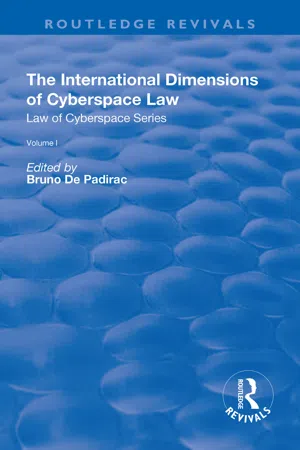
This title was first published in 2003. This text is part of the "Law of Cyberspace" series, which deals with the legal aspects of the emerging information society and corresponding ethical matters. The book examines the international dimensions of cyberspace law and the timeliness of drawing up the most appropriate international standard instrument for this environment, exploring ways and means of achieving it and defining the organization's precise role in this respect. The text presents the framework that UNESCO is helping to develop for the international community, with the participation of all the actors in cyberspace, aiming to be ethical, flexible and technologically neutral, multiform, and universal.
- 260 pages
- English
- ePUB (mobile friendly)
- Available on iOS & Android
eBook - ePub
The International Dimensions of Cyberspace Law
About this book
Information
1
The Possibilities for a Legal Framework for Cyberspace – including a New Zealand Perspective
Longworth Elizabeth
Introduction
The complexity and diversity of the legal, ethical and societal issues raised by the global information infrastructure and the emerging information society has prompted UNESCO1 to question whether there is a need for a new international agreement – a ‘cyberspace law’, to be expressed as a framework and built on an underlying consensus – to address these issues. Most countries, including New Zealand, agreed that a careful study of the issues was required before any decision should be taken. This chapter was prepared as a contribution to the ensuing dialogue.
The Creation of a New Political Economy through Cyberspace
The UNESCO brief for this paper was to consider the desirability, feasibility and difficulties of establishing a legal framework for cyberspace. The significance of addressing future developments in ‘cyberspace law’ is apparent if we look at the wider context. Don Tapscott in The Digital Economy describes humanity as being ‘at the dawn of an Age of Networked Intelligence – an age that is giving birth to a new economy, a new politics, and a new society’.2
The Internet will be the critical medium for the transformation predicted by Tapscott. The need to examine the role of the law and regulation is obvious in a world where there is ‘the potential for severe social stratification, unprecedented invasion of privacy and other rights, structural unemployment, and massive social dislocation and conflict’.3
The desirability and feasibility of ‘establishing cyberspace law’ will come down to the decisions and actions (whether conscious, passive or by omission) within the various hierarchies of the Internet and by the numerous agencies worldwide that are currently considering the impact of this new technology within their own spheres of influence.
The task for this chapter is to provide a better understanding of just what is possible within the design parameters of ‘cyberspace law’. It should also suggest a methodology by which any suggestion of ‘regulation’ of the Internet, and its impacts, could be analysed.
Desirability and Feasibility: From whose Perspective?
Any discussion which focuses on the prerequisites to developing ‘an international cyberspace law’ must first clarify its assumptions. From which perspective is the desirability and feasibility of such an outcome to be viewed? What do we mean by a ‘cyberspace law’? Is it an international law in the conventional sense or a macro-strategy for all laws touching on, and touched by, the advent of the Internet? What are the mechanisms for implementing a cyberspace law? Who and what institutions would make the rules and enforce them (irrespective of their content)? At the abstract level, who is to be governed? Who will be the ‘cyberpolice’?4 And even if such a complex topic could be distilled into these few issues, why should cyberspace be regulated?
The Paradigm Shift away from Substantive Centralized Legal Models
The scope and complexity of the concept of cyberspace law and the pervasiveness of its influence on nations, economies and societies mean that much of the commentary on this topic moves straight to issues of substantive law. It has proved relatively easy for commentators to consider the adaptation of existing and discrete laws to the electronic systems within the global networked environment. It is far more difficult to devise a strategy which assumes a unified global approach to law design and which is capable of responding to the dynamic relationships within cyberspace.
For this reason there is plenty of commentary on specific aspects of laws in cyberspace: for example, intellectual property (copyright) issues; the liability of systems operators; the growth of electronic commerce; surveillance and the privacy invasive potential of Internet technologies; the undermining of sovereign control (tax havens); the opportunity for criminal and anti-social behaviours (pornography and paedophile rings) to go unchecked; encryption and law enforcement rights to intercept communications; and the value of freedom of speech versus censorship.
Much of the discussion on the possibilities of international cyberspace law is based on conventional legal paradigms: for example, matrices of rights and duties; centralized sources of law; defining legal outcomes in physical terms; and being constrained by the physical parameters of geography, location and the ability to fix an event or activity at a point in time.
David Post5 explains that the focus on the substantive content of legal rules is known as ‘legal centralism’. This is where the inquiry focuses on alternative sets of substantive laws, on the assumption that there is some law-making body in a position to choose the optimal set. He observes a difficulty in that the global network is proving ‘relatively resistant to centralised control’. The reasons for this are explored in this chapter.
The concepts of cyberspace demand a reassessment of how we create and apply law. In his analysis of Law in a Digital World, Ethan Katsh talks about the law as journeying in new directions and to new places, to being displayed on screen rather than on paper, and as posing significant challenges to traditional legal practices and concepts. These include:
… an unfamiliar and rapidly changing information environment … where the value of information increases more when it moves than when it is put away for safekeeping and is guarded. To a world of flexible spaces, of new relationships, and of greater possibilities for individual and group communication. To a place where law faces new meanings and new expectations.6
A macro-analysis of the legal implications of cyberspace is justified, even if Tapscott’s prediction on the ‘Age of Networked Intelligence’ is only partly true. The role of the Internet has been likened to ‘the revolutionary media of the past’ and is seen as ‘central to this quiet and radical reallocation of political and economic power – the creation of a new political economy. The I-Way is the technological enabling mechanism.’7
The Focus on the Process of Design and Law-making
This chapter will suggest that a credible discussion of the possibilities of a legal framework for cyberspace must follow a process-based analysis. The method assumes that the question of a cyberspace law is essentially a design issue, necessitating an understanding of how and why laws are made. The significance of this approach is illustrated by Katsh, as he explains the way in which law is employed as both a tool and a symbol:
Law is a process that we hope will shape behaviour, settle disputes, secure rights and protect liberties, even achieve justice. It is a social force with many components, something that touches many other institutions and, in turn, is influenced by them. It is a set of rules and doctrines, an institution that embodies cultural values and traditions, and it is also a profession. It can, of course, be much less than this by preserving injustice, violating principle, and denying the realization of rights.8
The methodology of the following analysis begins with a consideration of the characteristics of cyberspace. What is peculiar to activities on, and the nature of, the Internet which impact on the development of law? How do the architecture, network protocols and worldwide access to the global information infrastructure impact on the design of the legal infrastructure which has already emerged or will evolve? The description of these particular characteristics will identify critical design parameters. These constraints and opportunities modify and influence the development of a legal framework for cyberspace.
There are also various law-making processes that are highly relevant to the emerging ‘landscape’ of cyberspace law. These include applicable regulatory models, an understanding of how control is exerted within a networked environment, the effect of competition and the analogy of customary law. It is also important to consider the reasons why laws are made, and their inherent values and policy objectives.
Any analysis of a legal framework must also address the difficulties of dispute resolution in cyberspace. In particular, the issues of jurisdiction, choice of law and enforcement pose significant constraints on the evolution of a cyberspace law. This discussion considers the merits of existing legal structures, such as international law, by treaty and forum. The possibilities of adapting private law, especially contractual arbitration, are explained, along with the potential to develop certain alternative dispute resolution models.
What emerges from the discussion is a clear outline of a legal framework for cyberspace. The existing infrastructure has been identified. The desirability and feasibility of developing certain components have been addressed. The framework is illustrated by reference to the New Zealand experience and perspective.
In order to conceptualize such a complex topic and diverse issues, the chapter is structured into three principal sections, as follows:
- The Characteristics of Cyberspace and the Processes which Influence Law-making
- Dispute Resolution in Cyberspace, and
- The Emerging Legal Framework for Cyberspace.
A Synthesis to Identify Relevant Themes or Principles
There are a number of key authors and other sources who have influenced the approach taken in this chapter; they include David Johnson, Ethan Katsh, Lawrence Lessig, Darrell Menthe, Henry Perritt and David Post. I have drawn on their work because of their philosophical and jurisprudential focus on the dynamics and evolution of regulatory controls in cyberspace. The following discussion, therefore, is a synthesis of many views into themes and principles that are distinct possibilities for a legal framework. All these are worth pursuing in terms of future directions and, from a New Zealand perspective, are consistent with that country’s approach to regulation and governance.
The Characteristics of Cyberspace and the Processes Which Influence Law-Making
What is Cyberspace?
What is meant by references to ‘cyberspace’? This popular term was originally coined to describe ‘the emerging digital world’.9 It conveyed the experience of a new environment and dimension, as being the inverse of physical reality; cyberspace is thought of as an ‘alternative’ reality where the computer controls sensory stimuli. It is now a common expression used to describe the complexities of the phenomenon created by a global network of computers that use the telecommunications infrastructure to transmit electronic messages.10 I...
Table of contents
- Cover
- Half Title
- Title Page
- Copyright Page
- Contents
- Contributor
- Foreword
- Preface
- List of Abbreviations
- Introduction: UNESCO and the Law of Cyberspace
- 1 The Possibilities for a Legal Framework for Cyberspace – including a New Zealand Perspective
- 2 Freedom of Expression and Regulation of Information in Cyberspace: Issues concerning Potential International Cooperation Principles
- 3 An International Legal Instrument for Cyberspace? A Comparative Analysis with the Law of Outer Space
- 4 Some Considerations on Cyberspace Law
- 5 Liability in Cyberspace
- 6 Developing Legal Systems and Good Morals for the Internet
- Appendix: Report to the Director-General of UNESCO on the International Experts Meeting on Cyberspace Law
- Index
Trusted by 375,005 students
Access to over 1.5 million titles for a fair monthly price.
Study more efficiently using our study tools.
Frequently asked questions
Yes, you can cancel anytime from the Subscription tab in your account settings on the Perlego website. Your subscription will stay active until the end of your current billing period. Learn how to cancel your subscription
No, books cannot be downloaded as external files, such as PDFs, for use outside of Perlego. However, you can download books within the Perlego app for offline reading on mobile or tablet. Learn how to download books offline
Perlego offers two plans: Essential and Complete
- Essential is ideal for learners and professionals who enjoy exploring a wide range of subjects. Access the Essential Library with 800,000+ trusted titles and best-sellers across business, personal growth, and the humanities. Includes unlimited reading time and Standard Read Aloud voice.
- Complete: Perfect for advanced learners and researchers needing full, unrestricted access. Unlock 1.5M+ books across hundreds of subjects, including academic and specialized titles. The Complete Plan also includes advanced features like Premium Read Aloud and Research Assistant.
We are an online textbook subscription service, where you can get access to an entire online library for less than the price of a single book per month. With over 1.5 million books across 990+ topics, we’ve got you covered! Learn about our mission
Look out for the read-aloud symbol on your next book to see if you can listen to it. The read-aloud tool reads text aloud for you, highlighting the text as it is being read. You can pause it, speed it up and slow it down. Learn more about Read Aloud
Yes! You can use the Perlego app on both iOS and Android devices to read anytime, anywhere — even offline. Perfect for commutes or when you’re on the go.
Please note we cannot support devices running on iOS 13 and Android 7 or earlier. Learn more about using the app
Please note we cannot support devices running on iOS 13 and Android 7 or earlier. Learn more about using the app
Yes, you can access The International Dimensions of Cyberspace Law by Bruno De Padirac, Bruno Padirac in PDF and/or ePUB format, as well as other popular books in Social Sciences & Sociology. We have over 1.5 million books available in our catalogue for you to explore.