eBook - ePub
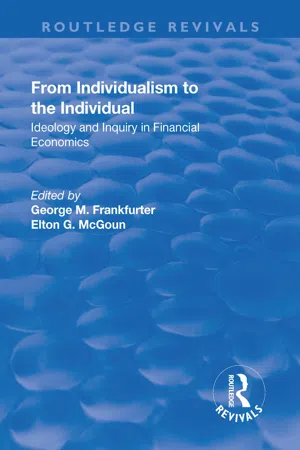
From Individualism to the Individual
Ideology and Inquiry in Financial Economics
- 510 pages
- English
- ePUB (mobile friendly)
- Available on iOS & Android
eBook - ePub
From Individualism to the Individual
Ideology and Inquiry in Financial Economics
About this book
This title was first published in 2002: From Individualism to the Individual treats finance as a social and cultural process, exploring the unseen side of academic discourse and the many obstacles the deeply entrenched elite puts in the way of alternative thinking. Opening with a detailed discussion of the role of ideology in the perpetuation of the limited methodological bias of the profession toward markets, the book then examines the more specific effects of such ideological limitations on theoretical and empirical research in finance. The authors develop alternative ways to examine finance both as a profession and as a field of inquiry. This book will be of particular value to researchers and practitioners working in finance, as well as those in other social science disciplines whose research relates to finance, culture and society.
Chapter 1
Introduction
Unlike its intellectual parents, accounting and economics, the academic discipline of finance (or “financial economics” as it has come to call itself to reinforce its being “a chip off the old [academically more respectable, at least among the social sciences] block”) so far has been almost totally lacking philosophical or critical literature. A situation like this is quite a rarity, because methodological controversy and the quest for a clear understanding of methodology almost always perturb young fields of inquiry such as financial economics, which is less than 50 years old by the most generous measure. Yet, it is hard to deny that for all practical purposes, there is only one way to do research in financial economics today: the way that firmly rests on a foundation of methodological individualism.
These individuals whose actions generate financial phenomena do not act as the individuals with whom we are familiar; rather, they act as homo economics, that determinedly rational utility maximizer, well known to everyone who has had even just one introductory course in microeconomics. And the counterpart to homo economicus is homo academicus, that determinedly positivistic individual academic researcher who lets the facts speak for themselves in his search for the underlying explanations for just what homo economicus is rationally maximizing and just how he is going about rationally maximizing it. Although the rational behavior itself and the rational process of explaining it are “individualistic,” in that they are the actions of independently acting individuals, they require no “individuality,” in that every individual acts the same. In fact, there is no need of an individual at all, as a computer program could easily generate the modus operandi of both the rational homo economicus and homo academicus.
It should surprise no one at all that in the so-called “real world” outside the pages of the academic literature, neither financial economics behavior nor financial economics research is rational. The puzzle is why we have gone on for nearly 50 years in this discipline acting as if they were. In the first section of this book, Ideology and the Profession, we argue that a method of inquiry that appears to be value-free (after all, what could be more value-free than rationality?), is in fact quite value-laden, and its values are those which serve the professional aspirations of the members of the financial economics discipline. Chapter 2 introduces the concept of ideology and its pervasiveness within financial economics. Individualism demands that there be markets in which individuals interact, and the language we use to describe those markets justifies whatever outcomes market interactions may have on individuals. That markets embody quite specific values that are in fact not universally held disappears beneath a patina of “rationality.”
The dominant methodology of financial economics is itself a sort of market for explanatory theories. “Efficient” markets for goods and services are supposed to determine fundamental or intrinsic values, and the “positive” market for theories is supposed to determine truth. But just as markets for goods and services can often be manipulated to exaggerate value and immensely enrich the personal wealth of certain individuals, the market for theories is manipulated to exaggerate their value and immensely enrich the academic reputations (and, concomitantly, the personal wealth) of its selected elite. In Chapter 3, we show that financial economics’ “methodology of positive economics” is a very rational-sounding process that is in fact much better at perpetuating a system of academic gamesmanship than it is at explaining just what it is that is going on in the real world of finance.
The work of Adam Smith is often cited as the justification for individualism being the preferred perspective from which to view and to interpret economic activity. But as David Collison argues in Chapter 4, this is the result of a pervasive propaganda effort directed toward society in general on the part of those specific groups who would benefit from such a way of thinking.
Chapter 5 continues with a more thorough description of the process of thought contagion by which financial economics theories are disseminated and perpetuated within the academic community. Section I concludes with Chapter 6, in which we focus on how the current ideology of financial economics is preserving itself against its strongest competitor, behavioral finance, in which the individualistic behavior of homo economicus might (but thanks to the efforts of the entrenched ideology unfortunately probably will not) be supplanted by the individuality of real human beings.
The ideology of financial economics has led to some very peculiar traditions in financial economics research, and these are the subjects of the second section of this book, Ideology and Inquiry. In Chapter 6, we introduced the subject of anomalies and how financial economics has used the term to trivialize the efforts of its only real ideological competition, behavioral finance. Chapter 7 expands upon the misuse of this word and how this misuse reflects a fundamental misunderstanding of what science ought to be about. Surprising as it may sound, it is virtually impossible in financial economics for any finding to lead to any serious questioning of the dominant ideology. After all, how could mere “anomalies” constitute a serious challenge to the body of so-called “knowledge” that has been assembled?
Signaling, discussed in Chapter 8 is an example of how erroneous the logic of financial economics theories can be. One explanation for the payment of dividends, which puzzle was introduced in Chapter 5, is that an increase in dividends is a reliable signal that the prospects of the firm are sufficiently attractive to sustain the increased dividend in the future. One problem with signaling is that any costly action that a firm undertakes without apparent benefit can be called a “signal.” Thus, there has to be a historical rationale for any action to be interpreted as a signal rather than a sensible business decision in its own right. But this is not the only problem. Another obvious dilemma is that variables used to explain signaling more often than not cannot be measured. This deficiency should disqualify the concept of signaling within a positivist/instrumentalist methodology. Strangely, however, this drawback is not only disregarded, but in many minds signaling is elevated to the level of a principle of financial economics. Although “signaling” looks to be a very sophisticated rationale for a number of business decisions and can be completely expressed in the language of mathematics, it has no explanatory power whatsoever.
Although not often regarded as such, the formal and informal structures that financial economics has for the dissemination of ideas are in fact an important component of its methodology. The justification process is as much a matter of persuasion as it is of formal empirical testing, especially since empirical testing in financial economics never has been nor ever will be a way to conclusively demonstrate truth. Chapter 9 begins with a discussion of these issues by Reiter and Williams in a more or less general way. Chapters 10 and 11 continue with some personal revelations about the publication and reviewing processes, illustrating the problem with specific situations encountered by the authors in which these processes were perhaps being used to preserved the dominant ideology.
In Chapter 7 we briefly addressed the absurdity of the exclusive use of mathematical models in financial economics and suggested that such methods were a consequence of academic “jousting”. Through a close examination of the origins of mathematization in economics in the 1950s, Chapter 12 demonstrates that this was indeed the case. Mathematics was obviously being used as much as an indicator of intellectual superiority as it was a potentially useful tool for the elucidation and explanation of economic phenomena.
It is one thing to criticize the behavior of the academic financial economics profession; it is another thing to suggest what it ought to be doing instead of what it is doing. Of course, implicit in the first two sections of this book has been the recommendation that financial economics acknowledge the ideological bases of its methodology and consider research on new topics in new ways. As we have discussed, behavioral finance has the potential to be one of these, but so far it has not been able to break free of the constraints of the current ideology and methodology of financial economics research and may in fact be cooperating in its own suppression. The last two sections of this book explore two ways in which financial economics might move away from the rigid individualism to which it has adhered in a new direction in which there is a concern with the individual as a member of society (Section III – Financial Economics and Society) and as an individual in his or her own right (Section IV – Financial Economics and the Individual).
As we have discussed, traditional financial economics research regards markets as necessary for the interactions of individuals. While it may be impossible to dispute the necessity of markets if we define them as broadly as this, it is possible to dispute the necessity of the interactions or exchanges that occur on them. Many commentators have observed the vast increases in trading volume and question their necessity. The first four chapters of Section III find cultural explanations, as opposed to economic explanations, for why financial markets have become so much more active in recent years.
Chapter 13 argues that we may be seeing a situation in which some financial transactions indeed accompany and facilitate underlying real economic activity, but that there may also be trading for the sake of trading, which might be called “hyperrear economic activity. Traditionally the value of money was to facilitate the exchange of goods and services. “Value” is a quite complex concept, however, and there is no reason why money should not be a sign of status within a culture and trading should not be another status symbol in itself. Money need not be culturally neutral even if it is economically neutral. The problem, of course, is that all trading, real or hyperreal, looks the same, and there is no way to tell the liquid from the foam, if that is indeed what it is.
Naturally, no one would be willing to admit that there is trading for the sake of trading and that finance is to a considerable extent just a game being played for the pleasure of its players and spectators. There must be a more respectable alibi. Chapter 14 considers the theories of the French sociologist Pierre Bourdieu, who studied how and why societies engage in such self-deceptive practices. We take the financial game very seriously because our culture conditions us to regard finance as a very serious matter. Many of us engage professionals to handle our financial affairs, not because there is any evidence that they can do so better than we can ourselves, but because we cannot imagine finance being left to those not trained or experienced in it, regardless of the value of that training and experience.
Returning to the notion of money having sign value within a culture, just what is it a sign of? Trading for the sake of trading blurs the distinction between the activities of investment and consumption; in other words, the activities that traditional financial economics has called investment have become a form of consumption. And this new form of conspicuous consumption, detached from the real goods and services which had been necessary to be a “conspicuous consumer” in the past, is as much about sex and power as is a more obvious form of conspicuous consumption, haute couture. Both are about fashion – about staying apart from the herd, but never too far apart, and always in the direction in which the herd will eventually move. Chapter 15 considers these issues and suggests that sociological and anthropological theories of fashion might help us to understand the investment behavior of individuals.
If it is true that investment is a form of consumption, then it also makes sense to examine the marketing literature for theories that might have applications in financial economics. One of these is a set of metaphors that can be used to understand hedonic consumption. Hedonic consumption, in which there is value in the act of consuming, is a relatively recent departure from traditional marketing, which has concerned itself with the rational choices by which consumers select goods and services. Of course, this is not unlike traditional financial economics, in which investment is a rational choice of the securities to be purchased by an investor. Chapter 16 applies these metaphors of hedonic consumption to investment, and their explanatory value suggests that there is indeed such a thing as hedonic investment.
The preceding chapters in Section III have all considered financial economics as a product of contemporary society. An alternative perspective on financial economics is its historical development; that is, what we observe today is the result of a succession of institutional responses to changing social and economic conditions. Finance, contrary to the beliefs of its orthodoxy, is not a teleological phenomenon in which our markets and institutions evolve in the direction of greater and greater efficiency; rather, they are constrained by their past and adapt as conditions change. Dividends, which we discuss in Chapters 17, 18, and 19, are one of the great puzzles of financial economics, and modern financial economics theory has so far been unable to explain them. But as a vestige of historical conditions that no longer exist, they make perfect sense. And it may be desirable to consider this in designing other nations’ transitions to capitalism/market economies. Chapter 19 concludes that firms pay dividends because investors like them, and of course to understand why investors like them, we must look at these real investors which we do in Section IV.
In Chapter 14 we referred to the long-standing “structure versus agency” debate in the social sciences; that is, are individuals agents acting in accordance with their own free wills, or are they subject to the social and cultural structures in which they find themselves and are thereby constrained to behave in certain ways? In some ways, Section III argued for the “structure” side of this controversy, and in Section IV, we introduce the “agency” side. But the individual that we talk about in Section IV is not the same rational individual of traditional financial economics. He or she is someone more.
Chapter 20 introduces some ideas of just what this “more” might be. The individual of traditional financial economics makes rational cost/benefit analyses using the data that are available. The individual of behavioral finance, in contrast to the individual of modern finance, is looked on as one who makes quasi-rational cost/benefit analyses. Yet, behavioral finance conducts research using the same data and the same methods of analysis as modern finance does. The minds of real individuals are not computers that process data, however. They are embodied minds in which new data are incorporated in preexisting images, and the subsequent modified images are drawn upon to make decisions. Both processes of creating and using images necessarily involve emotions. The so-called “rational” individual of traditional financial economics would more precisely be called “logical”, and to behave perfectly logically, the Vulcans of Star Trek not withstanding, would in fact be quite irrational. Clearly, human behavior is much richer than behavioral finance has considered, and finance research must address this richness in new ways. Thus, we must go beyond behavioral finance, and Chapter 21 argues for doing so.
Chapter 22 illustrates this idea. Traditional financial economics views risk as something that can be expressed by a frequency distribution of historical returns. Behavioral finance views risk as a more complicated phenomenon, but still subjects it to a mathematical treatment. Real risk, however, is much, much more complex. In this chapter we look at an instrument used by a practitioner of finance to assess the risk tolerance of his investment clients and consider what of it relates to the traditional view of risk and to the research findings of behavioral finance.
Finally, in Chapter 23, we ...
Table of contents
- Cover
- Half Title
- Title Page
- Copyright Page
- Contents
- List of Contributors
- Preface
- 1 Introduction
- Section I Ideology and the Profession
- Section II Ideology and Inquiry
- Section III Finance and Society
- Section IV Finance and the Individual
Trusted by 375,005 students
Access to over 1.5 million titles for a fair monthly price.
Study more efficiently using our study tools.
Frequently asked questions
Yes, you can cancel anytime from the Subscription tab in your account settings on the Perlego website. Your subscription will stay active until the end of your current billing period. Learn how to cancel your subscription
No, books cannot be downloaded as external files, such as PDFs, for use outside of Perlego. However, you can download books within the Perlego app for offline reading on mobile or tablet. Learn how to download books offline
Perlego offers two plans: Essential and Complete
- Essential is ideal for learners and professionals who enjoy exploring a wide range of subjects. Access the Essential Library with 800,000+ trusted titles and best-sellers across business, personal growth, and the humanities. Includes unlimited reading time and Standard Read Aloud voice.
- Complete: Perfect for advanced learners and researchers needing full, unrestricted access. Unlock 1.5M+ books across hundreds of subjects, including academic and specialized titles. The Complete Plan also includes advanced features like Premium Read Aloud and Research Assistant.
We are an online textbook subscription service, where you can get access to an entire online library for less than the price of a single book per month. With over 1.5 million books across 990+ topics, we’ve got you covered! Learn about our mission
Look out for the read-aloud symbol on your next book to see if you can listen to it. The read-aloud tool reads text aloud for you, highlighting the text as it is being read. You can pause it, speed it up and slow it down. Learn more about Read Aloud
Yes! You can use the Perlego app on both iOS and Android devices to read anytime, anywhere — even offline. Perfect for commutes or when you’re on the go.
Please note we cannot support devices running on iOS 13 and Android 7 or earlier. Learn more about using the app
Please note we cannot support devices running on iOS 13 and Android 7 or earlier. Learn more about using the app
Yes, you can access From Individualism to the Individual by George M. Frankfurter,Elton G. McGoun in PDF and/or ePUB format, as well as other popular books in Business & Business General. We have over 1.5 million books available in our catalogue for you to explore.