- 233 pages
- English
- ePUB (mobile friendly)
- Available on iOS & Android
eBook - ePub
About this book
This book analyzes the nature of polio replication complexes with respect to subcellular fractionation, responses to detergent treatments, and the viral/cellular proteins involved. It presents models for both initiation and elongation of RNA chains by the poliovirus replicase.
Information
RNA Replication of Positive Strand RNA Viruses
Chapter 1
Kinetics of RNA Replication by Qβ Replicase
Christof Κ. Biebricher and Manfred Eigen
Table of Contents
- I. Introduction
- II. The Infection Cycle of RNA Coliphages
- III. Characterization of the Replication Apparatus
- IV. Replication of Viral RNA
- V. Mechanism of RNA Replication
- VI. Kinetics of Nucleotide Incorporation
- VII. Interaction of Complementary Strands
- VIII. Competition Among RNA Species
- IX. Noninstructed RNA Synthesis
- X. Conclusions
- Acknowledgments
- Appendix
- References
I. Introduction
RNA viruses are unique in having their information encoded in RNA. Their diversity, their widespread occurrence, and host range — prokaryotes, plants, and animals — reflect their evolutionary success. Even though RNA is generally believed to be the older form of information carrier, RNA genomes are extremely rare in cellular organisms — RNA plasmids1 generally being regarded as inherited relics of viral infections — and so RNA replication does not occur in the normal processing of the genetic information. As a consequence, replication of viral RNA has several unique features.
Besides their extrinsic information — the message encoded by the nucleotide sequence — nucleic acids also possess intrinsic information, the specific folding of the sequence chain due to molecular interactions.2 The intrinsic information is responsible for the recognition of nucleic acids by the expression machinery; together with recognition boxes, it affects the formatting of the extrinsic information. While the intrinsic information of double-stranded DNA is rather limited, there is an enormous potential for utilizing the intrinsic information of single-stranded RNA up to the sophistication level of enzymic catalysis.3,4 It seems likely that the replication process makes extensive use of such intrinsic information. Therefore, there is selection pressure for preserving or improving the intrinsic information, as well as the extrinsic information, and both types of information must be reconciled with one another during evolution.
Normally, RNA synthesis in the cell occurs by transcription from the DNA genome. The reading accuracy of nucleotides as dictated by their chemical nature suffices, since errors are neither propagated to other RNA molecules nor transmitted to offspring of the cell. There is therefore no selection pressure favoring error-correcting mechanisms as there is in DNA replication. When RNA itself is replicated, however, error propagation has serious consequences, RNA viruses have to live with this limited replication accuracy; the amount of information they can transmit and thus their chain lengths are constrained by this fact.5 Other consequences of the limited replication accuracy are rapid genetic drift and high sequence variability of RNA viral genomes6,7 (RNA variability and its biological implications are reviewed in other areas of this book).
In contrast to cellular genomes, viral genomes are not confined to different compartments after each duplication step. Late in an infection cycle, many copies of the RNA genome are present together with their expression products. In this case, selection pressure acts on the whole genome distribution, since some mutants unable to launch a successful infection on their own can still be amplified in a cell. Such mutants can survive several infection cycles if cells are infected with high multiplicities. Recloning and selecting for the full information of the individual genome is only observed when a single virus invades a new cell. This "swamping" effect also favors genetic variability and allows "hitchhiking" of foreign defective RNA, e.g., of satellite RNA. It is thus no surprise that only a small fraction of intact RNA viruses are infectious.
The RNA in positive-strand viruses has several roles: it acts as messenger for expression of the viral proteins, as template in RNA replication and as core in the assembly of virion particles. At least the first two roles are difficult to reconcile with one another because of the different polarity of the reactions involved: while protein synthesis proceeds in the 5' to 3' direction, RNA replication begins at the 3' end of the template RNA and proceeds towards its 5' end. The reactions must be regulated in vivo so as to avoid clashes.
The two complementary viral strands found in infected cells may form double-stranded structures by Watson-Crick base pairing. In the first replication round, single-stranded viral RNA has to be transcribed by a viral RNA-dependent RNA polymerase. It is unlikely that one and the same enzyme catalyzes transcription from both single- and double-stranded RNA. Thus, if no other RNA-dependent RNA polymerase activity is present in the cell, viral RNA replication is unlikely to involve a double-stranded replicative form, except for a short stretch bound to the enzyme at the replication site.
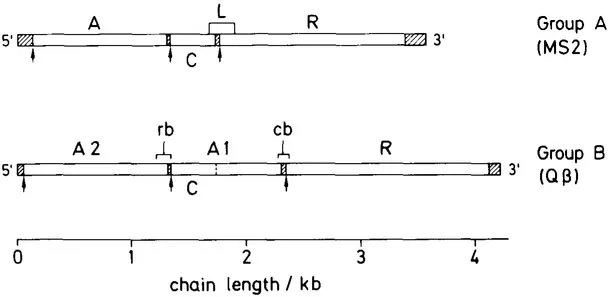
FIGURE 1. Gene maps of leviviruses. Upper: group A (MS2), lower group Β (Qβ). Ribosome binding sites are indicated by arrows, rb = replicase binding site (interfering with ribosome binding at C initiation site); cb = coat protein binding site (interfering with ribosome binding at R initia...
Table of contents
- Cover
- Title
- Copyright
- The Editors
- Contributors
- Table of Contents
- RNA REPLICATION OF POSITIVE STRAND RNA VIRUSES
- RNA REPLICATION OF NEGATIVE STRAND RNA VIRUSES
- RNA REPLICATION OF DOUBLE-STRANDED RNA VIRUSES
- INDEX
Trusted by 375,005 students
Access to over 1.5 million titles for a fair monthly price.
Study more efficiently using our study tools.
Frequently asked questions
Yes, you can cancel anytime from the Subscription tab in your account settings on the Perlego website. Your subscription will stay active until the end of your current billing period. Learn how to cancel your subscription
No, books cannot be downloaded as external files, such as PDFs, for use outside of Perlego. However, you can download books within the Perlego app for offline reading on mobile or tablet. Learn how to download books offline
Perlego offers two plans: Essential and Complete
- Essential is ideal for learners and professionals who enjoy exploring a wide range of subjects. Access the Essential Library with 800,000+ trusted titles and best-sellers across business, personal growth, and the humanities. Includes unlimited reading time and Standard Read Aloud voice.
- Complete: Perfect for advanced learners and researchers needing full, unrestricted access. Unlock 1.5M+ books across hundreds of subjects, including academic and specialized titles. The Complete Plan also includes advanced features like Premium Read Aloud and Research Assistant.
We are an online textbook subscription service, where you can get access to an entire online library for less than the price of a single book per month. With over 1.5 million books across 990+ topics, we’ve got you covered! Learn about our mission
Look out for the read-aloud symbol on your next book to see if you can listen to it. The read-aloud tool reads text aloud for you, highlighting the text as it is being read. You can pause it, speed it up and slow it down. Learn more about Read Aloud
Yes! You can use the Perlego app on both iOS and Android devices to read anytime, anywhere — even offline. Perfect for commutes or when you’re on the go.
Please note we cannot support devices running on iOS 13 and Android 7 or earlier. Learn more about using the app
Please note we cannot support devices running on iOS 13 and Android 7 or earlier. Learn more about using the app
Yes, you can access RNA Genetics by Esteban Domingo in PDF and/or ePUB format, as well as other popular books in Biological Sciences & Biology. We have over 1.5 million books available in our catalogue for you to explore.