- 479 pages
- English
- ePUB (mobile friendly)
- Available on iOS & Android
eBook - ePub
Helicobacter pylori Biology and Clinical Practice
About this book
Helicobacter pylori: Biology and Clinical Practice is the first book to fully describe H. pylori and the pathogenesis of H. pylori infections. It delineates the genome of H. pylori, discusses the molecular biology of the unique urease enzyme, and examines the clinical application of these discoveries. The book describes the epidemiology of H. pylori and its relevance to gastric cancer, and it offers clear guidance to clinicians for the diagnosis and treatment of peptic ulcer and non-ulcer dyspepsia in adults and children. Vaccine principles and possibilities are presented for the first time.
Edited by the leader of the microbiology team that achieved the first culture of H. pylori, and named the Helicobacter genus, this book is essential for bacteriologists, gastroenterologists, microbiologists, infectious disease specialists, and other researchers interested in H. pylori.
Information
Chapter 1
The Helicobacter Genus: The History of H. Pylori and Taxonomy of Current Species
C. Stewart Goodwin and Bryan W. Worsley
TABLE OF CONTENTS
I. Introduction
II. History of H. pylori
A. Early Papers
B. First Culture of H. pylori in 1982 and Realization of the New Genus
III. Taxonomic Features of the Helicobacter Genus
A. Ultrastructure
B. Growth Conditions
C. Biochemical Capabilities
D. Antibiotic Susceptibility
E. Cellular Fatty Acid Composition
F. Menaquinones and Lipid A
G. Phylogenetic Analysis
1. DNA Base Composition
2. Hybridization
3. RNA Sequencing
H. Protein Analysis
I. Immunoanalysis
IV. Conclusion
References
I. Introduction
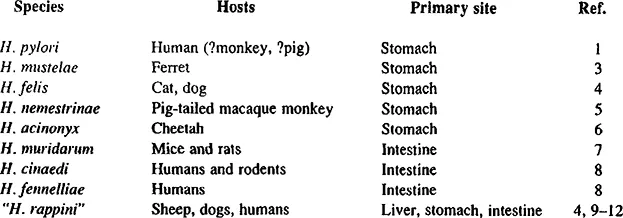
How the name Helicobacter was chosen is described in the Preface; the genus name was first published in 1989, with two species, H. pylori and H. mustelae.1 Teamwork, among four departments, was the secret of the first successful culture of H. pylori in Royal Perth Hospital, Western Australia, in 19822 (see below). By 1992, this new genus contained nine named species (Table 1) with at least four other unnamed species identified. The table shows that five species are gastric pathogens, three other species are lower gut organisms, and “H. rappini” has been found in a variety of sites. “H. rappini” was originally named “Flexispira rappini”;9 although it has some phenotypic differences from H. pylori,’ it possesses urease and genotypically should be in the Helicobacter genus.4, 8 “H. rappini” has been isolated from the widest range of hosts and tissues. It was first isolated from the liver of aborted lambs,10then seen in the stomachs of beagle dogs,11 and then isolated from feces of humans with gastroenteritis.12 Helicobacter species have been found in the feces of terns, gulls, house sparrows, and pigs, and a Helicobacter species distinct from H. mustelae has been found in ferret feces (Paster, personal communication). “Gastrospirillum hominis”,13 which has not been cultured nor characterized, has not been officially named. However, RNA sequencing has shown that “G. hominis” is also in the Helicobacter genus, and the name “H. heilmanii” has been suggested.13®
II. History Of H. Pylori
A. Early Papers
Credit for the first description of spiral organisms in the human stomach should probably be given to Bottcher in 1974.14 Bizzozero in 189315 and Salomon in 189616 described “spirochaetes” in animals, but these were unlikely to have been H. pylori. Probably they were “H. heilmanii.” Krienitz described human gastric spiral organisms in 1906,17 and Freedberg and Barron in 1940.18 Those who described spiral bacteria in humans and animals usually failed to distinguish the shorter, gently spiraled H. pylori from the longer, tightly spiraled “H. heilmanii.”19 Even in 1987, when “H. rappini” was noted in beagles, the three electron micrographs in fact showed ”H. rappini,” H. felis, and “H. heilmanii.”11 H. muridarum was cultured in Sydney about the same time as H. pylori.20 However, it was officially named only in January 1992.7 Studies of human H. pylori were at first only histological and ultrastructural, without successful culture. In 1975, Steer noted that spiral bacteria were closely apposed to the gastric mucus secreting cells,21 but culture yielded only Pseudomonas aeruginosa.22 Electron micrographs of spiral bacteria in large numbers on gastric epithelial cells were published by him in May 1984.23Independently, in Birmingham, England, in 1981 Rollason et al. had observed gastric spiral bacteria.24
TABLE 1
Helicobacter Species and their Hosts (as of 1992)
Helicobacter Species and their Hosts (as of 1992)
B. First Culture of H. Pylori in 1982 and Realization Of the new Genus
In Perth, Western Australia, at the Royal Perth Hospital, histological and ultrastructural studies of the gastric mucosa had been published in 1979;25spiral bacteria were seen, but because they did not invade the mucosa were thought to be irrelevant. The histopathologist Warren correlated them with the presence of polymorphonuclear leukocytes.26 In 1981, Marshall was training in internal medicine, and for 6 months was learning gastroenterology. With Warren he reviewed the patients in whom large numbers of gastric spiral bacteria had been seen.27 One of these had been treated fortuitously with tetracycline; his symptoms resolved, and subsequent endoscopic biopsy showed that the antral gastritis had also resolved.27 By then Armstrong had come to Royal Perth Hospital from Mill Hill to head the Electronmicroscopy Unit at Royal Perth Hospital. He obtained high-magnification electron micrographs of H. pylori. (When Warren and Marshall could not agree on the wording of a joint letter to The Lancet in 1983, Armstrong advised them to write separate letters.26, 28) Goodwin was Head of the Microbiology Department, and in late 1981 Marshall asked him for microbiological assistance. A protocol was agreed; gastric biopsy specimens from 100 consecutive patients would be taken by the consultant gastroenterologists Waters and Sanderson and these would be processed by Gram stain and culture and by the histopathology department. The project started in March 1982, with the microbiologist Pearman supervising the project. Among the first 34 specimens, spiral bacteria were seen in the Gram stain in 6. However, in spite of frequent variations of media, and incubation temperatures, spiral bacteria were not cultured, because incubation was limited to 48 h. The 35th culture was left incubating during the Easter holiday, which in Australia lasted for 5 d. When the plates were finally viewed, a pure growth of 1-mm transparent colonies were seen. H. pylori had been finally cultured! The date was the 14th of April, 1982.2 Fro...
Table of contents
- Cover
- Title Page
- Copyright Page
- Dedication
- Table of Contents
- Chapter 1 The Helicobacter Genus: The History of H. pylori and Taxonomy of Current Species
- Chapter 2 Ultrastructure of Helicobacter Organisms and Possible Relevance for Pathogenesis
- Chapter 3 Histology and Ultrastructure of Helicobacter pylori Infections: Gastritis, Duodenitis, and Peptic Ulceration, and Their Relevance as Prccancerous Conditions
- Chapter 4 The Worldwide Prevalence of Helicobacter pylori: Asymptomatic Infection and Clinical States Associated with Infection in Adults
- Chapter 5 Clinical Syndromes of Helicobacter pylori Infection in Children
- Chapter 6 The Epidemiology of Helicobacter pylori Infection and its Relation to Gastric Cancer
- Chapter 7 The Metabolism and Enzymes of Helicobacter pylori: Function and Potential Virulence Effects
- Chapter 8 Molecular Studies on the Epidemiology and Pathogenicity of Helicobacter pylori
- Chapter 9 Genome Mapping of Helicobacter pylori
- Chapter 10 Organization and Expression of the Helicobacter pylori Urease Gene Cluster
- Chapter 11 Proteins, Antigens, and Typing Methods for Helicobacter pylori
- Chapter 12 Helicobacter pylori: Receptors and Adhesins
- Chapter 13 Tissue Culture Models for the Study of Helicobacter pylori Pathogenicity
- Chapter 14 The Pathogenesis of Helicobacter pylori Infection and Duodenal Ulcer: the Role of Gastrin and Other Soluble Factors
- Chapter 15 Cellular Immunity to Helicobacter pylori
- Chapter 16 Cultural Techniques for the Growth and Isolation of Helicobacter pylori
- Chapter 17 The Antibody Response to Helicobacter pylori Infection, and the Value of Serologic Tests to Detect H. pylori and for Post-Treatment Monitoring
- Chapter 18 Breath Tests to Detect Helicobacter pylori
- Chapter 19 The Comparative Value of Different Diagnostic Tests for Helicobacter pylori
- Chapter 20 The Susceptibility of Helicobacter pylori to Antibiotics
- Chapter 21 Bismuth Preparations
- Chapter 22 The Diagnosis and Treatment of Duodenal and Gastric Ulcer
- Chapter 23 The Management and Treatment of Dyspepsia and Helicobacter pylori Gastritis
- Chapter 24 Gastric Helicobacter Infection in Animals: Natural and Experimental Infections
- Chapter 25 Overview of Helicobacter pylori Gastritis, Peptic Ulcer, and Gastric Cancer, and the Possible Development of an H. pylori Vaccine
- Index
Trusted by 375,005 students
Access to over 1.5 million titles for a fair monthly price.
Study more efficiently using our study tools.
Frequently asked questions
Yes, you can cancel anytime from the Subscription tab in your account settings on the Perlego website. Your subscription will stay active until the end of your current billing period. Learn how to cancel your subscription
No, books cannot be downloaded as external files, such as PDFs, for use outside of Perlego. However, you can download books within the Perlego app for offline reading on mobile or tablet. Learn how to download books offline
We are an online textbook subscription service, where you can get access to an entire online library for less than the price of a single book per month. With over 1.5 million books across 990+ topics, we’ve got you covered! Learn about our mission
Look out for the read-aloud symbol on your next book to see if you can listen to it. The read-aloud tool reads text aloud for you, highlighting the text as it is being read. You can pause it, speed it up and slow it down. Learn more about Read Aloud
Yes! You can use the Perlego app on both iOS and Android devices to read anytime, anywhere — even offline. Perfect for commutes or when you’re on the go.
Please note we cannot support devices running on iOS 13 and Android 7 or earlier. Learn more about using the app
Please note we cannot support devices running on iOS 13 and Android 7 or earlier. Learn more about using the app
Yes, you can access Helicobacter pylori Biology and Clinical Practice by C. Stewart Goodwin in PDF and/or ePUB format, as well as other popular books in Biological Sciences & Biology. We have over 1.5 million books available in our catalogue for you to explore.