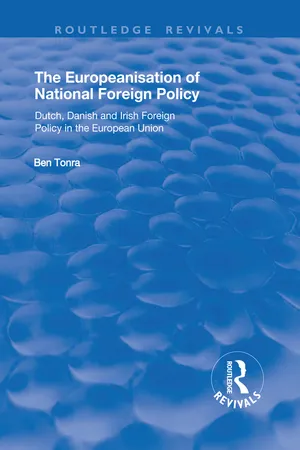
This title was first published in 2001. This study questions whether the development of foreign and security policy co-operation within the EU has constrained or empowered Danish, Dutch and Irish foreign policy. This entails a study of the relationship between national foreign policy and EU frameworks for co-operation.
eBook - ePub
The Europeanisation of National Foreign Policy
Dutch, Danish and Irish Foreign Policy in the European Union
- 314 pages
- English
- ePUB (mobile friendly)
- Available on iOS & Android
eBook - ePub
The Europeanisation of National Foreign Policy
Dutch, Danish and Irish Foreign Policy in the European Union
About this book
Information
1 Analysing European Foreign and Security Policy
The Unique Nature of Foreign Policy Co-operation
The 1970 Luxembourg Report marked the start of a process in which European Community (EC) member states sought to consult one another on foreign policy issues and, where possible, to co-ordinate respective national positions. As established in 1970, European Political Cooperation (EPC) was a framework within which foreign policy cooperation could take place.1 Member state governments consulted one another through a regularised system of meetings of ministers and officials. Information on agenda items agreed for discussion was exchanged and national views shared. This was the vehicle through which common and contrasting opinions could be identified. When common positions existed - or could be constructed - EPC provided a framework through which these could be co-ordinated. This emerged in the form of agreed policy statements and occasional diplomatic demarches.2
Member states were unwilling to associate an area of such national sensitivity as foreign policy formulation with the legal obligations of EC membership. As a result, EPC was consciously segregated from the agenda and institutions of the EC. It soon became evident that this distinction was extraordinarily difficult to maintain. The agendas of what had been intended to be parallel and complementary processes overlapped to a considerable degree and a working relationship had to be established between them.
This early period in foreign policy co-operation must be seen in the broader context of European integration. From a very early stage in the development of the European Communities, the ambition to establish a political identity existed. The early design of European integration was based upon the assumption that political integration would follow economic integration. The European Defence Community (EDC) of 1954 and the Fouchet proposals of the early 1960s were early attempts, based upon very different models, to supplement economic integration with a stronger political identity. In 1970, co-operation in the field of foreign policy, established in parallel with the existing EC structures, was the means chosen to create this identity.
Over time, foreign policy co-operation was drawn towards the institutional and political penumbra of integration. The ever-closer relationship between foreign policy co-operation and EC institutions illustrates this evolution. There was an initial determination, for example, that the process of foreign policy co-operation would have little if any relationship with the EC Commission. As early as 1973, however, it was recognised that the agenda of foreign policy co-operation would inevitably impinge upon that of the Commission. The 1973 Copenhagen Report on the operation of EPC noted that, where there were matters that affected Community activities, close contact would be maintained with the Commission. With the London Report of 1981, this position was extended to the point where the Commission was fully associated with all policy areas that encroached on Community responsibilities. This position was then formalised when the 1987 Single European Act codified EPC procedures. For its part, the 1993 Maastricht Treaty gave the Commission a right of initiative, alongside that of the member states, within the newly established Common Foreign and Security Policy of the European Union. The Commission is now a full partner of the member states, although it had no formal role in decision-making.
Initially, the policy distinction between foreign and security policy co-operation and European integration was repeatedly underscored. Ministers insisted that the foreign policy machinery, which dealt at an intergovernmental level with problems of international politics, was distinct from and additional to the activities and institutions of the Community which were based on the Treaties of Rome and Paris. The work of foreign policy co-operation slowly eroded the substance, if not the form, of this legal distinction. In order to give its political declarations some teeth, member states found themselves repeatedly calling upon Community resources and tools such as economic assistance, trade agreements and, in some instances, sanctions. Substantively, this established a working symbiosis between the two processes. Formal linkage between the two decision-making frameworks was established under the Maastricht Treaty.
While there was never any legal obligation on Member States to pursue foreign and security policy co-operation, the political obligation of states towards this process was strengthened over time. When the provisions of EPC were first codified in the 1987 Single European Act, the member states' commitments to EPC were always qualified. By contrast, the Maastricht and Amsterdam treaties eliminated much of this linguistic equivocation and placed member states under a greater political onus to arrive at and implement joint foreign policy initiatives.3
Common Foreign and Security Policy and the European Union
With the establishment of CFSP, a new threshold in foreign and security policy co-operation was reached. CFSP shares many of the features of EPC but adds significantly to them. First, like EPC, it is an interstate design operating within a framework of political integration. On the one hand, the decision-making process is almost exclusively intergovernmental, comprising the second pillar of the three-piilared European Union.4 Each participating state has a veto or may choose to exercise an abstention if this is preferred. No significant policy decision can be taken without the concurrence of all the member states. This would suggest that CFSP should be seen in the same light as most major multilateral organisations. On the other hand, what has become known as the 'reflex condition' has led policy makers in all member states to qualify, adapt and in some cases recast, national foreign policies in ways which are inconceivable in a truly intergovernmental arrangement. Second, the ultimate expressed goal of this process has been progressively widened. It is a political structure, the aim of which is the progressive integration of the foreign, security and defence policies of the member states. Third, the range of issues under discussion, the involvement of Community institutions and the breadth of activities undertaken have all expanded over time. Moreover, the principle of majority voting has been accepted and extended under first the Maastricht Treaty and later the Amsterdam treaty. Thus, we can point to two elements that are crucial to our understanding of CFSP and its relationship to the member states. First, member states have accepted a process that, as it has developed, has progressively compromised their scope for independent action. The corpus of policy decisions and orientations which have been established (the acquis politique) are accepted as the base line for the foreign policy positions of the member states, and their endorsement by applicant states has been set as a precondition of membership. Second, CFSP, operating at a unique nexus between the member states and European integration, has created a form of symbiosis in which states are increasingly reliant upon the efficiency of the collective policy process and the collective policy process depends upon the political will of the states. Each is the hostage of the other.
The Treaty on European Union (TEU) set new targets for foreign policy co-operation 'through the implementation of a common foreign and security policy which shall include the eventual framing of a common defence policy which might in time lead to a common defence'.5 The Amsterdam Treaty went further to establish the CFSP as including 'the progressive framing of a common defence policy, which might lead to common defence, should the European Council so decide.' Why would any group of states participate in a process which, prima facie, reduces their scope for freedom of action on the world scene?
As has been indicated above, the member states initiated a process that began as a flexible, unstructured means for consultation on certain limited foreign policy questions. They have now arrived at a pass wherein an explicit, formalised political obligation exists to co-ordinate national foreign policies into a common foreign and security policy. Indeed, debate surrounding the further development of this process centres around proposals which would further strengthen the process and, at most, would establish a legal basis for CFSP in which member states would be obliged to support foreign and security policy actions with which they disagreed.6
Co-operation in the field of foreign and security affairs itself is not revolutionary. The Charter of the United Nations seeks to establish a common global view on international events, provides for majority voting within its highest decision-making body (with a provision for vetoes in the Security Council limited to its five permanent members), and can oblige its members to endorse and support enforcement measures ranging from diplomatic condemnation through to military intervention. Nor is the objective of a common defence extraordinary. The NATO alliance, for example, is predicated upon a collective defence of its members. More significantly, it has a well institutionalised integrated command structure that potentially places the armies of its member states under the operational command of foreign generals. So, in these two respects, the process we are looking at is not at all unusual.
What makes it unusual - and unprecedented - is the fact that this process must be seen in the context of a process of political and economic integration. Through this process the autonomy (or sovereignty) of the member states has been compromised in favour of common institutions operating within a legal system antecedent to that of the member states themselves.
For some member states this process suggests particular difficulties. States which are less able to shape events, to have their views taken into account or even to be heard internationally, are apparently willing to participate in a process which is progressively weakening their residual ability to speak or act independently. Are these states prisoners of a process in which they have become entangled for other reasons? Are they satisfied that the costs of participation are outweighed by the benefits thereof?
Theory and European Foreign and Security Policy
The unique nature and evolution of European foreign and security policy gives rise to two crucial questions: 'what are we studying?' and 'where do we seek our explanations?'. These questions may be asked of the study of any phenomenon in international relations. European foreign and security policy, however, poses some special difficulties in this regard. An answer to either of these questions must therefore entail some prior consideration of basic theory.
Our first challenge is to understand clearly what it is we are studying when we look at European foreign and security policy. In the first instance, this relates to what is known as the 'levels of analysis' problem. In his 1954 study Kenneth Waltz identified three locations where the scholar can seek explanations of international phenomena.7 In his analysis Waltz arranged the then existing literature on war into three categories - or what Waltz dubbed 'images'. The first group of texts identified war as being the result of human nature (of personal vanity, ego, stupidity, aggression etc.). The second saw it deriving from the nature of states (democracies, dictatorships etc.). The third image observed war as being the consequence of the anarchic nature of the international system.
The utility and simplicity of this categorisation was swiftly recognised and its typology quickly adopted, although Waltz' nomenclature of images was dropped in favour of Singer's identification of these locations as being different levels of analysis.8 What then ensued was a debate and discussion as to the identification and explanatory utility of these levels.
Thus this study is immediately faced with a quandary. Where does it search for its explanations of European foreign and security policy? In the personalities of European politicians and diplomats, in the nature of the...
Table of contents
- Cover
- Half Title
- Dedication
- Title
- Copyright
- Contents
- Preface
- Acknowledgements
- 1 Analysing European Foreign and Security Policy
- 2 Conceptual Frameworks
- 3 Dutch Foreign Policy: 1945-1970
- 4 Danish Foreign Policy: 1945-1973
- 5 Irish Foreign Policy: 1945-1973
- 6 The Foreign Policies of The Netherlands, Denmark and Ireland
- 7 The Netherlands, Denmark and Ireland and Foreign Policy Co-operation
- 8 European Foreign and Security Policy in the Middle East: 1970-1995
- 9 European Foreign and Security Policy and South Africa: 1976-1995
- 10 European Foreign and Security Policy in Yugoslavia/Bosnia: 1990-1996
- 11 The Practitioners' Assessment
- 12 Conclusions
- Bibliography
Trusted by 375,005 students
Access to over 1.5 million titles for a fair monthly price.
Study more efficiently using our study tools.
Frequently asked questions
Yes, you can cancel anytime from the Subscription tab in your account settings on the Perlego website. Your subscription will stay active until the end of your current billing period. Learn how to cancel your subscription
No, books cannot be downloaded as external files, such as PDFs, for use outside of Perlego. However, you can download books within the Perlego app for offline reading on mobile or tablet. Learn how to download books offline
Perlego offers two plans: Essential and Complete
- Essential is ideal for learners and professionals who enjoy exploring a wide range of subjects. Access the Essential Library with 800,000+ trusted titles and best-sellers across business, personal growth, and the humanities. Includes unlimited reading time and Standard Read Aloud voice.
- Complete: Perfect for advanced learners and researchers needing full, unrestricted access. Unlock 1.5M+ books across hundreds of subjects, including academic and specialized titles. The Complete Plan also includes advanced features like Premium Read Aloud and Research Assistant.
We are an online textbook subscription service, where you can get access to an entire online library for less than the price of a single book per month. With over 1.5 million books across 990+ topics, we’ve got you covered! Learn about our mission
Look out for the read-aloud symbol on your next book to see if you can listen to it. The read-aloud tool reads text aloud for you, highlighting the text as it is being read. You can pause it, speed it up and slow it down. Learn more about Read Aloud
Yes! You can use the Perlego app on both iOS and Android devices to read anytime, anywhere — even offline. Perfect for commutes or when you’re on the go.
Please note we cannot support devices running on iOS 13 and Android 7 or earlier. Learn more about using the app
Please note we cannot support devices running on iOS 13 and Android 7 or earlier. Learn more about using the app
Yes, you can access The Europeanisation of National Foreign Policy by Ben Tonra in PDF and/or ePUB format, as well as other popular books in Social Sciences & Sociology. We have over 1.5 million books available in our catalogue for you to explore.