Originally published 1987 Schooling Ordinary Kids looks at the 'invisible majority' of ordinary working-class pupils. The book explains why these pupils are now at the centre of a major educational crisis surrounding the soaring rates of youth unemployment. The book is a timely examination of educational inequalities, unemployment, and the new vocationalism. Drawing extensively the study of schools in the urban centre of South Wales the book highlights the need for an alternative politics of education, if we were to meet the educational challenge of the late-twentieth century. The new vocationalism is revealed here as a policy for inequality both politically and in the classroom.
eBook - ePub
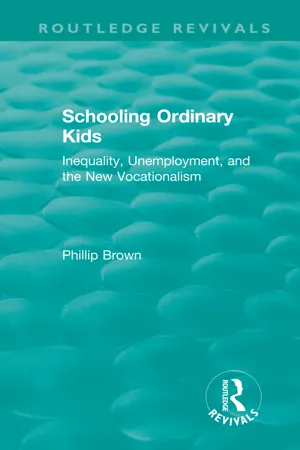
Routledge Revivals: Schooling Ordinary Kids (1987)
Inequality, Unemployment, and the New Vocationalism
- 216 pages
- English
- ePUB (mobile friendly)
- Available on iOS & Android
eBook - ePub
Routledge Revivals: Schooling Ordinary Kids (1987)
Inequality, Unemployment, and the New Vocationalism
About this book
Information
1• Introduction
In post-war Britain there has always been a minority of working-class pupils who appeared to accept the school, usually because they believed that by arming themselves with enough qualifications to compete for middle-class jobs, they could get out of their class of origin. Another minority have rejected the school as boring, irrelevant, and frequently repressive. This book, however, is about the ‘invisible majority’1 of ‘ordinary’ working-class pupils (Kahl 1961; Jenkins 1983) who neither left their names engraved on the school’s honours boards, nor gouged them into the top of classroom desks. It explains why these ordinary kids did not conform with the school ethos but were nevertheless willing to ‘make an effort’, and why they are now at the centre of a major educational crisis.
This crisis is closely connected to broader social and economic changes which have taken place outside the school over the last decade. Britain’s economy has been seriously affected by world recession and much of the country’s manufacturing industries languish in the shadow of international competition. There have been mass redundancies and unemployment on a scale which even at the time of Callaghan’s great debate on education in 1976, were unthinkable. We have also witnessed the rapid expansion of the Manpower Services Commission (MSC) as the problem of unemployment among both young and old alike has become more acute and apparently more intractable. Job opportunities for school leavers have virtually collapsed in many parts of England and Wales. In Britain as a whole only 18 per cent of 16-year-olds entered employment in 1984 compared with over 60 per cent a decade earlier (DES 1985). These changing circumstances outside the school have been accompanied by the rise of Thatcherism and the new right (Hall and Jacques 1983). According to one of its main protagonists, Sir Keith Joseph, Thatcherism represents a political doctrine motivated by a desire to convert ‘romantic and outmoded’ socialist aspirations into the acceptance of the ‘new common ground of reality’ (Hillard 1986) which enshrines the principle of individual free enterprise.
It is hardly surprising therefore that the right have sought to define the present educational crisis as a consequence of ill-conceived egalitarian liberal democratic reforms in the post-war period, which they argue has resulted in an unprecedented decline in educational and moral standards. They also identify the educational system as having contributed to the massive increase in youth unemployment as a result of teachers inculcating anti-business and industrial attitudes into pupils who, as a result, are believed to be grossly ill-prepared for the economic realities of the late twentieth century. Consequently the Thatcher government has engaged in a major programme of educational reform in an attempt to ensure that the educational system meets the needs of industry. This ‘new vocationalism’ (Bates et al. 1984; Ranson et al. 1986) has manifested itself in a number of recent programmes such as the Technical and Vocational Education Initiative (TVEI); the Certificate of Pre-Vocational Education (CPVE); and more recently the launch of twenty City Technology Colleges (CTCs).2
The conclusion of this book, however, will be that the right’s account of the educational crisis and arguments for the new vocationalism are not supported by the evidence. It will be argued that while the new vocationalism undoubtedly represents a major challenge to the principles of comprehensive education, it is motivated more by an attempt to maintain (indeed extend) educational and social inequalities than to equip pupils for adult life. This is occurring, furthermore, at a time when the economy and labour market are being restructured, and when the old educational settlement – the conditions under which compliance to the school was ensured – between teachers and the ordinary kids is breaking down. The current crisis in schools results from the fact that there has been a widespread collapse of the types of jobs which enabled the ordinary kids to ‘get on’ in working-class terms and become adult in a respectable fashion. Its conclusion is not that these pupils must be educated once more to know their place; it is that they already know their place but are less likely to see the school as useful in attaining it.
The classroom crisis among respectable working-class youth, therefore, dramatically highlights the contradictions which underlie the schooling of all working-class youth, and it will be argued that if we are going to meet the educational challenge of contemporary social and economic change, we will require social and educational policies that are geared towards breaking down social and educational inequalities. This will require the development of an alternative politics of education to that which underlies the new vocationalism, because the new vocationalism represents an attempt to subordinate concern about the provision of equal educational opportunities for the working class to ‘making the preparation for a place in the occupational structure the raison d–être of public education’ (Grubb and Lazerson 1982).
The study of ordinary kids also challenges a lot of what sociologists have hitherto told us about education and the working class. Much of the previous research on working-class responses to school has focused on either the high flyers or, more typically, the school rebels (Hammersley and Turner 1980). The very fact that the ordinary kids have been regarded by teachers and indeed by other pupils as ordinary has tended not to make them an intrinsically appealing object of sociological enquiry, and there has been little demand for such studies from teachers because they have not, at least until recently, been seen to be a cause for concern. Among sociologists, the ordinary kids’ relative quiescence in school (when it seems contrary to their class interests to be so), has led to them being seen as blindly conforming to the whims of teachers. This view has been expressed in a number of sociological studies, including Willis’ impressive book Learning to Labour (1977). According to Willis any working-class pupils who do not rebel against the school – this includes ordinary kids – constitute a further reminder of the ideological spell under which large numbers of working-class pupils are duped.
Such accounts of so-called ‘conformist’ responses are both deterministic and ‘over socialized’ (Wrong 1967), and are in fact grossly inadequate for understanding the way in which ordinary kids experience school life. It will be shown that the way the ordinary kids responded to school was as much a working-class cultural response as the one which led to its rejection. The ordinary kids’ willingness to make an effort in school, albeit limited, was part of an authentic attempt to maintain command of their own lives; to maintain a sense of personal dignity and respect (Sennett and Cobb 1977) in circumstances where they were not academically successful; and, on their own terms, to enhance their chances of making a working-class career when they left school (Ashton and Field 1976).
A further reason why the ordinary kids have been largely ignored and misunderstood is because their ‘invisibility’ and apparent conformity has been associated with female pupils. The study of gender and schooling has recently become a major topic within the sociology of education and the belief that girls are the passive recipients of the school’s formal and hidden agendas has correctly been questioned by a number of writers (Davies 1984; Griffin 1985). This study will show clearly that boys as well as girls fall within the category of ordinary kids, and that despite important differences in the way they experience school they adopt a similar orientation, which in turn highlights a number of issues about the relationship between class and gender for understanding working-class educational behaviour.
A study of ordinary kids, and the way their responses to school differ from other groups of pupils, also leads to the twofold conclusion that the educational system neither simply fails the working class, nor do the working class simply fail themselves, as Willis appears to imply. It is the moving encounter between identities and institutions (Abrams 1982) which enables us to understand why the ordinary kids bother to make any effort in school; why some working-class pupils have successfully utilized school as a way of ‘getting out’ of their class of origin; and why unemployment has brought to a head the contradictions underlying the schooling of ordinary kids. The argument of this book is that the structure and organization of schooling does make a difference to the way ordinary kids respond to school, and if it is indeed the case that the working-class demand for education is to be understood in terms of an interplay between identity and institutional structure, then there is nothing inevitable about the contemporary pattern of working-class educational behaviour. These ideas are elaborated in the next chapter, but to begin with, a brief description of the Middleport study is required.
THE MIDDLEPORT STUDY
The study was conducted in a large urban settlement in industrial South Wales. In order to maintain the confidentiality of the pupils and schools involved, it has been called Middleport. Middleport is socially and culturally divided into distinct ‘north’ and ‘south’ areas. The north is characterized by middle-class private housing, while the south has retained much of its appearance and identity as a traditional working-class area (Jackson 1968; Willmott 1966), although much of the original industrial base has now disappeared. It was in the south of Middleport that most of the research was conducted. The Welsh language is rarely spoken in this town, and coming from a small working-class town in England’s Home Counties, I was struck as much by the similarities as by the differences in the dispositions and outlooks of the people in the two settings.
Middleport provided an ideal location for studying the impact of unemployment on the way the ordinary kids responded to school and their struggle to find employment. As with the rest of industrial South Wales, Middleport has experienced large-scale redundancies as the heavy engineering and steel industries in the area shed labour or simply went out of business. What new jobs have been created are to be found in the service sector, particularly in the retail industry, junior clerical work, cleaning, and light manufacturing. These jobs tend to recruit a large proportion of female labour, a trend which motivated one local newspaper to herald the age of the ‘petticoat workforce’ (sic).
In the early 1980s Middleport’s official unemployment rate was approximately the same as the rest of Wales, which had doubled from 7.3 per cent in 1979 to almost 16 per cent in 1983. This unemployment rate was also comparable to many other unemployment blackspots in the North of England and the West Midlands (Central Statistical Office 1985), and the study can therefore claim a degree of typicality. Another common characteristic of these areas is that the young have been especially hard hit by changing economic circumstances (Jackson 1985; Raffe 1987). In Wales more than one-third of the unemployed were between the ages of 18 and 23 (MSC 1985a), and a growing proportion of these young adults are still experiencing long-term unemployment. The situation for school leavers is even bleaker. In Thomas High School which I will describe below, those who left school at 16 years of age in 1983 had only one-quarter of the chances of getting a job which their predecessors had enjoyed in 1979, and only one-eighth of a chance of an apprenticeship.
Middleport also provided an interesting case study of the impact of unemployment on the school, because of the time-honoured assumption that working-class parents and children in Wales have a greater respect for, and interest in, education than is the case in England. In 1979 a report on Welsh education noted:
Traditional attitudes and expectations . . . impinge in a marked way on the education service of the Principality. Historically education offered for the academically able a way out of the industrial rut. This phenomenon had the effect of investing academic education with a measure of esteem and respectability and this attitude still persists in some measure to the disadvantage of more technical or practical areas of learning. (p. 2)
The characterization of Wales as the great exporter of teachers and preachers is not without an element of truth, but the idea that there is a consensus about the virtues of academic study, which is distinctly Welsh, should be treated with caution. Belief in the existence of this consensus has invariably been based upon the fact that Wales once produced a higher proportion of academic achievers than England. However, since the late 1970s this has ceased to be the case. Indeed, what the later statistical comparisons between the two countries in fact highlight is the larger proportion of children from Welsh schools who are entering the labour market with no formal qualifications at all (Rees and Rees 1980).
The belief that academic study is highly valued throughout Wales must also be treated with caution because it ignores regional variations in educational performance within the principality itself. There may well be important differences in educational attitudes between the rural and the urban industrial regions. However, even making a distinction between rural and urban areas in this rather simplistic way tends to underplay differences in educational ambitions among people living in the same ‘local social structure’ (Rogoff 1961; Urry 1981). It will be shown in this study that within the working-class districts of Middleport, striving for academic success as a way out of the industrial rut is in fact a minority pursuit.
In other parts of Britain there are already signs of a growing disaffection with school, particularly among black youth (Jenkins and Troyna 1983). What this study offers is the chance to examine how unemployment has affected the educational responses of an almost exclusively white, traditional working-class neighbourhood. Thus, if there is evidence of a growing disenchantment with school among the ordinary kids described in this study, then the same phenomenon is quite likely to be taking place in similar regions throughout the rest of Wales and England.
Thomas High School was therefore chosen as the main study school because of a desire to examine a co-educational comprehensive school which was of average reputation in the town; neither particularly rough nor particularly academic.
Thomas High School was built in the early 1970s as a community school to service the people living in the south of Middleport. The school was located in a densely populated working-class neighbourhood of terraced housing, interspersed with a generous quantity of corner shops, public houses, and chapels. Thomas High School had a fairly good reputation among local people, ‘as schools go’. The staff were relatively young and progressive in their attitudes towards their job. They frequently espoused a belief that in this sort of area the academic curriculum was irrelevant to the lives of all but a small minority of pupils, and therefore that they had an important socially educative role to perform. However, the only manifestation of this philosophy which occurred while I was at the school were the daily tutorial periods of 30 minutes each. I was told that attempts had once been made to remove the streaming of pupils when they entered the school, but that this idea had been abandoned after a number of complaints from local parents. Finally we should note that pupils entered Thomas High School at the age of 14 from two feeder junior high schools, and tha...
Table of contents
- Cover
- Half Title
- Title Page
- Copyright Page
- Original Title Page
- Original Copyright Page
- Dedication
- Table of Contents
- Acknowledgements
- 1 • Introduction
- 2 • Schooling the working class
- 3 • Pupil orientations and youth unemployment
- 4 • Rems, swots, and ordinary kids
- 5 • Ordinary kids and the new vocationalism
- 6 • Ordinary kids in the labour market
- 7 • Unemployment and educational change
- Notes
- References
- Name index
- Subject index
Trusted by 375,005 students
Access to over 1.5 million titles for a fair monthly price.
Study more efficiently using our study tools.
Frequently asked questions
Yes, you can cancel anytime from the Subscription tab in your account settings on the Perlego website. Your subscription will stay active until the end of your current billing period. Learn how to cancel your subscription
No, books cannot be downloaded as external files, such as PDFs, for use outside of Perlego. However, you can download books within the Perlego app for offline reading on mobile or tablet. Learn how to download books offline
Perlego offers two plans: Essential and Complete
- Essential is ideal for learners and professionals who enjoy exploring a wide range of subjects. Access the Essential Library with 800,000+ trusted titles and best-sellers across business, personal growth, and the humanities. Includes unlimited reading time and Standard Read Aloud voice.
- Complete: Perfect for advanced learners and researchers needing full, unrestricted access. Unlock 1.5M+ books across hundreds of subjects, including academic and specialized titles. The Complete Plan also includes advanced features like Premium Read Aloud and Research Assistant.
We are an online textbook subscription service, where you can get access to an entire online library for less than the price of a single book per month. With over 1.5 million books across 990+ topics, we’ve got you covered! Learn about our mission
Look out for the read-aloud symbol on your next book to see if you can listen to it. The read-aloud tool reads text aloud for you, highlighting the text as it is being read. You can pause it, speed it up and slow it down. Learn more about Read Aloud
Yes! You can use the Perlego app on both iOS and Android devices to read anytime, anywhere — even offline. Perfect for commutes or when you’re on the go.
Please note we cannot support devices running on iOS 13 and Android 7 or earlier. Learn more about using the app
Please note we cannot support devices running on iOS 13 and Android 7 or earlier. Learn more about using the app
Yes, you can access Routledge Revivals: Schooling Ordinary Kids (1987) by Phillip Brown in PDF and/or ePUB format, as well as other popular books in Social Sciences & Sociology. We have over 1.5 million books available in our catalogue for you to explore.