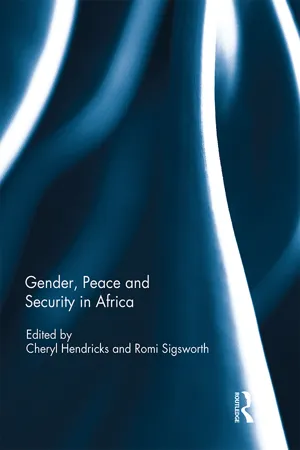
There is often a moment in time that acts as a rallying point around a particular issue. 2015 was one of those moments for women, peace and security as numerous landmark anniversaries were celebrated in the field. Africa has, in many ways, been the global laboratory for the gender, peace and security agenda, not only because of the number of conflicts occurring on the continent but also because African regional organisations, governments and civil society organisations have been at the forefront of striving for gender equality and implementing United Nations Security Council Resolution 1325. This book explores gender, peace and security in Africa from multiple angles, including: the conceptual and implementation challenges and shifts around women, peace and security in Africa over the last 15 years; women's role as combatants in national liberation forces in South Africa; the dynamics of gender in the military through the lens of Kenyan women combatants; food security through a feminist lens; and a series of case studies on the nexus between gender and security in Zimbabwe, Nigeria, Madagascar, the Democratic Republic of Congo, Kenya and Somalia. This book was previously published as a special issue of the African Security Review.
eBook - ePub
Gender, Peace and Security in Africa
- 120 pages
- English
- ePUB (mobile friendly)
- Available on iOS & Android
eBook - ePub
Gender, Peace and Security in Africa
About this book
Information
Women, peace and security in Africa
Conceptual and implementation challenges and shifts
This article highlights and critiques the underlying conceptualisations and assumptions of the women, peace and security (WPS) agenda that emerged with the adoption of United Nations Security Council Resolution 1325 in 2000. The main argument is that we need to rethink the WPS agenda to produce more holistic and groundbreaking responses for the types of challenges encountered, i.e., that gender inequality and insecurity are deep rooted and multi-layered, and thus negate mechanistic responses that do not deal with cultural and structural issues. It specifically focuses on gender and peace-making and gender and peacekeeping to point to the pitfalls in the current conceptions and practices in this arena.
Introduction
The year 2015 is a milepost for assessing progress and challenges in the quest for gender equality and for creating a more gender-sensitive and gender-responsive security sector globally. It is 20 years since the adoption of the Beijing Declaration and Platform for Action (1995), 15 years since the adoption of the United Nations Security Council Resolution (UNSCR) 1325 (2000), and it is the year in which the targets of the Millennium Development Goals (2000) and the Southern African Development Community (SADC) Protocol on Gender and Development (2008) should be met. Consequently, there has been a hive of activity geared towards gender ‘stock-taking’ and the setting of new goals and targets. In relation to peace and security, the United Nations (UN) conducted a high-level review and global study on women, peace and security and high-level reviews of the peacebuilding architecture and peacekeeping operations in 2015. These reviews are likely to play an important role in reconceptualising peacekeeping and peacebuilding and in shaping the future areas of engagement on women, peace and security (WPS).
The African Union (AU) is a leading organisation for setting the normative agenda on gender equality on the continent. It is active in advocating for gender mainstreaming, in accordance with UNSCR 1325, in peace and security processes. The AU's Protocol to the African Charter on Human and Peoples' Rights on the Rights of Women (2003), Solemn Declaration of Gender Equality in Africa (2004), Gender Policy (2009), Framework for Post Conflict Reconstruction and Development (2006), and Policy Framework for Security Sector Reform (2011) all call for gender equality and women's inclusion in peace and security structures and processes.1 Under the current stewardship of Nkosazana Dlamini-Zuma, appointed as Chairperson of the AU Commission in 2012, there is a more concerted effort by the AU on mainstreaming gender into peace and security. For example, the AU appointed Bineta Diop as Special Envoy on WPS, launched a five-year gender, peace and security programme, is developing a ‘Continental Results Framework’ for women, peace and security,2 and has themed the Heads of State Summits for 2015 around women's empowerment.
Global and continental efforts at gender mainstreaming in peace and security have been accompanied by state-level attempts to increase the participation of women in their security sector, as well as in peacekeeping deployments, and by civil society activism across the continent advocating for the implementation of UNSCR 1325.
Despite all the frameworks, agenda setting, national action plans, advocacy and training, however, 15 years post UNSCR 1325 there is little substantive progress in increasing women's participation in peace and security structures and processes and in creating greater security for women. In 2004, the UN Secretary General called for member states to adopt national action plans (NAPs) to ensure implementation of the resolution. Currently, only 50 countries (out of 196) have these plans, 15 (30%) of which are in Africa, and very few of these are actually being realised.3 Women remain marginal to peace processes, with less than 4% as signatories to peace agreements and less than 10% as negotiators at peace tables.4 The UN has made little progress in the deployment of women peacekeepers, performing below the envisaged targets of 10% for military and 20% for police (women only constitute 3% of the military and 10% of the police who are deployed on peace missions).5 Data on gender representation in the national security sector institutions in Africa remains largely inaccessible.
Significantly, there has been little visible translation of the drive for women's participation in the security sector into actual security for women. Sexual and gender-based violence (SGBV) in conflict areas remains high, and accusations of peacekeepers abusing women and children abound, blurring the boundaries between perpetrators and protectors. Moreover, violence against women is not confined to conflict situations; it is arguably more pervasive, and part of the ‘everyday’ experiences of women in countries not considered to be involved in conflict. SGBV is also not limited to the public sphere – domestic violence is as ubiquitous, and it is the bane of women, girls, boys and, to a lesser extent, men. Beyond physical violence, women's security in many countries is constrained by ‘structural violence’6 – access to food, water, shelter, sanitation, employment, health care, discriminatory and exclusionary cultures, and so forth – creating general conditions of human insecurity. Post 9/11 we have also seen the remilitarisation of our societies, the normalisation of violence and the re-ascendance of a hyper-masculinity, all of which reinforce patriarchy and undermine the agenda of creating gender equality and peace and security for women. Therefore, there is a need to extend the focus and implementation of UNSCR 1325 beyond its predominant conflict–country application, and we must have a far broader view of the sources of insecurity for women.
After decades of feminist theorising, gender activism and the collation of empirical data, we know much more about the interrelationship between gender and security, and the security challenges facing women, especially in Africa. This accumulation of knowledge has been the drive behind the frameworks and programmes that have been adopted and implemented, but the application has had less than the desired impact for gender transformation within the security sector. Much of the explanation to date has been on the implementation gap, hence the call for better measuring tools and accountability mechanisms. Though this may be necessary, it is a rather depoliticised, technical response to issues that are fundamentally about reconstructing gender power relations.
This article, and others in this special issue of African Security Review, highlights the need for a different set of questions that may assist in moving the WPS agenda out of the cul-de-sac it appears to be trapped in; i.e., more and more resolutions and programming, but little headway in terms of increasing women's participation, transforming institutions and cultures, and improving the security of women. These questions relate to determining the dominant conceptualisation of the WPS agenda. Where are the conceptual limitations in the discourse? What explains the gaps between theory, policy and practice? What are the new conversations transpiring around issues of gender and security in Africa, and how should these inform an agenda moving forward? What are the implementation challenges in relation to gender, peace and security in Africa?
This article provides a brief overview of the theoretical and advocacy interventions that created the space for the adoption of UNSCR 1325 in 2000, unpacks the conceptualisation of the WPS agenda, and, through the purview of what has become the doctrine for conflict management – peace-making, peacekeeping and peacebuilding – discerns the assumptions, challenges and progress of mainstreaming gender into the security sector. The main argument of this article is that we need to rethink the WPS agenda to produce more holistic and groundbreaking responses for the type of challenges encountered; i.e., that gender inequality and insecurity are deep rooted and multi-layered, and thus negate mechanistic responses that do not deal with cultural and structural issues. The majority of the interventions to date have not dealt with the key issues of patriarchy, militarism and ‘gender normative violence’ (e.g., routine coercion, domination, violence, and the silencing of women and girls),7 and the ‘vast majority of women, therefore, remain unequal, insecure and unsafe during both peace and war’.8
From theory to practice
The end of the Cold War opened the space for new critical thinking on peace and security, questioning the then taken for granted interpretations of how the world worked, how peace and security were to be attained, and whose knowledge and experiences counted. Old state-centric, status-quo-oriented, male-dominated Realist perspectives of security gave way to new conceptualisations, actors and issues that were broadly grouped into ‘Critical Security Studies’. Feminist international relations and feminist security studies scholars and activists employed a gender lens for analysing war to determine where the women were and what was happening to them, and/or to highlight the gendered constructions and impact of war, and argued for recognition of the role of women as both victims and actors during conflict.9 By the 1990s, security was being redefined from a narrow, national-interest interpretation to security as emancipation, as centred on individuals, as the ability to exercise choice and live in dignity, as linked to development, as situated in regional complexes, and as gendered. There was recognition of the roles of non-state actors and the broadening of security issues. These ideas, some of which coalesced into the human security approach, were advocated by the Aberystwyth, Copenhagen and Frankfurt schools and among feminist, post-colonial and post-modernist scholars. The ideas marked a fundamental rupture from the previously dominant conservative academic and policy discourses centred on national security.
The Nairobi Forward Looking Strategies (1985) highlighted that ‘peace cannot be realised under conditions of economic and sexual inequality, denial of basic human rights and fundamental freedoms …’, and it also made an explicit link between peace and development.10 The Beijing Declaration (1995), a decade later, noted that ‘local, nation...
Table of contents
- Cover
- Half Title
- Title Page
- Copyright Page
- Table of Contents
- Citation Information
- Notes on Contributors
- Introduction
- 1. Women, peace and security in Africa: Conceptual and implementation challenges and shifts
- 2. The convergence and divergence of three pillars of influence in gender and security
- 3. Women combatants and the liberation movements in South Africa: Guerrilla girls, combative mothers and the in-betweeners
- 4. Feminine masculinities in the military: The case of female combatants in the Kenya Defence Forces' operation in Somalia
- 5. Gender, feminism and food studies: A critical review
- 6. A case study of gender and security sector reform in Zimbabwe
- 7. Women police in the Nigerian security sector
- 8. Madagascar: Paving the way to national ‘fampihavanana’ and lasting peace
- 9. Sexual and gender-based violence in the Democratic Republic of Congo
- 10. Kenya and Somalia: Fragile constitutional gains for women and the threat of patriarchy
- Index
Trusted by 375,005 students
Access to over 1.5 million titles for a fair monthly price.
Study more efficiently using our study tools.
Frequently asked questions
Yes, you can cancel anytime from the Subscription tab in your account settings on the Perlego website. Your subscription will stay active until the end of your current billing period. Learn how to cancel your subscription
No, books cannot be downloaded as external files, such as PDFs, for use outside of Perlego. However, you can download books within the Perlego app for offline reading on mobile or tablet. Learn how to download books offline
Perlego offers two plans: Essential and Complete
- Essential is ideal for learners and professionals who enjoy exploring a wide range of subjects. Access the Essential Library with 800,000+ trusted titles and best-sellers across business, personal growth, and the humanities. Includes unlimited reading time and Standard Read Aloud voice.
- Complete: Perfect for advanced learners and researchers needing full, unrestricted access. Unlock 1.5M+ books across hundreds of subjects, including academic and specialized titles. The Complete Plan also includes advanced features like Premium Read Aloud and Research Assistant.
We are an online textbook subscription service, where you can get access to an entire online library for less than the price of a single book per month. With over 1.5 million books across 990+ topics, we’ve got you covered! Learn about our mission
Look out for the read-aloud symbol on your next book to see if you can listen to it. The read-aloud tool reads text aloud for you, highlighting the text as it is being read. You can pause it, speed it up and slow it down. Learn more about Read Aloud
Yes! You can use the Perlego app on both iOS and Android devices to read anytime, anywhere — even offline. Perfect for commutes or when you’re on the go.
Please note we cannot support devices running on iOS 13 and Android 7 or earlier. Learn more about using the app
Please note we cannot support devices running on iOS 13 and Android 7 or earlier. Learn more about using the app
Yes, you can access Gender, Peace and Security in Africa by Cheryl Hendricks, Romi Sigsworth, Cheryl Hendricks,Romi Sigsworth in PDF and/or ePUB format, as well as other popular books in Social Sciences & African Politics. We have over 1.5 million books available in our catalogue for you to explore.