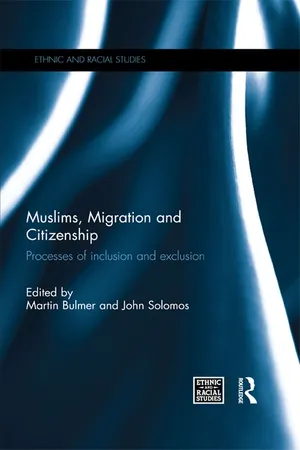
Bringing together ten research based contributions, Muslims, Migration and Citizenship addresses questions about the changing experiences of Muslim communities, or specific groups within them, in various national and localised environments. Although not an exhaustive survey of the broad range of scholarly research in this evolving field, this book covers issues that are likely to be of some importance in the coming period. In particular, the contributors highlight the complexity of the experiences of Muslim communities in different national and cultural environments, and the evolution of both policy discourses and debates in civil society. This book was originally published as a special issue of Ethnic and Racial Studies.
eBook - ePub
Muslims, Migration and Citizenship
Processes of Inclusion and Exclusion
- 180 pages
- English
- ePUB (mobile friendly)
- Available on iOS & Android
eBook - ePub
About this book
Information
Controversy, Islam and politics: an exploration of the ‘Innocence of Muslims’ affair through the eyes of British Muslim elites
Chris Allen and Arshad Isakjee
In September 2012, a video entitled ‘Innocence of Muslims’ was uploaded to YouTube. The fourteen-minute clip featured actors playing the Prophet Muhammad, his companions and wives, and while production values were amateurish, aided by airings on Egyptian national television and others elsewhere, the video went viral. Recalling the Rushdie affair two decades beforehand, angry protests took place across the world. In the UK, the response from Muslims was markedly different. This article traces the ‘Innocence of Muslims’ affair from the eyes of those involved in formal Muslim-governmental relations. It explores what the new controversy tells us about the representation of Muslim communities in the process of political engagement since the Rushdie affair. It considers the experiential disconnect that exists between Muslim and political actors in contemporary Britain before exploring three important political factors – the cultural, representational and geopolitical – that influence and impact upon Muslim–governmental relations.
1. Introduction
The controversy surrounding the 1988 publication of Salman Rushdie’s novel, The Satanic Verses (the ‘Rushdie affair’) is regarded as a watershed moment for British Muslims. A crucial moment in the shaping and construction of Britain’s Muslims as an indeterminable ‘Other’ in the popular discourses present in both social and political spaces (Poynting and Mason 2007; Allen 2010), its aftermath prompted a shift in consciousness for many British Muslims (Modood 1990a, 1990b). For Werbner (2000), this catalysed the need for British Muslims to engage politically in order to lobby for greater recognition and rights, which in turn gave impetus to embryonic formal Muslim–governmental relations (McLoughlin 2010; Silvestre 2010). It also marked the beginning of what has become a complex and evolving relationship between governmental institutions and politicians on the one hand, and Muslim representative organizations on the other (O’Toole et al. 2013). It is these relationships between Muslims and government, often forged against a backdrop of similar controversies, that form the focus of this paper.
In the two decades since Rushdie, a number of similarly resonant controversies have emerged: the Prophet Muhammad cartoons in Denmark; satirical cartoons in France’s Charlie Hebdo; the Lars Vilk’s Dog Muhammad cartoons in Norway; and films by Dutch film-maker Theo van Gogh and politician Geert Wilders, respectively. While stark differences exist between all of them, a clear chronological lineage can be traced from the Rushdie affair. Each controversy has typically seen a proliferation of media images showing Muslims protesting, typically aggressively, against a cultural product perceived as ‘Western’. Likewise, each has ignited debates about the boundaries between free speech and hate speech. Conversely, each has cemented the need for dialogue, diplomacy and cooperation between governments and Muslims, and have been important in shaping Muslim communities’ intergovernmental relationships.
McLoughlin (2004, 2010) emphasized the importance of the Rushdie affair in prompting new government initiatives to liaise with British Muslims directly. Indeed, it was in the immediate fallout from this that the Conservative British Home Secretary Michael Howard asked Muslims leaders to found a new body in order to speak with a unified voice. This potentially essentializing approach was also reflected in the New Labour government’s use of the Muslim Council of Britain (MCB) as a single, professionalized representative body for British Muslims (McLoughlin 2010). Since then, there has been a move away from single representative bodies by government, driven by the increased scrutiny of those groups and different governments’ dissatisfaction with a lack of support for its policies (Birt 2006). Towards the end of the New Labour era, government became inclined to choosing its Muslim partners depending on the nature of whatever policies it was seeking to address, without worrying about how ‘representative’ those might be. This shift has continued with the current Coalition government. Muslim organizations working with government to represent Muslim interests today, eschew the notion that they are truly ‘representative’ and acknowledge that their links to Muslim communities at a local level can be loose. Nonetheless, the heterogeneous set of Muslim groups currently liaising with the Coalition government must negotiate the legacy of past failed attempts of representation. As their seat at the decision-making table is not guaranteed, they can find themselves caught between representing community perspectives accurately and cooperating with government agendas that impact upon Muslim ‘communities’ (Brown 2008; Allen and Guru 2012; O’Toole et al. 2012).
The posting of a fourteen-minute video titled ‘Innocence of Muslims’ on the YouTube website was to bring these dilemmas to the fore. As with Rushdie, the video was roundly condemned for denigrating Islam and the Prophet Muhammad. Resonating with the pattern of preceding controversies, protests duly took place around the world, some of which were violent. A preliminary survey of British newspapers suggests that around seventy-five people died worldwide as a result of the protests, with a further 650 being injured.1 However, while the worldwide protests resonated with those against Rushdie decades beforehand, aside from a few provocative protests engineered by an extremely small number of British Muslims, the response to the video in Britain was markedly different – and fuelled by a variety of political concerns. Unlike the Rushdie affair, during which significant numbers of British Muslims protested, some choosing to burn copies of the book or voice support for the Iranian fatwa calling for the death of Rushdie, the response to ‘Innocence of Muslims’ was less incendiary. Instead of high-profile protests, most prominent British Muslim organizations issued low-key press releases that not only condemned the video but also the violent protests that took place outside the UK.
The ‘Innocence of Muslims’ affair, similar to previous controversies pitting Muslim ‘feeling’ against notions of free speech, saw those Muslim actors who had acquired positions of engagement and representation grappling with that delicate balance between being advocates for their communities on the one hand while maintaining active partnerships with government on the other – voicing concern or dissent while not upsetting government in the process. This article begins by exploring the various responses of British Muslims who were actively engaged in Muslim–governmental relations during that autumn of 2012, and then proceeds to analyse them in two ways. First, it seeks to examine the varied, sometimes emotional responses to the video, which then had to be translated into political action and engagement. Second, the article analyses the dilemmas of that Muslim response, thereby allowing us to explore the political factors – of culture, representation and the geopolitical – that currently shapes the decision-making of Britain’s Muslim representatives. To conclude, a reflection on the controversy highlights the changing political and cultural dynamic between British Muslims, their organizations and the British government after two decades of formal Muslim–governmental relations.
2. Methodology
The findings for this article are principally drawn from ten in-depth interviews with British Muslim actors engaged in formal Muslim–governmental relations in the past two years. All interviewees had first-hand experience and contact with governmental bodies and were able to offer intimate insights into the cultural, political and emotional dynamics that existed and were shaping the relationships between Muslims and government. All interviews were undertaken in the immediate aftermath of the global video protests: five male and five female, each representing a different Muslim civil society organization. While having a national remit, the organizations represented had different interests and were actively engaged with different government departments including the Department for Communities and Local Government (DCLG), Foreign Office and Home Office, among others, on a range of different issues perceived to be ‘Muslim’ or ‘Islamic’. The female actors interviewed worked for organizations with interests relating to gender, political participation and Muslim youth; the final female actor represented an organization with a much broader ‘Muslim’ focus. The organizational interests of the male actors included interfaith, leadership and policing. The two others represented organizations focused on broader ‘Muslim’ issues; one of these was also an imam.
For this research, notions of power and expertise were necessarily treated critically, neither supposing nor implying that any of the interviewees formed any sort of ‘true’ representative body of British Muslim opinion. As Michael (2004) is correct to note, the co-option of Muslim elites into the political process is largely ad hoc. Hopkins and Kahani-Hopkins (2004a, 2004b) agree, noting also the existence of political entrepreneurism, something that meant that some of the ‘elites’ being interviewed may have deployed the term ‘Muslim’ in order to maintain positions of power and influence. Nonetheless, all of those interviewed had been afforded the privilege of being able to speak, as Ivanescu (2010, 320) puts it, on behalf of ‘the Muslim community, with a Muslim voice’.
3. ‘Innocence of Muslims’
‘Innocence of Muslims’ first appeared on YouTube on 1 July 2012, purporting to be a trailer for a feature-length film that had allegedly been shown two weeks earlier in Los Angeles.2 For some months after, the video remained largely unnoticed. However, by early September 2012, the video had been dubbed into Arabic and parts of it broadcast on an Egyptian television show before being shown in other parts of the Muslim world. Around the same period, the Pastor Terry Jones – infamous for his plans to burn 200 Korans on the tenth anniversary of 9/11 – announced plans to screen the film at his church, while a press release from the alleged film-makers claimed that the film was the work of an Israeli Jew. It was later revealed that the film was instead the product of four non-Jewish men based in California.
Within days of the clips being shown in Egypt, violent protests began around the world. Internationally, the most significant occurred in Egypt, leading to a scaling of the wall of the US diplomatic mission in Cairo. In Libya, protests coincided with an attack on the US consulate in Benghazi and the death of the American ambassador. Largely seen as a separate incident, the protests were seen as being used as a smokescreen by some to attack American interests in the country. In Europe, protests took place in Denmark, France, Sweden and Britain. In London, Anjem Choudary, former leader of various proscribed Islamist groups and ‘celebrity’ Muslim voice for the media, led a demonstration of 150 people outside the US embassy, burning American and Israeli flags. Another protest in London was organized by Hizb Ut-Tahrir and attracted 800 people. Further activities followed, including the spreading of conciliatory messages of ‘love’ to shoppers and commuters in London and Birmingham. None of these peaceful activities attracted significant media attention.
Responses from most British Muslim organizations were low key and muted in comparison to the Rushdie affair. Most released tempered statements coupling condemnation of the video with condemnation of violence. For the largest organizations, this also included condemning the death of the ambassador in Benghazi. The MCB, still Britain’s largest Muslim organization, was one of these. Stressing how ‘the violence we saw is not in keeping with the teachings of the Prophet’ it went on:
Those who carried out these attacks are in a minority and do not speak for Muslims, or our faith. The death of the US ambassador to Libya is a deep tragedy… Whilst this in no way justifies these attacks, the film-maker responsible for this defamatory video mocking Prophet Muhammad, peace be upon him, should be ashamed of his actions. (Euro-Islam 2012)
The Muslim Association of Britain sought to remind Muslims that this was ‘an opportunity to show the world who Muhammad is and what his character and practices were’ (Fernandes 2012). In comparison, the Muslim Public Affairs Committee (MPACUK 2012) and iEngage (2012) took the opportunity to question the bounds of free speech in relation to religion and religious communities; similarly, smaller British Muslim organizations voiced disapproval rather than anger. Somewhat anomalous was the Muslim Action Forum (MAF), an organization created in direct response to the video. While little is known about it, MAF claimed that it provided a ‘united platform’ from which to denounce ‘Innocence of Muslims’ (MAF 2013). Intending to protest outside the London offices of Google ‘every working day [from 14 January 2013] until such time they retract the showing of the insulting, vulgar and obscene films’ (MAF 2013), little evidence exists to suggest that this took place. However, news reports from October 2012 suggest that MAF did mobilize around 10,000 Muslims in a one-off protest (The Sun 2012).
Events surrounding ‘Innocence of Muslims’ can be read as the latest in a line of similar controversies dating back to the Rushdie affair. Following each, there has typically been condemnation of the cultural product and an expression of anger by some Muslims that prompts a shift in the focus of the media, public and politicians from the original object of controversy to the reaction and behaviour of some Muslims (Ruthven 1990). As Werbner (2000) observes, many of these protests are against an abstract entity that is loosely conflated with ‘the West’. This essentialism is reflected back and Muslims then homogenously risk becoming framed as being on the wrong side of conflicts between censorship and freedom of expression, tolerance and intolerance, theocratic law and secular liberalism (CBMI 1997; Allen 2010). A similar pattern was observed with regards to ‘Innocence of Muslims’. However, it is necessary to acknowledge a key difference between the furores: while The Satanic Verses was written by a (formerly) Muslim writer, all subsequent events – the various cartoons and films – have been produced by non-Muslims. This is important for two reasons. First, because as the findings here suggest, some Muslims believe that such more recent incidents have been deliberately engineered externally to provoke a very specific, ‘Muslim response’. Second, Rushdie’s being formerly Muslim evoked a sense of betrayal or even treachery among his Muslim opponents, not least because of his public profile (Modood 1990a). For the ‘Innocence of Muslims’ affair and others since Rushdie, that sense of betrayal ...
Table of contents
- Cover
- Half Title
- Series Page
- Title
- Copyright
- Contents
- Citation Information
- Notes on Contributors
- Introduction
- 1. Controversy, Islam and politics: an exploration of the ‘Innocence of Muslims’ affair through the eyes of British Muslim elites
- 2. Reluctant pluralists: European Muslims and essentialist identities
- 3. Freedom of religion, women’s agency and banning the face veil: the role of feminist beliefs in shaping women’s opinion
- 4. Balancing agency, gender and race: how do Muslim female teenagers in Quebec negotiate the social meanings embedded in the hijab?
- 5. White privilege in the lives of Muslim converts in Britain
- 6. A complex interplay between religion, gender and marginalization: Pakistani schoolgirls in Hong Kong
- 7. Radicalization and counter-radicalization at British universities: Muslim encounters and alternatives
- 8. The ‘metropolis of dissent’: Muslim participation in Leicester and the ‘failure’ of multiculturalism in Britain
- 9. Online Islamophobia and the politics of fear: manufacturing the green scare
- 10. Being Muslim and being Irish after 9/11: self-conceptions of place in Irish society
- Index
Trusted by 375,005 students
Access to over 1.5 million titles for a fair monthly price.
Study more efficiently using our study tools.
Frequently asked questions
Yes, you can cancel anytime from the Subscription tab in your account settings on the Perlego website. Your subscription will stay active until the end of your current billing period. Learn how to cancel your subscription
No, books cannot be downloaded as external files, such as PDFs, for use outside of Perlego. However, you can download books within the Perlego app for offline reading on mobile or tablet. Learn how to download books offline
Perlego offers two plans: Essential and Complete
- Essential is ideal for learners and professionals who enjoy exploring a wide range of subjects. Access the Essential Library with 800,000+ trusted titles and best-sellers across business, personal growth, and the humanities. Includes unlimited reading time and Standard Read Aloud voice.
- Complete: Perfect for advanced learners and researchers needing full, unrestricted access. Unlock 1.5M+ books across hundreds of subjects, including academic and specialized titles. The Complete Plan also includes advanced features like Premium Read Aloud and Research Assistant.
We are an online textbook subscription service, where you can get access to an entire online library for less than the price of a single book per month. With over 1.5 million books across 990+ topics, we’ve got you covered! Learn about our mission
Look out for the read-aloud symbol on your next book to see if you can listen to it. The read-aloud tool reads text aloud for you, highlighting the text as it is being read. You can pause it, speed it up and slow it down. Learn more about Read Aloud
Yes! You can use the Perlego app on both iOS and Android devices to read anytime, anywhere — even offline. Perfect for commutes or when you’re on the go.
Please note we cannot support devices running on iOS 13 and Android 7 or earlier. Learn more about using the app
Please note we cannot support devices running on iOS 13 and Android 7 or earlier. Learn more about using the app
Yes, you can access Muslims, Migration and Citizenship by Martin Bulmer,John Solomos in PDF and/or ePUB format, as well as other popular books in Social Sciences & Sociology. We have over 1.5 million books available in our catalogue for you to explore.