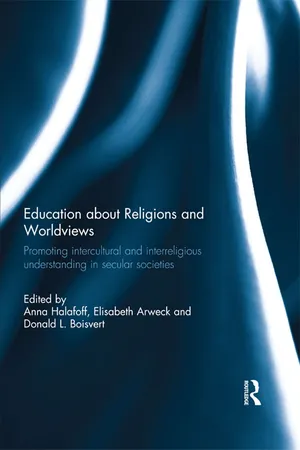
This volume presents the findings of a number of empirical and theoretical studies on education about religions and worldviews (ERW) conducted in the Western societies of Britain, Ireland, Canada, Norway, Finland, New Zealand, Australia and Canada. Educational programmes about diverse religions and worldviews began to be investigated and implemented as strategies to encourage interreligious understanding and social cohesion, particularly following the 2005 London bombings when a fear of youth radicalisation and home-grown terrorism became prevalent. In addition, as a growing number of people in Western societies, and young people especially, declare themselves to have no religious affiliation, state actors are currently grappling with the reality that we are living in increasingly multifaith and non-religious societies and government education systems have become places of contestation as a result of these changes. This volume examines ERW research and policies in a number of diverse places in the hope of identifying common themes, overlapping insights and best practices that can inform research and policy for religious literacy and interreligious understanding in other contexts. This book was originally published as a special issue of the Journal of Intercultural Studies.
eBook - ePub
Education about Religions and Worldviews
Promoting Intercultural and Interreligious Understanding in Secular Societies
- 158 pages
- English
- ePUB (mobile friendly)
- Available on iOS & Android
eBook - ePub
Education about Religions and Worldviews
Promoting Intercultural and Interreligious Understanding in Secular Societies
About this book
Information
Elisabeth Arweck & Gemma Penny
This article is based on data arising from focus group discussions with young people in British schools, to draw out socialising influences and factors that shape their approaches to religious diversity. It explores questions such as: is religious socialisation taking place in the home, with active participation in religious communities, or is religious socialisation weakening from generation to generation? How does religious socialisation (or its lack) differ between and within religions and between particular localities? Which factors facilitate or impede socialising processes? These questions are addressed in the light of discussions with young people and survey results. The data arise from a project (2009–2012) in the Warwick Religions and Education Research Unit at the University of Warwick, funded by the Economic and Social Research Council/Arts and Humanities Research Council Religion and Society Programme, which applied a mixed methods approach to explore the attitudes of 13–16-year-old pupils across the UK towards religious diversity.
This article draws on data produced in focus group discussions with young people in UK schools on religious diversity to explore the factors involved in socialising processes, focusing on the role that families – nuclear and extended – play in shaping young people’s approaches to religion and religious diversity. The data were analysed to find out whether religious socialisation is taking place in the home, with active participation in religious communities, or whether religious socialisation is weakening from generation to generation. Another question relates to the differences between religions, and the role that location plays regarding religious socialisation (or its lack). Data from the group discussions are set in dialogue with questionnaire data. Both sets of data arise from a three-year project (2009–2012) in the Warwick Religions and Education Research Unit (WRERU) at the University of Warwick, exploring the attitudes of 13–16-year-old pupils across the UK towards religious diversity. The project was funded by the Economic and Social Research Council (ESRC)/Arts and Humanities Research Council (AHRC) Religion and Society Programme.
This article first provides a brief description of the project, then gives an overview of the literature in which the project is embedded and an outline of the data production, before introducing the socialising elements and discussing these in some detail. Young people’s own belief and practice are followed with sections on the role of the family, friends, school and media, with the conclusion drawing the various strands together at the end.
The Project
The three-year project ‘Young People’s Attitudes to Religious Diversity’ (2009–2012) was based in the WRERU at the University of Warwick, UK, and funded by the ‘Religion and Society Programme’ – a joint research programme of the AHRC and the ESRC, two major public funding bodies in the UK. The project was a large research grant under the Programme’s ‘youth call’. The project team consisted of WRERU staff, representing a range of expertise and academic disciplines, and one PhD candidate.
The paucity of research on young people’s attitudes towards religious diversity and the factors that influence and shape their attitudes provided the impetus for the project. The overall aim was to take account of young people’s (13–16-year olds) socioeconomic, cultural, ethnic and religious backgrounds in order to explore their views and the influence of contextual factors, such as school, family, media and local neighbourhood. In order to achieve this, the project applied a mixed methods approach, combining ethnographic (qualitative) with quantitative (survey questionnaire) research methods. The ethnographic phase was of an exploratory nature and thus took place at the beginning of the project. Its findings then informed the design of the survey questionnaire.
The Project in the Context of Wider Literature
The topic of religious diversity (see, for example, Stringer 2013; Salzbrunn 2014) links with debates about multiculturalism and interculturalism (see, for example, Baumann 1999; Parekh 2000; Hasan 2010; Cantle 2012; Meer and Modood 2012) and attendant areas, such as religious pluralism (see Kühle 2012a), ‘new’ multiculturalism (see Vertovec 2001; Toğuşlu et al. 2014) and super-diversity (Vertovec 2007, 2014), and with debates about (de)secularisation, migration, transnationalism as well as race, ethnicity and culture, and their link with religion. The way religious diversity was conceptualised for the project is set out elsewhere (Arweck 2013). The question of attitudes towards other people touches on contact theory or contact hypothesis (Allport 1954) and the social construction of religion (Beckford 2003) and the Other.
Young people’s religious identity relates to theories of identity and identity formation as well as religious socialisation (transmission) and nurture; this includes the question of socialising agents and factors (see, for example, Sherkat 2003; Becci 2012; Bengtson et al. 2013). Although socialising processes are complex, existing research suggests a strong link between the religious beliefs of parents, especially mothers, and their children in accordance with parental socialisation (Axinn and Thornton 1993; Barber 2001), parental preference for passing on their own faith and contextual influences such as the neighbourhood where parents choose to live. Yet, the notion of family and family structures has undergone changes in diverse societies, which in turn have an impact on the role of religion in families (Houseknecht and Pankhurst 1999; Edgell 2006).
The implications of multiculturalism and religious diversity for religious socialisation are another important area of research, including religious nurture of young people of and within ethnic minorities (Kühle 2012b). Relevant also are the notions of embodied socialisation (see, for example, McGuire 2002; Orsi 2005), religion as a chain of memory (Hervieu-Léger 2000) and lived or everyday religion (see, for example, Ammermann 2006; McGuire 2008). Socialisation further includes religious education – both in the strict and wider sense, whether in school or community contexts, of a formal or informal nature – and this broadens into educational and pedagogical agendas and curriculum requirements, such interreligious and intercultural education, with the underlying aim of counteracting conflict and promoting tolerance (see, for example, Jackson 2004), and post-9/11 concerns, for example, issues around securitisation (see Quartermaine 2014). As a curriculum subject, Religious Education (RE) also touches on young people’s moral and spiritual development and on issues around citizenship and human rights.
Social scientists, including educationalists, now also pay more attention to the absence of religion in people’s lives, including young people’s. This is a research field which has become topical again after having lain fallow for some time (see Arweck 2012). Studies of young people’s non-religious stances (see Bullivant 2008; Voas and McAndrew 2012; Arweck 2013; Wallis 2014) thus reflect increasing numbers of young people (as also documented in the 2011 UK Census results) lacking links with, or reporting distance from religion for a number of reasons – such as not being socialised into one or having rejected a religious heritage – pointing to the effects of secularising trends and the decline of institutional religion.
The Qualitative Phase
The aim of the project’s ethnographic phase was to investigate the key themes and issues that young people identify with religious diversity and the vareity of positions they adopt in response. In order to explore these, focus group discussions were conducted in 21 secondary schools across the four nations of the UK (England, Wales, Scotland and Northern Ireland) and London – because of its size and distinctive patterns of diversity, due to its immigration history. The choice of schools was designed to include a wide range, regarding pupil composition, location, social context and the type of school, access permitting.
The focus group discussions were based on semi-structured schedules, with questions arranged in four clusters: faith background/identity, values, encounter with diversity and attitudes to diversity. In order to allow for flexibility (for example, time constraints) and to ensure reasonably even data (two researchers shared the fieldwork), priority questions were identified beforehand.
The focus groups generally consisted of six pupils, usually mixed in terms of gender, ethnic and social backgrounds and school classes. The research was designed to separate religious and non-religious groups – based on young people’s own identification – but this did not apply to all groups. A teacher, with whom selection criteria had been discussed beforehand, selected pupils, usually asking for volunteers. The young people were generally willing, if not eager, to participate. Some proved impressively articulate. The focus groups generally took the place of a lesson (40–60 minutes). Each group was briefed about the project and the purpose of the discussion. In all instances, researchers sought the pupils’ consent to participate, and their permission to record the discussions.
Once fieldwork data were gathered, the transcripts from each school were combined so that data and extracts from the discussions were organised in themes. These followed the structure of the schedule, but also reported emerging themes. The collated data then fed into the design of the survey questionnaire. This article draws on young people’s responses to questions about their faith backgrounds, religious identities and their encounter with diversity and other relevant questions in the questionnaire. Since one of the project’s objectives was to give voice to young people, as many direct quotes from the focus groups as space allows are included here. Given the nature of focus group discussions, the findings derived from them are neither definitive nor representative.
The Quantitative Phase
The quantitative phase formed the second part of the project. Its aim was to obtain data from 2000 pupils (aged 13–15 years) in each of the five regions using a questionnaire. The sample of 10,000 ensured reliable visibility of minorities. Completed questionnaires were provided by 11,725 pupils: 2398 from England, 1988 from Northern Ireland, 2724 from Scotland, 2319 from Wales and 2296 from London. The analysis here is based on a subgroup of 4494 pupils living in England and Wales, in order to match the qualitative data discussed here. Of these, 2532 questionnaires were completed by pupils attending schools with a religious character (‘religious schools’) and 2212 questionnaires were completed by pupils attending schools without a religious foundation (‘secular schools’).
The survey was designed for self-completion, using mainly multiple-choice questions and Likert scaling on five points (agree strongly, agree, not certain, disagree and disagree strongly). Six sets of multiple-choice items explore young people’s worship attendance, their religious affiliation, parental affiliation and worship attendance (mother and father). Five sets of Likert scaling items explore how young people’s attitudes towards religion are influenced by mother, father, friends, RE and school and the media. The analysis also shows how these data vary according to school type.
Socialising Agents and Factors Emerging from the Data
As mentioned, the questions in both phases of the project were designed to explore the influence of a range of contextual factors in young people’s lives. The social contexts can be seen as a set of concentric circles, with the family in the middle, and circles of friends, school and faith community extending outwards. ‘Family’ is understood here in the wider sense, including parents, grandparents, extended family and family friends. ‘Friends’ includes peers and (non-)religious friends. The school context includes the study or religion(s) and religious education in the wider sense, and the community dimension is about awareness of, and links with, faith communities. Both phases also explored the influence of the media, including television and the Internet. For reasons of space, the influence of peers, school and media will not be discussed in as much depth as that of the family. Influence was explored in terms of the conversations and discussions that young people had with family and friends or in the classroom, and their engagement with faith communities and the media – thus how they perceived the influence of the various agents and fa...
Table of contents
- Cover
- Half Title
- Title
- Copyright
- Contents
- Citation Information
- Notes on Contributors
- Introduction – Education about Religions and Worldviews: Promoting Intercultural and Interreligious Understanding in Secular Societies
- 1. Young People’s Attitudes to Religious Diversity: Socialising Agents and Factors Emerging from Qualitative and Quantitative Data of a Nation-Wide Project in the UK
- 2. ‘Respect Study’ the Treatment of Religious Difference and Otherness: An Ethnographic Investigation in UK Schools
- 3. International Human Rights Law: Its Potential and Limitations in Effecting Change to the Place of Religion in the Irish Education System
- 4. Education and Common Values in a Multicultural Society – The Norwegian Case
- 5. Pupils’ Perceptions of Worldview Diversity and Religious Education in the Finnish Comprehensive School
- 6. Religion in New Zealand’s State Primary Schools
- 7. Education about Diverse Religions and Worldviews, Social Inclusion and Countering Extremism: Lessons for the Australian Curriculum
- 8. Quebec’s Ethics and Religious Culture School Curriculum: A Critical Perspective
- Index
Trusted by 375,005 students
Access to over 1.5 million titles for a fair monthly price.
Study more efficiently using our study tools.
Frequently asked questions
Yes, you can cancel anytime from the Subscription tab in your account settings on the Perlego website. Your subscription will stay active until the end of your current billing period. Learn how to cancel your subscription
No, books cannot be downloaded as external files, such as PDFs, for use outside of Perlego. However, you can download books within the Perlego app for offline reading on mobile or tablet. Learn how to download books offline
Perlego offers two plans: Essential and Complete
- Essential is ideal for learners and professionals who enjoy exploring a wide range of subjects. Access the Essential Library with 800,000+ trusted titles and best-sellers across business, personal growth, and the humanities. Includes unlimited reading time and Standard Read Aloud voice.
- Complete: Perfect for advanced learners and researchers needing full, unrestricted access. Unlock 1.5M+ books across hundreds of subjects, including academic and specialized titles. The Complete Plan also includes advanced features like Premium Read Aloud and Research Assistant.
We are an online textbook subscription service, where you can get access to an entire online library for less than the price of a single book per month. With over 1.5 million books across 990+ topics, we’ve got you covered! Learn about our mission
Look out for the read-aloud symbol on your next book to see if you can listen to it. The read-aloud tool reads text aloud for you, highlighting the text as it is being read. You can pause it, speed it up and slow it down. Learn more about Read Aloud
Yes! You can use the Perlego app on both iOS and Android devices to read anytime, anywhere — even offline. Perfect for commutes or when you’re on the go.
Please note we cannot support devices running on iOS 13 and Android 7 or earlier. Learn more about using the app
Please note we cannot support devices running on iOS 13 and Android 7 or earlier. Learn more about using the app
Yes, you can access Education about Religions and Worldviews by Anna Halafoff,Elisabeth Arweck,Donald Boisvert in PDF and/or ePUB format, as well as other popular books in Theology & Religion & Religion. We have over 1.5 million books available in our catalogue for you to explore.