Over the last three decades, electoral reform has moved centre stage in both new and established democracies. In Europe, the post 1989 democratisation wave brought important debates about electoral system choice and free and fair elections. But electoral reform also emerged on the agenda in a number of established democracies. Declining political participation, corruption scandals and party finance irregularities put the management of the democratic process on the political agenda. Election administration problems such as those in the Gore Bush election of 2000 thrust electoral integrity into the global political spotlight. In this edited collection, we are primarily concerned with the mechanics of how elections are run. Elections are complex administrative tasks and as International IDEA points out, they are also usually administered against a politically charged backdrop. This book brings together specialists to consider the election management process using diverse theoretical approaches and, addressing both emerging and perennial election debates such as the role of voter advice applications, election management bodies, districting, ballot design and media practices in the coverage of elections. The volume includes a number of comparative chapters which utilise data from large international datasets (VDem and CSES), several Irish case studies and an important Dutch study of voter advice applications with pioneering data. Collectively, the chapters provide insights into election administration in Ireland and many other established democracies. This book was previously published as a special issue of Irish Political Studies.
eBook - ePub
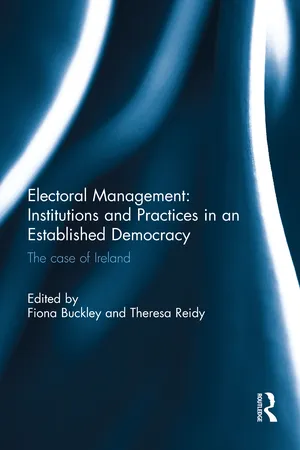
Electoral Management: Institutions and Practices in an Established Democracy
The Case of Ireland
- 212 pages
- English
- ePUB (mobile friendly)
- Available on iOS & Android
eBook - ePub
Electoral Management: Institutions and Practices in an Established Democracy
The Case of Ireland
About this book
Information
Managing the Electoral Process: Insights from, and for, Ireland
FIONA BUCKLEY & THERESA REIDY
Department of Government, University College Cork, Western Road, Cork, Ireland
ABSTRACT In this article, we provide an overview of the contributions to this special issue of Irish Political Studies on electoral management practices in Ireland. We document the rationale behind the issue and explore its contribution to our understanding of how elections are operated. We would like to thank the authors in this issue for participating in the Election Institutions and Electoral Integrity workshop at the National University of Ireland in October 2014. We acknowledge their valuable and generous comments on all of the articles in this special issue. The workshop was funded by a grant from the ‘New Foundations’ scheme of the Irish Research Council.
1. Introduction
Ireland is a relatively old democracy approaching its one hundred year anniversary of free and fair elections as an independent state. Over the last three decades, electoral reform has moved centre stage in both new and established democracies. In Europe, the post-1989 democratisation wave brought important debates about electoral system choice and free and fair elections. But electoral reform also emerged on the agenda in a number of established democracies. In common with other countries, declining political participation, corruption scandals and party finance irregularities put the management of the democratic process on the political agenda (Birch, 2011; Alvarez et al., 2013). Election administration problems such as those in the Gore Bush election of 2000 thrust electoral integrity into the global political spotlight.
Public confidence in the electoral process is an essential part of democratic politics and is central to widespread acceptance of the outcomes of elections (Elklit & Reynolds, 2001). In this special issue, we are primarily concerned with the management of the election process which is understood to mean the mechanics of how elections are run. Elections are complex administrative tasks and as International IDEA (2006: 1) points out, they are also usually administered against a politically charged backdrop. Internationally, electoral management has been identified as a vital part of the process for delivering electoral integrity (IDEA, 2006) and it has emerged as a major concern of policy-makers and academics alike. Norris et al. (2014) discuss electoral integrity as referring to ‘agreed international principles, values, and standards of elections, applying universally to all countries worldwide throughout the electoral cycle, including during the pre-electoral period, the campaign and on polling day and its aftermath’. Norris (2014: 35) conceptualises the electoral process as a cycle with 11 distinct stages beginning with electoral laws and ending with the Electoral Management Body (EMB). Alvarez et al. (2013) use the idea of an electoral eco-system to frame their analysis and Elklit and Reynolds (2001) provide a 12-point framework for evaluating electoral processes and administration. These conceptualisations are important reminders of the complexity of managing electoral processes, and in the literature the interconnectedness of the various stages of the election management process is emphasised. It is somewhat self-evident to point out that electoral management must be about providing a level playing field throughout the entire electoral process and that no policy or procedure should confer advantage onto one candidate or party. And equally as Elklit and Reynolds (2001, 2005) discuss, the electoral process must be robust. Even in an established democracy, where tight elections are the norm and candidates may win or lose by a few votes, democratic legitimacy can be affected by failures in electoral management.
Jacobs and Leyenaar (2011) suggest useful adaptions to Lijphart’s (1994) definition of major electoral reform and suggest that the categorisations of major, minor and technical can be used to capture the diversity of electoral reforms which have been introduced in recent decades. Election management practices ordinarily fall into the minor and technical categories concerned as they are with elements such as ballot structure, redistricting and voter registration. All of these areas are considered within this special issue. The type of institution allocated responsibility for the direct administration of elections and referendums has also become an important element of debate. A trend towards establishing autonomous electoral management bodies has been established. In some older democracies, elections continue to be managed by government departments and hybrid approaches are also present where administration of an election is directed by the executive branch of government but administered in a decentralised manner usually through local government as is the case in Ireland.
This issue of Irish Political Studies brings together a collection of specialists to consider the election management process in Ireland. The volume presents studies using diverse theoretical approaches, addressing emerging and perennial election debates including the role of voter advice applications (VAAs), redistricting, ballot design and media practice in the coverage of elections. The volume includes several Irish case studies, an important Dutch study of VAAs with pioneering data and a number of comparative articles which utilise data from large international datasets (VDem and CSES). Collectively, the articles provide insights into election administration in Ireland, and for Ireland, examining how Ireland compares to other countries and what Ireland can learn from experiences in other jurisdictions.
In this introduction to the special issue, we detail some of the core concerns in the field of election management. In this section, we have drawn from the international literature, while Section 2 takes a more Irish-specific focus and documents the main features of election management practice in Ireland and outlines some important changes and developments in election management in recent decades. Section 3 provides an overview of the individual contributions and discusses their relevance to debates on current election management in the Republic of Ireland. A brief conclusion is provided at the end.
2. The Election Management Debate in Ireland
Ireland operates a hybrid model of election management. Responsibility is fragmented across a series of agencies. Policy is devised and directed by the Franchise Section of the Department of the Environment, Community and Local Government. Electoral services are provided by a series of permanent and ad hoc agencies and committees. Voter registration, polling and counting are the responsibility of local authorities while districting is conducted by ad hoc committees established at intervals across the local and general election electoral cycles. Political finance falls under the remit of the Standards in Public Office Commission and at each referendum, a Referendum Commission is established to provide information on the referendum question and to promote turnout.
Public confidence in the electoral process in Ireland is very good. In a 2008 report on the establishment of an independent electoral commission, it was reported that citizens have a high degree of the trust in how elections are run (Sinnott et al., 2008) and James (2011) concludes that elections are run without partisan interference. The positive evaluation of Irish electoral management processes is also confirmed in data taken from the Electoral Integrity Project (EIP)1 audit of the 2011 election. The EIP uses an expert survey procedure to evaluate electoral processes in countries across the world. The data for Ireland were collected using the standardised EIP questionnaire and a response rate of 72.5 per cent was achieved. The conventional wisdom that elections in Ireland are free and fair is very clear from the headline results. However, areas of concern do emerge from the data and these include the electoral registration process, the treatment of minorities, equal access to politics for women and political finance regulations (Buckley et al. 2015).
Considerable progress was achieved in two of the areas highlighted in the EIP data with the passage of the Electoral Amendment (Party Financing) Act (2012). The act linked state funding of political parties to a legislative gender quota and it limited donations to political parties, placing comprehensive restrictions on corporate donations (Buckley & Galligan, 2013). There was a sharp increase in the number of women candidates, and also the numbers of women elected to local authorities, at the 2014 local elections. Early data in advance of the next general election suggest that most, if not all, parties will achieve the 30 per cent quota, indicating that the gender quota legislation will have achieved its objective of improving access to politics for women. The act also contained provisions in relation to political finance and these developments are part of a series of changes which have been implemented since the 1990s, partly in response to a number of party finance scandals. Concerns remain about the transparency of party financing but this is not unusual. As Scarrow (2007) points out, global public concerns about political financing have not been alleviated by increasing restrictive rules governing political finance.
As a consequence of declining turnout from the 1980s, there was renewed interest in facilitation measures to make the act of voting easier. In the 1990s, steps were taken to address some concerns and ballot paper structure and design was changed (see Reidy & Buckley, 2015) and there was an increase in the opening hours of polling stations. In a major departure from the usually conservative approach to the management of the electoral process in Ireland, electronic voting machines were used on a trial basis in three constituencies at the 2002 general election. There was considerable public concern about the reliability of the machines and the absence of a paper trail, should anything go wrong. The government appointed the Independent Commission on Electronic Voting and Counting at Elections to consider the issues which had arisen and the machines were not used in 2004 at the local elections. Although the Commission issued a qualified recommendation that the machines were reliable, controversy about their use persisted and electronic voting machines were eventually scrapped in 2009 and the paper and pencil elections approach to polling day was confirmed (Murphy, 2008).
Notably, some areas of electoral management where serious concerns have been raised have been ignored (|Farrell, 2013, 2014; Reidy, 2014). Concerns about the electoral registration process date back to the 1980s (O’Malley, 2001) but no action has been taken on foot of several decades of debate and, most recently a report on improving the electoral registration process carried out by Dun Laoghaire Rathdown County Council on behalf of the four Dublin local authorities in 2011, received little or no consideration by government. Equally long-standing debates about weekend polling, widening access to postal voting and providing some form of early voting have yielded no action. Furthermore, some basic functions receive little attention; there is a poor record of research into electoral management practices and indeed the provision of electoral data is mixed with it often taking many months for final elections results to be made public. The general public access election results from the extensive archives provided by several media organisations in the absence of a centralised system reliably operated and provided by the government department with responsibility for election management. Referendums provide an unusual bright spot in this regard with clear, timely information made available to voters.
3. Managing the Electoral Process: Insights from, and for, Ireland: An Overview
Drawing from different perspectives, politics, law and communications, the contributions in this special issue address some of the long-standing and controversial debates in the area of election management in Ireland but they also present insights into new debates using both comparative data and case studies from other European jurisdictions.
The special issue opens with two comparative articles focused on one of the central questions from the election management literature, what is the best type of election management body? Van Ham and Lindberg use data from the Varieties of Democracy Project to shed new light on this persistent debate. Their definitive analysis demonstrates that differences between established and new democracies are critical variables in explaining why EMB type does not have a uniform impact on electoral integrity. Their findings are intuitive and persuasive; in high-level democracies with effective and efficient election administration, the type of EMB is of limited consequence but the opposite is true in states with low levels of democracy, here independent EMBs can, and do deliver, higher levels of EMB autonomy and this enables the agencies to be more assertive in managing the electoral process. Their essential conclusion is that EMB type matters and independent EMBs can deliver greater electoral integrity in states where democracy needs the greatest level of support.
The focus on the role and consequences of EMB type is continued in Quinlan’s article. Using data from the Comparative Study of Electoral Systems, he looks at how election turnout can be affected by the conduct of election management processes including voter registration and election timing. Quinlan demonstrates that several aspects of election timing such as weekend voting, polling hours and the time of the year at which the election is conducted are unconnected with turnout. In relation to voter registration, his evidence demonstrates that compulsory registration does not increase the likelihood of voting but he does show that where voter registration is managed by an independent EMB, there is an increased likelihood of participation in elections by voters. In his discussion, he suggests that an independent EMB, rather than a government EMB, is more likely to dedicate extra time and resources to voter registration and this may explain why an independent EMB is more efficacious in increasing the probability of voters going to the polls.
The two articles have important implications for contemporary debates on election management and these are teased out separately in both studies. The establishment of an independent EMB in Ireland has been mooted for some time. The findings from these articles should sound a note of caution. Both authors see value in an independent EMB and van Ham and Lindberg provide data to show that there is plenty space for improvement in the conduct of elections in Ireland and Quinlan’s findings demonstrate that oversight of the electoral registration process is an important role that should be allocated to any new EMB. However, both articles demonstrate that independent EMBs are not a panacea for the problems of established democracies. Declining trust in politics and falling political participation will not be substantively addressed by a change in electoral management but they do suggest that an independent EMB is small step in the right direction.
In an important contribution to the issue, Kavanagh provides an evaluation of the legal framework for the conduct of elections and referendums. She marries the legal framework for election management with some of the more contentious political debates in the area. In her evaluation, she provides a critique of how the legal framework is used to deliver public confidence in the electoral process. Her analysis spans constitutional provisions, the legislative framework and seminal case law on election administration. She is critical of what she describes as the ‘reactive rather than proactive’ response of Irish administrators to judicial findings that election regulations have been breached although overall she concludes that there is a strong effort to deliver electoral integrity in both the ‘spirit and intentions’ of electoral law.
The middle section of the special collection is concerned with the thorny issue of districting practices. Articles from Coakley and Murphy deliver insightful analyses of districting rules and practices at general and local elections. Coakley makes a compelling case for an alternative approach to districting. He provides an overview of the procedures used for drawing electoral boundaries from the foundation of the state and highlights the particular problems posed for representation by the regular re-design of consti...
Table of contents
- Cover
- Half Title
- Title Page
- Copyright Page
- Contents
- Citation Information
- Notes on Contributors
- 1. Managing the Electoral Process: Insights from, and for, Ireland
- 2. When Guardians Matter Most: Exploring the Conditions Under Which Electoral Management Body Institutional Design Affects Election Integrity
- 3. Facilitating the Electorate: A Multilevel Analysis of Election Timing, Registration Procedures, and Turnout
- 4. Electoral Law in Ireland: Sustaining Electoral Integrity from Process, Procedures, and Precedent?
- 5. Fixed-Boundary Constituencies and the Principle of Equal Representation in Ireland
- 6. ‘Residents are Fearful that Their Community will Die Around Them’: Some Thoughts from Inside the 2013 Local Electoral Area Boundary Committee
- 7. Regulating the Airwaves: How Political Balance is Achieved in Practice in Election News Coverage
- 8. The Effect of Voting Advice Applications on Political Knowledge and Vote Choice
- 9. Ballot Paper Design: Evidence from an Experimental Study at the 2009 Local Elections
- 10. Conclusion and Reflection: Time for an Electoral Commission for Ireland
- Index
Trusted by 375,005 students
Access to over 1.5 million titles for a fair monthly price.
Study more efficiently using our study tools.
Frequently asked questions
Yes, you can cancel anytime from the Subscription tab in your account settings on the Perlego website. Your subscription will stay active until the end of your current billing period. Learn how to cancel your subscription
No, books cannot be downloaded as external files, such as PDFs, for use outside of Perlego. However, you can download books within the Perlego app for offline reading on mobile or tablet. Learn how to download books offline
Perlego offers two plans: Essential and Complete
- Essential is ideal for learners and professionals who enjoy exploring a wide range of subjects. Access the Essential Library with 800,000+ trusted titles and best-sellers across business, personal growth, and the humanities. Includes unlimited reading time and Standard Read Aloud voice.
- Complete: Perfect for advanced learners and researchers needing full, unrestricted access. Unlock 1.5M+ books across hundreds of subjects, including academic and specialized titles. The Complete Plan also includes advanced features like Premium Read Aloud and Research Assistant.
We are an online textbook subscription service, where you can get access to an entire online library for less than the price of a single book per month. With over 1.5 million books across 990+ topics, we’ve got you covered! Learn about our mission
Look out for the read-aloud symbol on your next book to see if you can listen to it. The read-aloud tool reads text aloud for you, highlighting the text as it is being read. You can pause it, speed it up and slow it down. Learn more about Read Aloud
Yes! You can use the Perlego app on both iOS and Android devices to read anytime, anywhere — even offline. Perfect for commutes or when you’re on the go.
Please note we cannot support devices running on iOS 13 and Android 7 or earlier. Learn more about using the app
Please note we cannot support devices running on iOS 13 and Android 7 or earlier. Learn more about using the app
Yes, you can access Electoral Management: Institutions and Practices in an Established Democracy by Fiona Buckley,Theresa Reidy in PDF and/or ePUB format, as well as other popular books in Politics & International Relations & Civics & Citizenship. We have over 1.5 million books available in our catalogue for you to explore.