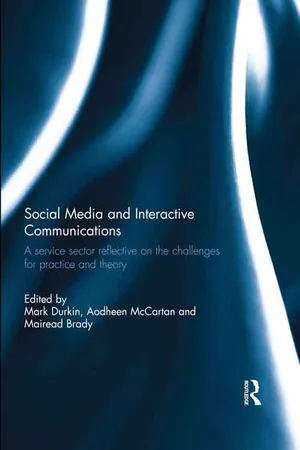
The extent to which social media can potentially add value within various service contexts is not well understood. While at a general level it would seem that direct and immediate interactive communication with customers and stakeholders would be of benefit in terms of general communications, the integration of new media alongside more traditional marketing activities is not without difficulty. Many organisations appear seduced by what new technological communication channels are capable of but evidence suggests that those same organisations may have limited sensitivity to the appropriateness of employing social media to add value to the customers' service experience. Launching social media initiatives appears low cost and fairly straightforward, technically, but managing the subsequent interactions and engagement appropriately, and indeed profitably, can often be beyond a firm's resources and competencies. In this book the challenges of effectively managing interactive communications through social media is described in various service contexts, (e.g. healthcare, travel, small businesses) and within prevailing, yet ever more crucial marketing concepts, such as customer relationship management (CRM) and customer complaining behaviour. This book was originally published as a special issue of the Service Industries Journal.
eBook - ePub
Social Media and Interactive Communications
A service sector reflective on the challenges for practice and theory
- 144 pages
- English
- ePUB (mobile friendly)
- Available on iOS & Android
eBook - ePub
Social Media and Interactive Communications
A service sector reflective on the challenges for practice and theory
Mary Beth Pinto
Penn State Erie, The Behrend College, Black School of Business, Erie, PA, USA
An important recent initiative in the effective transmission of healthcare services is the establishment of the patient-centered medicine (PCM) philosophy as a mechanism for enhancing customer satisfaction. Although the goals of PCM are important, there is less understanding of the means by which service providers can promote this philosophy.
This study examines the relationship between customers’ attitude toward and use of social media, PCM, and their satisfaction with healthcare services. Data were collected from a large, urban-based pediatric office in the northeast. The sample consisted of 234 respondents who were classified as ‘e-Patients’ – that is, they reported having access to the Internet and going online for health information. A three-stage regression analysis, conducted to establish the path coefficients for each stage in the model, shows that customers’ (patients’) attitude toward social media can be an effective method to enhance PCM and, ultimately, satisfaction. The findings contribute to theory in services by exploring the challenges of managing service delivery at the interface between customer satisfaction and the role and usefulness of adopting and effectively using social media.
Introduction
Healthcare service in the USA continues to be in a state of dynamic metamorphosis. Over the past 40 years, a number of initiatives, some public policy-based and others resulting from changes in technology and population demographics, have led to rethinking healthcare service delivery and the manner in which professionals are expected to practice. The recent introduction of the Patient Protection and Affordable Care Act in March of 2010 and the resulting controversies it has created present challenges for health service professionals, as they come to terms with the overriding goal of providing optimal patient care within a complex healthcare environment.
A critical paradigm for the nation’s healthcare delivery has been the adoption and expansion of patient-centered medicine (PCM). Interest in the topic dates back to the late 1960s and has continued over the last 50 plus years (Balint, 1969; Byrne & Long, 1976). The trend toward patient-centered medical care accelerated in 2001 when The Institute of Medicine identified PCM as one of the six goals for healthcare delivery in the USA. Specifically, PCM was identified as ‘care that is respectful of and responsive to individual patient preferences, needs, and values’ (Institute of Medicine, 2001, p. 3).
Since that time there have been numerous conceptualizations of PCM. Most frameworks agree that patient-centered decision making is ‘the process of identifying clinically relevant, patient-specific circumstances and behaviors to formulate a contextually appropriate care plan’ (Weiner et al., 2013, p. 573). Within PCM, effective care is seen to be collaborative – that is, defined by or in consultation with patients rather than by physician-dependent tools or standards.
The PCM initiative is rooted in Social Capital theory, as articulated by sociologists and organizational researchers over the past two decades (cf. Adler & Kwon, 2002; Anheier, Gerhards, & Romo, 1995; Lin, Cook, & Burt, 2008). Social capital generally refers to ‘the sum of resources, actual or virtual, that accrue to an individual or group by virtue of possessing a durable network of more or less institutionalized relationships of mutual acquaintance and recognition’ (Bourdieu & Wacquant, 1992, p. 14). It has been instrumental in furthering our knowledge of social interactions within communities, public health, organizational governance, and other problems of collective action. Further, social capital has been associated with several positive social outcomes such as better public health, lower crime rates, and more efficient financial markets (Adler & Kwon, 2002; Szreter & Woolcock, 2004). A recent example was the decision by the Cleveland Clinic to ask every patient calling in to seek an appointment if they would like to be seen that same day. Their reasoning was based on the principle of nurturing a collective sense of ‘we,’ in which all members of the social network partner to improve healthcare quality delivery (Norrish, Biller-Andorno, Ryan, & Lee, 2013).
The central tenet of social capital theory is that it allows people to ‘draw on resources from other members of the networks to which he or she belongs’ (Ellison, Steinfield, & Lampe, 2007, p. 1145). Social capital researchers believe that Internet-based relationships, such as those created through social media, allow users to develop and maintain larger networks from which they can potentially draw resources and benefits through the exchange of useful information, development of personal relationships, and the formation of groups for support or action (Donath & Boyd, 2004; Mathwick, Wiertz, & de Ruyter, 2008; Steinfield, Ellison, & Lampe, 2008). In a recent study on how technology – including the Internet and mobile phones – interfaces with medical care, researchers observed the creation of social capital for pregnant women seeking information and advice on prenatal care (Kraschnewski et al., 2014). The women in the study reported that information obtained from the Internet helped them cope with the health conditions surrounding their pregnancy. The authors concluded ‘given how critical patient-provider communication is to the therapeutic relationship, the Internet should be considered by more providers as a forum for both dissemination of evidence-based education information and integration into the prenatal care structure’ (Kraschnewski et al., 2014, p. e147). Thus, Social Capital theory supports attempts to pursue a broad patient satisfaction mandate (cf. Morrow, 1999) and, more specifically, informs and shapes initiatives such as the PCM movement herein described.
PCM operates with some important tenets. First, the medical encounter must be viewed and evaluated through the eyes of the patient, not the service provider (Epstein, Laine, Farber, Nelson, & Davidoff, 1996). As a result, it is incumbent upon doctors to recognize the need for the critical skills of empathy and communication in order to better understand patients’ perspective and engage with them as partners in their treatment. In their study of several hundred patients, Kim, Kaplowitz, and Johnson (2004) concluded that patient-perceived physician empathy was correlated with a perception of physician expertise, trust, and information exchange, and that such empathy was associated with greater patient satisfaction and compliance. Hojat, Louis, Maio, and Gonnella (2013) concur that empathic engagement in patient care lays the foundation for a trusting relationship and leads to improved patient outcomes.
Second, patients seek, fundamentally, relationships not transactions. The goal of health services should be long-term and empowering partnerships, with each party equally vested in both immediate treatments but more importantly long-term relationships. Little et al. (2001) demonstrated that a personal relationship between patient and doctor and a feeling of partnership led to patients who were more satisfied, more enabled, and had a lower symptom burden and lower r...
Table of contents
- Cover
- Half Title
- Title
- Copyright
- Contents
- Citation Information
- Notes on Contributors
- Introduction Enabling interactive communications through social media: Research from services contexts
- 1. Social media’s contribution to customer satisfaction with services
- 2. Extending customer relationship management into a social context
- 3. The value of social presence in mobile communications
- 4. Customer e-complaining behaviours using social media
- 5. Marketing technology for adoption by small business
- 6. Exploring interactive communication using social media
- Index
Trusted by 375,005 students
Access to over 1.5 million titles for a fair monthly price.
Study more efficiently using our study tools.
Frequently asked questions
Yes, you can cancel anytime from the Subscription tab in your account settings on the Perlego website. Your subscription will stay active until the end of your current billing period. Learn how to cancel your subscription
No, books cannot be downloaded as external files, such as PDFs, for use outside of Perlego. However, you can download books within the Perlego app for offline reading on mobile or tablet. Learn how to download books offline
Perlego offers two plans: Essential and Complete
- Essential is ideal for learners and professionals who enjoy exploring a wide range of subjects. Access the Essential Library with 800,000+ trusted titles and best-sellers across business, personal growth, and the humanities. Includes unlimited reading time and Standard Read Aloud voice.
- Complete: Perfect for advanced learners and researchers needing full, unrestricted access. Unlock 1.5M+ books across hundreds of subjects, including academic and specialized titles. The Complete Plan also includes advanced features like Premium Read Aloud and Research Assistant.
We are an online textbook subscription service, where you can get access to an entire online library for less than the price of a single book per month. With over 1.5 million books across 990+ topics, we’ve got you covered! Learn about our mission
Look out for the read-aloud symbol on your next book to see if you can listen to it. The read-aloud tool reads text aloud for you, highlighting the text as it is being read. You can pause it, speed it up and slow it down. Learn more about Read Aloud
Yes! You can use the Perlego app on both iOS and Android devices to read anytime, anywhere — even offline. Perfect for commutes or when you’re on the go.
Please note we cannot support devices running on iOS 13 and Android 7 or earlier. Learn more about using the app
Please note we cannot support devices running on iOS 13 and Android 7 or earlier. Learn more about using the app
Yes, you can access Social Media and Interactive Communications by Mark Durkin,Aodheen McCartan,Mairead Brady in PDF and/or ePUB format, as well as other popular books in Business & Business General. We have over 1.5 million books available in our catalogue for you to explore.