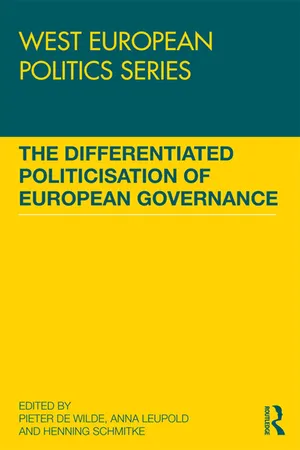
This book on the differentiated politicisation of European governance provides an overview of research on the growing salience of EU governance, polarisation of opinion and expansion of actors and audiences engaged in monitoring and influencing EU affairs in the national context. The contributors empirically map the diversity of these three core components of politicisation across countries, time and arenas. The chapters develop novel insights into the causes and consequence of this differentiated politicisation of European governance. Going beyond the current literature, the contributions disaggregate and examine politicisation processes among different sets of actors and on different objects using quantitative and qualitative methods leading to a differentiated picture of politicisation patterns across EU-member states and non-member states, such as Switzerland. They highlight the explanatory power of intermediating factors, like the institutional surrounding and country-specific economic and cultural conditions in addition to the transfer of political authority to the EU as the main driver of politicisation. This book was previously published as a special issue of West European Politics.
eBook - ePub
The Differentiated Politicisation of European Governance
- 182 pages
- English
- ePUB (mobile friendly)
- Available on iOS & Android
eBook - ePub
The Differentiated Politicisation of European Governance
About this book
Information
Edgar Grande and Swen Hutter
ABSTRACT
While there is increasing evidence that European integration has been politicised, knowledge of the driving forces of this process is still limited. This article contributes to the research by examining the importance of authority transfers to the EU as drivers of politicisation. It innovates in two ways. First, it extends the authority transfer argument by highlighting the mobilising power of membership conflicts; second, it analyses the relevance of national opportunity structures, referenda in particular, and mobilising strategies for politicisation. Empirically, it traces politicisation in public debates on every integration step (treaty reforms and enlargement) from the 1970s to the late 2000s in six West European countries (Austria, Britain, France, Germany, Sweden, and Switzerland), based on a quantitative content analysis of newspaper coverage.
While there is increasing evidence that European integration has been politicised, knowledge of the driving forces of this process is still limited. This article contributes to the research by examining the importance of authority transfers to the EU as drivers of politicisation. It innovates in two ways. First, it extends the authority transfer argument by highlighting the mobilising power of membership conflicts; second, it analyses the relevance of national opportunity structures, referenda in particular, and mobilising strategies for politicisation. Empirically, it traces politicisation in public debates on every integration step (treaty reforms and enlargement) from the 1970s to the late 2000s in six West European countries (Austria, Britain, France, Germany, Sweden, and Switzerland), based on a quantitative content analysis of newspaper coverage.
Whereas scholars agree that ‘something like politicisation has happened since the mid-1980s’ (Schmitter 2009: 211f.) in Europe, there is still considerable controversy about the causes and consequences of this process. The present article focuses on the causal factors and seeks to explain the level of politicisation in public debates over European integration. We test the most prominent argument advanced in the scholarly literature, namely that politicisation is ultimately driven by the accumulated effects of authority transfers to the EU (see De Wilde and Zürn 2012; Hooghe and Marks 2009; Rauh 2015; Statham and Trenz 2013b; Zürn 2006; Zürn et al. 2012). De Wilde and Zürn (2012: 138) made this argument most strongly: ‘the politicisation of European integration is driven by its increasing authority indicated by the transformation from a traditional international organisation to a more encompassing “political system”’. Such transfers are expected to provoke resistance among European citizens and increase demands for public justifications because of the insufficient legitimacy of supranational authority. As a consequence, we should see rising politicisation over time with peaks around major treaty reforms when formal ‘deepening’ of the EU is at stake. In this context, the Maastricht Treaty and subsequent treaty reforms, in particular the failed Constitutional Treaty and the Lisbon Treaty, are considered watersheds in the integration process and its politicisation.
There is certainly empirical evidence for such a claim (e.g. De Wilde and Zürn 2012: 146–9; Rauh 2015; Statham and Trenz 2013b), but the argument has not yet been scrutinised in a larger comparative analysis. A closer inspection of politicisation of European integration, including national election campaigns and major integration debates, casts some doubts on its validity. The pattern of politicisation in national election campaigns does not show such a clear-cut increase in the 2000s and reveals remarkable cross-national variation (e.g. Green-Pedersen 2012; Hoeglinger 2015; Hutter and Grande 2014; Hutter and Kerscher 2014; Kriesi 2007). Moreover, we find highly politicised integration debates in instances in which conflict was focused on the accession of new members or membership of one’s own country rather than on further authority transfers to the supranational level. The French debate on Britain’s membership in the EEC in the early 1970s, and the controversies on Turkey’s EU membership in the mid-2000s are cases in point (see von Oppeln 2005).
These examples suggest that the authority transfer argument does not capture the politicisation of Europe in all its relevant manifestations. Therefore, this article explores the scope of the authority transfer argument in a larger comparative setting. It innovates in two ways. First, we distinguish between conflicts over ‘authority transfer’ and ‘membership conflicts’ in integration debates. By comparing debates that focus attention either on authority transfers (‘deepening’) or on membership issues (‘widening’), we can qualify the mobilising power of authority transfers within the EU. Second, we examine the relevance of institutional and actor-centred factors that might condition the way political conflicts over Europe play out in public debates (see Hooghe and Marks 2009; 2012; Koopmans and Statham 2010; Kriesi 2007; Kriesi et al. 2012, 2008; Statham and Trenz 2013a, 2013b). More precisely, this article examines the explanatory power of four variables: national referenda, the national electoral cycle, the strength of populist right-wing challengers, and cultural-identitarian framing strategies. All four factors are based on the assumption that politicisation may be triggered by the deepening and widening of the EU; however, its extent ultimately depends on the strategies of political actors and the institutional opportunities they face.
In the following, we test this argument by comparing 86 domestic public debates on the main steps of European integration in six West European countries: France, Germany, Britain, Austria, Sweden, and Switzerland. In our analysis, we distinguish between public debates on (a) treaty reforms, (b) accession of third-party countries, and (c) accession of one’s own country. This allows us to compare the importance of authority transfers and membership conflicts. While substantial authority transfers have been the object of treaty reforms such as the Maastricht Treaty, membership issues have led to sometimes protracted negotiations between the EC/EU and the country seeking accession, embedded in complicated domestic political decision-making processes.
Public debates on major steps of integration seem to be perfect sites for both politicisation of European integration and for its empirical analysis. They are induced by critical institutional events in the integration process; they are open to participation by all kinds of actors beyond the narrow scope of governmental elites and political parties; and, unlike national elections, their public visibility is not overshadowed by other domestic issues. Thus, they seem most likely cases for a politicisation of Europe. Most importantly for our argument, the selected debates focus public attention on particular aspects of European integration: either transfers of authority and changes in the institutional framework of the EU or membership questions. For these reasons, they offer ideal windows of opportunity to compare the mobilising power of different integration steps and for new insights on the driving forces of politicisation.
We conduct our analysis in five steps. First, we briefly sketch how we conceptualise politicisation as our dependent variable. Second, we detail the hypotheses on the driving forces of politicisation. Third, we introduce the research design and methods of our study; fourth, we present the empirical findings of our comparative analysis; and, finally, we discuss the results in the context of current research on politicisation.
What is to be explained? Conceptualising politicisation
Our analysis is based on a multidimensional concept of politicisation that emphasises political conflict. Accordingly, politicisation can be seen as the ‘expansion of the scope of conflict’ (Schattschneider 1975 [1960]: 12) within a political system. More precisely, and in line with our previous suggestions (Hutter and Grande 2014), we characterise politicisation by three inter-related dimensions: issue salience, actor expansion, and polarisation (for a more detailed discussion, see Hutter et al. 2016). Such a definition is open in view of the type of political actors involved in a given conflict, the means they use to advance their claims, the arenas in which they act, their relationships to each other, and the consequences of their activities.
The first dimension, issue salience, refers to the visibility of a given issue in public debates. Only topics frequently raised by political actors in public can be considered politicised. This mirrors recent proposals by Green-Pedersen (2012) and Guinaudeau and Persico (2013), who suggest looking at politicisation primarily through the lens of salience. The second dimension is the expansion of the actors involved in a public debate. Following Schattschneider (1975 [1960]: 2), we argue that the ‘number of people involved in any conflict determines what happens’. If only a few (elite) actors publicly advance their positions, an issue is hardly politicised. More specifically, we focus on the degree to which other actors join the dominant executive actors in public debate (see Koopmans 2007; 2010; Statham and Trenz 2013b: 79ff.). The third dimension of politicisation refers to polarisation, i.e. the intensity of conflict over the issue. To be polarised, actors need to put forward starkly differing positions and we must find strong opposing camps (see De Wilde 2011; Hoeglinger 2015). The most polarising constellation is when two camps advocate completely opposing issue positions with strong and similar intensity.
Recent literature on the politicisation of European integration has discussed all these dimensions, although sometimes with a different labelling and a slightly different meaning (see De Wilde et al. 2015). In our previous work (Hutter and Grande 2014: 1004f.), we introduced a combined index of politicisation to make this multidimensional concept of politicisation accessible for quantitative empirical analysis. Our index acknowledges the crucial role of salience by multiplying it by the sum of the other two dimensions: politicisation = salience × (actor expansion + polarisation). More details on its calculation will be given in the methods section below.
Sources and driving forces of politicisation: the hypotheses
How can we explain the level and scope of politicisation of European integration? Why should Europe become a controversial issue? As argued in the introduction to this article, one key factor is the ever-increasing authority transfer to political institutions beyond the nation-state (see De Wilde and Zürn 2012; Hooghe and Marks 2009; Rauh 2015; Statham and Trenz 2013b; Zürn 2006; Zürn et al. 2012). Somewhat simplified, the proponents of this argument expect that the delegation and pooling of national competences at the EU level is the key force that triggers politicisation, because it increases demands for public justifications in general and provokes resistance from certain parts of the national population more specifically. As a consequence, political elites must take sides and discuss the issue of European integration publicly. In this context, treaty reforms which involve a significant transfer of authority, the Maastricht Treaty in particular, become watersheds in the integration process and its politicisation.
We explore the scope and validity of this argument by introducing two distinctions. First, we distinguish two types of integration problems which may cause political conflict: authority transfer and membership. Member states and their citizens have to decide on the size and composition of the ‘club’ to which they belong and on the scope of its authority. Both questions can be controversial between and within member states. While conflicts resulting from membership in the EU have not figured as prominently in the recent literature on politicisation, we assume widening the Community to include new members and one’s own country’s membership in the EU can be significant causes of domestic conflict as well. Therefore, analysing debates on treaty reforms and enlargement rounds allows us to compare the politicisation related to widening and deepening processes and to qualify the authority transfer argument.
Why should the ‘widening’ of the Community induce political conflict if it does not include a transfer of authority? Are membership conflicts not merely a variety of authority transfer conflict? To account for the independent politicising force of membership conflicts, we distinguish, second, between three different sources of integration conflict: loss of sovereignty, threats to national identity, and demands for transnational solidarity (Hutter et al. 2016). Conflicts resulting from the loss of national sovereignty might have been most persistent in the history of European integration, but threats to national or European identity, or demands for transnational solidarity, in particular a redistribution of financial resources among member states, can also trigger conflicts. To put it differently, the loss of sovereignty, threats to identity, and demands for solidarity represent, at least in principle, independent sources of conflict that can be politicised on different occasions. Accordingly, we may speak of them as sovereignty conflicts, identity conflicts, and solidarity conflicts.
Considering these different sources of conflict, the authority transfer arguments’ focus on delegation and pooling of sovereignty represents a restricted view of the causes of politicisation. EU membership conflicts do include transfers of national sovereignty, and at advanced stages of integration such a transfer must be particularly consequential. However, membership in a larger community raises questions of national identity (‘who is us?’) and jeopardises national principles, norms, institutions, and political routines. Membership may also trigger demands for transnational solidarity, causing re-distributional conflicts. In affluent countries, net contribution to the EU’s budget may be the cause of domestic conflicts, as in the quarrels over Britain’s EC membership in the 1970s and 1980s; while less developed countries’ participation in supranational funds and the access of their citizens and companies to the markets of other member states may lead to controversies over the desirability of membership.
These examples illustrate that the sources of conflict induced by European integration may not only coexist but amplify each other. As Lipset (1960: 77) does, we assume the mobilising power of a given conflict is strongest when it taps...
Table of contents
- Cover
- Half Title
- West European Politics Series
- Title
- Copyright
- Contents
- Citation Information
- Notes on Contributors
- Introduction: the differentiated politicisation of European governance
- 1. Beyond authority transfer: explaining the politicisation of Europe
- 2. The politicisation of European integration in domestic election campaigns
- 3. The differentiated politicisation of European tax governance
- 4. A structural approach to politicisation in the Euro crisis
- 5. The Eurozone crisis and citizen engagement in EU affairs
- 6. The party politics of the Euro crisis in the German Bundestag: frames, positions and salience
- 7. Assessing actually-existing trajectories of EU politicisation
- 8. Opening up Europe: next steps in politicisation research
- Index
Trusted by 375,005 students
Access to over 1.5 million titles for a fair monthly price.
Study more efficiently using our study tools.
Frequently asked questions
Yes, you can cancel anytime from the Subscription tab in your account settings on the Perlego website. Your subscription will stay active until the end of your current billing period. Learn how to cancel your subscription
No, books cannot be downloaded as external files, such as PDFs, for use outside of Perlego. However, you can download books within the Perlego app for offline reading on mobile or tablet. Learn how to download books offline
Perlego offers two plans: Essential and Complete
- Essential is ideal for learners and professionals who enjoy exploring a wide range of subjects. Access the Essential Library with 800,000+ trusted titles and best-sellers across business, personal growth, and the humanities. Includes unlimited reading time and Standard Read Aloud voice.
- Complete: Perfect for advanced learners and researchers needing full, unrestricted access. Unlock 1.5M+ books across hundreds of subjects, including academic and specialized titles. The Complete Plan also includes advanced features like Premium Read Aloud and Research Assistant.
We are an online textbook subscription service, where you can get access to an entire online library for less than the price of a single book per month. With over 1.5 million books across 990+ topics, we’ve got you covered! Learn about our mission
Look out for the read-aloud symbol on your next book to see if you can listen to it. The read-aloud tool reads text aloud for you, highlighting the text as it is being read. You can pause it, speed it up and slow it down. Learn more about Read Aloud
Yes! You can use the Perlego app on both iOS and Android devices to read anytime, anywhere — even offline. Perfect for commutes or when you’re on the go.
Please note we cannot support devices running on iOS 13 and Android 7 or earlier. Learn more about using the app
Please note we cannot support devices running on iOS 13 and Android 7 or earlier. Learn more about using the app
Yes, you can access The Differentiated Politicisation of European Governance by Pieter de Wilde,Anna Leupold,Henning Schmidtke in PDF and/or ePUB format, as well as other popular books in Politics & International Relations & Civics & Citizenship. We have over 1.5 million books available in our catalogue for you to explore.