- 214 pages
- English
- ePUB (mobile friendly)
- Available on iOS & Android
eBook - ePub
Gold Metallurgy and the Environment
About this book
This book gives an overview of all the gold extraction processes along with their mechanistic study and environmental impact.
Reviews extraction techniques previously employed as well as recently evolved technology for gold leaching, provides technical flow sheets for processing of ores with a diversity of lixiviants and offers a compulsory overview of every gold processing technique
It also discusses recent integrated techniques including hydro- and bio-metallurgical techniques with examples
Frequently asked questions
Yes, you can cancel anytime from the Subscription tab in your account settings on the Perlego website. Your subscription will stay active until the end of your current billing period. Learn how to cancel your subscription.
No, books cannot be downloaded as external files, such as PDFs, for use outside of Perlego. However, you can download books within the Perlego app for offline reading on mobile or tablet. Learn more here.
Perlego offers two plans: Essential and Complete
- Essential is ideal for learners and professionals who enjoy exploring a wide range of subjects. Access the Essential Library with 800,000+ trusted titles and best-sellers across business, personal growth, and the humanities. Includes unlimited reading time and Standard Read Aloud voice.
- Complete: Perfect for advanced learners and researchers needing full, unrestricted access. Unlock 1.4M+ books across hundreds of subjects, including academic and specialized titles. The Complete Plan also includes advanced features like Premium Read Aloud and Research Assistant.
We are an online textbook subscription service, where you can get access to an entire online library for less than the price of a single book per month. With over 1 million books across 1000+ topics, we’ve got you covered! Learn more here.
Look out for the read-aloud symbol on your next book to see if you can listen to it. The read-aloud tool reads text aloud for you, highlighting the text as it is being read. You can pause it, speed it up and slow it down. Learn more here.
Yes! You can use the Perlego app on both iOS or Android devices to read anytime, anywhere — even offline. Perfect for commutes or when you’re on the go.
Please note we cannot support devices running on iOS 13 and Android 7 or earlier. Learn more about using the app.
Yes, you can access Gold Metallurgy and the Environment by Sadia Ilyas,Jae-chun Lee in PDF and/or ePUB format, as well as other popular books in Biological Sciences & Environmental Science. We have over one million books available in our catalogue for you to explore.
Information
1
Gold Ore Processing and Environmental Impacts: An Introduction
1.1 Overview
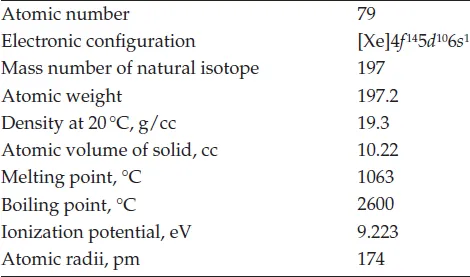
Gold is a precious metal; its worldwide influences proven in our economy, technology, and traditional values. Originated from the Latin word aurum, Au is the symbolic representation for this precious metal with the atomic number 79. It is a ruddy yellow, delicate, bendable, splendid, and thick metal in the pure form. The unique ruddy yellow appearance is due to the characteristic structure of gold, which readily absorbs electromagnetic radiation below 560 nm but reflects radiation above 560 nm. It is one of the minimum receptive substance components and is strong under standard conditions. Along with the other coinage metals, copper and silver, gold is a member of group IB of the periodic table, which is soluble under oxidative environment in aqua regia, cyanide, thiosulfate, thiourea, and halide solutions. It has face-centred cubic (fcc) crystalline structure with electronic configuration [Xe]4f145d106s1. The various characteristics of this precious metal are summarized in Table 1.1. Its chemical stability and high resistance to oxidation allow it to be the prominent noble metal. Notably, the electrical resistivity of gold (22.1 nΩ/m) is lesser than copper (17 nΩ/m) and silver (16 nΩ/m), but the latter two metals corrode at atmospheric conditions. Gold is present in the form of grains, chunks in alluvial stories, rocks, and veins in its free state. Gold is often associated with silver as electrum and with minerals like (chalco/arseno)-pyrites. Further, gold is also blended with tellurium as gold tellurides in the form of minerals and anode slimes of copper refineries.
TABLE 1.1
Typical Characteristics of the Precious Metal, Gold

1.2 A Historical Perspective
From ancient time to the present era of the techno-world, gold has been esteemed by humans. Egypt is the oldest gold-delivering country as evident from the map of a gold mine, supposedly drawn in 1320–1200 BC. Coptos in Wadi Hammamat was the world’s first gold-blast town where the gold bearing veins and rocks washed out the precious metal. Under Egyptian administration, approximately hundreds of underground mines were explored in Nubia during 1300 BC. In the Middle East, Egypt turned into an overwhelming force with the best gold treasury in their antiquated earth. Via the Red Sea, old Egyptians exchanged their circumstances because they did not have their own critical port at the Mediterranean. In the south-eastern side of the Black Sea, the date of gold exploitation is said to coincide with the time of Midas that was vital to establish the world’s earliest coinage in Lydia (at ~610 BC). From the 6th century BC, the Chu (state) circulated a square gold coin, Ying Yuan. A large scale operation of gold in Rome was supposed to have started from 25 BC onwards (in Hispania) and from 106 AD onwards (in Dacia). Some of the smaller deposits in Britain (like placer and hard-rock deposits) at Dolaucothi were also exploited by them.
1.2.1 Mining
In 2016, 3,236 t of gold was mined, with a 5% increase in supply at present. This is far ahead of what Herodotus (484–425 BC) alluded to as a few extraordinary gold-mining focuses in Asia Minor, and Strabo’s (63 BC) notice of gold-mining in a wide range of spots. Pliny (23–79 AD) gives many points of interest of antiquated in-situ mining, which was broad. The Romans had a small amount of the metal in their locales; however, their armed forces’ endeavours brought them significant sums as goods. They additionally abused the mineral abundance of nations they had conquered, particularly Spain, where up to 40,000 workers were utilized in the mining area. The state’s amassing of gold was huge; however, amid brute attacks and the fall of the realm this gold was spread and gold mining morphed in the Middle Ages. In spite of the fact that the conquistadors found an exceptional mining industry in Central America, their endeavours to build a gold generation were to a great extent unsuccessful on the grounds that the greater part of the discoveries consisted of silver. Around 1750, gold was exploited on a noteworthy extent on the eastern slants of the Ural Mountains. During the mid-19th century, alluvial gold was found in Siberia and Coloma, California. Coloma is around 50km southeast of Sacramento on the slants of the Sierra Nevada. A chronicled presentation gold stores likewise originated in Western Canada (1896), New Zealand and Western Australia (1892), Colorado (1875), Nevada (1859), and Eastern Australia (1851). In any case, those stores rapidly lost quite a bit of their significance. In 1885 their most grounded stimulus was given to gold creation via disclosure of the gold fields of the Witwatersrand in South Africa. South African gold soon became a prime location on the planet showcase. Creation developed consistently aside from a tiny intrusion of the Boer War (1899–1902). In the Middle Ages gold mining in the Gold Coast(Ghana) started to assume an unobtrusive part in the twentieth century, despite the fact that the stores were identified. Near the Thompson River, around the Fraser River, and then on Williams and Lightning Streams, the alluvial gold sources were found between 1858 and 1885. In 1911, the region of British Columbia was the major gold exploited area in the Canadian region and domains for a long time, yet with the disclosure of the Kirkland Lake stores, and in 1912 the opening up of the Porcupine locale, Ontario was in the front of the rest of the competition from that point onward.
1.2.2 Gold and Alchemy
The medieval chemists identified gold as a flawless metal. Chemists distinguished it by the sun with the righteousness of its splendid yellow shading, and this was given the image of a hover with a speck inside. Gold was so valuable that in every time man did everything they could to find it in nature. It is not astounding, that people have tried to change over different metals into gold. The philosopher’s stones were known as specialists that converted base metal to precious gold. Notwithstanding its convertory control, stones were accepted to have the properties of an all-inclusive drug for life span and everlasting status. Catalytic standards additionally have discovered their way into present day mental thoughts, notably by the Swiss specialist Carl Jung (1875–1961). The origin of speculative chemistry was known as Antiquated Egypt I. Zosimos (350–420), who was educated in Alexandria, is the earliest essayist identified as having honed speculative chemistry. In view of the absence of information of the organization of regular substances, a few chemists saw numerous conventional synthetic reactions as transmutor. For instance, testimony of Cu on press metal set in blue vitriol (CuSO4), a response well-known in Roman circumstances, where it was expected by a few to be a conversion of Fe into Cu in anticipation of the late recovery. During that time Au-production had been both supported and restricted by rulers and the Church. Amid medieval circumstances European lords and sovereigns bolstered chemists at their courts wanting to gain riches through their work.
1.3 Occurrence of Gold
With a crustal abundance of 3–5 parts per billion (ppb), this precious metal in the earth is supposed to come via two sources:
i. The supernova event: the collision of two or more neutron stars in space created several nuclear synthesis processes, which leads to the formation of a wide range of heavy elements. During the condensation of heavy elements and forming solar system, the elements which fell to the molten earth could end up sinking to the core (Seeger et al., 1965).
ii. The asteroid bombardment: the impact created around 4 billion years ago could enrich the earth’s crust and upper mantle through the bombardment of gold from the gold-bearing asteroids (Willbold et al., 2011). The widespread distribution of gold throughout the earth’s crust has been also explained by the asteroid bombardment model.
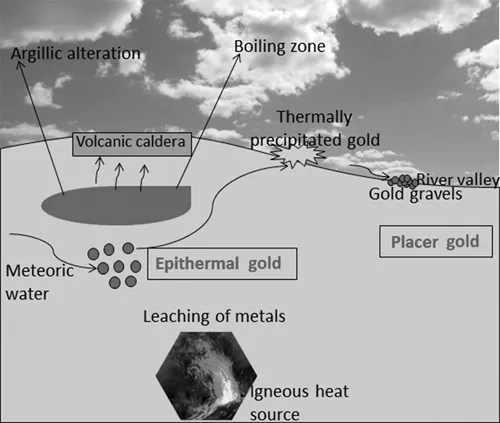
Besides the previously mentioned source of gold in earth’s crust, the formation of gold-bearing ores can be Endogenetic by hydrothermal process and Exogenetic by weathering effects of wind and/or water erosion of gold-bearing hard rock deposits. The heating of highly mineralized ground water caused by igneous intrusions enables water to adsorb and/or dissolve metals from surrounding rock formations; flow via rock fractures can produce veins which deposit microscopic particles of native gold embedded within calcite, quartz, and other minerals (Hamburger et al., 2010). A typical hydrothermal gold deposition (Endogenetic and Exogenetic) system is shown in Figure 1.1. Whereas, the erosion which drove Exogenetic eventually causes the alluvial, or placer deposits, located in the river system and coastal regions (Kettell, 1982). In a stream when the water slowly flows down, the higher density gold (19.32 g/cm3) drops out first, leaving the lighter rock minerals (~2.7 g/cm3) to continue to flow to concentrate gold. The placer deposits were the first to be exploited from the rivers, using the panning and sluicing techniques followed by the smelting.

FIGURE 1.1
A typical representation of the hydrothermal deposi...
Table of contents
- Cover
- Half Title
- Title Page
- Copyright Page
- Dedication
- Table of Contents
- Acknowledgement
- Preface
- Editors
- 1. Gold Ore Processing and Environmental Impacts: An Introduction
- 2. Artisanal Gold Mining and Amalgamation
- 3. Cyanidation of Gold-Bearing Ores
- 4. Thiosulfate Leaching of Gold
- 5. Thiourea Leaching of Gold
- 6. Halide Leaching of Gold
- 7. Microbial Cyanidation of Gold
- 8. Human Perspectives on Gold Exploitation and Case Studies
- Index