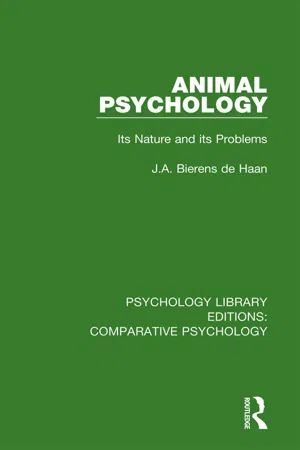
Originally published in 1948, the author follows the idea that the instincts are "the spring and basis of all animal behaviour (with the exception perhaps of play), and therewith the core of the animal's mind, and that individual experience, gathered by the animal in the course of its life, may influence and reconstruct these instincts, so as to guide, in the form of intelligence and understanding, this behaviour along new (i.e. innate) paths. Thus, instinct and experience become the pillars upon which animal behaviour is built up; instinct, intelligence, and understanding form a triad round which the facts of the psychology of animals may be grouped. As a foundation of all this the author first tries to prove the good right of a real and genuine animal psychology, not hampered by objectivistic and behaviouristic scruples, while in a final chapter, by way of conclusion, he tries to give an image of how the world of the animal is built up."
- 158 pages
- English
- ePUB (mobile friendly)
- Available on iOS & Android
eBook - ePub
About this book
Information
CHAPTER II
THE PROBLEM OF ANIMAL INSTINCT
For, where there is sensation, there is also pleasure and pain and, where these, necessarily also desire.
Aristotle, De Anima. (Translation J. A. Smith.)
EVERY science which is more than a simple agglomeration of assumed facts, but which tries to build up a logical construction of theories and hypotheses that bind such facts together, has generally one or more central problems to which all these theories and hypotheses are related. For animal psychology this central problem is that of animal instinct.
What, then, is an instinct?
In the philosophy of the man in the street the view may often be heard that the animal is impelled to its acts by “instinct,” man on the contrary by “intelligence.” According to this way of thinking, instinct comprises all the psychical faculties of the animal; it is, perhaps, even the only psychical quality with which the animal is credited. It is supposed to be some general, never-failing, mysterious, innate knowledge, which tells the animal in every circumstance of its life what it has to do and what it must avoid. Intelligence, on the other hand, a prerogative of man, is not such a “savoir faire inné” (Spaier), but a mental faculty which enables man consciously to choose the right means to attain some end, and to act after ample deliberation about the pros and cons of the performance of some act in a special circumstance.
This view, however, is certainly no more than a very crude approximation to the truth. That in the behaviour of animals instinct stands out more clearly than in that of man, that on the other hand the acts of man in many cases are executed after deliberation and are guided by the result of reflection, cannot be denied. But we know that in man also instinct, though it may be unnoticed by himself, often determines his actions. And that in the behaviour of animals intelligence may also play a part will be made clear in the course of this book. This old antithesis between instinct, as being alone responsible for the acts of animals, and intelligence, as being responsible for those of man, certainly cannot be maintained.
This antithesis, it must be admitted, is a very old one. Already the ancient Greeks, especially the Stoic philosophers, assumed in the animals as the springs of their actions a faculty of mind they called the “Hormè” (i.e. that which impels), and Scholasticism translated this word by “instinctus” from the Latin “instinguere,” which also means instigating, or impelling. And although both philosophies were more or less subject to the same fault we criticized just now in the popular psychology of the man in the street, the derivation of both terms from verbs that mean something like “incitation” or “impelling” shows that they consciously gave to the word instinct a psychological meaning. We will hold to this psychological meaning of the word.
It cannot be our intention to give a review of the great number of descriptions and definitions given in the course of time of this concept of instinct. Many of these satisfy us no longer, either because they give to the notion of instinct too wide a scope, whereby it comprises many phenomena that are better not included in it, or, on the other hand, they restrict it so much that even its psychological core sometimes gets lost. One of the best provisional definitions probably is that given by Romanes in his article on instinct in the ninth edition of the Encyclopaedia Britannica which runs as follows: “Instinct is a generic term comprising all those faculties of mind which lead to the (conscious) performance of actions that are adaptive in character but pursued without necessary knowledge of the relation between the means employed and the ends attained.” We have put the word “conscious” between brackets because, as we saw in the first chapter, the degree of consciousness with which the animal performs an action is something we do not know about. For the rest, the word is not of primary importance in this definition.
Instinct, then, according to this definition is a psychological factor, comprising a number of “faculties of mind,” i.e. of psychical phenomena, of inner experiences. What is the nature of these psychical phenomena, what is the relation between them, are questions we shall have to consider in this chapter. Instinct, or rather, instincts (for we have learned to give up here the idea of one simple general psychological faculty, and have come to distinguish between several instincts in the plural)—instincts, then, lead the animal to perform adaptive actions. Let us call these actions “instinctive actions,” and distinguish them clearly from the instinct itself that calls them up, a distinction that is not always kept in view. These actions, then, are performed without the animal understanding their meaning and purpose: it does not know their “why” and “for what.” The animal, acting on the urge of an instinct, mostly acts as if driven by a blind impulse. We may add yet two other characteristics of instincts, not mentioned by Romanes in his definition: they are innate and not acquired during the life of the animal, and they are characteristic for the whole species to which the animal belongs, not only for the individual animal. Let us illustrate all this by some examples from animal life.
Instincts and instinctive actions are characteristic of the species to which the animal belongs. All members of a species, or of a wider systematic group of animals, in similar circumstances behave in a similar instinctive way. At the end of the summer all our storks migrate to the South, and it does not depend on the individual decision of any one among them if he will depart or stay in the country. On the other hand, no house-sparrow undertakes such a journey but all remain in our country in winter. All spiders of the family of Agelenidae spin an irregular web of fine texture, and no one of them ever comes so far as to spin a regular orb-web which we all know as a characteristic of the family of Epeiridae. Among the birds the family of the Columbidae, according to Lorenz, is distinguished from other families of birds by no common morphological characteristic, but they distinguish themselves from other birds by their drinking instinct, the act of which consists in a rhythmical sucking up of the water with submerged beak, while the other birds drink by putting their bill into the water and then raising their head. Spaier even goes so far as to distinguish animals in general from plants as organisms subject to the working of instincts.
Instincts and instinctive actions in this way become characteristics of a species, just like the morphological ones on which as a rule the distinction between the species of animals is founded. The same holds true for the results of instinctive actions. By the nest of a bird we may recognize the species of the animal that built it, just as we may recognize this by the colour of its feathers. The insects stored in the nest of a digger-wasp tell us the species of the wasp that buried them, just like the colour of the abdomen or the form of the antennæ of the wasps themselves. In some cases the instinctive actions of animals may give even better and clearer marks of distinction than do morphological ones. We have seen this already for the family of pigeons. According to Wachs the courtship of sea-birds shows characteristic differences that are much more important than the morphological differences generally used to characterize the different species. The common and the Arctic tern (Sterna hirundo and paradisea) show but slight external differences. Van Oordt, however, discovered a typical difference in their brooding instinct: the former begins to sit directly after laying her first egg, while the latter does not do so before the whole clutch is complete. This has the result that the young chicken of the latter species are all of the same size, while in the former there are differences in size. It was only at the beginning of this century that De Winton’s yellow-necked mouse (Apodemus flavicollis Wintoni) was distinguished from the common field mouse (Apodemus sylvaticus sylvaticus) as a separate variety. As Frances Pitt remarks, a clear difference between the two, more marked than the morphological ones, is found in the fact that the latter never, or hardly ever, invades dwellings while the former is very fond of doing so. Thus many examples might be quoted in which instincts yield us a better criterion of a species than morphological characteristics. More important, however, for an understanding of instinct is the general fact that instincts are characteristic of the species, not of the individual.
This resemblance between the morphological or physiological structure and the instinctive outfit of an animal, the fact that both are specific and not individual in character, brings us to the question whether there is a mutual connection between this morphological structure and these instincts, and if so, which of them then is primary and which is dependent upon the other. That in many cases such a connection exists, nobody will deny. Without spinnerets no spider would be able to spin a web and without well-developed wings no bird could migrate to the South. The influence of hormones, especially of the sex hormones, on the instinctive behaviour of adult animals is beyond all doubt. But does this mean that instincts are the outcome of the animal’s morphological structure or physiological functions, as has been asserted in times when psychical phenomena were not held in high esteem? Is it true, as has been asserted by Miiller-Erlangen, that an instinct is nothing more than the need to use an organ that the animal possesses? Already the philosopher von Hartmann has combatted this view. All spiders possess the same spinning-glands; yet some of them make a regular orb-web and others an irregular web, while yet others live in holes they only line with their spinnings. Further, this admission at best would explain why an animal uses an organ, but not the way in which it uses it; that for instance the spider empties her spinning-glands, not that she weaves a web with their secretion. As Morgan remarked, nobody from the bodily structure of the eel would deduce the remarkable migration of these animals, nor from the anatomy of the ant-lion conclude that it makes a pit and there lies in wait for ants to fall down. On the other hand, similar instincts are shown by animals with quite a different bodily structure. Ants and termites, it is known, although belonging to quite different orders of insects, show a remarkable correspondence in their social instincts. Yet more striking perhaps is the resemblance, to which Wheeler has drawn our attention, between the instincts of the ant-lion and the worm-lion. The latter, the larva of the Dipteron Vermileo, is an animal which, with an entirely different bodily structure from that of the ant-lion, also makes a pit in the sand by throwing the sand up, lies there in wait for small insects which it pulls under the sand if they fall down into the pit, and also throws sand up if the prey tries to escape.
That there exists a connection between instinct and bodily structure nobody will deny; that on the other hand the instincts are determined by the bodily structure cannot be maintained. We must consider them both as two different aspects of one phenomenon that lies at the background of both, and is realized in the structure as well as in the instinct. This basic phenomenon is empirically unknowable to us. Speculations as to its nature would lead us into the realm of metaphysics and cannot therefore find a place here.
Another characteristic of instinct and instinctive actions is the fact that they are innate and the actions not acquired during lifetime, be it by imitation or trial or by instruction from older members of the species. It has often been proved that animals reared in isolation from their congeners showed normal instincts and normal instinctive activity when the time for these had arrived. Young birds of prey, reared in isolation and always fed by hand, showed on the first occasion the same way of attacking and killing a prey as their congeners grown up in normal circumstances. Birds, bred in nests of other species, built a nest typical of their own species, so showing that they were not influenced by any remembrance of the nest in which they had spent the first days of their life. A young moorhen, reared in isolation by Morgan, was swimming in a pool when it was frightened by a young yelping dog. It then at once dived, and swam away under water as if it had learnt this way of flight from older moorhens. Typical instinctive actions, further, do not change in principle with repetition: the first web of the young spider is built after the same pattern as that of the old one, although of smaller dimensions. And all those instinctive actions of insects and other animals often so complicated and performed but once in their life, such as those connected with the propagation of the species, are carried out in their characteristic way by all members of the species without any tuition from their parents, which, as a rule, are already dead when the young ones arrive at the age to perform these acts.
Characteristic of the instincts is therefore that they are innate and not acquired. This, however, does not mean that all instincts are manifested directly after the birth of the animal. This will at once be clear of instincts that require a certain bodily development of the animal before coming into action. Birds that are not yet able to fly cannot fly away if danger is menacing, but will press themselves down and keep as motionless as possible, while their mother flies away. Instinctive actions connected with the propagation of the species will not show themselves before the animal has reached sexual maturity. Instinctive actions of animals that have to pass through a metamorphosis cannot be performed by the larva. All such instincts that show themselves only after a certain development of the animal were called by Morgan “deferred instincts.”
The most interesting cases of these deferred instincts are those in which the delay of execution is not caused by a bodily development but by psychical maturation. A good example of this is provided by the division of labour in the bee-hive.
It was formerly believed that the different activities of the bees in the hive, such as the care for the brood, the building of the comb, the collecting of food and so on, were carried out by different groups of bees, so that the whole population was composed of different castes, each with its own task. Careful observations of Roesch, however, have shown that this is not the case, but that, on the contrary, every bee in the hive has during its lifetime to pass through all the different jobs. First, in the first ten days of their life, the young bees have the task to attend to the brood, to clean the cells in which the queen will deposit her eggs, to warm the developing brood by sitting on it, to feed the older larvæ with honey and pollen from the store-cells, and, when eventually their own food-glands have developed, to feed the young larvæ with the secretion of those glands. Then, in the second period, running from their tenth to twentieth day, they have other occupations, such as to take the food from the returning bees and bring it to the store-cells, to clean the hive and, further, to build the comb when their wax-glands have fully developed, which happens between the tenth and the seventeenth day. Finally, in the third period, which runs from the twentieth day up to their death, which in summer occurs between the thirtieth and thirty-fifth day, the bee works as a field-bee, collecting food and bringing it to the hive.
It is clear that we have here a number of examples of deferred instincts: although they are all innate, many of the instinctive actions of the bee are executed only at a certain age. It is also clear that in some of these cases there is a clear connection between the execution of the instinctive actions and bodily development. The feeding of the young larvæ with the bee’s own feeding-juice has to wait for the full functioning of the feeding-glands; the building of the comb for that of the wax-glands. Yet it would be wrong to believe that the appearance of all these instincts is determined by bodily development alone.
This was shown in a very interesting experiment by Roesch, in which he succeeded in dividing a population of bees into two groups of different ages: one younger and one older than eighteen days old. The result of this division was that in the younger population the menace of famine arose, as the foraging bees were wanting. Then, after some days, young bees of 7—15 days old flew out in search of food. At first they were still in possession of food-glands, and so flew out “physiologically precociously.” In adaptation to the abnormal circumstances the population was thus split up into two groups of the same age with different occupations. On the other hand, in the group of older bees there arose a menace to the care of the brood, till some older bees took this task upon themselves. Also bees older than the normal builders began to build on the comb, and to that end even developed new wax-glands. Here, therefore, we have a case where the instinctive activity is certainly not dependent upon bodily development, but, on the contrary, bodily development is adapted to the psychological wants of the individual. Roesch further made the important observation that bees which had been isolated during the first ten days of their life, when brought back to the hive first went through the activities they had missed during their absence and so had to work off the arrears. This again shows that the instincts are relatively independent of bodily development and that the influence of mental maturity is an overriding one.
Now it is a curious fact that instincts which for their full realization require a special kind of bodily or psychical development, may, before this maturity has been reached, sometimes show themselves in a more or less schematic form and towards an object other than the adequate one. Young animals of prey, still nourished by their mother, practise their hunting instinct on a living or lifeless prey; young animals not yet sexually mature treat their brothers and sisters in a schematical way as sex partners. Herring-gulls sometimes show a sham nest-building, which precedes the real building of the nest; the birds then pick up all sorts of material for nest-building in their beak, only to lay it down at another place without further attention to it. Howard observed with the whitethroat that the female one day takes some blades of grass in her beak but directly lets them fall again. The next day she carries the blades somewhat longer with her; the following day she deposits a number of them in the fork of a branch; some days later again she builds the beginning of a nest, till, finally, after having built such unfinished nests at different places, the final nest is built. Here we see before our eyes the maturation of an instinct and its development from a first tentative utterance up to its full expression. Much of what has been described as play in animals finds its explanation as a premature execution of instinctive activity. Groos, in his classic book on animal play, has stressed the value of such premature instinctive activities as a practice for later serious occupations. It is by no means certain, however, that the animal really requires such practice; certainly the normal maturation of its instincts is by itself sufficient to enable the animal to execute the movements concerned with the necessary skill. Anyhow, these premature instinctive activities again show the relative independence of the instincts from bodily development.
We have already seen that Romanes in his definition of instinct pointed to two characteristics of instinctive actions to wit, that they are adaptive in character, i.e. generally purposeful, and are executed without the animal knowing the relation between the means employed and the end attained; in other words that they are executed under the urge of a blind drive. This purposiveness presupposes a definite end towards which instinctive actions are directed. This, now, is an essential characteristic of instincts; their activity is all directed towards one special vitally important end, be it the propagation of the species or the preservation of life, or something else. By this characteristic instinctive activity is distinguished from other forms of activity that, although innate, are not directed towards such an end. Activities like swimming, flying, creeping, diving, burrowing, and the like, are innate and in the special way in which they are performed often typical of the species of larger groups of animals. Yet as such, they are not directed to one special end. A water-bird may dive in order to escape or to seek for food; a bird may fly for migrating, or in search of m...
Table of contents
- Cover
- Half Title
- Title Page
- Copyright Page
- Table of Contents
- Preface
- I The Problem of Animal Psychology
- II The Problem of Animal Instinct
- III The Problem of Animal Learning
- IV The Problem of Animal Intelligence
- V The Problem of Animal Understanding
- VI The Problem of Animal Ideation
- VII The Problem of the Animal’s World
- Bibliography
- Index
Trusted by 375,005 students
Access to over 1.5 million titles for a fair monthly price.
Study more efficiently using our study tools.
Frequently asked questions
Yes, you can cancel anytime from the Subscription tab in your account settings on the Perlego website. Your subscription will stay active until the end of your current billing period. Learn how to cancel your subscription
No, books cannot be downloaded as external files, such as PDFs, for use outside of Perlego. However, you can download books within the Perlego app for offline reading on mobile or tablet. Learn how to download books offline
Perlego offers two plans: Essential and Complete
- Essential is ideal for learners and professionals who enjoy exploring a wide range of subjects. Access the Essential Library with 800,000+ trusted titles and best-sellers across business, personal growth, and the humanities. Includes unlimited reading time and Standard Read Aloud voice.
- Complete: Perfect for advanced learners and researchers needing full, unrestricted access. Unlock 1.5M+ books across hundreds of subjects, including academic and specialized titles. The Complete Plan also includes advanced features like Premium Read Aloud and Research Assistant.
We are an online textbook subscription service, where you can get access to an entire online library for less than the price of a single book per month. With over 1.5 million books across 990+ topics, we’ve got you covered! Learn about our mission
Look out for the read-aloud symbol on your next book to see if you can listen to it. The read-aloud tool reads text aloud for you, highlighting the text as it is being read. You can pause it, speed it up and slow it down. Learn more about Read Aloud
Yes! You can use the Perlego app on both iOS and Android devices to read anytime, anywhere — even offline. Perfect for commutes or when you’re on the go.
Please note we cannot support devices running on iOS 13 and Android 7 or earlier. Learn more about using the app
Please note we cannot support devices running on iOS 13 and Android 7 or earlier. Learn more about using the app
Yes, you can access Animal Psychology by J.A. Bierens de Haan in PDF and/or ePUB format, as well as other popular books in Psicologia & Storia e teoria della psicologia. We have over 1.5 million books available in our catalogue for you to explore.