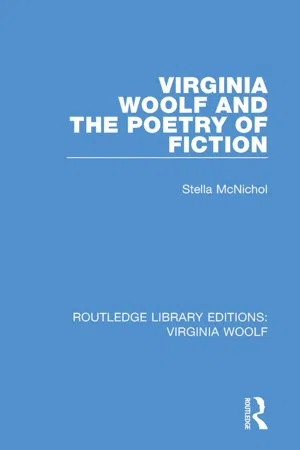
Originally published in 1990, Virginia Woolf and the Poetry of Fiction, provides a stylistic study of the fiction of Virginia Woolf. The book examines what is generally described as a 'traditional novel', examining such works as Jacob's Room, and the way in which meaning is nonetheless conveyed poetically. The book argues that her early novels, are shown to contain writing of considerable sophistication and maturity and how her major works of fiction are approached in a more specific way: Mrs Dalloway through its poetic rhythms, To the Lighthouse as a multi-perspectival exploration of a reality embodied in a single image, and The Waves as a play-poem.
- 194 pages
- English
- ePUB (mobile friendly)
- Available on iOS & Android
eBook - ePub
Virginia Woolf and the Poetry of Fiction
About this book
Information
Chapter One
SYMBOLIC INTRUSIONS IN THE VOYAGE OUT
The Voyage Out, written between 1907 and 1913 and published in 1915, reflects the mood and spirit of the Edwardian period. Through its central story the theme of love and marriage is explored, and through, in particular, the emergence of a young woman from the confines of a restrictive Victorian household into a freer world of the ‘New Woman’, the theme of the changing social role of women is opened up.
This first novel by a writer of sophisticated ‘Modernist’ fiction is a traditional novel and a bildungsroman, and as such it has been too readily dismissed by critics for not being innovative. Yet it is only its surface that makes it a novel of realism, and only at the surface of the book that the genre of the bildungsroman is truly applicable. The Voyage Out is a novel of surface simplicity, and of submerged complexity. Central to the surface realism of the traditional novel, and of the bildungsroman in particular, is the story of Rachel Vinrace who develops out of immaturity and ignorance into womanhood through a series of encounters and events. These chiefly consist of a sea journey and a river journey, social events (the picnic and the dance in particular), sexual awakening, and falling in love and engagement to be married, all of which form the novel’s linear structure. Within that structure the theme of love and marriage is examined in a widening social context. A strong sense of social change and disruption is built into the narrative, and the period, the Edwardian era, is specified by the particularity of the novel’s documentation.
The development of Rachel Vinrace is central to all levels of The Voyage Out’s structure. Virginia Woolf explores Rachel’s feelings, traces the development of her mind, and above all charts the fluctuations of her awakening consciousness. She traces her psychological development through the events which shape the course of her life and in which relationships develop, and these events are balanced by instances of solitary reflection and introspection. It is particularly by the fusion of the deeper symbolic structure of the novel into the natural sequence of events dictated by the plot structure that Virginia Woolf achieves a narrative of distinction. The events, because they are infused with the imaginative force of poetry, take on a mythic quality, and they linger in the mind.
The first of the significant events to take place is the picnic on Monte Rosa organized by Terence Hewet. Rachel’s invitation to join the party is brought to her by her aunt who interrupts a moment of introspection. That moment is one in which the author analyses the way in which Rachel learns about life vicariously through what she reads, then, more significantly, examines the kind of mental processes that underlie the simple act of taking up a book, reading it for a while, and then discarding it. Helen had promised her a room of her own ‘cut off from the rest of the house, large and private … a fortress as well as a sanctuary’. Within her ‘fortress’ Rachel had been reading Ibsen (after that it was Meredith’s Diana of the Crossways: she chooses to read ‘modern books’).
Rachel’s experience of reading the play goes through different stages. First she becomes the heroine (Nora in A Doll’s House) and lives the part for several days. Next comes the stage of personal enrichment from the experience. The author conveys Rachel’s direct experience of imaginative life in reading by describing the way in which she responds to her surroundings: as she puts her book down,
[t]he landscape outside, because she had seen nothing but print for the space of two hours, now appeared amazingly solid and clear, but although there were men on the hill washing the trunks of olive trees with a white liquid, for the moment she herself was the most vivid thing in it – an heroic statue in the middle of the foreground, dominating the view. Ibsen’s plays always left her in that condition.
(143)
The extraordinary nature of the experience, the heightening of the human consciousness, is presented in visual terms in the image of the ‘heroic statue’. When the transition from the imaginative world to the real world has been completed, Rachel attains the third level of mentally questioning the significance of what she has read.
She finds Diana of the Crossways less satisfactory. After putting the book aside, she sits immobile in a distracted state of mind. Here Virginia Woolf builds into a passage of ordinary narration an account of the existential experience of self-awareness. After the effort of concentration required by her reading, Rachel lets her mind relax. She gradually begins to take note of sounds around her; they form themselves into a regular rhythm. As that rhythm begins to assert itself in her consciousness, she senses the strangeness of life, but in a detached way: ‘It was all very real, very big, very impersonal…’ (144). In order to bring herself back to a sense of her own personality she goes through various self-conscious actions in which she looks upon herself, or at aspects of her self, as something separate from herself and so observable in an objective manner:
after a moment or two she began to raise her first finger and let it fall on the arm of her chair so as to bring back to herself some consciousness of her own existence.
(144)
Once she is ‘self-possessed’ again, she notes through reference to ordinary objects around her the extraordinary nature of her own human existence, and then in and through that the nature of existence itself. This transcendent experience takes over her consciousness again: this is indicated by her sense of being on a plane of existence outside or beyond her body (‘She could not raise her finger any more…. She forgot that she had any fingers to raise’ (145)).
Rachel’s experience of being suspended in time, in existence, on two different planes at once is conveyed unobtrusively within the simple surface narration of what is happening to her:
The things that existed were so immense and so desolate…. She continued to be conscious of these vast masses of substance for a long stretch of time, the clock still ticking in the midst of the universal silence.
(145)
The one word ‘universal’ indicates a different experiential mode within the mundane and the tangible. This is a fairly early (1915) expression in literature of the Bergsonian distinction between two different kinds of time, the ‘clock’ time of everyday finite existence and the ‘durée’ of psychological time in which the mind is momentarily freed from the shackles of the temporal to experience infinity or that which is beyond time. The nature of time, and the relation between past and present and future, is explored with greater complexity in Virginia Woolf’s later novels. What she says is essentially very similar to what T. S. Eliot examines through his image of the ‘still point’ and in ‘the point of intersection of the timeless with time’ (Four Quartets). He tends towards the philosophic in the expression of the theme in his poetry; Virginia Woolf tends increasingly towards the poetic (‘flowers of darkness’, ‘buds on the tree of life’ – MD: 33) in her psychological and phenomenological explorations of it in her fiction. In this particular instance Rachel’s heightened awareness is interrupted by Mrs Ambrose’s arrival with the invitation to join the expedition to go up Monte Rosa. The tone of the novel of realism is in this way carefully preserved, as Rachel seems momentarily unable to adjust to the intrusion:
“Come in,” she said mechanically, for a string in her brain seemed to be pulled by a persistent knocking at the door….
The utter absurdity of a woman coming into a room with a piece of paper in her hand amazed Rachel….
For the second time Rachel read the letter, but to herself. This time, instead of seeming vague as ghosts, each word was astonishingly prominent….
“We must go,” she said, rather surprising Helen by her decision.
(145–6)
So the invitation is accepted.
The picnic on Monte Rosa furthers the plot sequence by being the occasion on which Terence Hewet begins to take a serious interest in Rachel Vinrace. The occasion assumes, at the same time, a symbolic aspect. As Virginia Woolf’s art develops, her writing becomes more complex. Here, in her first novel, she is already selecting certain scenes, actions, and events and presenting them in a multi-layered way. In her mature fiction these are more fully integrated into the overall symbolic framework of the novel. This is appropriate in To the Lighthouse, for instance, because there she is writing an essentially symbolist work which she calls an ‘elegy’. The Voyage Out, however, is a traditional novel, so such instances as the following add depth and richness to the kind of story she is telling, which is one that any nineteenth-century novelist might have told before her.
When the little group reaches the summit, exhausted, they are overcome by the magnificence of what they see. In a lyric passage that flows easily in its language, the unfolding scene is described:
Before them they beheld an immense space – grey sands running into forest, and forest merging in mountains, and mountains washed by air, the infinite distances of South America. A river ran across the plain, as flat as the land, and appearing quite as stationary.
(153)
As most of these people are by nature inarticulate, they convey the immensity of what they feel by gesture, and Virginia Woolf’s description of how they react is tinged with humour: Evelyn Murgatroyd ‘took hold of the hand that was next to her; it chanced to be Miss Allan’s hand’ (153). Their absorption in the spectacle is such that they become unconcerned about each other’s personality and act unselfconsciously.
Hewet, on the other hand, who is a novelist and therefore an observer and analyst of human nature who articulates his observations, acts here as a detached observer, summing up the others in the way that Bernard (in a more extended and symbolic way) will sum up the lives of the other characters in The Waves. Keeping the surface narrative going, Virginia Woolf explores the scene through Hewet’s reflections. He goes on a little in advance of the others and then looks back at them. First, he describes what is literally there, which is a group of windswept people standing silently in a row. But the ordinary language in which this is described has a subtle suggestiveness about it. They are momentarily transfigured in the stillness of their response to the landscape.
He observed how strangely the people standing in a row with their figures bent slightly forward and their clothes plastered by the wind to the shape of their bodies resembled naked statues.
(153)
Hewet sees that ordinary dull people can take on something of the grandeur that confronts them. By following through the image of the statues he then makes his thoughts explicit.
On their pedestal of earth they looked unfamiliar and noble, but in another moment they had broken their rank, and he had to see to the laying out of food. Hirst came to his help, and they handed packets of chicken and bread from one to another.
(153)
The change in diction reflects the change in mode of experience, as there is a move from individual transfiguration to involvement in a social ritual. The phrases ‘pedestal of earth’ and ‘the laying out of food’ draw attention to themselves, and in so doing suggest ceremonial and ritual. The ‘pedestal of earth’ has an odd collocation of ideas. The ‘pedestal’ reinforces the ‘statues’ image, but the reference to ‘earth’ suggests something ancient and primal, all of which colours the group with an unusual solemnity.
The picnic episode reveals qualities of sophistication in its writing rare in first novels. The moment of transcendence moves naturally and easily back into the comedy of manners situation as the little group does battle with an invading army of ants.
The ants were pouring down a glacier of loose earth heaped between the stones of the ruin – large brown ants with polished bodies…. At Hewet’s suggestion it was decided to adopt the methods of modern warfare against an invading army. The table-cloth represented the invaded country, and round it they built barricades of baskets, set up the wine bottles in a rampart, made fortifications of bread and dug fosses of salt. When an ant got through it was exposed to a fire of breadcrumbs, until Susan pronounced that that was cruel, and rewarded those brave spirits with spoil in the shape of tongue. Playing this game they lost their stiffness….
(155–6)
Taking stock of the little group combating the ants, Hewet feels suddenly depressed by the mediocrity of most of his companions. Helen and Rachel, however, seem to him to be different from the rest. Helen’s personality impresses him as she laughs genuinely and straightforwardly with Miss Allan so that she stands out ‘from the rest like a great stone woman’ (157). The ‘stone woman’ image, which links back to the ‘statues’, suggests qualities of character the others seem only fleetingly to possess; she is the primal and mythic woman. He is instantly attracted to Rachel, sensing that they have something in common. Their encounter is enacted with economy and simplicity:
His eye fell upon Rachel…. Hewet crawled up to her on his knees, with a piece of bread in his hand.
“What are you looking at?” he asked.
She was a little startled, but answered directly, “Human beings.”
(157)
The plainness and simplicity of the language matches the simplicity of the action. All is pared down in terms of language and action, so that the encounter between Rachel and Terence is imbued with a quiet poetic intensity and suggestiveness.
The dance is the next event to further Rachel’s story. It fits into the natural sequence of events following on from the picnic as it is arranged to celebrate the engagement of Susan Warrington and Arthur Venning (they became engaged at the picnic), and their relationship is a foil to that developing between Rachel and Terence Hewet.
At the picnic Terence had been attracted to Rachel, and Hirst had attached himself to Helen Ambrose. They had wandered off in those pairings and then come together again as a group of four. They sat down and, despite knowing very little about each other, they had talked freely about themselves. The four of them form in the course of the novel a closely integrated square of relationships which centre on Rachel. Rachel’s is the most elaborately analysed personality within these relationships. Helen, Terence, and Hirst all influence her in some important way and contribute to her development. Helen, as Rachel’s older relative, begins as her guardian and becomes her friend. Hirst and Hewet are friends and contemporaries who have travelled out to Santa Marina together.
Like the novelist who is writing The Voyage Out, Hewet is writing a novel; like Virginia Woolf he explores personality. He articulates in particular both what he thinks of Rachel and what he feels for her as he expl...
Table of contents
- Cover
- Half Title
- Title Page
- Copyright Page
- Table of Contents
- Acknowledgements
- A note on the texts
- Introduction
- 1 SYMBOLIC INTRUSIONS IN THE VOYAGE OUT
- 2 ‘SHAPING FANTASIES’ IN NIGHTAND DAY
- 3 THE POETIC NARRATIVE OF JACOB’S ROOM
- 4 THE RHYTHMIC ORDER OF MRS. DALLOWAY
- 5 TO THE LIGHTHOUSE: AN ELEGY
- 6 THE WAVES: A PLAYPOEM
- 7 THE ‘PURE POETRY’ OF BETWEEN THE ACTS
- Select bibliography
- Index
Trusted by 375,005 students
Access to over 1.5 million titles for a fair monthly price.
Study more efficiently using our study tools.
Frequently asked questions
Yes, you can cancel anytime from the Subscription tab in your account settings on the Perlego website. Your subscription will stay active until the end of your current billing period. Learn how to cancel your subscription
No, books cannot be downloaded as external files, such as PDFs, for use outside of Perlego. However, you can download books within the Perlego app for offline reading on mobile or tablet. Learn how to download books offline
Perlego offers two plans: Essential and Complete
- Essential is ideal for learners and professionals who enjoy exploring a wide range of subjects. Access the Essential Library with 800,000+ trusted titles and best-sellers across business, personal growth, and the humanities. Includes unlimited reading time and Standard Read Aloud voice.
- Complete: Perfect for advanced learners and researchers needing full, unrestricted access. Unlock 1.5M+ books across hundreds of subjects, including academic and specialized titles. The Complete Plan also includes advanced features like Premium Read Aloud and Research Assistant.
We are an online textbook subscription service, where you can get access to an entire online library for less than the price of a single book per month. With over 1.5 million books across 990+ topics, we’ve got you covered! Learn about our mission
Look out for the read-aloud symbol on your next book to see if you can listen to it. The read-aloud tool reads text aloud for you, highlighting the text as it is being read. You can pause it, speed it up and slow it down. Learn more about Read Aloud
Yes! You can use the Perlego app on both iOS and Android devices to read anytime, anywhere — even offline. Perfect for commutes or when you’re on the go.
Please note we cannot support devices running on iOS 13 and Android 7 or earlier. Learn more about using the app
Please note we cannot support devices running on iOS 13 and Android 7 or earlier. Learn more about using the app
Yes, you can access Virginia Woolf and the Poetry of Fiction by Stella Mcnichol in PDF and/or ePUB format, as well as other popular books in Literature & Literary Criticism. We have over 1.5 million books available in our catalogue for you to explore.