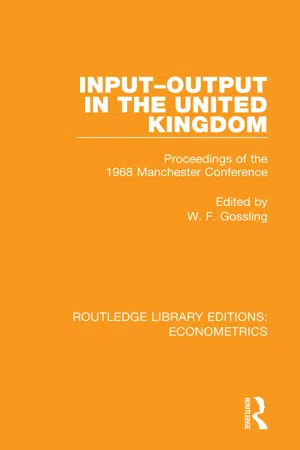
Input-Output in the United Kingdom
eBook - ePub

Input-Output in the United Kingdom

Proceedings of the 1968 Manchester Conference

  1. 230 pages
  2. English
  3. ePUB (mobile friendly)
  4. Available on iOS & Android
eBook - ePub

Input-Output in the United Kingdom

Proceedings of the 1968 Manchester Conference

About this book

Originally published in 1970. Input-output analysis has been described as the "lynch-pin of modern economic planning". Its purpose is to trace the consequences of any economic change through each sector of the economy; to measure, for example, the effects of an increase in fuel tax on the price of food, or of an expansion in car production on the country's import bill. This kind of knowledge is clearly essential for making economic predictions.

This book presents the proceedings of the 1968 Manchester Conference including six outline papers, each followed by discussion, and several summaries of ongoing and proposed research which were added afterwards. The speakers and participants constituted a representative sample of persons from Industry and Commerce, as well as the Universities and the Civil Service.

Frequently asked questions

Yes, you can cancel anytime from the Subscription tab in your account settings on the Perlego website. Your subscription will stay active until the end of your current billing period. Learn how to cancel your subscription.
No, books cannot be downloaded as external files, such as PDFs, for use outside of Perlego. However, you can download books within the Perlego app for offline reading on mobile or tablet. Learn more here.
Perlego offers two plans: Essential and Complete
  • Essential is ideal for learners and professionals who enjoy exploring a wide range of subjects. Access the Essential Library with 800,000+ trusted titles and best-sellers across business, personal growth, and the humanities. Includes unlimited reading time and Standard Read Aloud voice.
  • Complete: Perfect for advanced learners and researchers needing full, unrestricted access. Unlock 1.4M+ books across hundreds of subjects, including academic and specialized titles. The Complete Plan also includes advanced features like Premium Read Aloud and Research Assistant.
Both plans are available with monthly, semester, or annual billing cycles.
We are an online textbook subscription service, where you can get access to an entire online library for less than the price of a single book per month. With over 1 million books across 1000+ topics, we’ve got you covered! Learn more here.
Look out for the read-aloud symbol on your next book to see if you can listen to it. The read-aloud tool reads text aloud for you, highlighting the text as it is being read. You can pause it, speed it up and slow it down. Learn more here.
Yes! You can use the Perlego app on both iOS or Android devices to read anytime, anywhere — even offline. Perfect for commutes or when you’re on the go.
Please note we cannot support devices running on iOS 13 and Android 7 or earlier. Learn more about using the app.
Yes, you can access Input-Output in the United Kingdom by W. F. Gossling in PDF and/or ePUB format, as well as other popular books in Business & Business General. We have over one million books available in our catalogue for you to explore.

Information

Year
2018
Print ISBN
9780815354376
eBook ISBN
9781351131254
Edition
1

Session III

A Linear Model of Production, Distribution and Growth

by
A. Cigno1
Lecturer in the Department of Mathematical Economics, University of Birmingham
(Summary)
The model of economic growth proposed in this paper closely resembles Schumpeter’s ā€œvisionā€ of the development process [9]. The basic assumption is that only one or a few firms in each industry are capable of adjusting their production plans, in time, with respect to changes in technical know-how, consumers’ preferences, and supplies of original factors. These leading firms make profits, which are used to finance innovatory Investments, while the other firms make losses, which force them, after a while, to modify their production plans or go out of business.
The general model is built up step by step. The first section of this paper describes a recursive programming model of the profit-maximising firm. In the second section the individual models are aggregated at the industry level and an exact definition of ā€œindustryā€ is provided; the Solution of the aggregate model is not the sum of the component firms’ optimal Solutions, because some of the firms are not optimising. In the third section the analysis is extended to the whole economic system: prices and income distribution are deter-mined within a general-equilibrium setting and profits appear as the remuneration of a very special factor of production, ā€œentre-preneurshipā€, which becomes ā€œscarceā€ only in times of change.
The programming approach adopted makes the model suitable for empirical application. The model can be used to forecast output, prices and technical change for a whole economic system or for a section of it. With minor modifications, the model can also be con-verted into a decision model for economic planning.

I. A Dynamic Model of the Profit Maximising Firm

Let us assume, in the first place, that all entrepreneurs make or revise their production plans at regulƤr intervals, so that the con-tinuous flow of time can be subdivided into finite periods, each period being defined as the length of time that elapses between any two production decisions. Then consider the case of any particular firm: at the beginning of period t, the entrepreneur disposes of a collection of inventories and capital goods purchased or produced in the course of period t–1. Capital goods of the same nature but of different age can be regarded as different commodities and I shall refer indifferently to all these factors of production as the capital Stocks of the firm in period t.
The entrepreneur knows that by combining the factors of production already available with others that he can buy on the market, according to certain fixed proportions dictated by his technical knowledge, he can produce certain fixed combinations of goods. He also knows that the same ...

Table of contents

  1. Cover
  2. Half Title
  3. Title Page
  4. Copyright Page
  5. Contents
  6. List of Figures
  7. List of Tables
  8. Acknowledgements
  9. Introduction
  10. List of Participants
  11. Foreword Some Comments on Linear Models
  12. Session I Input-Output Applications for the Multi-activtty Firm
  13. Session II Developments in Input-Output Statistics
  14. Session III A Linear Model of Production, Distribution and Growth
  15. Session IV Production Models and Time Trends of Input-Output Coefficients
  16. Session V Input-Output and the Trading Economy
  17. Special Session Input-Output Studies of the Construction Industry
  18. Session VI The Use of Input-Output Methods in DEA
  19. Session VII Future Input-Output Research
  20. Index of Authors and Discussants
  21. List of General and Recent References
  22. Index of Subjects