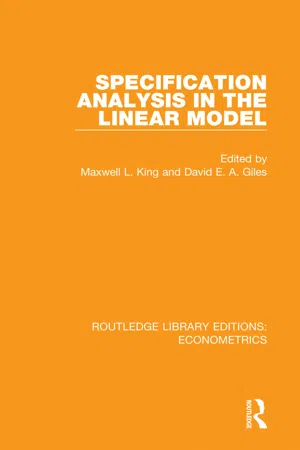
Originally published in 1987. This collection of original papers deals with various issues of specification in the context of the linear statistical model. The volume honours the early econometric work of Donald Cochrane, late Dean of Economics and Politics at Monash University in Australia. The chapters focus on problems associated with autocorrelation of the error term in the linear regression model and include appraisals of early work on this topic by Cochrane and Orcutt. The book includes an extensive survey of autocorrelation tests; some exact finite-sample tests; and some issues in preliminary test estimation. A wide range of other specification issues is discussed, including the implications of random regressors for Bayesian prediction; modelling with joint conditional probability functions; and results from duality theory. There is a major survey chapter dealing with specification tests for non-nested models, and some of the applications discussed by the contributors deal with the British National Accounts and with Australian financial and housing markets.
eBook - ePub
Specification Analysis in the Linear Model
- 366 pages
- English
- ePUB (mobile friendly)
- Available on iOS & Android
eBook - ePub
Specification Analysis in the Linear Model
1 Introduction
Maxwell L. King and David E. A. Giles
The basis for this book is a collection of fifteen original articles prepared by a number of Donald Cochrane’s colleagues and associates. These articles develop the general specification analysis theme in various ways. However, there is a particular emphasis on specification issues arising in the context of autocorrelated errors in the regression model, and this emphasis links the book closely to the early contribution of Cochrane and Orcutt (1949) and Orcutt and Cochrane (1949). These papers, and part of an article by Sargan (1964) which has direct bearing on the computational aspects of the Cochrane-Orcutt work, are reproduced as Appendixes to this book. Special features of the volume are the inclusion of major survey chapters, and the balance between theoretical and applied econometrics in the various articles. Indeed, it is the editors’ hope that this book will contain much that is of practical help and interest to applied researchers, as well as to students and researchers whose interests lie more with the underlying statistical theory of econometrics.
The first part of the book comprises six chapters which deal with various aspects of regression analysis when the model errors are autocorrelated. This section begins with two survey papers. In Chapter 2, Ted Hannan appraises the original Cochrane-Orcutt work from the present perspective. He discusses spectral methods for regression and considers a link between this approach and the Cochrane-Orcutt transformation in the handling of autocorrelated disturbances. Hannan notes that the models discussed by those authors are of the ARMAX type and he stresses the need for a careful interaction of prior and sample information in the fitting of such models, noting that a useful benefit of such interaction may be to constrain the problem to one of manageable size.
Chapter 3, by Maxwell King provides a comprehensive survey of the literature on testing for various forms of autocorrelation in regression disturbances. King links the early work of Cochrane and Orcutt on the consequences of, and estimation under, autocorrelated errors, to the work of Durbin and Watson (1950, 1951) on testing the hypothesis of serial independence against the alternative of a first-order autoregressive process. The emphasis of the survey is on the power properties of various tests, and one of King’s conclusions is that care must be taken not to place too much faith in Likelihood Ratio and Lagrange Multiplier tests unless their power properties have been adequately explored in finite samples. King proposes a general strategy for constructing tests against composite alternative hypotheses which will hopefully receive further attention in the literature.
Chapters 4 to 7 discuss various specific aspects of regression analysis with autocorrelated errors. In the first of these four papers Grant Hillier and Maxwell King obtain bounds on the value that may be taken by any linear combination of the elements of the best linear unbiased estimator of the coefficient vector in the model when the errors have a non-scalar covariance matrix. This situation arises, for example, when the disturbances are autocorrelated. Hillier and King use these bounds to investigate the range of values which may be taken by the statistic for testing simple restrictions on the coefficient vector when the true form of the error covariance matrix is taken into account. Their results indicate the extent to which our inferences may be sensitive to departures from the usual scalar error covariance assumption.
In Chapter 5, Lonnie Magee, Aman Ullah and Viren Srivastava provide some important analytical evidence on the sampling properties of the two-step Cochrane-Orcutt estimator when an estimate of the autocorrelation parameter is used. The estimator (and the closely associated procedure suggested by Prais and Winsten (1954)) is shown to be unbiased under quite general conditions. The efficiencies of these two estimators are compared by numerically evaluating certain large-sample approximations to their co-variance matrices in a variety of finite-sample situations.
David Giles and Murray Beattie consider the problem of estimating a dynamic regression model when the disturbances are autocorrelated and when a sequential strategy is adopted. Using a Monte Carlo experiment they investigate the finite-sample risks of various preliminary-test estimators, where the test in question is of the hypothesis that the disturbances are serially independent. The study illustrates some of the consequences of such pre-testing and suggests which tests and estimators may lead to relatively low risk in this context.
This first part of the book is completed with a paper by Peter Praetz, who considers several specification issues which relate closely to the work of Cochrane and Orcutt. Praetz considers the effects on the Durbin-Watson test of falsely omitting variables from a linear regression model; the extent to which this test statistic is biased when the functional form of the model is mis-specified; and the bias induced in other conventional tests and summary measures when the errors in fact follow a first-order autoregressive scheme. One interesting aspect of Praetz’s results is that model mis-specification may bias a statistic which is itself used to test for some form of mis-specification. This suggests a danger in placing too much emphasis on single specification errors, and as Praetz points out, many interesting combinations of model mis-specification remain to be studied.
Part II of the volume is devoted to some more general specification problems. The question of overall model specification is approached at a fundamental level by Guy Orcutt in Chapter 8. In this paper Orcutt makes the distinction between two broad types of structural modelling: that encountered in macroeconomic time-series models, where the equations may be either simultaneous or recursive in nature; and that used to describe micro activity, where a joint conditional probability function is introduced and represented by complete sets of recursive regressions (one set for the members of each micro-group). This second type of structural modelling is emphasised and supported by Orcutt in this chapter, and he argues that such microanalytic models are the most general of those usually encountered in empirical economic analysis. The author makes a convincing case for microentity-oriented joint conditional probability functions, and the use of recursive regressions for specification and estimation purposes.
The second paper in this section surveys the literature on testing separate (non-nested) regression models. In this chapter Michael McAleer discusses the links between some of the recent tests of this type, and some of the more established tests for various forms of model mis-specification. He also offers a unified presentation of those specification tests which have been developed from the likelihood ratio principle, and those which are founded on the fitting of artificial regressions. This survey points out some directions for future research in an area which has undergone rapid development in recent years, and which addresses the fundamental issues of model specification in econometrics.
This part of the volume concludes with a discussion of functional forms in duality theory, by Keith McLaren and Russel Cooper. This chapter deals with the specification of econometric relationships in a broad sense, namely in terms of the form of the estimating equation and the restrictions on the parameters implied by the underlying economic theory. The authors concentrate on the problem of generating functional forms which are consistent with the implications of intertemporal duality in the theory of the firm and in consumer theory. Some practical approaches are suggested. This paper serves to remind us that the question of model specification begins with the economic theory that underlies our estimating equations.
The third part of the book contains two chapters dealing with statistical issues of direct concern to econometricians. In Chapter 11 Geoffrey Watson considers the problem of estimating the spectral form of a population cross-product matrix from the eigenvalues and eigenvectors of the corresponding sample moment matrix. Alternative asymptotic approaches are discussed and compared. The techniques described in this paper are potentially applicable to other estimators of interest to econometricians such as the limited information maximum likelihood estimator for linear simultaneous equations.
The second study in this part of the volume deals with the problem of prediction from a regression model when the regressors are themselves random in nature. This situation arises frequently in econometrics, and raises some important specification issues. Clearly, a mis-specification problem arises if the random nature of the regressors is ignored either at the estimation stage of the analysis, or when the model is used to generate predictions. Here, Arnold Zellner and Soo-Bin Park analyse this situation from the Bayesian viewpoint, and take account of the uncertainty associated with the future values of the regressors in obtaining the full, unconditional, predictive density for the model’s dependent variable. The authors illustrate the consequences of failing to adequately take account of the randomness of the regressors – in an application they find that misleadingly precise predictive inferences arise. This study is a good example of the way in which the Bayesian approach in statistics offers powerful and flexible solutions to inference problems in econometrics.
The volume concludes with a section comprising three chapters devoted to data issues and applied econometric studies. In the first of these, Richard Stone considers systems of national income accounts, and in particular adjusting the entries so that the accounts balance without the introduction of residual errors, unidentified items and other balancing entries. The technique of making such adjustments by the method of least squares, proposed earlier by Stone and others, is reviewed. The author then discusses the important issue of the absolute accuracy of the national income account entries before and after adjustment.
In Chapter 14 Kenneth Clements and John Taylor use a portfolio approach to model the holdings of financial assets by Australian households. This study illustrates, among other things, the testing and implementation of restrictions from the underlying economic theory when specifying and estimating a structural econometric model. This structural modelling approach is compared with two alternatives: a Markov chain model, and the application of a logistic growth model to one of the assets in question. Maximum likelihood estimation is used to fit the logistic curve, and the results are found to accord well with the relevant findings from the structural modelling exercise.
The final chapter in the collection of original papers reports on an empirical study by Ross Williams, who models dwelling commencements in Australia. The emphasis of the study clearly is on model specification, especially with regard to the inter-related issues of lag structure and error autocorrelation. Williams takes the relevant part of the NIF-10 model of the Australian economy and investigates the consequences of modifying its specification in various ways. This study illustrates the need for a careful treatment of systematic and error dynamics when specifying and estimating econometric models, and the implications for policy-makers who may use the forecasts that these models generate.
The volume is completed with the inclusion of Appendixes which reproduce the two original articles written by Donald Cochrane and Guy Orcutt. These pieces are included to put directly before the reader the basic material which has stimulated a considerable amount of important work on model specification in econometrics. Obviously, these contributions are of direct relevance to the other papers in this book. Also reproduced there is an appendix to an important article by Denis Sargan. This piece is included because it provides a formal discussion of an iterative procedure which is directly relevant to the estimation of the parameters of a regression model after the ‘Cochrane-Orcutt transformation’ has been applied.
From this brief description of the contents of this volume it will be clear that the general theme of specification analysis in econometrics is developed in a variety of ways in the papers collected here. There is a heavy emphasis on the specification of the error term in regression analysis, which places these studies well within the spirit of the early econometric work to which Donald Cochrane contributed. At the same time, new issues are taken up, such as the testing of non-nested models, and pre-test estimation. There are numerous results and conclusions in these papers that point out new directions for further research, and offer practical guidance for applied researchers. Hopefully, this volume will stimulate further work on the many problems which remain unexplored in the general area of model specification and mis-specification in econometrics.
References
Cochrane, D. and Orcutt, G. H. (1949), ‘Application of Least Squares Regression to Relationships Containing Auto-Correlated Error Terms’, Journal of the American Statistical Association, 44, 32-61.
Durbin, J. and Watson, G. S. (1950), ‘Testing for Serial Correlation in Least Squares Regression I’, Biometrika, 37, 409-428.
Durbin, J. and Watson, G. S. (1951), ‘Testing for Serial Correlation in Least Squares Regression II’, Biometrika, 38, 159-178.
Orcutt, G. H. and Cochrane, D. (1949), ‘A Sampling Study of the Merits of Autoregressive and Reduced Form Transformations in Regression Analysis’, Journal of the American Statistical Association, 44, 356-372.
Prais, S. J. and Winsten, C. B. (1954), ‘Trend Estimators and Serial Correlation’, mimeographed, Chicago: Cowles Commission.
Sargan, J.D. (1964), ‘Wages and Prices in the United Kingdom: A Study in Econometric Methodology’, in Econometric Analysis for National Economic Planning, eds. P.E. Hart, G. Mills and J.K. Whitaker, London: Butterworths, 25-63.
Part I
Linear regression with autocorrelated errors
2 The Cochrane and Orcutt papers
E. J. Hannan
1 The first paper
In 1949 two papers by D. Cochrane and G.H. Orcutt introduced a range of problems connected with dynamic, linear models that are still being studied. Avoiding such hyperbole as the occasion might induce it may fairly be said that the papers were important. The papers dealt with two problems, namely that arising from the fact that there may be many endogenous variabl...
Table of contents
- Cover
- Half Title
- Title Page
- Copyright Page
- Contents
- Preface
- 1 Introduction
- Part I Linear regression with autocorrelated errors
- Part II General model specification issues
- Part III Some statistical issues
- Part IV Applications
- Notes on contributors
- Appendix 1 Application of least squares regression to relationships containing auto-correlated error terms
- Appendix 2 A sampling study of the merits of autoregressive and reduced form transformations in regression analysis
- Appendix 3 The method of iterative maximization
- Index
Trusted by 375,005 students
Access to over 1.5 million titles for a fair monthly price.
Study more efficiently using our study tools.
Frequently asked questions
Yes, you can cancel anytime from the Subscription tab in your account settings on the Perlego website. Your subscription will stay active until the end of your current billing period. Learn how to cancel your subscription
No, books cannot be downloaded as external files, such as PDFs, for use outside of Perlego. However, you can download books within the Perlego app for offline reading on mobile or tablet. Learn how to download books offline
Perlego offers two plans: Essential and Complete
- Essential is ideal for learners and professionals who enjoy exploring a wide range of subjects. Access the Essential Library with 800,000+ trusted titles and best-sellers across business, personal growth, and the humanities. Includes unlimited reading time and Standard Read Aloud voice.
- Complete: Perfect for advanced learners and researchers needing full, unrestricted access. Unlock 1.5M+ books across hundreds of subjects, including academic and specialized titles. The Complete Plan also includes advanced features like Premium Read Aloud and Research Assistant.
We are an online textbook subscription service, where you can get access to an entire online library for less than the price of a single book per month. With over 1.5 million books across 990+ topics, we’ve got you covered! Learn about our mission
Look out for the read-aloud symbol on your next book to see if you can listen to it. The read-aloud tool reads text aloud for you, highlighting the text as it is being read. You can pause it, speed it up and slow it down. Learn more about Read Aloud
Yes! You can use the Perlego app on both iOS and Android devices to read anytime, anywhere — even offline. Perfect for commutes or when you’re on the go.
Please note we cannot support devices running on iOS 13 and Android 7 or earlier. Learn more about using the app
Please note we cannot support devices running on iOS 13 and Android 7 or earlier. Learn more about using the app
Yes, you can access Specification Analysis in the Linear Model by Maxwell L. King, David E. A. Giles, Maxwell L. King,David E. A. Giles in PDF and/or ePUB format, as well as other popular books in Business & Business General. We have over 1.5 million books available in our catalogue for you to explore.