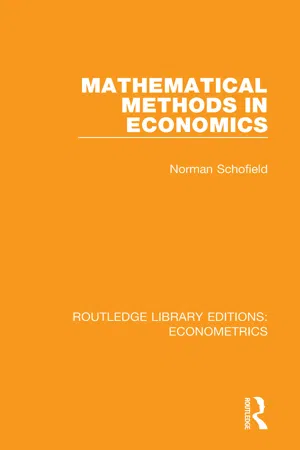
Originally published in 1984. Since the logic underlying economic theory can only be grasped fully by a thorough understanding of the mathematics, this book will be invaluable to economists wishing to understand vast areas of important research. It provides a basic introduction to the fundamental mathematical ideas of topology and calculus, and uses these to present modern singularity theory and recent results on the generic existence of isolated price equilibria in exchange economies.
- 294 pages
- English
- ePUB (mobile friendly)
- Available on iOS & Android
eBook - ePub
Mathematical Methods in Economics
Chapter 1.
SETS, RELATIONS AND PREFERENCES
In this chapter we introduce the elementary set theory and notation to be used throughout the book. We also define the notions of binary relation, function, as well as the axioms of a group and field. Finally we discuss the idea of an individual and social preference relation, and mention some of the concepts of social choice and welfare economics.
1.1. Elements of Set Theory
Let U be a collection of objects, which we shall call the domain of discourse, universal set or universe. A set B in this universe (or subset of U) is a subcollection of objects from U. B may be defined either explicitly by enumerating the objects, for example by writing
Alternatively B may be defined implicitly be reference to some property P(B), which characterises the elements of B, thus
For example:
B = {x: x is an integer satisfying 1 ≤ x ≤ 5} is a satisfactory definition of the set B, where the universal set could be the collection of all integers. If B is a set write x ɛ B to mean that the element x is a member of B. Write {x} for the set which contains only one element, x.
If A, B are two sets write A ∩ B for the set which contains only those elements which are both in A and B, and A ∪ B for the set whose elements are either in A or B. The null set Φ, is that subset of U which contains no elements in U.
Finally if A is a subset of U, define the negation of A, or complement of A in U to be the set
1.1.1. A Set Theory
Now let T be a family of subsets of U, where T includes both U and Φ, i.e.
If A is a member of T, then write A ɛ T. Note here that T is a set of sets.
Suppose that T satisfies the following properties:
- for any A ɛ T,
- for any A, B in in T, A ∪...
Table of contents
- Cover
- Half Title
- Title Page
- Copyright page
- Contents
- Foreword
- 1. Sets, Relations and Preferences
- 2. Linear Systems
- 3. Topology and Convex Optimisation
- 4. Differential Calculus and Smooth Optimisation
- 5. Singularity Theory and General Equilibrium
- Further Reading
- Review Exercises
- Index
Trusted by 375,005 students
Access to over 1.5 million titles for a fair monthly price.
Study more efficiently using our study tools.
Frequently asked questions
Yes, you can cancel anytime from the Subscription tab in your account settings on the Perlego website. Your subscription will stay active until the end of your current billing period. Learn how to cancel your subscription
No, books cannot be downloaded as external files, such as PDFs, for use outside of Perlego. However, you can download books within the Perlego app for offline reading on mobile or tablet. Learn how to download books offline
Perlego offers two plans: Essential and Complete
- Essential is ideal for learners and professionals who enjoy exploring a wide range of subjects. Access the Essential Library with 800,000+ trusted titles and best-sellers across business, personal growth, and the humanities. Includes unlimited reading time and Standard Read Aloud voice.
- Complete: Perfect for advanced learners and researchers needing full, unrestricted access. Unlock 1.5M+ books across hundreds of subjects, including academic and specialized titles. The Complete Plan also includes advanced features like Premium Read Aloud and Research Assistant.
We are an online textbook subscription service, where you can get access to an entire online library for less than the price of a single book per month. With over 1.5 million books across 990+ topics, we’ve got you covered! Learn about our mission
Look out for the read-aloud symbol on your next book to see if you can listen to it. The read-aloud tool reads text aloud for you, highlighting the text as it is being read. You can pause it, speed it up and slow it down. Learn more about Read Aloud
Yes! You can use the Perlego app on both iOS and Android devices to read anytime, anywhere — even offline. Perfect for commutes or when you’re on the go.
Please note we cannot support devices running on iOS 13 and Android 7 or earlier. Learn more about using the app
Please note we cannot support devices running on iOS 13 and Android 7 or earlier. Learn more about using the app
Yes, you can access Mathematical Methods in Economics by Norman Schofield in PDF and/or ePUB format, as well as other popular books in Business & Business General. We have over 1.5 million books available in our catalogue for you to explore.