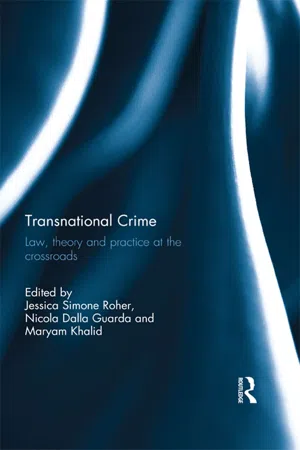
Philip Jessup coined the term "transnational law" in his Storrs Lecture on Jurisprudence delivered in 1956 to describe law that regulates activities or actions that transcend national borders. The term redefined the development and practice of the law, and became a distinct field of study. In 2001, Neil Boister applied Jessup's concept to the field of criminal law and identified the emergence of transnational criminal law in a formative article published in the European Journal of International Law. Inspired by Boister's work, the editors of the journal Transnational Legal Theory sought contributions from leading academics and practitioners for a symposium issue on transnational criminal law. In their papers, the authors built upon and developed novel approaches to legal issues arising in an increasingly globalized world, where both crimes and the regulation of crimes transcend borders. The publication of this book marks the sixtieth anniversary of Jessup's seminal lecture and exemplifies the significant impact that Jessup, and later Boister, have had on legal scholarship and practice in the area of criminal law. We are honoured to publish the symposium as a monograph and to contribute to this rapidly evolving field. This book was previously published as a special issue of Transnational Legal Theory.
eBook - ePub
Transnational Crime
Law, Theory and Practice at the Crossroads
- 260 pages
- English
- ePUB (mobile friendly)
- Available on iOS & Android
eBook - ePub
Transnational Crime
Law, Theory and Practice at the Crossroads
Further reflections on the concept of transnational criminal law
Neil Boister*
Te Piringa Faculty of Law, University of Waikato, New Zealand
In an attempt to clarify the concept of transnational criminal law, this piece examines its basic elements, analysing questions about what its essential components are and whether purely national crimes and laws for criminal cooperation are part of transnational criminal law. It then turns to the difficult question of whether transnational criminal law can accurately be termed a legal system, examining whether – and if so, how – apparently unrelated national criminal laws dealing with transnational crime are in a systemic relation. The piece then shifts its attention to whether it is possible to expand the transnational legal space to include rules that are made autonomously from state or international authority. After discussing whether transnational criminal law is a pluralist legal order, it concludes by examining who benefits from transnational criminal law, focusing on whether – and if so, how – transnational criminal law can escape the taint of Western hegemony.
Introduction
In 2001, I proposed consideration of use of the term ‘transnational criminal law’ as a suitable label for the category of domestic crimes established through treaty obligations in multilateral crime suppression conventions such as the 1988 Vienna Convention1 – the so-called ‘treaty crimes’2 or ‘crimes of international concern’.3 I argued that transnational criminal law provided a suitable doctrinal match for the criminological term ‘transnational crime’, while making it possible to distinguish this category of criminal law from international criminal law in a strict sense, i.e. the criminal law applicable in international criminal tribunals where individual criminal responsibility was directly applied under international law. My motivation was to focus attention on this relatively neglected area because of concerns about the process of criminalisation of transnational conduct, legitimacy in the development of the system, doctrinal weaknesses, human rights considerations, legitimacy in governance, and implementation problems unique to transnational criminal law. With the claim that crimes with a transnational element fell within international criminal law in an undifferentiated sense4 firmly in my sights, in 2001 I looked for distinguishing features of what I additionally, albeit rather tentatively, claimed was a ‘system’ of transnational criminal law. I argued that the distinction could be made on four grounds: the indirect nature of transnational criminal law as opposed to the direct nature of international criminal law; the application only of limited forms of extraterritorial jurisdiction to transnational crimes as opposed to the application of absolute universality to truly international crimes; the protection only of limited transnational values and interests by transnational criminal law as opposed to the international values and interests intrinsic to international criminal law; and the differently constituted international societies that project these penal norms.
The latter distinction involved what was really my central contention: that the identity of the community that international criminal law was constructed to serve was different from that of transnational criminal law. While the former was claimed to be an instrument of a Grotian society of states where communitarian values dominated and laws of cooperation were the result, I suggested that the latter was at most a creature of a loosely aligned pluralist Vattelian society of states where sovereignty and self-interest were the dominant values and laws of coordination the result.5 The degree of coordination varies from crime to crime, depending on the threat of harm or actual harm perceived to be offered by the particular harmful conduct concerned, balanced against complex factors like vested societal interests in carrying out that conduct, the spatial impact of the conduct, and so forth. This analysis was focused on differentiating transnational criminal law from international criminal law in a strict or narrow sense, rather than thinking about the unique features of transnational criminal law.
In 2012 I attempted a crisper answer to the question of what is transnational criminal law.6 In that piece I again claimed that it is a system and that it has two distinct functions: (i) to suppress transnational crime; and (ii) to transnationalise criminal law by diffusing criminal offences that originate in one or more states through the agency of international law into the law of other states. The instruments of agency were the crime suppression conventions through which states parties embrace tortious or delictual treaty obligations to criminalise the activities specified in those conventions and to adopt procedural provisions that enable them to cooperate with other states which seek to take and exercise jurisdiction over the criminals concerned.
The label ‘transnational criminal law’ is now fairly well used.7 My interest in this piece is to provide greater conceptual clarity about transnational criminal law by trying to identify more carefully the sources and the boundaries of transnational criminal law. Section I of this piece re-examines the basic elements of the concept. Section II examines whether transnational criminal law can accurately be termed a legal system. Section III asks whether it is possible to expand the transnational legal space. Section IV considers whether transnational criminal law is a pluralist legal order. Section V asks who benefits from transnational criminal law. In this five-part examination, I also try to answer the following nagging questions about the concept: (i) Is a transnational element a necessary element of a transnational crime? (ii) Is a treaty element necessary? (iii) Are purely national crimes and the national laws for criminal cooperation in their regard part of transnational criminal law? (iv) Does transnational criminal law include rules that are made autonomously from state or international authority? (v) How are the apparently unrelated national criminal laws in a systemic relation to each other? (vi) How can transnational criminal law escape the taint of Western hegemony?
I. The basic elements of the concept of transnational criminal law revisited
The perception that certain forms of criminality have become increasingly globalised drives the globalisation of the legal response to these actions. The starting point is the notion of transnational crime, a term coined by the UN Crime Prevention and Criminal Justice Branch to ‘identify certain criminal phenomena transcending international borders, transgressing the laws of several states or having an impact on another country’.8 This idea has received explicit expression in the ‘Scope of Application’ of the United Nations Convention against Transnational Organized Crime (UNTOC). According to Article 3, the Convention applies to a range of offences that are ‘transnational in nature’, including any offence that is
committed in more than one State; (b) … committed in one State but a substantial part of its preparation, planning, direction or control takes place in another State; (c) … committed in one State but involves an organised criminal group that engages in criminal activities in more than one State; or (d) … committed in one State but has substantial effects in another State.9
Evidence of a transnational element provides what Nadelmann terms a ‘transnational hook’10, the hook used to convince states that they should participate in the construction of a suppression convention in which they promise to criminalise that behaviour. The suppression conventions on a particular crime and resultant domestic law and practice together create a ‘global prohibition regime’ on drugs, money laundering, corruption and so forth. The first question of some importance to the concept of transnational criminal law is whether there must be a cross-border element in the definition of the transnational crimes in these conventions. Somewhat paradoxically, the answer is no. The suppression conventions include within their scope behaviour that (i) actually crosses borders or (ii) has substantial effects in other states. Nadelmann’s critical insight is that the practice of states as reflected in the suppression conventions (iii) also includes local crime that has only the most tenuous potential extraterritorial impact but which is of transboundary moral concern sufficient to include this behaviour within the scope of treaty obligations obliging its criminalisation.11 As Scott points out, transnational issues also include
phenomena not involving physical acts or events across borders that are nonetheless understood by relevant participants and/or observers as ‘transnational’ situations because of how the issue has come to be constructed by interacting normative (legal, policy, and moral) discourses as transcending … national frontiers....
Table of contents
- Cover
- Half Title
- Title
- Copyright
- Contents
- Citation Information
- Notes on Contributors
- Introduction
- 1. Further reflections on the concept of transnational criminal law
- 2. Transnational counter-terrorism law: law, power and legitimacy in the ‘wars on terror’
- 3. Rethinking the ‘international law of crime’: provocations from transnational legal studies
- 4. The ‘elephant in the room’ in debates about universal jurisdiction: diasporas, duties of hospitality, and the constitution of the political
- 5. Bird’s-eye view and worm’s-eye view: towards a defendant-based approach in transnational criminal law
- 6. Global policing and transnational rule with law
- 7. International criminal law’s incongruity in Colombia: why core crime prosecution in national jurisdictions should be included in analyses of transnational criminal law
- 8. Governing the ungovernable: international relations, transnational cybercrime law, and the post-Westphalian regulatory state
- Index
Trusted by 375,005 students
Access to over 1.5 million titles for a fair monthly price.
Study more efficiently using our study tools.
Frequently asked questions
Yes, you can cancel anytime from the Subscription tab in your account settings on the Perlego website. Your subscription will stay active until the end of your current billing period. Learn how to cancel your subscription
No, books cannot be downloaded as external files, such as PDFs, for use outside of Perlego. However, you can download books within the Perlego app for offline reading on mobile or tablet. Learn how to download books offline
Perlego offers two plans: Essential and Complete
- Essential is ideal for learners and professionals who enjoy exploring a wide range of subjects. Access the Essential Library with 800,000+ trusted titles and best-sellers across business, personal growth, and the humanities. Includes unlimited reading time and Standard Read Aloud voice.
- Complete: Perfect for advanced learners and researchers needing full, unrestricted access. Unlock 1.5M+ books across hundreds of subjects, including academic and specialized titles. The Complete Plan also includes advanced features like Premium Read Aloud and Research Assistant.
We are an online textbook subscription service, where you can get access to an entire online library for less than the price of a single book per month. With over 1.5 million books across 990+ topics, we’ve got you covered! Learn about our mission
Look out for the read-aloud symbol on your next book to see if you can listen to it. The read-aloud tool reads text aloud for you, highlighting the text as it is being read. You can pause it, speed it up and slow it down. Learn more about Read Aloud
Yes! You can use the Perlego app on both iOS and Android devices to read anytime, anywhere — even offline. Perfect for commutes or when you’re on the go.
Please note we cannot support devices running on iOS 13 and Android 7 or earlier. Learn more about using the app
Please note we cannot support devices running on iOS 13 and Android 7 or earlier. Learn more about using the app
Yes, you can access Transnational Crime by Jessica Roher, Nicola Dalla Guarda, Maryam Khalid, Jessica Roher,Nicola Dalla Guarda,Maryam Khalid, Jessica Roher, Nicola Guarda, Maryam Khalid in PDF and/or ePUB format, as well as other popular books in Law & Conflict of Laws. We have over 1.5 million books available in our catalogue for you to explore.