eBook - ePub
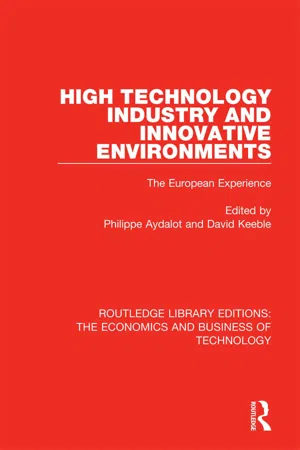
High Technology Industry and Innovative Environments
The European Experience
- 250 pages
- English
- ePUB (mobile friendly)
- Available on iOS & Android
eBook - ePub
High Technology Industry and Innovative Environments
The European Experience
About this book
Originally published in 1988, this book explores how new technologies, industrial innovation and the growth of high technology industry have affected regional employment and economic change in different European countries. It discusses the factors which make some areas better suited than others to the development of the new industries, emphasising how fuctional integration and dependence upon highly-qualified manpower tend to concentrate these industries in particular locations. Attempts to encourage innovation and the development of high technology industry in old industrial areas are discussed, with particular reference to the role of large firms, training programmes and government policies.
Chapter 1
High-Technology Industry and Innovative Environments In Europe: An Overview
DEFINITION AND CONCEPTUALISATION OF HIGH-TECHNOLOGY ACTIVITY
Amongst the various factors which may permit an understanding of current industrial and economic change in Europe, the role of new technologies is one of the most important. New technologies are one of the most visible aspects of the dramatic transformation of European society and economy which appears to be in progress at the end of the 20th century, involving daily life, work relations, and all aspects of economic organisation. At the same time, major changes are occurring at the spatial level. Rural industrialization contrasts with largescale urban manufacturing decline, crisis in traditional industrial areas contrasts with new dynamism in once-backward regions, “snowbelt” de-industrialization contrasts with “sunbelt” industrial take-off. Recent reversals in migration flows, and shifts in the geography of unemployment, graphically illustrate the effects of these changes upon the spatial economic landscape. Such changes cannot however be understood without considering the disruptive and creative effects of new technologies upon firms, industries and regions.
These effects are most frequently associated, in popular impression if not academic analysis, with the development of socalled “high-technology industry”. What however is high-technology industry? The growth in attempts at its definition only serves to highlight the lack of agreement on this issue. Is high technology the introduction of particular technical changes within the production process, or is it the evolution of a whole new “information technology” paradigm? (Castells, 1984: Freeman and Soete, 1984). There is often confusion between definition and classification (Haug, 1986). Although general ideas about new technologies may provide an appropriate starting-point, the stumbling-block of how to match specific indicators with a list of high-technology activities is quickly reached. The following represent some of the approaches or types of indicators which are present in the literature (Glasmeier, 1985a):
i) public opinion or the views of experts on the list of products or activities judged to be indicative of the new technologies. These are based largely on subjective value judgments.
ii) the rate of change in employment or output. The underlying idea here is that while old industries decline, new activities based on new technologies are likely to exhibit rapid growth in sales, output and employment. However, as workers such as Glasmeier (1985a) and Thompson (1987) point out, some traditional industries can perform better than those often considered as high-technology. Thus in the USA between 1965 and 1977, employment in the furniture industry grew faster than that in electronics (Glasmeier, 1985a).
iii) the ratio of R and D expenditure to sales may give some idea of an industry’s capacity for technical evolution and its “information” content. However, sectors with a large volume of sales such as petroleum-refining are probably under-valued by this measure compared with younger sectors whose turnover is still small. The index thus perhaps measures rate of technical progress rather than the absolute level of technology incorporated into production: while all else being equal, a higher level of competition in a sector may also lead to a greater concentration on R and D.
iv) the proportion of technically-qualified workers in the total workforce. This frequently-used measure (Glasmeier, 1985b) has the advantage of facilitating inter-sectoral comparisons, but its links with a clear definition of high-technology activity remain to be considered.
Underlying these questions and uncertainties are many ambiguities due to the lack of a coherent attempt at definition. Among the ideas implicit in various lists of high-technology sectors, there are at least four underlying definitions of high-technology activity, none of which is fully satisfactory. These are:
i) high-technology as a young or new activity. Examples might be semi-conductors in the 1960s, and microcomputing at the end of the 1970s. The problem here however is that the majority of activities usually considered as high-technology are relatively old. Thus the telecommunications and aerospace industries first came into existence more than a century ago, while the electronics industry is now 40 years old. This perhaps explains the frequent failure of attempts to identify in such sectors less concentrated organizational structures focussed on small and medium-sized firms, of the type often supposed to characterize the early stages of development of new sectors (Markusen, 1985). Indeed, Glasmeier (1985a) and Swynguedow and Anderson (1986) have shown that high technology sectors are often more concentrated, in terms of domination by large firms, than the average.
ii) high-technology as an innovative industry. Do high-technology sectors innovate more than others? This is not certain. After all, both the automobile and steel industries have adopted many new innovations in recent years, scarcely less perhaps than the electronics sector. The latter does however have a much greater rate of product rather than process innovations, which is probably a more significant measure of high-technology activity. The problem then arises of classifying innovations as “process” or “product”.
iii) high-technology as an industry whose products alter the behaviour of both individuals and groups in society, as well as economic practices. From this viewpoint, the electronics sector does appear to warrant definition as a high-technology activity because of its widespread current use and impact socially and technologically (computers, telecommunications…).
iv) high-technology as a “science-based” activity. The emphasis here is on the fact that some activities have high proportions of their workforce engaged in the production of applied knowledge. However, is knowledge content the key point here, or is it rather that certain activities exhibit in extreme form a functional division of labour in which relatively few routine workers, whose work has little skill content, are contrasted with many non-production staff, in whom virtually all the knowledge required is vested?
Thus, for example, it is generally agreed that the aerospace industry, a relatively old industry by date of origin, is a high-technology activity. Is this because it exhibits a high innovation rate, because it uses a high proportion of products developed out of recent, new technologies, because it frequently changes its products, or because it permits and creates new forms of social behaviour, such as the international movement of people? The lack of a clear definition perpetuates the underlying confusion over what should be classified as high technology. One of the consequences of this uncertainty is that a very broad definition is usually adopted, while indicators may be chosen less for what they really express than for the extent to which they fit a pre-established list of sectors.
In effect, two contrasting approaches exist to the study of high-technology industry. These need to be distinguished in order to understand the nature of the choice which has to be made. Emphasis can either be focussed on the special nature of new activities and the types of changes which they engender in society: or on the degree of rupture with previous technologies and forms of social and economic organisation which they cause. In the former case, the focus is on the nature of the change, in the latter, on the amount of change. Are the recent upheavals in Europe’s industrial economies the expression, to greater or lesser degree, of the invasion of our societies by particular radically-new technologies and activities? Or are they to be viewed as the first phase of a longer-term cyclical process? Which of these two aspects, both of which do seem to be present, is the more important? If the key point is the initiation of the first phase of a new economic cycle, then comparison with previous periods of technological upheaval may be helpful. If however the key factor today is the specific and distinctive properties and characteristics of current new technologies, then a different approach is required.
In comparison with previous technological revolutions, that which we have been experiencing during the past ten years clearly possesses distinctive characteristics. While earlier revolutions were, for the most part, linked to the emergence of new forms of energy (the steam engine and the railway, the combustion engine and the car), this one is focussed on the production and supply of information in all its forms. It has very important non-material aspects, concerned less with products than with the quality of knowledge used to produce them, and the diffusion of knowledge. It is transforming an economy which was based on the production of material goods into a machine for the creation and transfer of information. The productive processes themselves depend upon techniques which rely upon information. It is therefore easy to argue from this the case for the originality and specificity of current new technology, as well as for its particularly powerful and widespread impact: all aspects of daily life, of social behaviour, and of production are being affected. The form of settlements and towns, the organisation of work and leisure time, the very nature of leisure itself, all increasingly bear the imprint of these new technologies.
There is an alternative way of interpreting the current situation. From this perspective, high-technology activity symbolises and causes the rupture or reversal of a previous long cycle of economic change, the obsolescence of traditional technologies and of the industries and regions which embodied them. It involves new patterns of investment, focussed on new firms, new qualifications and skills, and new labour markets. Since the beginnings of industrialization, it is possible to identify successive phases of sustained economic growth and crisis. The rhythm of economic development appears to conform to long waves of boom and slump, with many observers arguing that the 1980s mark the beginning of the fifth Kondratief cycle (Hall, 1981, 1984: Freeman, 1986). This has been preceded by others, each based on a new and different technology. The crisis of the 1970s bears comparison with that of the late 1920s and early 1930s, whilst the last two decades of the 19th century were equally characterised by severe economic depression. So from this perspective, it is not a question of an historically-unique change resulting from the development of a totally new technology which has divided European history into two periods – before and after the information technology revolution – but rather one of major periodic technological, economic, and indeed spatial, re-alignments.
From this viewpoint, it can be argued that notwithstanding the current importance of new information technologies, the steam engine at the beginning of the 19th century, the internal combustion engine at the beginning of the 20th century, and other major innovations have played an equally important role in past periods. This in turn suggests – and this is the crucial point – that more deeprooted economic, social and spatial processes predate the development of new information technology, which is no more than the catalyst or driving force for a new cycle. On this argument, the determinants of spatial organisation have as much to do with these wider underlying forces as with the particular nature of information technology per se.
Both these two interpretations are tenable. However, they do not result in the same list of technologically-advanced activities. In the first case, analysis focusses on micro-electronics, computers, and associated information technology industries and services. In the second case, however, all new technologies which have appeared in the last few decades, such as bio-engineering, laser technology and aerospace as well as micro-electronics and computers, must be included in the high-technology sector.
Equally, the first interpretation does not point to identification of high-technology activities on the basis of the level of research and development activity, or of new technology, involved. Rather, it suggests that they should be defined in terms of the degree of upheaval they engender in individual and collective behaviour, in the sphere of work as well as in daily life. In contrast, the second interpretation directs attention to establishing a list of the significant innovations which give birth to the new sectors and economic activities which come to replace those of earlier cycles.
The challenge presented by the new technologies to the spatial analyst stems from the fact that their development calls into question traditional ideas and theories of the location of industrial activity and regional economic structures. For many years, the dominant trend in Europe and Northern America seemed clearly to be one of spatial concentration. Explanations were developed around notions of the dominance of a leading sector or firm (Perroux, 1955), of the formation of industrial complexes (Czamanski, 1971), and even of the simple mechanism of attraction. Today, through the concept of synergy, there is new interest in the processes which may lead to firm clustering in geographic space.
However, since at least the early 1970s, the general emphasis has switched to the observation and explanation of spatial dispersion, now apparent in virtually all industrialized countries and at all spatial scales (Keeble, 1976: Keeble, Owens and Thompson, 1983). One fruitful approach to an understanding of this trend is that invoking the development of a new spatial division of labour (Aydalot, 1976, 1983: Hymer, 1979: Massey, 1979) as a consequence of the hierarchical dispersion of functions by large, multi-plant industrial companies. The growth in the importance of such organizations, at least until the 1970s, and their ever-widening geographical area of operations, has enabled them to exploit regional labour market variations through systems of functionally-specialized but spatially-dispersed branch establishments (Keeble, 1987, 6–9).
Attempts to render this approach more dynamic have focussed on how firm spatial organisation has changed with changing phases of a given long cycle. Vernon (1966), Aydalot (1976) and Markusen (1985) have each showed in turn how early stages of the product/profit cycle appear to be characterised by the co-existence of dispersed industrial (firm-size) structur...
Table of contents
- Cover
- Half Title
- Title Page
- Copyright Page
- Table of Contents
- List of Figures
- Preface
- 1. High-Technology Industry and Innovative Environments in Europe: An Overview
- 2. Technological Trajectories and Regional Innovation in Europe
- 3. Functional Integration and Locational Shifts in New Technology Industry
- 4. High-Technology Industry and Local Environments in the United Kingdom
- 5. Local Innovation and Large Firm Strategies in Europe
- 6. Technological Clusters and Regional Economic Restructuring
- 7. New Technologies, Local Synergies and Regional Policies in Europe
- 8. Economic and Territorial Conditions for Indigenous Revival in Europe’s Industrial Regions
- 9. Local Employment, Training Structures and New Technologies in Traditional Industrial Regions: European Comparisons
- 10. Development Theory, Technological Change and Europe’s Frontier Regions
- 11. The Role of Innovations in Regional Economic Restructuring in Eastern Europe
- Index
Trusted by 375,005 students
Access to over 1.5 million titles for a fair monthly price.
Study more efficiently using our study tools.
Frequently asked questions
Yes, you can cancel anytime from the Subscription tab in your account settings on the Perlego website. Your subscription will stay active until the end of your current billing period. Learn how to cancel your subscription
No, books cannot be downloaded as external files, such as PDFs, for use outside of Perlego. However, you can download books within the Perlego app for offline reading on mobile or tablet. Learn how to download books offline
Perlego offers two plans: Essential and Complete
- Essential is ideal for learners and professionals who enjoy exploring a wide range of subjects. Access the Essential Library with 800,000+ trusted titles and best-sellers across business, personal growth, and the humanities. Includes unlimited reading time and Standard Read Aloud voice.
- Complete: Perfect for advanced learners and researchers needing full, unrestricted access. Unlock 1.5M+ books across hundreds of subjects, including academic and specialized titles. The Complete Plan also includes advanced features like Premium Read Aloud and Research Assistant.
We are an online textbook subscription service, where you can get access to an entire online library for less than the price of a single book per month. With over 1.5 million books across 990+ topics, we’ve got you covered! Learn about our mission
Look out for the read-aloud symbol on your next book to see if you can listen to it. The read-aloud tool reads text aloud for you, highlighting the text as it is being read. You can pause it, speed it up and slow it down. Learn more about Read Aloud
Yes! You can use the Perlego app on both iOS and Android devices to read anytime, anywhere — even offline. Perfect for commutes or when you’re on the go.
Please note we cannot support devices running on iOS 13 and Android 7 or earlier. Learn more about using the app
Please note we cannot support devices running on iOS 13 and Android 7 or earlier. Learn more about using the app
Yes, you can access High Technology Industry and Innovative Environments by Philippe Aydalot,David Keeble in PDF and/or ePUB format, as well as other popular books in Economics & Business General. We have over 1.5 million books available in our catalogue for you to explore.