![]()
1
Introduction to Energy-Efficient Building Development and Sustainability
R. Singh and V.V.N. Kishore
CONTENTS
1.1 Introduction
1.2 Growth in Building Sector
1.3 Building’s Energy Consumption and Greenhouse Gas Emissions
1.4 Building Sustainability
1.5 The Energy Conservation Building Codes and Green Building Rating Tools
1.6 Cost Effective Energy-Efficiency Concepts for Energy-Efficient/Green Buildings
1.6.1 Improved Ventilation
1.6.2 Shading of Glazed Components
1.6.3 Insulation of Opaque Components
1.6.4 Green Roof Concept
1.7 Benefits and Impact on the Society
1.8 Conclusion
References
1.1 Introduction
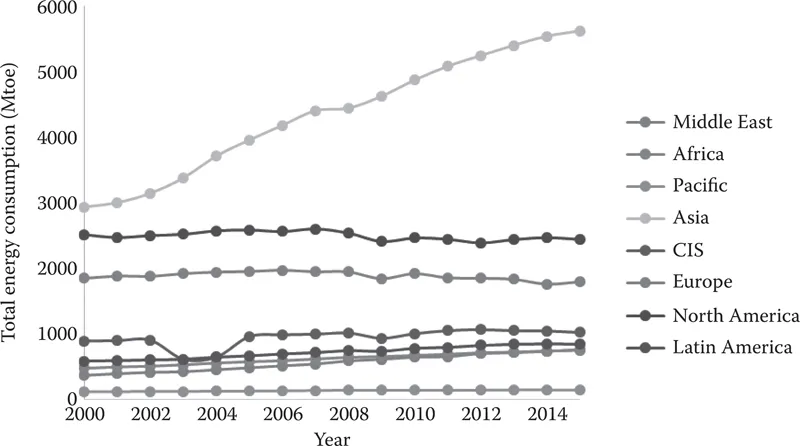
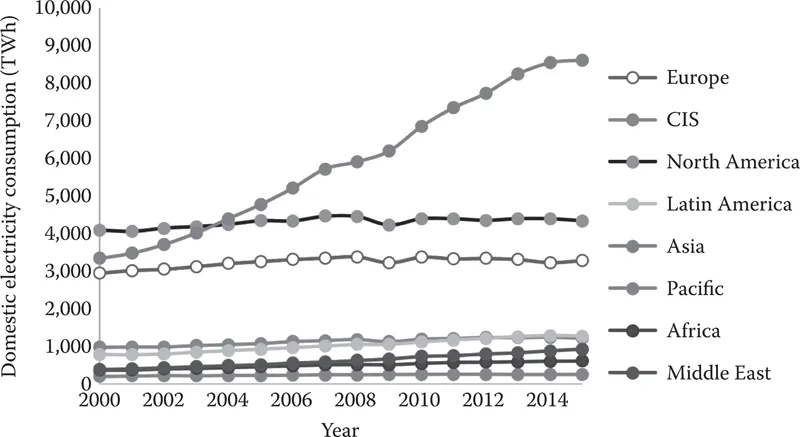
The fifth assessment report by the Intergovernmental Panel on Climate Change (IPCC) confirmed with 95% certainty that global warming is mainly a result of anthropogenic greenhouse gas (GHG) emissions. It has also been clearly mentioned in the report that the human activities disrupted the climate significantly and led to severe risks that are pervasive and irreversible impacts for the people and ecosystems [1]. Therefore, appropriate actions were suggested to be taken urgently to stabilize the rise in the global temperature below 2°C relative to preindustrial level. The modern life style, increased population, and economic status have increased the energy demand immensely around the globe. As in the present scenario, almost every activity performed by the human consumes energy to complete the task. These energy consuming activities have increased the energy demand tremendously and created unsustainability in the energy sector globally. The energy demand will continue grow in future too if proper attention is not be given to the sector to minimize the demand as well as to shift from conventional to renewable energy sources. Figure 1.1 shows total energy consumption between years 2000 and 2015 for different regions [2]. The energy consumption for Latin America, Africa, Pacific, Middle East, and CIS remains between 0 and 1000 Mtoe with substantial increase year after year. Major change can be observed for Asia, where total energy consumption increased from 3000 to approximately 6000 Mtoe. The energy consumption for Europe and CIS does not show much variation. The electricity consumption for different regions, between years 2000 and 2015, is shown in Figure 1.2 [2]. A similar trend can be observed with highest increase (6.5%) in the Asian electricity consumption followed by Middle East, Africa, and Latin America with 5.8%, 3.4%, and 3.2% increase respectively. This increased energy consumption resulted in higher GHG emissions and issue of climate change, which eventually created severe issues like catastrophic drought, heat waves, and stronger hurricanes that could be life-threatening.
FIGURE 1.1
Regional total energy consumption trend. (From www.enerdata.net.)
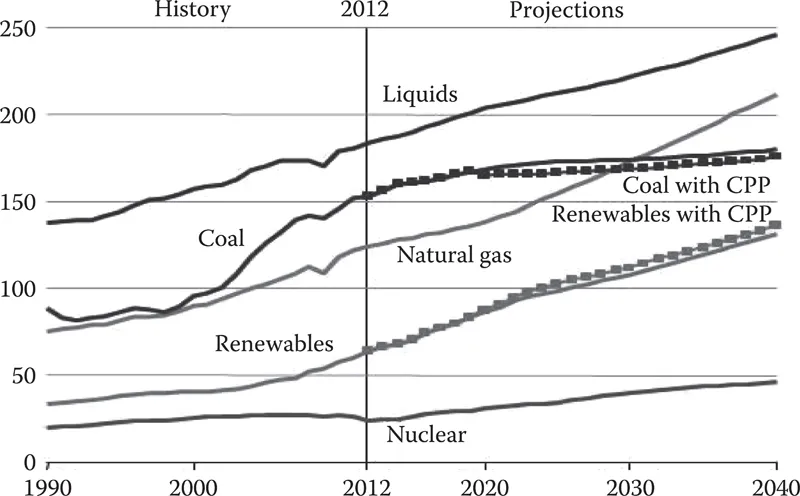
Recent EIA projection for a period of 28 years, between the years 2012 and 2040, clearly indicates a 48% increase in the worldwide energy demand. The energy demand, which was 549 quadrillion British thermal units (Btu) in the year 2012, is estimated to be 815 quadrillion Btu in 2040 (Figure 1.3). The demand for conventional fuels will grow continuously despite significant increase in the use of renewable energy too. Almost stable consumption of coal (between 150 and 200 btu) is one of positive and persuasive outcomes of the projection indicating shift in the energy consumption behavior and efficient technology adaptation [3]. However, increased global energy consumption would still be a significant concern for the sustainability of the society and the energy sector. Continuous advancement in the technologies regarding their efficiency, adaptation of energy efficiency and conservation measures, and increased use of renewable energy sources in passive as well as active mode would possibly ensure the sustainability. Recently, Paris Climate Conference (COP21) also reached an agreement to set out an action plan to minimize the effects of climate change by keeping the increase in global average temperature well below 2°C. To achieve the above goal of keeping the temperature within the desirable limit, the energy consumption and emission must be reduced in all economic sectors including buildings [4].
FIGURE 1.2
Domestic electricity consumption. (From www.enerdata.net.)
FIGURE 1.3
World energy consumption by energy source, 1990–2040 (quadrillion Btu). (Courtesy of U.S. Energy Information Administration, Washington, DC.)
The building sector consumes approximately 30%–40% of total global energy production and has enormous energy conservation opportunities to lower the energy demand like in other major energy consuming sectors. This chapter aims to explore and discuss the growth in the building sector and current and future energy consumption trends as a result of growth in the building sector. Moreover, energy conservation strategies, standards, and procedures that are being implemented in the building sector to reduce the overall energy consumption, negative impact on the environment, and future sustainability of the sector are discussed in this study.
1.2 Growth in Building Sector
The continuous population growth has resulted in higher demand of residential dwellings as well as the commercial floor space around the world. The demand for building infrastructure has been observed to be prominently and substantially high particularly in Asia and so is the energy consumption. The trend is expected to be the same in future too. Recently, the Global Construction 2030 forecast report indicated a worldwide construction growth close to 85%, which is equivalent to $15.5 trillion, by 2030. Particularly, three countries: China, US, and India leading the way and would account for 57% of total global growth. Over the next 15 years, the growth in the Chinese construction market is expected to increase marginally while US construction market will grow little faster than China. The Indian construction market probably will overtake Japan to become the world’s third largest construction market by 2021. The growth in Indian construction market is expected to be almost twice as fast as in China by 2030. Moreover, India’s urban population is expected to grow by a staggering 165 million by 2030, swelling Delhi by 10.4 million people to become the world’s second largest city [5]. A similar growth in the sector can be expected in other cities. In Canada, about 12.5 million residential units and 430,000 commercial and institutional buildings account for approximately 33% of total energy use, 50% of natural resource consumption and responsible for 30% of Canadian GHG emissions and produce about 25% of the nation’s landfill waste [6]. The above data indicate that the energy consumption will continue to grow because of faster growth in the construction sector demanded by increased population.
1.3 Building’s Energy Consumption and Greenhouse Gas Emissions
Design, fabrication, construction, and operation of buildings, in which we live and work, are responsible for consumption of energy and natural resources. As explained previously, the buildings consume a significant portion of total energy globally, over one-third of final energy, and are equally responsible for carbon dioxide (CO2) emissions [7]. The energy consumed by the buildings sector consists of residential and commercial end users and accounts for 20.1% of the total delivered energy consumed worldwide. In 2010, the building sector accounted for approximately 117 exajoules (EJ) or 32% of global final energy consumption, 19% of energy-related CO2 emissions and 51% of global electricity consumption [8]. Moreover, final energy use of the buildings sector is expected to grow from approximately 117 exajoules per year (EJ/yr) in 2010 to 270 EJ/yr in 2050. If only currently planned policies are implemented, the final energy use in buildings that could be locked-in by 2050 is equivalent to approximately 80% of the final energy use of the buildings sector in 2005 [9]. Recently, Güneralp et al. [10] projected the energy use for heating and cooling by the middle of the century between 45 and 59 EJ/yr (with an increase of 7%–40% since 2010). In this study, reason of the variability could be uncertainty in the future urban densities of rapidly growing cities in Asia and particularly in China. The electricity share of world residential energy consumption will grow from 39% in 2012 to 43% in 2040. China and India continue to lead world residential energy demand growth mainly as a result of their relatively fast-paced economic and population growth. In 2040 their combined residential energy consumption will be more than double 2012 total consumption and will account nearly 27% of total world residential energy consumption [3]. Therefore, this sector...