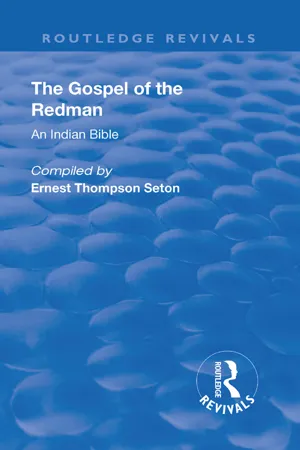
There is no Native American Bible, just as there was no Pentateuch written by Moses, no Tripitika by Buddha, no Dialogues by Socrates, no Gospels written by Christ. The Native American teachings in the fields of art, handicraft, woodcraft, agriculture, social life, health, and joy, need no argument beyond presentation; they speak for themselves. This book, originally published in 1937, offers these teachings under the author's belief that the example and precept are what the world needs above any other ethical teaching, and in particular, the spiritual message, which is more important, but supposedly less understood.
eBook - ePub
Revival: The Gospel of the Redman (1937)
An Indian Bible
- 112 pages
- English
- ePUB (mobile friendly)
- Available on iOS & Android
eBook - ePub
About this book
Information
I
THE SOUL OF THE REDMAN
HIS SPIRITUALITY
THE culture and civilization of the Whiteman are essentially material; his measure of success is “How much property have I acquired for myself?” The culture of the Redman is fundamentally spiritual; his measure of success is, “How much service have I rendered to my people?”2 His mode of life, his thought, his every act are given spiritual significance, approached and coloured with complete realization of the spirit world.
Garrick Mallery, the leading Smithsonian authority of his day, says: “The most surprising fact relating to the North American Indians, which until lately had not been realized, is that they habitually lived in and by religion to a degree comparable with that of the old Israelites under the theocracy. This was sometimes ignored, and sometimes denied in terms, by many of the early missionaries and explorers. The aboriginal religion was not their [the missionaries’] religion, and therefore was not recognized to have an existence or was pronounced to be satanic.”3
“Religion was the real life of the tribes, permeating all their activities and institutions.”4
John James, after living sixty years among the Choctaw Indians of Texas, writes:
“I claim for the North American Indian the purest religion, and the loftiest conceptions of the Great Creator, of any non-Christian religion that has ever been known to this old world….
“The North American Indian has no priests, no idols, no sacrifices, but went direct to the Great Spirit and worshipped Him who was invisible, and seeing Him by faith, adored Him who seeketh such to worship Him in spirit and in truth, who is a Spirit and planted a similar spirit in His creatures, that there might be communion between the two.”5
In 1834 Captain Bonneville visited the Nez Percés and Flatheads before they had been in contact with Whites, either traders or missionaries, and sums up these wholly primitive Indians:
“Simply to call these people religious would convey but a faint idea of the deep hue of piety and devotion which pervades their whole conduct. Their honesty is immaculate, and their purity of purpose and their observance of the rites of their religion are most uniform and remarkable. They are certainly more like a nation of saints than a horde of savages.”6
Tom Newcomb, my mountain guide in 1912 and 1914, was an old scout of the Miles campaign, who lived with the Sioux under Crazy Horse for some years in the early ′70’s. He said to me once (and not only said, but dictated for record):
“I tell you I never saw more kindness or real Christianity anywhere. The poor, the sick, the aged, the widows and the orphans were always looked after first. Whenever we moved camp, someone took care that the widows’ lodges were moved first and set up first. After every hunt, a good-sized chunk of meat was dropped at each door where it was most needed. I was treated like a brother; and I tell you I have never seen any community of church people that was as really truly Christians as that band of Indians.”
RELIGION
The idea of one Great Oversoul is widely spread among the Indians; not universal, perhaps, but much more widely spread than in the Old World.
All of our best Indians believe apparently in one Great God. From among many recorded statements, I quote the following by Grinnell. In his discussion of the Pawnee belief in the Great Spirit, whom they call Tirawa, he says:
“Tirawa is an intangible spirit, omnipotent and beneficent. He pervades the universe, and is a Supreme Ruler. Upon His will depends everything that happens. He can bring good or bad; can give success or failure. Everything rests with Him… nothing is undertaken without a prayer to the Father for assistance.
“When the pipe is lighted, the first whiffs are blown to the Deity. When food is eaten, a small portion is placed on the ground [or in the fire] as a sacrifice to Him.”7
Other Tribes, each in their own tongue, acknowledge the one Great Spirit. Orenda, Manito, Wakonda, Olelbis, Agriskoue, Maona, Tirawa, Awonawilona, etc., are among the names by which He is worshipped, sometimes as a personal God, sometimes as an impersonal all-pervading Spirit; but with a completeness of worship that has valuable lessons for other peoples and races.
Some superficial observers maintain that the Indians were Sun-worshippers. To this, Ohiyesa, the cultured Sioux, replies: “The Indian no more worshipped the sun than the Christian adores the Cross.”8
Catlin writes of the primitive Indians on the Missouri, “The North American Indians are nowhere idolaters—they appeal at once to the Great Spirit, and know of no mediator, either personal or symbolical.”9
Their breadth of view and complete toleration are reflected in a saying attributed to Wabasha and Red-jacket:
“If any man do anything, sincerely believing that thereby he is worshipping the Great Spirit, he is worshipping the Great Spirit, and his worship must be treated with respect, so long as he is not trespassing on the rights of others.”
Again, by the same prophets:
“Trouble no man about his religion—respect him in his view of the Great Spirit, and demand of him that he respect yours. Treat with respect such things as he holds sacred. Do not force your religion on anyone.”
THE INDIAN SUNDAY
The Redman’s religion is not a matter of certain days and set observances, but is a part of his every thought and his daily life.
Many years ago in Montana, I heard a missionary severely rebuke an Indian for driving his team on Sunday.
The Indian looked puzzled, as he was merely minding his business and caring for his family. The missionary reiterated that this was the Lord’s Day. At last a light dawned on the Indian. He glanced up with a gleam in his eye and answered, “Oh, I see. Your God comes only one day a week; my God is with me every day and all the time.”10
Later I heard the same missionary denouncing an Indian dance, although it was beautiful, clean, athletic, and manly—much akin to the dance with which Miriam celebrated the defeat of Pharaoh, also the dance that King David did to express his joy when the Ark came back to Israel.
The missionary used violent language, and threatened jail and soldiers if the Indians did not cut off their long hair.
I defended the Indians and pointed out that not only Benjamin Franklin and George Washington wore their hair long, but the Lord Jesus Himself did—and finally, that Samson made the ruinous mistake of his life when he allowed them to cut off his long hair.
THE CHIEF AND THE MISSIONARY
A recent book by Long Lance gives some helpful light on Indian thought and worship.11 The authenticity of the book has been challenged, but the incident here set forth has happened many times, and is incontrovertible in its fundamental truth.
“… The next morning the White minister at the Hudson’s Bay Post sent word to the Indians that he was coming over to visit them. The Suksiseoketuk told us that he was going to tell us about the Whiteman’s Wakantonka, his Great Spirit.
“When they received this news of the coming of the minister, all of the Indians painted their faces and put on all of their best medicine clothes. The medicine man got out his drum, and soon we were ready to receive him.
“When we saw the minister coming, the medicine man started to beat his tomtom and sing one of his medicine songs; for he thought that would please the visitor who represented the Whiteman’s ‘medicine’ and Great Spirit. Our Chief went out and met the minister and shook his hand, and then took him over to meet our minister, the medicine man.
“After they shook hands, the minister made a speech. He told our medicine man that he was preaching something not worth while. He said:
“‘I didn’t mean for you people to fix up like this; I meant for you to wash the paint off your faces and put your medicine drums away. There is only one God in Heaven, and I am here to tell you about Him.’
“Indians never interrupt anyone when he is talking, even if he should talk all day—that is an ancient courtesy among Indians—so everyone stood and listened to the minister while he told us of the White-man’s God. He made a long speech. He said that the Indians must lay down their arms and live peacefully alongside the Whiteman who was coming i...
Table of contents
- Cover
- Half Title
- Title Page
- Copyright Page
- Original Title Page
- Original Copyright Page
- Foreword
- Table of Contents
- Introduction
- I. The Soul of the Redman
- II. The Ancient Way
- III. By Their Fruits Ye Shall Know Them
- IV. Wabasha
- V. The Wisdom of the Old Men
- VI. Prophets of the Red Race
- VII. White Expression of Indianic Thought
- VIII. Whither?
- Epilogue
- Books by Ernest Thompson Seton
Trusted by 375,005 students
Access to over 1.5 million titles for a fair monthly price.
Study more efficiently using our study tools.
Frequently asked questions
Yes, you can cancel anytime from the Subscription tab in your account settings on the Perlego website. Your subscription will stay active until the end of your current billing period. Learn how to cancel your subscription
No, books cannot be downloaded as external files, such as PDFs, for use outside of Perlego. However, you can download books within the Perlego app for offline reading on mobile or tablet. Learn how to download books offline
Perlego offers two plans: Essential and Complete
- Essential is ideal for learners and professionals who enjoy exploring a wide range of subjects. Access the Essential Library with 800,000+ trusted titles and best-sellers across business, personal growth, and the humanities. Includes unlimited reading time and Standard Read Aloud voice.
- Complete: Perfect for advanced learners and researchers needing full, unrestricted access. Unlock 1.5M+ books across hundreds of subjects, including academic and specialized titles. The Complete Plan also includes advanced features like Premium Read Aloud and Research Assistant.
We are an online textbook subscription service, where you can get access to an entire online library for less than the price of a single book per month. With over 1.5 million books across 990+ topics, we’ve got you covered! Learn about our mission
Look out for the read-aloud symbol on your next book to see if you can listen to it. The read-aloud tool reads text aloud for you, highlighting the text as it is being read. You can pause it, speed it up and slow it down. Learn more about Read Aloud
Yes! You can use the Perlego app on both iOS and Android devices to read anytime, anywhere — even offline. Perfect for commutes or when you’re on the go.
Please note we cannot support devices running on iOS 13 and Android 7 or earlier. Learn more about using the app
Please note we cannot support devices running on iOS 13 and Android 7 or earlier. Learn more about using the app
Yes, you can access Revival: The Gospel of the Redman (1937) by Ernest Thompson Seton,Julia Moss Seton in PDF and/or ePUB format, as well as other popular books in Theology & Religion & Religion. We have over 1.5 million books available in our catalogue for you to explore.