- 392 pages
- English
- ePUB (mobile friendly)
- Available on iOS & Android
eBook - ePub
About this book
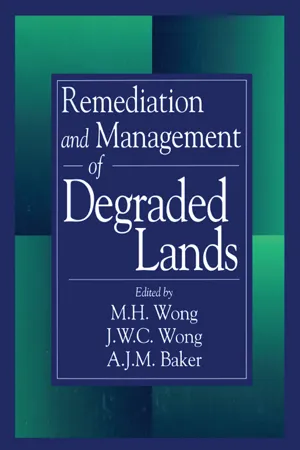
Remediation and Management of Degraded Lands presents the program of the first International Conference on the Remediation and Management of Degraded Lands. This collection reviews the extent of resource debasement and offers solutions for their restoration.
The 14-part first section deals with mine management and rehabilitation. Topics include the devastating results of open-cut mining, open-pit mining, lignite surface mining and acid mining. Despite such ruin, the articles reveal the possibilities for reclamation.
Part two devotes nine chapters to the management of derelict lands. Reforestation, soil fertility prognosis, and the uses of nitrogen are just a few of the covered subjects. This portion of the book pays special attention to the successful results of remediation in China and Hong Kong.
The final division addresses soil contamination and reclamation. There are eleven chapters on subjects that include the single and interactive effects of aluminum, the effectiveness of EDTA/HCI and the value of pig-on-litter compost as a tool for edible crop growth. These and other innovative techniques make Remediation and Management of Degraded Lands a valuable addition to any environmental library.
Information

MINE MANAGEMENT AND REHABILITATION
Chapter 1
A Multidisciplinary Approach to Producing Solutions for Sustainable Mine Rehabilitation—The Role of the Australian Centre for Minesite Rehabilitation Research
INTRODUCTION
Although data on the proportion of land disturbed by mining globally is not available, extrapolation from data available for major mining countries such as the United States and Australia would suggest that this percentage is small (<1%) in relation to that devoted to other land uses. For example, in Australia it is estimated that land disturbed by mining is less than 0.02% (Farrell and Kratzing, 1996), whereas 54% is devoted to grazing and 6% to cropping (Alexander, 1996).
Notwithstanding the relatively small proportion of land disturbed by mining globally, there is the potential for severe local environmental impact, particularly with surface mining. In the latter case, areas of existing vegetation and fauna habitat are destroyed, and the removal of the overburden covering the mineral resource may result in a marked change in topography, hydrology, and stability of the landscape. In the absence of effective environmental management, these on-site effects may also cause further impacts off-site, resulting from the water and wind erosion of unstabilized overburden spoil or of tailings resulting from mineral processing. These effects may include sedimentation of surrounding streams, and an additional decrease in water quality through the increase in salinity, acidity, and toxic element load in these streams, these latter effects often being associated with acid mine drainage (AMD) resulting from oxidation of sulfidic minerals (Mulligan, 1996).
Given the potential for mining to create severe environmental impact, it is not surprising that communities now expect companies to put in place effective environmental management programs which ensure that mined land is rehabilitated. The immediate objective of rehabilitation is to ensure the postmining landscape is stable to the erosive forces of wind and water. A second objective is to return the land to a condition suitable for other forms of land use (Bell, 1996).
Important elements of a rehabilitation plan for a mine site are: (1) construction of a landform which satisfies land use, drainage, and erosion requirements; (2) development of a suitable plant growth medium through selective handling of soil and overburden; and (3) establishment of a vegetative cover. Thus the technologies required to achieve effective rehabilitation are based upon input from disciplines spanning engineering and the physical and biological sciences. Additional challenges for mine-site environmental managers arise with the need to apply these technologies to components such as waste rock dumps, open pits and, in those cases where mineral processing is undertaken, tailings disposal facilities.
Although the mining industry worldwide has made significant advances in the development of technologies for rehabilitation in the past decade, there are a number of major issues for which best-practice solutions are still being sought. For example, in 1994 the Australian Mining Industry Council (AMIC) (now the Minerals Council of Australia), in a review of priorities and needs for environmental research in the Australian mining industry, identified the main strategic issues as ecosystem establishment and resilience, final voids, biodiversity, acid drainage, greenhouse effects, tailings, and waste rock and overburden dumps (AMIC, 1994).
The value of undertaking research and development to underpin environmental management is exemplified by the bauxite and mineral sand mining industries in Australia which have achieved international recognition for their standard of rehabilitation (Ward et al., 1996; Brooks, 1989). However, there has been recognition that, generally, rehabilitation research in Australia in the past has tended to be: (1) site-specific with less emphasis on strategic issues; (2) lacking interaction between researchers in the engineering and biological science disciplines; and (3) undertaken by research groups acting independently. In 1993 the Australian Centre for Minesite Rehabilitation Research was established as an initiative of the mining industry to overcome these deficiencies. This chapter describes the objectives, structure, research, and technology transfer programs of this Centre which may serve as a model for similar centres in other countries.
CENTRE VISION AND GOALS
The vision of the Centre is the development, with industry, of sustainable systems for land affected by exploration, mining, and mineral processing activities, acceptable to government and the community. The challenge of the Centre is to pursue the vision by undertaking research which:
• promotes the development of rehabilitation technologies for mines sited across a diverse range of ecosystems;
• integrates the spectrum of disciplinary skills represented by engineering, and the physical and biological sciences; and
• harnesses the skills of world-class research scientists in a number of organizations in a cooperative manner to produce synergistic benefits for the industry and the community.
The vision is being pursued, and the challenge accepted, by working toward the following goals:
• to conduct strategic research into mining rehabilitation to provide ecologically sustainable environmental solutions;
• to attain international recognition as a centre of excellence undertaking commissioned research on mining rehabilitation in an independent and thorough manner;
• to provide scientific and technological foundations to facilitate industry and government in setting acceptable rehabilitation standards;
• to act as a networking and communications focus of rehabilitation practice, and to enhance education and training in mining rehabilitation.
CENTRE PARTNERS AND EXPERTISE
The ACMRR is an unincorporated joint venture between five of the major groups in Australia carrying out minesite rehabilitation research:
• Centre for Land Rehabilitation, University of Western Australia
• Centre for Mined Land Rehabilitation, University of Queensland
• Environmental Science Program, Australian Nuclear Science and Technology Organisation (ANSTO)
• Minesite Rehabilitation Research Program, CSIRO
• Mulga Research Centre and Mine Rehabilitation Group, Curtin University of Technology and the Australian minerals industry, through the Australian Mineral Industries Research Association Limited (AMIRA).
The Centre brings together an impressive grouping of multidisciplinary research expertise to focus on mining rehabilitation and is unequaled in the major mining countries of the world. Its aim is to use this expertise effectively in collaborative research projects, so that a significant multidisciplinary synergy is developed.
The Centre for Land Rehabilitation at the University of Western Australia, in Perth, combines the expertise of staff from the faculty of Agriculture, Department of Civil Engineering, and the Department of Environmental Engineering, and has particular expertise in consolidation and stability of constructed landforms (tailings, waste dumps, and pits), contaminant transport processes, waste characterization, and ecosystem reconstruction processes.
The Centre for Mined Land Rehabilitation (CMLR) at the University of Queensland, in Brisbane, is comprised of the Departments of Agriculture, Botany, Chemical Engineering, Civil Engineering, Earth Sciences, Economics, Geographical Sciences and Planning, Management Studies, Mining, Minerals and Materials Engineering, Plant Production and Zoology, and has particular expertise in erosion and water quality control on constructed landforms, leachate and groundwater dynamics, tailings disposal techniques, and ecosystem reconstruction.
The Environmental Science Program of ANSTO, south of Sydney, is multidisciplinary incorporating Environmental Physics, Environmental Chemistry, Ecological Impacts, Chemical and Waste Engineering, and Radioanalytical Applications sections. The Centre has specific expertise in the processes of leaching of heavy metals from mine wastes and tailings, acid mine drainage, treatment of mine and waste waters, bioremediation and physicochemical rehabilitation of mining and contaminated industrial sites, and the design of mine waste and tailings structures to minimize environmental impacts.
The Minesite Rehabilitation Research Program within CSIRO is a collaboration between the Divisions of Soils, Exploration and Mining, Water Resources, Coal and Energy Technology, Wildlife and Ecology, Tropical Crops and Pastures, and Entomology with staff located across Australia. Major research themes in the CSIRO program are the characterization of mine wastes, long-term behavior and processes of evolution of landforms constructed of mine wastes (waste rock/spoil dumps, tailings dams, final voids), and ecosystem establishment and long-term sustainability.
The Mulga Research Centre and Mine Rehabilitation Group at the Curtin University of Technology, in Perth, are organized around the School of Environmental Biology with links which include the Schools of Applied Geology, Mines, and Agriculture. The Centre has strong expertise in the biology of flora and fauna and a particular interest in revegetation strategies for degraded landscapes, seed biology, faunal recolonization, and monitoring of ecosystem reconstruction.
The Australian Mineral Industries Research Association Ltd. (AMIRA), in Melbourne, was established in 1959 by the mineral industries in Australia to initiate and coordinate jointly sponsored research and development contracts on behalf of its member companies. The organization is an important partner in the ACMRR because of its long experience in identification of problems in the minerals industry, the development of research proposals to solve those problems, and the management of research contracts.
The ACMRR can also involve other research groups as necessary, when additional skills or resources are required. This involvement may be as a subcontractor for specific projects, depending upon the Centre’s ability to meet industry requirements.
STRATEGIC RESEARCH PROGRAM
The research program areas of the Centre have been established on the ba...
Table of contents
- Cover
- Half Title
- Title Page
- Copyright Page
- Table of Contents
- I. MINE MANAGEMENT AND REHABILITATION
- II. MANAGEMENT OF DERELICT LANDS
- III. SOIL CONTAMINATION AND REMEDIATION
- Index
Trusted by 375,005 students
Access to over 1.5 million titles for a fair monthly price.
Study more efficiently using our study tools.
Frequently asked questions
Yes, you can cancel anytime from the Subscription tab in your account settings on the Perlego website. Your subscription will stay active until the end of your current billing period. Learn how to cancel your subscription
No, books cannot be downloaded as external files, such as PDFs, for use outside of Perlego. However, you can download books within the Perlego app for offline reading on mobile or tablet. Learn how to download books offline
Perlego offers two plans: Essential and Complete
- Essential is ideal for learners and professionals who enjoy exploring a wide range of subjects. Access the Essential Library with 800,000+ trusted titles and best-sellers across business, personal growth, and the humanities. Includes unlimited reading time and Standard Read Aloud voice.
- Complete: Perfect for advanced learners and researchers needing full, unrestricted access. Unlock 1.5M+ books across hundreds of subjects, including academic and specialized titles. The Complete Plan also includes advanced features like Premium Read Aloud and Research Assistant.
We are an online textbook subscription service, where you can get access to an entire online library for less than the price of a single book per month. With over 1.5 million books across 990+ topics, we’ve got you covered! Learn about our mission
Look out for the read-aloud symbol on your next book to see if you can listen to it. The read-aloud tool reads text aloud for you, highlighting the text as it is being read. You can pause it, speed it up and slow it down. Learn more about Read Aloud
Yes! You can use the Perlego app on both iOS and Android devices to read anytime, anywhere — even offline. Perfect for commutes or when you’re on the go.
Please note we cannot support devices running on iOS 13 and Android 7 or earlier. Learn more about using the app
Please note we cannot support devices running on iOS 13 and Android 7 or earlier. Learn more about using the app
Yes, you can access Remediation and Management of Degraded Lands by M H Wong,MH Wong in PDF and/or ePUB format, as well as other popular books in Biological Sciences & Environmental Science. We have over 1.5 million books available in our catalogue for you to explore.