
eBook - ePub
Revival: Conquests and Discoveries of Henry the Navigator: Being the Chronicles of Azurara (1936)
Being the Chronicles of Azurara
- 262 pages
- English
- ePUB (mobile friendly)
- Available on iOS & Android
eBook - ePub
Revival: Conquests and Discoveries of Henry the Navigator: Being the Chronicles of Azurara (1936)
Being the Chronicles of Azurara
About this book
A preface from the pen of the late Marshal Lyautey introduces this book, which is an abridged translation of the Chronicales of Gomes Eannes de Azura, recording the siege and capture of Ceuta by the Portuguese, and the discovery of Guinea. Ceuta was captured because of the sons of John I--who had married the daughter of John of Gaunt--were ripe for knighthood , and rebelled against the bourgeois notion of receiving the acolade during a series of State banquets. Nothing less than the taking of a city from the Infidels would serve their turn; their knighthood must be truly earned and so Portugal became posessed of Ceuta. The second part of the book deals with the discovery of Guinea, Senegal, and Sierra Leone by Lancarote and others. The Chronicles, which made most excellent reading, have been edited by Senhora Virgina de Castro e Almeida, who is compiling an anthology of contemporary accounts of the great Portuguese navigators and colonists of the fifteenth and sixteenth centuries.
THE CHRONICLE OF THE DISCOVERY OF GUINEA
Extract from the Introduction to the Edition of 1841
by THE VISCONDE DE SANTAREM
THE Chronicle of the Discovery of Guinea was written by a contemporary. It is one of the most valuable monuments of the history of the Portuguese discoveries and conquests, and it is also the first book written by a European concerning the regions situated on the western coast of Africa, beyond Cape Bojador. It was believed, until well on in the nineteenth century, that the oldest chronicler to write of the Infante Dom Henrique, and of his labours and discoveries, was a foreigner, the celebrated Italian traveller Cadomosto, who came to Portugal and entered the service of the Infante about the year 1455. The Chronicle of the Discovery of Guinea, however, was completed in 1448. It seems that the Portuguese King Dom Affonso V (nephew of the Infante Dom Henrique) presented it to his uncle the King of Naples, Affonso the Magnanimous, about 1453–7. At the beginning of the eighteenth century this chronicle of Azurara’s was in Spanish hands. Ferdinand Denis found it in 1837 in Paris, in the Bibliothèque Nationale, where it still remains.1 This original text is a small folio written on parchment, and sumptuously executed. It contains 319 pages and 622 columns, and a miniature of the Infante Dom Henrique, painted during his lifetime: the only authentic portrait of this prince. His head is covered with a great black hat; he wears no insignia; and his hair is cut short in token of mourning, as was the custom of the period. His brother, the Infante Dom Pedro, Duke of Coimbra, had not long been dead.
The Visconde de Carreira, Minister Plenipotentiary of Portugal in France, immediately obtained from the French Government its authorization to publish this chronicle. He copied it with his own hand,2 and the proofs were corrected by a Portuguese philologist. It was published in 1841 (J. P. Ailland, Paris) in an édition de luxe, having as its frontispiece a facsimile of the miniature of the Infante.
Azurara’s fidelity as historian is incontestable. His scruples as chronicler, and his love of truth, were such that being sometimes unable to obtain absolutely exact data concerning the termination of certain events which he was engaged in recounting, he preferred to leave his narrative uncompleted. His authority as a contemporary writer is very great, for he lived in intimate relations with the Infante Dom Henrique, and he knew personally the leading captains to whom the world owed the discoveries of this period, and of whom almost all were the servitors of the Infante, instructed in the sciences under this prince’s direction.
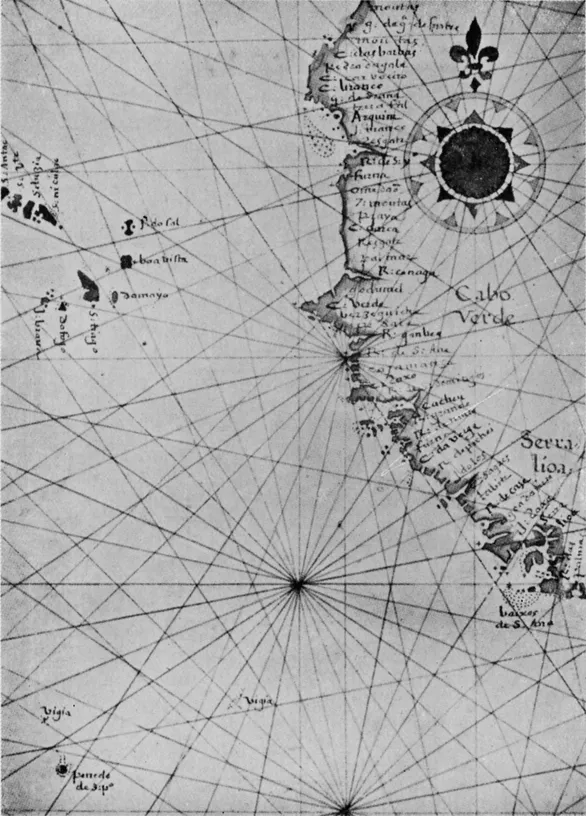
THE WEST COAST OF AFRICA
Portuguese Chart of the Sixteenth Century.—From the Atlas known as the Duchesse de Berry’s Atlas. B.JV. Res. Ge FF 14409
1 F. Denis made it known to the public in his book: Chroniques Chevaleresques de l’Espagne et du Portugal, Paris, 1839, vol, ii, pp. 43–53.
1 The notes to this chronicle are also from the pen of the Visconde de Santarem, being reprinted from the edition of 1841.
CHAPTER I
How Azurara speaks of the Infante Dom Henrique before beginning his tale of the discovery of Guinea
IT seems to me that I should write overmuch if I had to recount in full all the particularities which some historians are wont to write down concerning the princes of whom they are speaking. Thus, in relating what these princes have done, seized by the desire to exalt their virtues, they begin the history of their lives at the time of their earliest infancy. And although one may think that writers so capable must have good reasons for so doing, as for me I shall depart from this procedure, recognizing that in respect of my present subject it would be a labour hardly necessary. I do not propose to discourse at great length even concerning his bodily aspect, for there have been many persons in this world with features in good proportion, yet their offences against honesty did violence to their renown; and for the rest, what the philosopher has said on this subject will suffice us—that corporeal beauty is not a perfect good. And thus, returning to my subject, I say that this noble prince was of middle stature, a man thickset, with limbs large and powerful, and bushy hair; the skin was white, but the travail and the battles of life altered its hue as time went on. His aspect, to those who beheld him for the first time, was severe; when anger carried him away—rarely—his countenance became terrifying. He had force of mind and acute intelligence in a high degree. His desire to accomplish great deeds was beyond all comparison. Lust and avarice had never obtained a hold upon his heart, for as to the first of these vices, he was so moderate that all his life he preserved the most perfect chastity, and his body was virgin when it was laid in the earth. What shall I say of his magnificence, which was extreme among all the princes of the world! To my thinking, he was the uncrowned prince who had in his household the greatest number of servants, and of the finest quality. His house gave welcome to all men of the realm who possessed merit, and even more to foreigners whose renown justified the expense he was at to have them there; for as an ordinary thing he had about him men of different countries; men of very distant countries, and all held him for a great marvel; and never departed without receiving great benefits from him. All his days were filled with assiduous labour; for surely among all the nations of mankind one could not find any more able than he to subdue himself. It would be hard indeed to count the nights during which his eyes knew no sleep, and his body so mortified itself that it seemed to make a new nature for itself. The continuance of his labour was such that, even as the poets figured Atlas, the giant sustaining the heavens on his shoulders, because of his great knowledge of the celestial bodies, so the people of our realm held it for a maxim that the great labours of this prince surpassed the summits of the loftiest mountains. I shall say that things which seemed impossible to men were rendered easy by the persistence of his effort. He was a man of excellent counsel, and of great authority, wise and possessed of a faithful memory, but slow in certain things,
perchance because his character was something phlegmatic, or because such was his will in a certain purpose of which those about him were ignorant. He was quiet in manner, and his words were calm; in adversity he was constant, and humble in prosperity. It is very sure that no other prince has ever had vassal like unto him, or who could even be compared with him, in obedience and veneration, such as he showed to the kings who in his time reigned over Portugal; above all to King Dom Affonso, his nephew, during the early part of his reign, as you may see more clearly by this chronicle. Never was known in him hatred or ill-will toward any, even though heavy faults were committed against him, and in this point his bounty was such that competent men reproached him with weakness in the dispensing of justice, for he judged all alike. And they thought so because on certain of his servants, who abandoned him during the siege of Tangier, which was the most perilous adventure that ever he was engaged in, he inflicted no punishment; not only did he receive them back again, but he gave them great privileges, more than to others who had served him well, while according to the judgment of men the first were far from deserving what they had received. This is the only weakness which I have found it possible to relate of him . . .
... He drank wine only during a very short period of his life, and this was in his early youth; but afterwards, all his life long, he drank none. He had always a great love for the commonwealth of this kingdom, dedicating thereto a large part of his labours, and it pleased him to make trial of novelties for the general good, even devoting great expenditure to them; he gave himself with much delight to the exercise of arms, especially against the enemies of the holy faith; and he desired peace with all Christians. He was generally loved by all, for he did good to all and harm to none. His replies were always courteous, which honoured the condition of the persons who spoke to him without abating his own. Never did lewd or unhandsome word issue from his mouth. He was obedient to all the commands of Holy Church, and attended her offices with great devotion; in his chapel these offices were performed with as much solemnity and ceremony as in the chancel of no matter what cathedral. And also he cherished a great veneration for all sacred things, and honoured their ministers and loaded them with benefits. He fasted almost half the year, and the poor never left his presence with empty hands. Assuredly I could not find another Catholic or religious man, whether prince or no, who could compare with him. His heart never knew fear other than the fear of sin, and because high exploits are bom of virtuous works and righteous customs, I shall assemble in the following chapter all the noteworthy things which he accomplished in the service of God and for the honour of the realm.
…
I shall not find a better opening for this chapter than the recital of the remarkable conquest of the great city of Ceuta, a celebrated victory which glorified the heavens and favoured the earth. For it seems to me that there was enough glory for the college of celestial virtues in all the divine sacrifices and sacred ceremonies which until this day have been performed in this city in honour of Jesus Christ our Lord, and which, by His divine grace, will continue to be performed. As for the profit which the earth has received thereby, the Levant and the Ponent1 are sure witnesses, for their inhabitants can now exchange their merchandise without great danger to their goods; and it cannot be denied that the city of Ceuta is the key of the whole Mediterranean Sea.
In this conquest the Infante Dom Henrique was the captain of a very great and very powerful fleet, and, as a valiant knight, he fought all that day on which the city was taken from the Moors. Under his command were the Count of Barcellos, bastard of the King, and Dom Fernando, lord of Bragança, his nephew, and Gonçalo Vasques Coutinho, who was a very puissant seigneur, and also many other fidalgos, with all their men, and yet others who joined them, from these provinces, which is to say from Beira, Traz os Montes, and betwixt Douro and Minho.
The first royal captain who touched land near the walls of Ceuta was he of whom I write, and his square banner was the first to pass the gates of the city, the Infante himself being not far from its shadow. And the blows he dealt the enemy that day were noteworthy among all others, since for five hours he fought without respite, and neither the heat, which was great, nor the fatigue of such an effort could persuade him to depart and take some rest . . .
And in this city the Infante was knighted, with much honour, by the hands of his father on the day the cathedral was consecrated, as well as his brothers.
The capture of this city took place on a Thursday, August 31, 1415. And on returning into his kingdom the King Dom João, in a certain place in Algarve, confirmed the prince in the dignity of duke, with the seigneurie (of this domain).
At the end of three years a great multitude of Moors came down upon the city of Ceuta; the alfaqueques2 afterwards found that there were a hundred thousand of them; for there were the people of the King of Fez, the King of Granada, the King of Tunis, the King of Morocco, and the King of Bugia, with great quantities of engines and artillery, in the intent to recapture this city by besieging it on land and sea.
The Infante Dom Henrique, with his two brothers, Dom João and the Count of Barcellos, who afterwards became the Duke of Bragança, came to the succour of the city, with many other lords and fidalgos, and a great fleet. And having accomplished a great carnage among the Moors, he quickly freed the city, repaired it, and returned victoriously into Portugal; not well content, however, for the circumstances did not allow him to take the city of Gibraltar as he had thought to do, and the chief cause of this was the severity of the winter which was beginning; for the sea was perilous everywhere at this time of the year, and more so than ever in this place, by reason of the strong tides which are there.
The Infante went also with a great fleet to the Canary Isles, in order to lead their inhabitants into the path of the holy faith.
And afterwards, during the reign of the King Dom Duarte, and by his order, the Infante went the third time into Africa, where he laid siege to the city of Tangier, and installed himself in the territories of his enemies in nineteen places, with his banners unfurled. The siege lasted twenty-two days, and great exploits were accomplished there, worthy of being recalled, and with great loss to his enemies, as you will see in the Chronicle of the realm.
The Infante Dom Henrique governed Ceuta for thirty-five years3 by order of the king, his father, his brother, and his nephew, with so much wisdom and skill that the crown of the realm always derived honour therefrom, and at length, by reason of his great labours, he left the government of Ceuta to his nephew the King Dom Affonso at the beginning of his reign.
After the taking of Ceuta the Infante had ships at sea armed against the Infidels, whom he fought, and upon whom he did much ravage, and this on the two coasts, in such sort that the terror of his enemies gave security to the countries neighbouring on our Spain, and still more to th...
Table of contents
- Cover
- Half Title
- Title Page
- Copyright Page
- Dedication
- Contents
- Preface
- Notes on the History of Portugal
- The Conquest of Ceuta: Being The Chronicle of The King Dom João I
- The Chronicle of the Discovery of Guinea
Trusted by 375,005 students
Access to over 1.5 million titles for a fair monthly price.
Study more efficiently using our study tools.
Frequently asked questions
Yes, you can cancel anytime from the Subscription tab in your account settings on the Perlego website. Your subscription will stay active until the end of your current billing period. Learn how to cancel your subscription
No, books cannot be downloaded as external files, such as PDFs, for use outside of Perlego. However, you can download books within the Perlego app for offline reading on mobile or tablet. Learn how to download books offline
Perlego offers two plans: Essential and Complete
- Essential is ideal for learners and professionals who enjoy exploring a wide range of subjects. Access the Essential Library with 800,000+ trusted titles and best-sellers across business, personal growth, and the humanities. Includes unlimited reading time and Standard Read Aloud voice.
- Complete: Perfect for advanced learners and researchers needing full, unrestricted access. Unlock 1.5M+ books across hundreds of subjects, including academic and specialized titles. The Complete Plan also includes advanced features like Premium Read Aloud and Research Assistant.
We are an online textbook subscription service, where you can get access to an entire online library for less than the price of a single book per month. With over 1.5 million books across 990+ topics, we’ve got you covered! Learn about our mission
Look out for the read-aloud symbol on your next book to see if you can listen to it. The read-aloud tool reads text aloud for you, highlighting the text as it is being read. You can pause it, speed it up and slow it down. Learn more about Read Aloud
Yes! You can use the Perlego app on both iOS and Android devices to read anytime, anywhere — even offline. Perfect for commutes or when you’re on the go.
Please note we cannot support devices running on iOS 13 and Android 7 or earlier. Learn more about using the app
Please note we cannot support devices running on iOS 13 and Android 7 or earlier. Learn more about using the app
Yes, you can access Revival: Conquests and Discoveries of Henry the Navigator: Being the Chronicles of Azurara (1936) by Virginia De Castro E Almeida, Bernard Miall in PDF and/or ePUB format, as well as other popular books in History & European History. We have over 1.5 million books available in our catalogue for you to explore.