- 279 pages
- English
- ePUB (mobile friendly)
- Available on iOS & Android
eBook - ePub
The Chemistry of PCB'S
About this book
The literature on chlorinated biphenyl is growing rapidly. Review articles on PCB's cited in this book usually contained a section on the toxicity of PCB. The structure and nomenclature are detailed. The chapters and topics included are (1) commercial PCB preparations: properties and compositions, (2) synthesis of chlorobiphenyls, (3) chemical reactions of chlorobiphenyls, (4) photodegradation of chlorobiphenyls, (5) metabolism of chlorobiphenyls, (5) mass spectroscopy of chlorobiphenyls, (6) nuclear magnetic resonance of chlorobiphenyls, (7) ultraviolet spectroscopy of chlorobiphenyls, (8) infrared spectrometry of chlorobiphenyls, (9) determination of chlorobiphenyls, and (10) recent developments.
Information
Chapter 1
INTRODUCTION
Historical and Literature
Chlorinated biphenyls were known before the turn of the century and the useful industrial properties of mixtures obtained by chlorination of biphenyl were recognized early (cf. 77). From a purely chemical point of view, the chlorobiphenyls are a rather unattractive class of compounds and limited attention was paid to them by the scientific community. In 1966, a note in the New Scientist about the discovery of the widespread occurrence of chlorinated biphenyls in the Swedish environment (Figure 1) and the following events were responsible for the truly dramatic upsurge of interest in these compounds.3, 46 In 1967, Widmark reported mass spectroscopic data as unambiguous proof of the chemical nature of these new contaminants106 and at about the same time PCB’s were found in various parts of the world.42, 43, 54, 56, 81
Even before the reports mentioned above, analysis were aware of “spurious peaks” in electron capture gas chromatography which did not correspond to any of the known chlorinated pesticides.37, 41, 92, 93, 105 These peaks corresponding to components of PCB are not separated well under GC conditions usually used in pesticide analysis (Figures 2 and 3) and it is quite likely that many reports gave falsely high results for some pesticide residues (cf. 55).
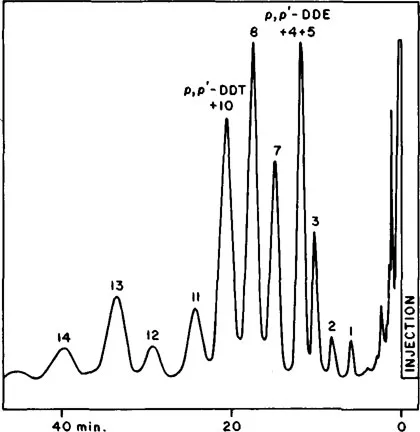
FIGURE 1. Gas chromatogram from purified extract of a white-tailed eagle found dead in the archipelago of Stockholm. All peaks except DDT and DDE were unknown. (Courtesy of Dr. Jensen.)
It is now established that because of chemical properties (lipid solubility and resistance to degradation) PCB’s accumulate in food chains and are distributed worldwide, similar to the chlorinated pesticides such as DDT.
The literature on chlorinated biphenyl is growing rapidly and a number of reviews on various aspects of the problem are available. Generally, chlorinated biphenyls have been discussed in the context of chlorinated pesticides32, 54, 66, 91 and specifically.9, 22, 23, 24, 34, 44, 75, 76, 90, 100, 108, 109) A bibliography (to 1971) of articles dealing with chlorobiphenyls has been published83 and useful information can be obtained from conference reports,4, 26, 33 a review of the Panel on Hazardous Trace Substances,73 a recent Monsanto report,68 and a mimeographed publication PCB Newsletter,96 Analytical methods have been discussed.67, 86, 87, 88, 107
Toxicology of PCB’s
Long ago, toxicity of PCB’s to humans was recognized as causing yellow atrophy of the liver in fatal cases, dermatitis, and fatty degeneration of the liver in chronic exposure.14 Threshold limit values of 0.5 and 1 mg/m3 for PCB’s containing 42 and 54% chlorine, respectively, were established for industrial environments.97
In 1966, the discovery of PCB’s in environmental samples spurred renewed interest in the toxicity of PCB’s and a mass of information on the acute and chronic toxicity of PCB’s to a variety of animals has been obtained since then. Most of the studies were carried out using commercial PCB preparations and very little is known about the toxicity of individual chlorobiphenyls.
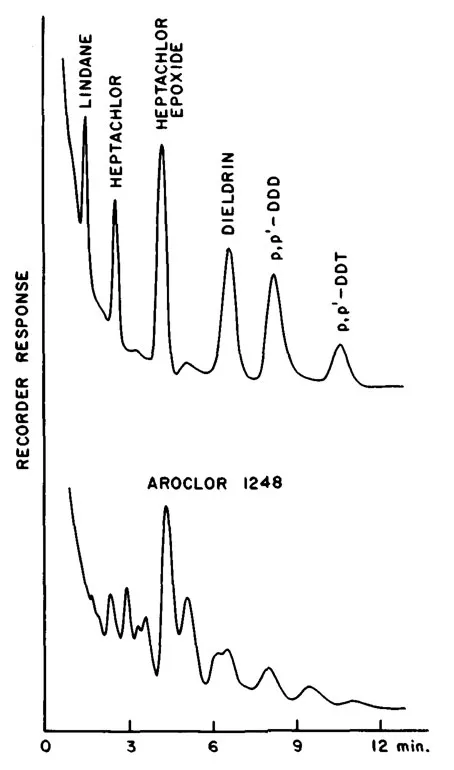
FIGURE 2. Gas chromatograms of Aroclor® 1248 (bottom) and some common pesticides (top). Conditions: 40% SE-30 or Chromosorb W® 60/80; 200°; carrier gas, nitrogen 60 ml/min.
PCB’s accumulate in living matter, particularly in tissues and organs rich in lipids. The accumulation appears to be higher in the case of penta- and more highly chlorinated biphenyls. Tetra and less chlorinated biphenyls are hydroxylated and excreted (see Chapter 7). The toxicity of PCB’s varies a great deal from species to species, probably as a result of differences in metabolic rates and capabilities, physiological differences, etc. Thus, PCB’s are more toxic to some aquatic invertebrates than to fish and more toxic to salmon eggs than to juvenile Atlantic salmon. Chicken eggs may fail to hatch if they contain a high concentration of PCB’s and mink fail to reproduce when fed a PCB-contaminated diet. In humans, the appearance of symptoms of PCB poisoning was observed after the consumption of approximately 0.5 g of PCB’s in rice oil.
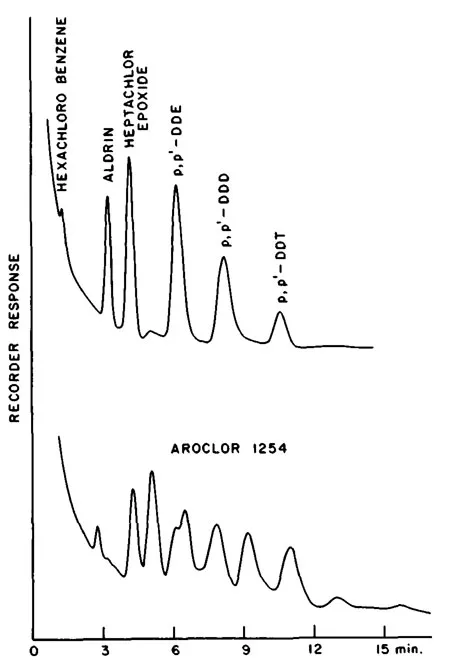
FIGURE 3. Gas chromatograms of Aroclor 1254 (bottom) and some common pesticides (top). Conditions identical to those of Figure 2.
The mechanism of the toxic action of PCB’s is not know...
Table of contents
- Cover
- Title Page
- Copyright Page
- Table of Contents
- Chapter 1 Introduction
- Chapter 2 Commercial PCB Preparations: Properties and Compositions
- Chapter 3 Synthesis of Chlorobiphenyls
- Chapter 4 Other Biphenyl Syntheses
- Chapter 5 Chemical Reactions of Chlorobiphenyls
- Chapter 6 Photodegradation of Chlorobiphenyls
- Chapter 7 Metabolism of Chlorobiphenyls
- Chapter 8 Mass Spectrometry of Chlorobiphenyls
- Chapter 9 Nuclear Magnetic Resonance Spectroscopy of Chlorobiphenyls
- Chapter 10 Ultraviolet Spectroscopy of Chlorobiphenyls
- Chapter 11 Infrared Spectrometry of Chlorobiphenyls
- Chapter 12 Determination of PCB’s
- Chapter 13 Recent Developments
- Index
Trusted by 375,005 students
Access to over 1.5 million titles for a fair monthly price.
Study more efficiently using our study tools.
Frequently asked questions
Yes, you can cancel anytime from the Subscription tab in your account settings on the Perlego website. Your subscription will stay active until the end of your current billing period. Learn how to cancel your subscription
No, books cannot be downloaded as external files, such as PDFs, for use outside of Perlego. However, you can download books within the Perlego app for offline reading on mobile or tablet. Learn how to download books offline
Perlego offers two plans: Essential and Complete
- Essential is ideal for learners and professionals who enjoy exploring a wide range of subjects. Access the Essential Library with 800,000+ trusted titles and best-sellers across business, personal growth, and the humanities. Includes unlimited reading time and Standard Read Aloud voice.
- Complete: Perfect for advanced learners and researchers needing full, unrestricted access. Unlock 1.5M+ books across hundreds of subjects, including academic and specialized titles. The Complete Plan also includes advanced features like Premium Read Aloud and Research Assistant.
We are an online textbook subscription service, where you can get access to an entire online library for less than the price of a single book per month. With over 1.5 million books across 990+ topics, we’ve got you covered! Learn about our mission
Look out for the read-aloud symbol on your next book to see if you can listen to it. The read-aloud tool reads text aloud for you, highlighting the text as it is being read. You can pause it, speed it up and slow it down. Learn more about Read Aloud
Yes! You can use the Perlego app on both iOS and Android devices to read anytime, anywhere — even offline. Perfect for commutes or when you’re on the go.
Please note we cannot support devices running on iOS 13 and Android 7 or earlier. Learn more about using the app
Please note we cannot support devices running on iOS 13 and Android 7 or earlier. Learn more about using the app
Yes, you can access The Chemistry of PCB'S by Otto Hutzinger in PDF and/or ePUB format, as well as other popular books in Medicine & Biochemistry in Medicine. We have over 1.5 million books available in our catalogue for you to explore.