- 880 pages
- English
- ePUB (mobile friendly)
- Available on iOS & Android
eBook - ePub
Reliability 91
About this book
This book is a collection of papers presented at the International Conference on Reliability Techniques and their Application.Reliability 91, 10-12 June 1991 was held at the Royal Lancaster Hotel, London, UK, organised by SRD (the Safety and Reliability Consultants of AEA Technology) and the institution of Quality Assurance (IQA), and supported by the European Safety and Reliability Association (ESRA).
Information
RELIABILITY ASPECTS IN SATELLITE DATA COMMUNICATION EQUIPMENT: A CASE STUDY
FTPTAT/CPqD-TELEBRÁS
CPqD-TELEBRÁS Caixa Postal 1579 CEP 13085 Campinas - SP Brazil
ABSTRACT
The use of redundant equipment is one of the fault-tolerant techniques that permit a high reliability assignment to the services provided by a Satellite Data Communication System. However, the redundancy efficiency depends on a good fault coverage.
As the coverage directly influences the system reliability, it is important to characterize the recovered fault proportion in order to accurately determine the coverage factor of redundant equipment and to evaluate the impact of this parameter on the overall system reliability.
This paper aims to describe the procedures related to the coverage factor determination of the SAMSAT (a TDMA system) baseband equipment, during the product development stages. Further, this paper shows the unavailability estimated values of this equipment set, considering determinant factors for an adequate reliability performance, such as coverage and Mean Time to Repair (MTTR).
INTRODUCTION
The utilization of reliability analysis in the specification and design of the current Satellite Data Communication Systems has been extremely important for the reliable system obtainment and for improving the quality of the offered service [1]. This analysis makes it possible :
• To predict or to measure reliability parameters and, consequently, to verify if the requirements have been considered;
• To eliminate failure points;
• To provide information on the necessity of redundancy utilization;
• To evaluate the quality level associated to the parts and to the system itself.
All these factors collectively contribute to increase the overall quality of service as perceived by the users of a Satellite Data Communication System. In terms of global evaluation of service, the system capacity for providing communication between two users connected to two earth stations can be evaluated through the equipment and link availability, which, in turn, behave as the reliability parameters that best reflect the user’s subjective impressions of the system.
The CCIR, by means of the recommendation 579–1 [2], considers that the availability of the digital path for the link establishment is determined by the combined effects of equipment and propagation availability. It also considers that the equipment availability depends on reliability performance, maintainability facilities and maintenance support performance. In this context, the CCIR recommends that the unavailability of a link, due to equipment, be not more than 0.002 of a year.
For the purpose of achieving these goals, some efforts for reliability improvement can be adopted. The use of redundancy in the essential parts of the system is one of the fault-tolerant techniques that permits a high level reliability assignment to the system, making it possible to attend to the recommended reliability requirements with an adequate cost-reliability relation. The redundancy ensures a very low probability of hardware inoperation, however, its correct utilization depends on the efficiency of fault-tolerant mechanisms, the location of faulty units and the switching of these units, that is, the efficiency of fault-supervising mechanisms.
The probability of these mechanisms to work, once a fault has occurred, defines the coverage factor (c), that is,
Thus, the coverage factor is associated to the supervising mechanisms and reflects the ability of the system to promptly recover from the occurrence of a fault. Many authors ([3, 4, 5, 6] for example) have shown that the coverage directly influences the system reliability. Within this context, it is important to characterize the recovered fault proportion in order to accurately determine the coverage factor of redundant architecture, and, consequentely, to evaluate the impact of this parameter on the overall system reliability. Concerning system development, this characterization/evaluation is essential mainly during the initial (specification and implementation) and revision phases.
This paper aims to describe the procedures related to the coverage factor determination of the SAMSAT (a TDMA system) baseband equipment, during the product development stages. Further, this paper shows the unavailability estimated values of this equipment set, considering the determinant factors for an adequate reliability performance, such as coverage and Mean Time To Repair (MTTR).
The SAMSAT structure is shortly described in the following section, principally emphasizing the used redundancy techniques and the fault-supervising mechanisms.
The section entitled The Coverage Analysis brings the great coverage factor influence on the availability of redundant equipment and the method used for its evaluation in the SAMSAT project.
The section entitled Unavailability Prediction shows unavailability estimated values of the SAMSAT redundant baseband equipment as function of the coverage factor and the MTTR. This section also shows estimated values of the link unavailability due to baseband equipment, corresponding to the options of SAMSAT hardware configuration.
SAMSAT STRUCTURE
The SAMSAT is composed of Traffic Terminal Earth Stations (ETS), which provides access gates to digital/voice services offered by the system, and two Reference Earth Stations: a principal (ERO) and a secondary one (ER1), responsible for the centralized realization of the supervising and control functions which coordinates the TDMA technique application [7].
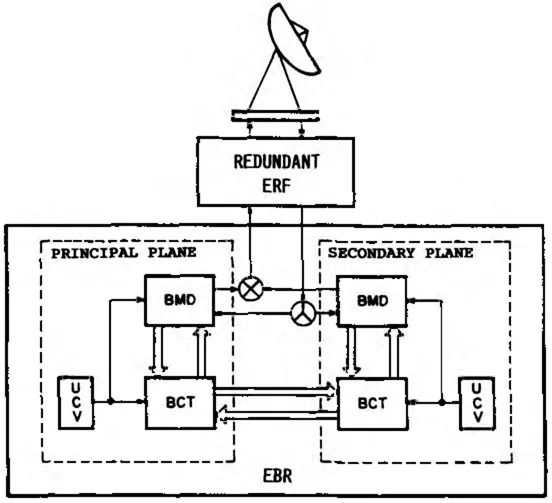
Figure 1. ER0/ER1 Block Diagram.
The operation of the Reference Earth Stations is realized in a conjoined form, compounding a redundant reference and control structure (RCS) which follows the active redundancy principle. This redundant structure aims a high reliability level assignment to the realization of essential activities performed by these stations, that is, the system synchronism maintenance. The main a...
Table of contents
- Cover
- Half Title
- Title Page
- Copyright Page
- Table of Contents
- Foreword
- Session 1A: Reliability in Manufacturing
- Session 1B: Data Collection and Analysis
- Session 2A: Human Reliability
- Session 2B: Software Reliability
- Session 3A: Electronics Reliability
- Session 3B: Design for Reliability
- Session 3C: Poster Session
- Session 4A: Defence Reliability, Maintainability and Procurement
- Session 4B: Systems Reliability
- Session 5A: Expert Systems Applications and Maintenance
- Session 5B: Safety Culture in the Organisation
- Session 6A: Economics and Competitiveness
- Session 6B: Risk Analysis and Management
Trusted by 375,005 students
Access to over 1.5 million titles for a fair monthly price.
Study more efficiently using our study tools.
Frequently asked questions
Yes, you can cancel anytime from the Subscription tab in your account settings on the Perlego website. Your subscription will stay active until the end of your current billing period. Learn how to cancel your subscription
No, books cannot be downloaded as external files, such as PDFs, for use outside of Perlego. However, you can download books within the Perlego app for offline reading on mobile or tablet. Learn how to download books offline
Perlego offers two plans: Essential and Complete
- Essential is ideal for learners and professionals who enjoy exploring a wide range of subjects. Access the Essential Library with 800,000+ trusted titles and best-sellers across business, personal growth, and the humanities. Includes unlimited reading time and Standard Read Aloud voice.
- Complete: Perfect for advanced learners and researchers needing full, unrestricted access. Unlock 1.5M+ books across hundreds of subjects, including academic and specialized titles. The Complete Plan also includes advanced features like Premium Read Aloud and Research Assistant.
We are an online textbook subscription service, where you can get access to an entire online library for less than the price of a single book per month. With over 1.5 million books across 990+ topics, we’ve got you covered! Learn about our mission
Look out for the read-aloud symbol on your next book to see if you can listen to it. The read-aloud tool reads text aloud for you, highlighting the text as it is being read. You can pause it, speed it up and slow it down. Learn more about Read Aloud
Yes! You can use the Perlego app on both iOS and Android devices to read anytime, anywhere — even offline. Perfect for commutes or when you’re on the go.
Please note we cannot support devices running on iOS 13 and Android 7 or earlier. Learn more about using the app
Please note we cannot support devices running on iOS 13 and Android 7 or earlier. Learn more about using the app
Yes, you can access Reliability 91 by R.H. Matthews in PDF and/or ePUB format, as well as other popular books in Business & Operazioni. We have over 1.5 million books available in our catalogue for you to explore.