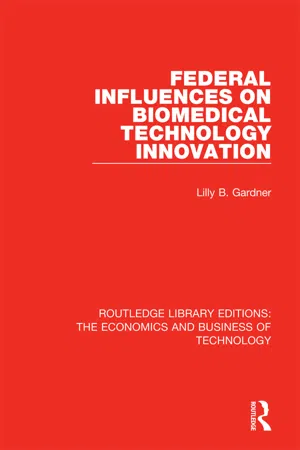
Published in 1994, this book examines a small segment of the medical technology innovation process to characterize the manner in which the federal government influences small business-based investigators to participate or withdraw from the medical technology innovation process. It provides an historical account of the federal government's involvement in biomedical technology research and development, and traces the social and economic significance of this involvement.
- 170 pages
- English
- ePUB (mobile friendly)
- Available on iOS & Android
eBook - ePub
Federal Influences on Biomedical Technology Innovation
About this book
Trusted by 375,005 students
Access to over 1.5 million titles for a fair monthly price.
Study more efficiently using our study tools.
Information
VII
Results and Discussion
The classification system developed for this study provides a means to evaluate federal incentives and disincentives to participate in the biomedical innovation process at two levels. The first describes those actions and events likely to be encountered by most would-be participants in the biomedical innovation process. The second level identifies those actions and conditions which indirectly facilitated or hampered participation in the innovation process. These are described in detail below.
PRIMARY INCENTIVES
Using the NIH Division of Research Grants (DRG) historical financial data presented in Table 1, it was determined that the SBIR program offered the company the strongest alternative to obtain funds for biomedical technology R&D. The DRG funding data revealed only token awards were made to private/for profit organizations before 1983. Because the increases in private sector awards noted from 1983 through 1986 were directly related to the phasing in of SBIR legislation and the fact that the company qualified as a small business, the SBIR was chosen.
Table 2 identifies the Primary Incentives noted in the review of the SBIR as a potential funding source. Incentives include partial, or sometimes, total funding for one or more steps of the innovation process up to the point of commercialization, a set-aside program specifically designed to advance the innovation process, and strong program support from the Small Business Administration. These Primary incentives are discussed in detail below.
Table 1
Domestic Awards Made by NIH for Fiscal Years 1981 Through 1986 by Performera
Domestic Awards Made by NIH for Fiscal Years 1981 Through 1986 by Performera
| Fiscal Year | Number | Dollars | Number | Dollars |
| Public | Private/Non Profit | |||
| 1981 | 9,177 | 931,932,554 | 8,909 | 1,213,773,408 |
| 1982 | 8,850 | 957,636,218 | 8,712 | 1,258,918,449 |
| 1983 | 9,133 | 1,059,221,876 | 9,151 | 1,419,964,622 |
| 1984 | 9,383 | 1,213,767,270 | 9,464 | 1,610,227,379 |
| 1985 | 9,985 | 1,411,190,543 | 9,932 | 1,840,391,104 |
| 1986 | 10,212 | 1,469,701,234 | 10,090 | 1,915,654,749 |
| Profit/Large & Unknown | Profit/Small | |||
| 1981 | 0 | 0 | 3 | 40,512 |
| 1982 | 2 | 210,436 | 8 | 531,728 |
| 1983 | 12 | 1,045,415 | 139 | 7,776,509 |
| 1984 | 17 | 1,970,402 | 271 | 23,942,617 |
| 1985 | 16 | 1,936,673 | 373 | 36,722,911 |
| 1986 | 12 | 1,209,336 | 478 | 49,531,772 |
a Data provided by NIH, DRG.
Table 2
Primary Incentives that were Noted in the Review of the SBIR Program as a Potential Funding Source for this Case-Study
Primary Incentives that were Noted in the Review of the SBIR Program as a Potential Funding Source for this Case-Study
| Generous funding for R&D—Sponsoring agency partially funds the entire innovation process or fully funds one or more steps. |
| Contracting policy—Sponsoring agency decides on a solicitation strategy to enhance private sector response. |
| Patent, copyright, and rights-in-data policy—Sponsoring agency makes agreement with developer regarding disposition of proprietary claims over the patent. |
| Lobbying and testimonies—Efforts by sponsoring agency personnel to influence budgetary or legislative processes. |
| Continuous Funding Cycle—Application cycle offers multiple opportunities to submit applications each Fiscal Year. |
Generous Funding for R&D
Under the phase-in SBIR legislation, all participating agencies, including NIH, were obligated to set-aside one and one-half percent of their R&D budgets by 1986, for small firms to develop commercial applications of federally funded research. This represents a small percentage of the total NIH biomedical research budget. Even so, these funds go a long way toward providing funding for R&D work by many small, innovative science and technology-based companies (USGAO, 1987). This program offered a means to acquire total support for at least two phases of multiple R&D activities. This was considered to be quite generous.
Contracting Policy
In the case of the SBIR program, the contracting policy is dictated by P. L. 97-219, the Small Business Innovation Development Act (SBDA). NIH determines the solicitation strategy through the development of their Omnibus Solicitation publications for both grants and contracts. These contain numerous areas of research interest to the government and reflect current agency planning. The set-aside legislation guarantees that at least one and one-half percent of the agency’s total research budget will go to small businesses pursuing projects of interest to the federal government.
Patents, Copyrights, and Rights in Data
Small firms are able to retain rights in inventions and technical data derived from the funded work. As was discussed in Chapter V, the SBIR program differs from th...
Table of contents
- Cover
- Half Title
- Title Page
- Copyright Page
- Table of Contents
- Preface
- Health and Government
- Federal Involvement
- Social Significance
- Economic Significance
- The Role of the Investigator
- Investigative Procedures
- Results and Discussion
- Conclusions and Recommendations
- Glossary of Terms
- Appendix A
- Appendix B
- Appendix C
- Appendix D
- References
- Index
Frequently asked questions
Yes, you can cancel anytime from the Subscription tab in your account settings on the Perlego website. Your subscription will stay active until the end of your current billing period. Learn how to cancel your subscription
No, books cannot be downloaded as external files, such as PDFs, for use outside of Perlego. However, you can download books within the Perlego app for offline reading on mobile or tablet. Learn how to download books offline
Perlego offers two plans: Essential and Complete
- Essential is ideal for learners and professionals who enjoy exploring a wide range of subjects. Access the Essential Library with 800,000+ trusted titles and best-sellers across business, personal growth, and the humanities. Includes unlimited reading time and Standard Read Aloud voice.
- Complete: Perfect for advanced learners and researchers needing full, unrestricted access. Unlock 1.5M+ books across hundreds of subjects, including academic and specialized titles. The Complete Plan also includes advanced features like Premium Read Aloud and Research Assistant.
We are an online textbook subscription service, where you can get access to an entire online library for less than the price of a single book per month. With over 1.5 million books across 990+ topics, we’ve got you covered! Learn about our mission
Look out for the read-aloud symbol on your next book to see if you can listen to it. The read-aloud tool reads text aloud for you, highlighting the text as it is being read. You can pause it, speed it up and slow it down. Learn more about Read Aloud
Yes! You can use the Perlego app on both iOS and Android devices to read anytime, anywhere — even offline. Perfect for commutes or when you’re on the go.
Please note we cannot support devices running on iOS 13 and Android 7 or earlier. Learn more about using the app
Please note we cannot support devices running on iOS 13 and Android 7 or earlier. Learn more about using the app
Yes, you can access Federal Influences on Biomedical Technology Innovation by Lilly B. Gardner in PDF and/or ePUB format, as well as other popular books in Business & Business General. We have over 1.5 million books available in our catalogue for you to explore.