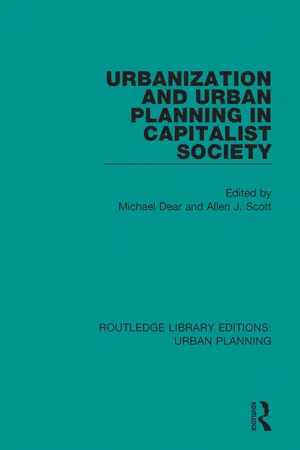
Originally published in 1981, Urbanization and Urban Planning in Capitalist Society, is a comprehensive collection of papers addressing urban crises. Through a synthesis of current discussions around various critical approaches to the urban question, the book defines a general theory of urbanization and urban planning in capitalist society. It examines the conceptual preliminaries necessary for the establishment of capitalist theory and provides a theoretical exposition of the fundamental logic of urbanization and urban planning. It also provides a detailed discussion of commodity production and its effects on urban development.
eBook - ePub
Urbanization and Urban Planning in Capitalist Society
- 650 pages
- English
- ePUB (mobile friendly)
- Available on iOS & Android
eBook - ePub
Urbanization and Urban Planning in Capitalist Society
1 Towards a framework for analysis
Michael Dear and Allen J. Scott
Introduction
The purpose of this book is to examine the structure, logic and historical manifestations of urban land use and space as outcomes of private and political decision-making within capitalism. Two specific themes are vital to our analysis, and they intersect decisively at various points in the following text. A first theme concerns the organization of urban form and structure as the tangible expression of the private locational decisions of firms and households (the basic behavioural units of civil society). The logic of these decisions is derivative from the logic of the wider capitalist social formation, and it leads persistently to the emergence of social problems and predicaments which in turn call for urban planning. A second theme, therefore, concerns the genesis and character of urban planning (collective urban intervention) as the capitalist State confronts the problems and predicaments of the urban system. As these two themes intersect, there emerges a conceptualization of the urban process as the composite reflection of a system of private and public land-use decisions in the specific context of the capitalist mode of production. This book, in brief, is not just about social processes in cities; it is also about the basic historical tendencies and internal order of cities.
It is only with the recent emergence of various Marxian, neo-Marxian and critical analyses of the city that a mature, comprehensive treatment of this topic has become possible. Existing mainstream approaches to urbanization and planning have tended to be eclectic and partial, in that they are divorced from any wider theory of capitalist society. At the same time, these approaches have tended to erect artificial barriers between the concepts of urbanization and the concepts of planning that they advocate. The manifest shortcomings of these approaches and their self-imposed limitations have been discussed in several recent critical statements (cf. Castells 1977a; Harloe 1977; Harvey 1973; Tabb and Sawers 1978). Here, we shall proceed directly to an examination of an alternative, historically-rooted view of urbanization and planning as a composite social event. This view is now evolving from the revival of historical materialism that is currently proceeding throughout the social sciences. One of the main points of departure in this revival is the proposition that modern urban phenomena are comprehensible only in the context of some prior analysis of the production and reproduction relations of capitalism. In short, urbanization is decipherable only as a mediated outcome of the social dynamics and imperatives of the capitalist mode of production in specific conjunctural circumstances. This basic viewpoint is beginning to engender a wide and energetic discussion about the urban question and the rational foundations of urban politics.
The intent in this book is to capture and to elaborate upon some of the main axes of this discussion. In what remains of this introductory chapter we provide an elementary guide to the main articulations of the urban question in the light of a historical materialist theory of knowledge and action. The chapters that follow take up the discussion and explore its various ramifications through a wide variety of urban processes and historical situations.
The bases of an analytical orientation
Let us begin with this simple proposition: neither urbanization in general, nor urban planning in particular, constitute independent, self-determinate occurrences. On the contrary, they are social events, embedded within society, and deriving their logic and historical meaning from the general pattern of society as a whole. These assertions, of course, provide no clues as to the nature of this general pattern. Nor do they (as yet) yield any insights into the ways in which this pattern is mediated and re-ordered by the specific processes of urbanization and planning. What they do affirm, however, is the self-evident (though, in practice, widely overlooked) notion that urbanization and planning can never be effectively treated as objects of theoretical study divorced from some wider theory of society.
Historical materialism and the capitalist mode of production
What, then, are the necessary features of this wider theory of society? Four features in particular would seem to be crucial. These capture essential levels and moments of social and historical reality, and together make conceptually coherent the disparate and fractured nature of social and urban life. First, this theory should establish a definition of society as a total and evolving structure. Second, it must elucidate the mechanisms whereby society is physically reproduced, i.e. it must identify the material foundations of society in terms of a web of forces and relations of production. Third, it must be capable of demonstrating how the life-projects, intentionality and character of individual human beings in society are engendered and maintained. Fourth, it must be capable of illuminating and guiding human action; in other words, it should be policy-relevant in that it is self-concious about matters of social and political change. These four points seem to provide the essential foundations of any reasonably powerful analytical-cum-political statement about the function and purpose of human society. There remain, of course, many questions about the manner in which any such statement should proceed, and we do not automatically preclude the possibility that it does not (or cannot) exist. If, however, some viable wider theory of society cannot be discovered, then social enquiry must surely fall into eclecticism, disjointedness and an arbitrary empiricism.
Now, of all existing systems of discourse, only one makes any definite claim to attack with coherence and historical self-awareness the four main points outlined above. This is the problematic of historical materialism, with its specific theoretical concept of human history as an interlocking system of modes of production. In particular, the Marxian and neo-Marxian theory of the capitalist mode of production constitutes a powerful framework for analysis of contemporary social issues. The various papers in this book attempt, with varying degrees of explicitness, to understand the phenomena of urbanization and planning by situating them in a theoretical context that is either historical materialist in some clearly identifiable way, or is at least consistent with and allied to a historical materialist (as opposed to a mainstream) position. Furthermore, the majority of these papers seek to imbue urbanization and planning with a specific social content by intentionally relating them to the capitalist mode of production.
This effort to derive a theory of urbanization and planning from a more fundamental theory of capitalist society does not presuppose that the debate on this latter issue has been foreclosed. On the contrary, there remains considerable disagreement within and around the problematic of historical materialism as to what constitutes an acceptable theory of capitalist society. (This is exemplified by the debate recently set off by Hindess and Hirst (1977) on the notion of concrete social formations versus abstract modes of production). At the same time, and as a corollary, there is a vital and widely-ranging debate at every level of analysis in the chapters that follow – from questions on the basic theory of knowledge to the political meaning of collective intervention in the urbanization process. What this debate avoids, however, is the rootlessness and capriciousness that characterize so much existing (mainstream) social and urban theory. It is, by contrast, rendered coherent – and analytical and politically productive – by a common agreement that what constitutes an acceptable universe of discourse must always coherently address the four basic points identified above.
The urban question
Despite our earlier assertion that urbanization and planning can only be understood in the context of some global concept of society, this does not mean that effective discussion of these phenomena simply dissolve away into a matrix of more fundamental propositions. To be sure, urbanization and planning are mediated out of a wider system of social processes, but they also retain an authenticity and significance as questions at their own specific level of analysis. The pessimistic view of Castells (1977b: 62), who asserts that ‘urbanization is neither a specific real object nor a scientific object’ is most certainly wrong in emphasis, if not in substance.
A specifically urban question does indeed exist. It is structured around the particular and indissoluble geographical and land-contingent phenomena that come into existence as capitalist social and property relations are mediated through the dimension of urban space. The urban question is composed of a set of integrated facets, each of which poses a further question at its own level of resolution. A first facet involves the ways in which the private behavioural entities of modern capitalist society (i.e. firms and households) interact with one another to produce a land use system. A second facet involves consideration of the dynamics of social and institutional breakdown in the urban land-use system, and the concomitant imperative of urban planning. A third facet involves an analysis of the genesis, trajectory and consequences of urban planning. Finally, from these particular questions, there emerges a composite question as to the evolutionary development of the modern city. This question revolves around the interdependent decisions and actions of firms, households and planners in a general urban system consisting of an integrated hierarchy of land-use complexes. It is our contention that, while these various questions are embedded within the wider structure and logic of capitalism, they nevertheless address themselves to analytical problems and human predicaments that cannot be automatically read off from the overarching capital-labour relation.
The city, then, is considerably more than a locale in which the grand, unmediated events of the class struggle are played out. The city is a definite object of theoretical enquiry (though we reaffirm that any thorough urban analysis must be situated within the wider problematic of the historical materialist theory of capitalism). We need, at this stage, to outline the internal order of the capitalist mode of production; and then, from this, to construct detailed statements on the specific properties of capitalist urbanization and planning.
The structure of capitalist civil society and the capitalist State
We here provide a brief, much-simplified description of the form, dynamics and imperatives of capitalist civil society and the capitalist State.
Commodity production in capitalism
The inner core of capitalist society consists of the institution of commodity production. This institution may be characterized as a general social process in which capitalist firms take materials and equipment, combine these with live labour, and then sell the resulting output at prices that secure for producers at least a normal rate of profit. Capitalist society presents itself as a bipartite system of production relations, comprising commodity producers (capitalist firms, together with an associated constellation of directorial, managerial, and stockholder interests) and workers (blue collar and white collar). These production relations coincide, imperfectly but decisively, with the basic allocation of authority and subordination in capitalist society, in that: (a) the meaning and purposes of capitalism (production for accumulation) are ultimately defined by the interests of commodity producers; and (b) the global social structures and processes of capitalism, into which the populace is socialized (e.g. the division of labour, the dynamics of applied technology, the pattern of urbanization, etc.) remain largely outside the domain of deliberate collective decidability. These social structures and processes emerge out of the dynamics of capitalist society, but they are not freely chosen, nor are they usually changeable except after arduous struggle and political conflict. Even so, contemporary capitalism is by no means simply reducible to a rigid model, consisting of a binary social structure of opposing capitalist and proletarian classes. For, around the basic capital-labour relation, there exist many different social groups which enormously complicate the patterns of social and political alliances in capitalism. As the essays in this volume show, one of the significant expressions of this complexity is the modern city, where territorial divisions and conflicts consistently breach class divisions and conflicts.
In spite of the constant mutations of capitalist production relations through time, and in spite of the increasing ambiguity of their contingent structural forms, the production of commodities in order to generate profit remains the central motor of capitalist society. It is the key to understanding the dynamics of capitalism. In particular, as a consequence of the competition among commodity producers for markets, the profits earned in commodity production are persistently ploughed back (i.e. accumulated) into expanding the bases of production. Two conditions are essential to the success of this fundamental process, and hence to the continued viability of capitalism. The first is that internally engendered limitations on the processes of production, exchange, and accumulation must be controlled or eliminated. The second is that there must be a constantly available labour force which is effectively socialized into the basic rationality of the production, exchange, and consumption of commodities. In particular, labour must be physically, mentally and morally equipped to perform the tasks of commodity production. Neither of these vital conditions is spontaneously and automatically guaranteed by purely capitalistic processes of production and exchange. On the one hand, commodity production itself is latent with self-disorganizing tendencies, such as crises of overproduction, market failure, monopolization, and so on. On the other hand, the reproduction of the labour force depends in part on unpredictable personal and psychological dynamics which constantly threaten to undermine the perpetuation of an effective, compliant and disciplined labour force.
Emergence of the capitalist State
The inability of capitalism spontaneously to regenerate itself is clearly a major dilemma. A further threat to the stability of capitalism derives from the immanent class conflict between commodity producers and the labour force, and this conflict often erupts into overt political struggles. Out of these dissonances, and the concomitant threat of social disorder, there emerges an overarching historical imperative. This is the social necessity for the appearance of some mediating agency, invested with certain powers of social control, and capable of re-establishing vital social institutions when their existence is in some way threatened.
Thus it is that the State makes its irreversible appearance as the collective guarantor of production and reproduction relations in capitalist society. On the one hand, the State continually seeks to facilitate accumulation by attempting to ensure that (capitalistically) rational allocation and disposition of resources. On the other hand, it intervenes in the reproduction process in matters of housing, education, medical care, social work and so on. Further, by maintaining a continuous, ideological discourse about its own purposes and functions, and about the positive aspects of social life, the State seeks to legitimate the existing order of things, and to maintain in equilibrium (by physical force, when necessary) the tense internal balance of commodity-producing society. However, although the State is invested with powers of social control, it in no way establishes itself as the ultimate arbiter of all social activity. For the State is embedded in, and takes its meaning from, the general structure of commodity-producing society. Its actions are manifestations of the imperatives of that society, and not of purely self-engendered inclinations. Simply expressed, the State is bound by the very structure of the society that it oversees. Hence, the State in capitalism has no mandate to re-organize the foundations of society. Its mandate is, instead, to maintain those very foundations while engaging in remedial reforms that leave the main structure and purposes of society intact. As a corollary, the capitalist State (existing as it does in a society that is ordered by democratic and market institutions) cannot exist as the private preserve of some privileged or dominant élite. This does not mean, however, that the State in capitalism is somehow perfectly neutral and unbiased. Simply by maintaining the existing social order, the State simultaneously maintains existing relations of authority and subordination in capitalism.
As the capitalist State evolves historically, it interacts with civil society in a process of response and counter-response. Civil society continually encounters internally generated predicaments that require the remedial intervention of the State. Then, as the State intervenes, so society moves forward to a new stage of development, in which new predicaments calling for further state intervention make their appearance. This spiral of events changes society’s external form through time, although society’s inner logic remains relatively unchanged. As we shall see, such interdependencies between the State and civil society are nowhere more evident than in the domain of the city, which is the ever-changing expression of interactions between private firms and households and urban planners as these interactions are mediated through space.
Urbanization and planning
We are now in a position to make a concise statement about the historical appearance of an urbanization process in capitalism, and about the internal order and dynamics of this process. For the sake of clarity, let us reaffirm that urbanization and planning constitute an integrated social event which is outwardly manifested in the form of a hierarchy of complex, dense and highly polarized land-use systems. Within these systems, civil society (firms and households) and the State (urban planners) interact with each other in highly specific and often analytically puzzling ways.
The urbanization process
Initially, cities in capitalism emerge out of the economic imperatives of commodity production and exchange. Given, in particular, the insistent profit-maximizing drives of commodity producers, the spontaneous development of spatially concentrated clusters of industrial fir...
Table of contents
- Cover
- Half Title
- Title Page
- Copyright Page
- Table of Contents
- Preface to the 2018 Edition
- Notes on contributors
- Preface
- I The urban question
- 1 Towards a framework for analysis
- II Prolegomena to a theory of urbanization and planning
- 2 Capitalism, accumulation and the explanation of urban phenomena
- 3 The State in capitalism and the capitalist State
- 4 Some reflexions on epistemology, design and planning theory
- III Urbanization and planning in capitalist society
- 5 The urban process under capitalism: a framework for analysis
- 6 The urban land question
- 7 Urban planning in early and late capitalist societies: outline of a theoretical perspective
- 8 Notes on comparative urban research
- IV Commodity production and urban development
- 9 The UK electrical engineering and electronics industries: the implications of the crisis for the restructuring of capital and locational change
- 10 Policies as chameleons: an interpretation of regional policy and office policy in Britain
- 11 The property sector in late capitalism: the case of Britain
- 12 The new international division of labor, multinational corporations and urban hierarchy
- V Reproduction and the dynamics of urban life
- 13 Community and accumulation
- 14 Accumulation versus reproduction in the inner city: The Recurrent Crisis of London revisited
- 15 A theory of suburbanization: capitalism and the construction of urban space in the United States
- 16 Capitalism and conflict around the communal living space
- 17 Homeownership and the capitalist social order
- 18 Social and spatial reproduction of the mentally ill
- VI Urbanization and the political sphere
- 19 The analysis of state intervention in nineteenth-century cities: the case of municipal labour policy in east London, 1886–1914
- 20 Amnesia, integration and repression: the roots of Canadian urban political culture
- 21 The relative autonomy of the State or state mode of production?
- 22 The apparatus of the State, the reproduction of capital and urban conflicts
- Author index
- Subject index
Trusted by 375,005 students
Access to over 1.5 million titles for a fair monthly price.
Study more efficiently using our study tools.
Frequently asked questions
Yes, you can cancel anytime from the Subscription tab in your account settings on the Perlego website. Your subscription will stay active until the end of your current billing period. Learn how to cancel your subscription
No, books cannot be downloaded as external files, such as PDFs, for use outside of Perlego. However, you can download books within the Perlego app for offline reading on mobile or tablet. Learn how to download books offline
Perlego offers two plans: Essential and Complete
- Essential is ideal for learners and professionals who enjoy exploring a wide range of subjects. Access the Essential Library with 800,000+ trusted titles and best-sellers across business, personal growth, and the humanities. Includes unlimited reading time and Standard Read Aloud voice.
- Complete: Perfect for advanced learners and researchers needing full, unrestricted access. Unlock 1.5M+ books across hundreds of subjects, including academic and specialized titles. The Complete Plan also includes advanced features like Premium Read Aloud and Research Assistant.
We are an online textbook subscription service, where you can get access to an entire online library for less than the price of a single book per month. With over 1.5 million books across 990+ topics, we’ve got you covered! Learn about our mission
Look out for the read-aloud symbol on your next book to see if you can listen to it. The read-aloud tool reads text aloud for you, highlighting the text as it is being read. You can pause it, speed it up and slow it down. Learn more about Read Aloud
Yes! You can use the Perlego app on both iOS and Android devices to read anytime, anywhere — even offline. Perfect for commutes or when you’re on the go.
Please note we cannot support devices running on iOS 13 and Android 7 or earlier. Learn more about using the app
Please note we cannot support devices running on iOS 13 and Android 7 or earlier. Learn more about using the app
Yes, you can access Urbanization and Urban Planning in Capitalist Society by Michael Dear, Allen Scott, Michael Dear,Allen Scott, Michael Dear, Allen J. Scott in PDF and/or ePUB format, as well as other popular books in Physical Sciences & Geography. We have over 1.5 million books available in our catalogue for you to explore.