Originally published in 1968. Corporate planning is now an established part of management thinking. John Argenti had a large part to play in introducing the technique to British management. His book shows how the manager can apply corporate planning in his own company with a very clear idea of why he is introducing it, what to expect from it, how to start, and what to avoid. This title will be of interest to students of business studies and management.
- 268 pages
- English
- ePUB (mobile friendly)
- Available on iOS & Android
eBook - ePub
CHAPTER IV
Step 1. Determine The Objective
A philosophical step - the corporate planner starts work -some objectives are proposed and tested - three different types - ‘survival’.
THE reader will recall that Step 1 of the Five Step process was described in Chapter II as follows:
‘Determine the company’s objective and decide on a target.’ It was also stated in Chapter I that although this book is intended as a practical guide, the more theoretical aspects of corporate planning must not be ignored. In fact, and this is the best moment to say this, unless the theory holds water the practice will not hold water either. Corporate planners who put an ill-conceived theory into practice run the risk of finding flaws in the system after they have recommended a company to take some action that is later discovered to be ill-founded. Certain parts of the corporate planning process result almost entirely from logical considerations while other parts are largely of a practical, empirical nature.
The parts most dependent on logic are the first stage of Step 1 and the first stage of Step 4 - i.e. ‘determine the objective’ and ‘decide constraints’; this latter will be discussed in Chapter X. There is, perhaps, more need for the philosophical discussion of management principles and practice than is often realized by managers, some of whom seem to think that as men of action they are called upon only to take prompt and vigorous action to do their job. Some deep reflection on basic premises might not be out of place, however, and at this first stage in the corporate planning process it is particularly appropriate.
The purpose of the next few chapters is to describe the corporate planning process. The best way of doing this is possibly to follow the route that would be taken by a corporate planner from the start of his task to its completion - by so doing the difficulties that he may meet can be discussed in the order and in the context in which he will meet them in real life.
The corporate planner starts work
He will be able to start work on ‘determining the objective’ the very day he starts his job as a company’s corporate planner. This is because at this stage he need know almost nothing about the company he is working for since the objective of every company is the same. In spite of this universality of objective few companies have thought out what it is and the corporate planner’s first job is to act as a catalyst in the company’s efforts to define it.
Before trying to decide what a company’s objective is it is sensible to ask what the word means. The objective for which the corporate planner is looking is something fundamental to the nature of a company and which distinguishes it from other types of organization; it is therefore something permanent and unalterable. It is the reason for the very existence of the company, that for which it came into being and what it is for now. It is that which, if the company fails to achieve it, the company itself fails. It is its permanent unalterable purpose or raison d’etre.
Some objectives are proposed and tested
The corporate planner can now start asking the company’s directors to suggest what they think their company’s objective is, but it is so important to identify the objective correctly-everything else that the company does depends on this - that he will submit each of their suggestions to three test questions designed to establish whether they are indeed the permanent unalterable raison d’etre of the company. The directors will probably make several suggestions as to what the objective may be; for example:
- To increase our share of the market,
- To increase the volume of sales,
- To lead our industry in technology,
- To increase production,
- To be good employers,
- To make a profit.
Now let us test the first of these - ‘to increase our share of the market’. Since a company’s objective is something permanent and unalterable, we would expect the company never to abandon it. So if we asked ‘under what circumstances would the company not try to increase its share of the market?’ we would expect the answer ‘none’. But we do not get that answer to this question. There are many occasions when a company might not aim to increase its share of the market. If it had 2 or 3 per cent of the market it might, by increasing its share to, say, 5 per cent, attract the unwelcome attention of a large competitor. Or if it had 31 per cent of the market it might, by increasing it to over 33\ per cent, attract the attention of the Monopolies Commission. If the market was subject to violent fluctuations or if it was contracting, the company might prefer to diversify into some other market rather than increase its share of the present one.
‘To increase our share of the market’ has failed the first test question, but even so, the other two questions should be tried. If this suggestion really was a genuine objective we would expect the reply to the question, ‘why does the Company want to increase its share of the market’ ? to be, ‘in order to survive’, since we also defined the company’s objective as its raison d’etre - i.e. reason for continuing in existence. But we do not get this reply. We have noted that the company does not always wish to try to increase its share, but on the occasions when it does, it does so in order to improve its profits. Again, not a satisfactory answer, but we will try the third question, which is a contrary to the second: the second asked why the company wanted to do something, the third asks what would happen if the company failed to do it; it is a cross-check on the second question.
The third question, therefore, is, ‘If the company failed to increase its share of the market, would it fail as a company and therefore cease to exist’ ? If increasing its share of the market was the genuine objective, we would expect to be able to answer ‘yes’, but we do not get this answer; a company whose share of the market is not increasing may not be in a healthy state, but there are few cases when this failing alone could cause its demise.
This suggestion has failed all three test questions. ‘To increase our share of the market’ is not this company’s objective, nor is it any company’s in spite of some assertions to the contrary in some of the literature. The second suggestion, ‘to increase the volume of sales’ is so similar to the first that an identical set of replies would be obtained from the three test questions. The third suggestion was, ‘to lead our industry in technology’, and this will be put through the triple test quite quickly:
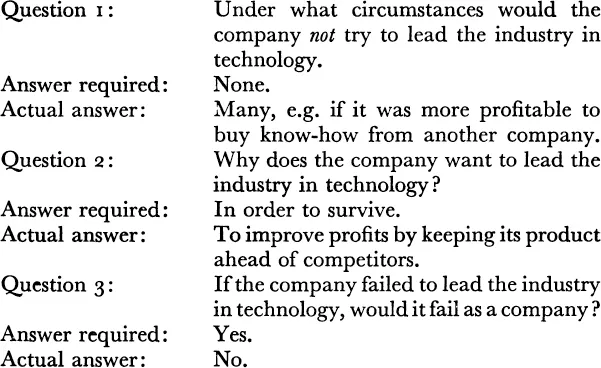
The pattern of answers obtained with this suggested objective is similar to the last two. A genuine objective would have given the answers:
- ‘None.’
- ‘In order to survive.’
- ‘Yes.’
but we have been obtaining the pattern:
- ‘If it did not improve profits.’
- ‘To improve profits.’
- ‘No.’
A similar pattern would be obtained with ‘to increase production’ and many other similar suggestions. However, two other possibilities remain in the list proposed by the directors: ‘to be a good employer’ and ‘to make a profit’. Test the first one:
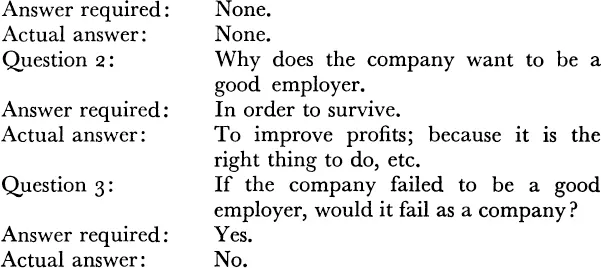
Now, although this suggestion has clearly failed to pass the test - it failed two out of three questions - it differs in kind from the previous ‘objectives’ tested in that under no circumstances would the company not try to be good employers (Question 1); for all the other ‘objectives’ in the list so far tested there were circumstances under which it might not try to achieve them. Even so, the ‘good employer’ suggestion has failed the test because it failed two of the questions.
Finally the last suggested objective must be tested: this was, ‘to make a profit’.
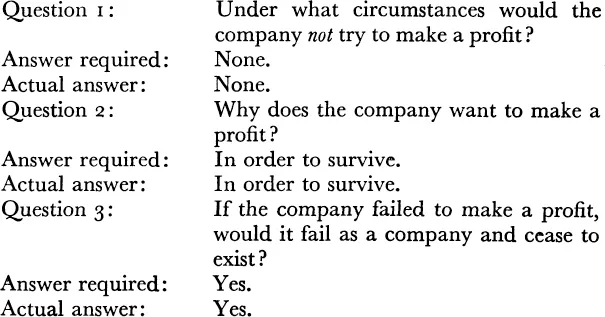
Quite evidently this has passed the test and the true objective of the company - indeed of all companies - is ‘to make a profit’. What a discovery! The reader will have met this statement with astonishment - ‘do you mean to tell me’, he will be saying, ‘that I have waded through the last few pages just to be told that - of course the objective of a company is to make a profit!’ But that is not the conclusion we have reached. The conclusion is that the only objective of a company is to make a profit. There is no other ‘objective’ whatever, in spite of the fact that most companies apparently think there are. Companies do not have several objectives, they have one, and only one.
Three different types
What, then, is the nature of the other suggested objectives that were listed on page 28 and which appear so often as objectives in books on management and in the Board Minutes of companies ? The three patterns of reply to the three questions were:
| Pattern A | Pattern B | Pattern C The True Objective |
| 1. If it did not improve profits | None | None |
| 2. To improve profits, etc. | To improve profits etc | To survive |
| 3. No | No | Yes |
Pattern A is obtained from suggestions that are really the means by which the company hopes to achieve its objective, that is to say, any action that the company believes will lead to an improvement in profits. If they do not think it will lead to an improvement then they will not do it.
Pattern B is obtained from suggestions that are constraints on the achievement of the objective, that is to say, any action that the company will not take - even if not taking it makes the objective harder to achieve, or any action the company feels it must take even though taking it makes the objective harder to achieve. Thus a company might wish to be good employers because by encouraging good human relations profits could be improved. But even if it could be proved that bad human relations actually caused an improvement in profits the company might decide that it would be morally wrong to foster bad human relations in order to improve profits. Means and Constraints are discussed at length later on,1 meanwhile let us summarize the last few pages in three definitions.
OBECTIVE. A company has one and only one permanent, unalterable raison d’etre, namely to make a profit.
MEANS are those actions which a company may take if it believes that they will improve profits. It will not take them if it believes they will not improve profits.
CONSTRAINTS are those actions which a company will take whether or not they improve profits because the company believes them to be the right things to do on moral grounds.
‘Survival’
There is one other suggested objective that has not been considered yet, because it is in a somewhat different logical category to the ones...
Table of contents
- Cover
- Half Title
- Title Page
- Copyright Page
- Dedication Page
- Contents
- I Introduction
- II Introduction to the Corporate Planning System
- III The Need for Corporate Planning
- IV Step 1. Determine The Objective
- V Step 1 . . . Who Decides How Much
- VI Step 1 . . . And Decide on a Profit Target
- VII Step 2 Prepare a Forecast
- VIII Step 2 . . . And Declare The Probable Error
- IX Step 3 Calculate The Gap and Decide The Task
- X Step 4 Determine The Constraints
- XI Step 4 . . . And Determine The Means
- XII Step 4 Draw Up The Policy Statements
- XIII Step 5 Draw Up The Plan
- XIV Monitoring, Revising, Timing
- XV How Far Ahead Should One Forecast?
- XVI Organizing For Planning
- XVII The Essence of Corporate Planning
- 1 Outline of the Five Step Process
- 2 List of Management Techniques
- 3 A Practical Application of Decision Theory
- 4 A Glossary of Terms
- Index
Trusted by 375,005 students
Access to over 1.5 million titles for a fair monthly price.
Study more efficiently using our study tools.
Frequently asked questions
Yes, you can cancel anytime from the Subscription tab in your account settings on the Perlego website. Your subscription will stay active until the end of your current billing period. Learn how to cancel your subscription
No, books cannot be downloaded as external files, such as PDFs, for use outside of Perlego. However, you can download books within the Perlego app for offline reading on mobile or tablet. Learn how to download books offline
Perlego offers two plans: Essential and Complete
- Essential is ideal for learners and professionals who enjoy exploring a wide range of subjects. Access the Essential Library with 800,000+ trusted titles and best-sellers across business, personal growth, and the humanities. Includes unlimited reading time and Standard Read Aloud voice.
- Complete: Perfect for advanced learners and researchers needing full, unrestricted access. Unlock 1.5M+ books across hundreds of subjects, including academic and specialized titles. The Complete Plan also includes advanced features like Premium Read Aloud and Research Assistant.
We are an online textbook subscription service, where you can get access to an entire online library for less than the price of a single book per month. With over 1.5 million books across 990+ topics, we’ve got you covered! Learn about our mission
Look out for the read-aloud symbol on your next book to see if you can listen to it. The read-aloud tool reads text aloud for you, highlighting the text as it is being read. You can pause it, speed it up and slow it down. Learn more about Read Aloud
Yes! You can use the Perlego app on both iOS and Android devices to read anytime, anywhere — even offline. Perfect for commutes or when you’re on the go.
Please note we cannot support devices running on iOS 13 and Android 7 or earlier. Learn more about using the app
Please note we cannot support devices running on iOS 13 and Android 7 or earlier. Learn more about using the app
Yes, you can access Corporate Planning by John Argenti in PDF and/or ePUB format, as well as other popular books in Business & Business General. We have over 1.5 million books available in our catalogue for you to explore.