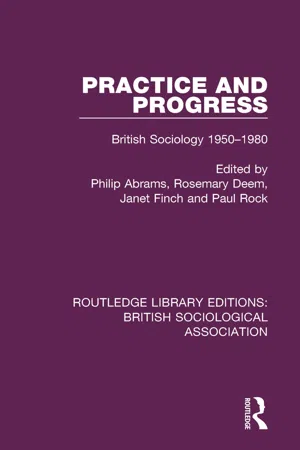
Originally published in 1981 Practice and Progress is a collection examining the changes that have occurred in the theories, methodologies and practices of sociology, in the institutional and educational setting of the subject, and in British society. The themes pursued include the professionalization of sociology its development and standing in the universities; the impact on it of Marxism and feminism and the major debates over positivism and empiricism, quantitative methods, linguistic analysis; and numerous other crucial methodological and theoretical concerns.
eBook - ePub
Practice and Progress
British Sociology 1950-1980
- 212 pages
- English
- ePUB (mobile friendly)
- Available on iOS & Android
eBook - ePub
About this book
Information
Part One
Intellectual Debates and Institutional Contexts
1
Professionalism in British Sociology
J. A. Barnes
Ever since the British Sociological Association was founded its members have argued about whether sociology, or sociologists, should become professional. With few exceptions members of the Association have not seriously questioned the value of sociology; their arguments have been about what kind of sociology is needed and how its practitioners should be identified and stratified. Recently, market forces conducive to professionalism have increased significantly. The debate has quickened accordingly but we should remember that professionalism has remained a perennial topic of controversy among British sociologists during the last thirty years, despite wide fluctuations in the market for sociologists. Similar controversies have occurred within the ranks of cognate disciplines during the same period and in other countries as well as in Britain (see Tapper, 1980).
Within the Association this debate has manifested itself mainly in arguments about who could join, how its membership should be stratified, what activities it should undertake and what relation it should have with government departments and agencies. The debate began before the Association started and continues both inside and outside its ambit. Despite the variety of arguments and proposals that have been advanced, the term ‘professional’ has, however, remained virtually unexamined and uncontested, both by those who champion professionalism and by those who oppose it. The corpus of writings on the sociology of the professions has grown prodigiously during the thirty years under review but has had little impact on how sociologists perceive their own backyard. Yet if sociology is to be taken as a significant enterprise, the entailments of professionalism in sociology must be examined in sociological terms, rather than by reference to native common sense and gut feelings.
Sociology in Britain does not start with the Association (see Abrams, 1968). Many of the standard American histories of sociology are quite contemptuous about the slow progress made in Britain during the formative period at the turn of the century when sociology was being established in the United States and on the mainland of Europe. For example, Barnes and Becker (1938, p. 794) write that ‘It is disconcerting to begin a survey of sociology in Great Britain with the necessary statement that it is almost as rare as gold in sea-water’. Nevertheless a Sociological Society was founded in 1903 by a group of academics and other professional men and women, most of them inspired by the writings of Frédéric Le Play. This group transformed itself into the Institute of Sociology and its journal, the Sociological Review, was still being published in 1939. It had however lost touch with the only academic centre of sociology in Britain, at the London School of Economics, and, partly because it concentrated its message on the evils of industrial civilisation, it was ignored when sociological teaching began to expand after 1945 (Farquharson, 1955). With more persons being trained in sociology and with the general public more conscious of both the need for and the possibility of social intervention, some new organisation for the mobilisation of common interest was clearly needed.
Discussions about the formation of a British sociological association began in 1950. Right from the start the issue of professionalism was on the agenda (Marshall, 1953; Tropp, 1956; Banks, 1967 and 1975). The promoters of the new association were generally agreed that there should be a two-tier membership distinguishing those potential supporters who had technical qualifications - academic, practical, or publications - though not necessarily in sociology, from those who lacked qualifications and simply had an interest in sociology. Applications for membership were soon received from persons who appeared to lie on the borderline between the categories and at least one associate member appealed successfully for reclassification as a full member. The two-tier system was abandoned after only two years because of the difficulties experienced in distinguishing between the two categories. It was to be replaced by a three-category scheme: students, who were to pay a lower subscription; the main body of ordinary members; and a third category, a select body of fellows who were to add lustre to the Association and at the same time be specially represented on the executive committee. At the annual general meeting in March 1952 several of those present made clear their doubts about the creation of a class of fellows. In December, at a meeting called to change the basis of membership, the general secretary made explicit the rationale behind the proposal for the creation of this elevated class. The Association, he said, had a dual function. On the one hand it was to be an organisation for all persons who, irrespective of qualifications, had an interest in sociology. But at the same time it was intended to be a learned society, engaged in advancing knowledge and raising standards of scholarship. This second function might be vested in a category of fellows. The executive committee, seeing itself as an administrative body, was however not able to specify the qualifications and functions of fellows and hence had no option but to leave the matter in abeyance for the time being. Accordingly the new constitution made no provision for fellows, though the executive committee did retain its right to refuse an application for membership. With this modification the new scheme was accepted.
Almost all the former associates accepted the invitation to become full members. Although the idea of an honorific class of fellows was never taken up again, a vestige of the idea survived in the creation in 1956 of the office of president, which was seen as a way in which the Association could honour eminent sociologists.
The proposal for a class of fellows, supported mainly by those senior members of the Association who sought to establish an orthodox professional structure for sociology, had been foiled by outspoken younger sociologists. In 1956 they counter-attacked with a conference on ‘The present state and development of professional sociology’ (Banks, 1967, p. 4) in which the initiative was taken by younger university teachers. In 1958 there was another proposal for the creation of a separate category of membership for professional sociologists, and a couple of years later an attempt to limit attendance at a conference on the teaching of sociology to teachers of sociology met with criticism. The two functions of the Association, as identified in 1952, were already working in opposite directions.
A group of members who wanted what Parkin (1979) calls an exclusionary strategy to provide them with a professional basis took a decisive step in 1961 by holding a closed conference for professional discussions relating to university teaching and research in sociology. The exclusionary flavour of this strategy was manifested not only in the impressively complicated set of criteria for membership of the Sociology Teachers’ Section which was established following the conference but also in the exclusion of professors from the conference itself. Those of the postwar generation who had been trained in sociology wished to mark themselves off from their elders who had moved into sociology from other disciplines, though in fact several leaders of this young group soon achieved professorial rank. The exclusiveness of the new section did not go unchallenged, particularly its exclusion of lecturers in sociology at teacher training colleges. On the other hand an independent suggestion was made at about this time that the membership list of the Association should indicate who was a professional sociologist and who was not.
At the end of the 1960s the Association, like many other groupings in the social sciences, felt the effect of the swing towards what we might call epistemological populism. The notion that some members knew more and knew better than others came under attack and in the minds of many the whole idea of professionalism began to be equated with repression. The vision of the Association as a learned society began to fade, and with it the goal of maintaining standards and advancing knowledge that had been one of the objectives of the Association’s founders. The Teachers’ Section, the only segment of the Association where exclusiveness was openly practised, was disbanded. The policy of the Association came to be more concerned with maintaining and increasing its membership, and with ensuring that within its own ranks all members had an equal opportunity to participate and decide.
The first twenty years of the Association’s existence were characterised by a sustained expansion in academic activity generally and in particular in social science teaching and research (see Fincham, 1975). The reversal of this trend, which by about 1976 had become unmistakable, had its effects on attitudes towards professionalism. Emphasis on consumer-sponsored research, increasing competition for academic posts and pressure on teachers and researchers alike to demonstrate the ‘relevance’ of their activities all pointed towards a greater emphasis on professional standards and to some form of supervision of credentials, if not yet to undisguised restrictions on recruitment and other features of credentialism. The initiative towards greater professionalism has come principally from outside the Association, though the summer schools and other training schemes sponsored by the Association do constitute a mild step in the professional direction. The main pressure, as I see it, has come from the Social Science Research Council (SSRC) which is itself subject to pressure from the government and other research councils. For the first decade or so of its existence the SSRC took the same attitude towards the social science disciplines as the executive committee of the Association had taken, ten or more years earlier, toward the nomination of fellows. The Council avoided, as far as possible, making judgements about the relative merits of university departments and abstained completely from telling them what they should teach their graduate students. With the growth in the number of potential outlets the Council considered itself forced to discriminate and thus, however reluctantly, to develop standards for recognition which, to be politically acceptable, must be couched in universalistic terms. It therefore seems likely that the task of maintaining standards or, to speak more bluntly, of imposing intellectual criteria, may be pre-empted by the SSRC, and perhaps by other major sponsors, rather than remaining latent in the hands of a democratic Association.
If the Association has, so far, failed to function as a learned body, as an Academy of Fellows of Sociology, what about other aspects of its corporate life? Because my concern in this chapter is with professional sociology I need comment only briefly on the success or failure of the Association as a body open to all with an interest in sociology, irrespective of qualifications, as this is reflected in the size and distribution of its membership. The experience of other associations in the past might seem to suggest that there is no inherent incompatibility between the activities of an open, or nearly open, association and the pursuit of professional objectives. In certain contexts a large body of passive affluent lay members may continue happily to subsidise the activities of a small core of active but impoverished professionals who speak at meetings, edit journals and dominate committees. For better or worse the Association has never experienced this state of affairs. Now that the learned lecture, illustrated with magic lantern slides, has been superseded by television as the relaxation of the upper middle class, this option is probably no longer available to the Association.
Two other aspects of the Association’s activities have a more direct bearing on the phenomenon of professionalism. In a well-established profession, medicine being a good example, there is a division of labour between the learned body and the professional association, narrowly defined. A learned body exists to seek truth and promote scholarship, unsullied by material and ephemeral considerations; the Royal Society of Medicine seems to fill this niche. The professional association, in this case the British Medical Association, is then left free to concentrate its energies on the defence and furtherance of the mundane interests of the professionals, their remuneration, legal protection, and the like. The two activities cannot be carried on entirely independently but they are sufficiently distinct to make good sense of an organisational disjunction. What, then, of sociology, a discipline less well entrenched and much smaller than medicine? If the Association functions with only limited success as a learned body, does it do better as an organisation protecting the collective interests of sociologists?
Just as opinion within the membership of the Association has been divided about the merits of professionalism as an intellectual stance, so there have been divided counsels about the defence of mundane collective interests. The proposal to introduce a category of fellows, and later the restrictions on the rights of student members, may both be seen as moves to protect the interests of segments of the membership against those of the rest. These were internal conflicts. When the Association was first established there seems to have been no discussion of how or whether it might represent the interests of sociologists to other bodies. As early as 1952, however, the Association appointed a committee to study the recruitment, training and employment of sociologists (Banks, 1967, p. 3). This step was taken at a time when the SSRC did not exist and when grants for research and postgraduate training in sociology were much harder to obtain than was the case some fifteen years later. The committee was concerned to discover what positions would be available for sociologists outside the confines of academia. It discovered that very few sociology graduates were unemployed. For our present purpose what is of interest is the perception held by this committee about the aims of the Association. The compatibility of the committee’s inquiries with the newly acquired charitable status of the Association was queried. A suggestion that the Association should carry out a study of the employment possibilities open to those who graduated in 1953 was rejected on the grounds that the Association was not a research organisation and that ‘an enquiry of this kind would inevitably have the character, not of disinterested scientific research, but of a preoccupation with the material interests of its members which would be inconsistent with the aims of the Association’ (British Sociological Association, 1953). Despite these objections, surveys of the employment of sociology graduates were carried out under the aegis of the Association from time to time (Banks, 1954; Banks and Banks, 1956; Banks, 1958; Abbott, 1969; and see Smith, 1975).
A different view of the Association’s role was expressed forcefully by a speaker at the AGM of March 1957, when the charitable status of the Association appeared to some members as an unwelcome constraint on their freedom of action. Following a proposal that the Association should be regarded first and foremost as a professional body and secondarily as a charitable organisation, the meeting agreed that the Association should proceed experimentally with any activity it thought appropriate until such time as this might in law be ruled as incompatible with its charitable status, whereupon the matter should be reconsidered. After this shaky start the Association has continued to take an interest in the position of sociology graduates in the workforce. The propriety of the Association concerning itself with the material interests of its members seems never again to have been queried.
Nevertheless a broad interest in the welfare of its members is a very weak substitute for collective bargaining over pay and conditions of service, as practised by some professional associations. The Association has never come near to doing this, partly because this activity has been pre-empted, for much of its membership, by bodies such as the Association of University Teachers and partly, I think, because the Association has never resigned itself to being an association of sociologists in one form of employment only, namely, of academic sociologists and sociologists elsewhere in higher and further education. Even if the interested lay public has become a relatively insignificant residual category in its membership, the Association certainly hopes to attract teachers of sociology in schools and, probably the largest category of all, those working on social surveys and other empirical inquiries within government departments, and commercial enterprises, including market research and opinion polling. With such diversity in the conditions of employment of its members, potential or actual, it is not surprising that the Association has never tried to negotiate with employers on their behalf.
Maybe this diversity provides part of the explanation for the absence of any moves, or rather of any successful moves, towards credentialism and its negative aspect, professional censure (Parkin, 1979, pp. 54-60). For example, no discussion of a professional code of ethics seems to have taken place in the Association until 1966. A few years later a fairly simple set of guidelines was adopted (Stacey, 1968; British Sociological Association, 1970). As with the ethical codes of almost all professional associations, there are no effective sanctions to enforce its injunctions. The Association does not issue certificates of good standing and has nothing to withdraw from those of its members who ignore its ethical norms. Expulsion from the Association carries no dire consequences; indeed, there are many active sociologists, including some who are academically eminent, who do not belong to the Association (see Hawthorn, 1975). The Association’s committee on professional ethics serves a useful purpose but, like the few other ethics committees I know about, is concerned with the rights and wrongs of members as academics rather than as sociologists (see Anonymous, 1975).
The other aspect of the Association’s activities which bears on ...
Table of contents
- Cover
- Half Title
- Title Page
- Copyright Page
- Contents
- Introduction
- Part One Intellectual Debates and Institutional Contexts
- Part Two Sociological Knowledge: Creation and Practice
- Part Three Marxism and Feminism: Radical Interventions in Sociology
- Bibliography
- Index
Trusted by 375,005 students
Access to over 1.5 million titles for a fair monthly price.
Study more efficiently using our study tools.
Frequently asked questions
Yes, you can cancel anytime from the Subscription tab in your account settings on the Perlego website. Your subscription will stay active until the end of your current billing period. Learn how to cancel your subscription
No, books cannot be downloaded as external files, such as PDFs, for use outside of Perlego. However, you can download books within the Perlego app for offline reading on mobile or tablet. Learn how to download books offline
Perlego offers two plans: Essential and Complete
- Essential is ideal for learners and professionals who enjoy exploring a wide range of subjects. Access the Essential Library with 800,000+ trusted titles and best-sellers across business, personal growth, and the humanities. Includes unlimited reading time and Standard Read Aloud voice.
- Complete: Perfect for advanced learners and researchers needing full, unrestricted access. Unlock 1.5M+ books across hundreds of subjects, including academic and specialized titles. The Complete Plan also includes advanced features like Premium Read Aloud and Research Assistant.
We are an online textbook subscription service, where you can get access to an entire online library for less than the price of a single book per month. With over 1.5 million books across 990+ topics, we’ve got you covered! Learn about our mission
Look out for the read-aloud symbol on your next book to see if you can listen to it. The read-aloud tool reads text aloud for you, highlighting the text as it is being read. You can pause it, speed it up and slow it down. Learn more about Read Aloud
Yes! You can use the Perlego app on both iOS and Android devices to read anytime, anywhere — even offline. Perfect for commutes or when you’re on the go.
Please note we cannot support devices running on iOS 13 and Android 7 or earlier. Learn more about using the app
Please note we cannot support devices running on iOS 13 and Android 7 or earlier. Learn more about using the app
Yes, you can access Practice and Progress by Philip Abrams,Rosemary Deem,Janet Finch,Paul Rock in PDF and/or ePUB format, as well as other popular books in Social Sciences & Sociology. We have over 1.5 million books available in our catalogue for you to explore.