This volume, first published in 1988, examines the challenge to management which is posed by ever more sophisticated applications of information technology. It reports on cases of actual practice, and seeks to draw lessons from these experiences which will be of practical value to managers and their advisers. The book will also be a useful source of ideas, experience, and examples to students of economics, business studies, and management.
eBook - ePub
The New Management Challenge
Information Systems for Improved Performance
- 154 pages
- English
- ePUB (mobile friendly)
- Available on iOS & Android
eBook - ePub
The New Management Challenge
Information Systems for Improved Performance
1
The New Management Challenge: Information Systems for Improved Performance
David Boddy and David Buchanan
Developments in information technology, and in the way it is applied, are raising new challenges for managers. Although computers have been part of the business world for almost 40 years, their effect on most organisations has been less than revolutionary. As King (1986) has argued, ‘the “nuts and bolts” of many businesses would quickly halt if computers were to stop functioning’ (p. 34). But in most instances, ‘the computer system and the information that it processes do not serve as a resource that is integral and critical to business success’ (p. 34).
That is changing. Continuing technical developments allow radical new links between information technology and the overall strategic direction of an organisation. These possibilities have been shown by, for example, Matteis (1979), Buchanan (1983), Benjamin et al. (1984), Rockart and Scott Morton (1984), and Porter and Miller (1985), all of whom show how technology has been used to enhance strategic positions.
It is also clear, however, that the link is not automatic. The real challenge to managers is to take the actions that will turn technical possibilities into business success. Earl (1986), for example, refers to technical developments providing business with ‘new strategic options’ (emphasis added). The management challenge is to perceive those options and to implement them in a way that demonstrably improves business performance.
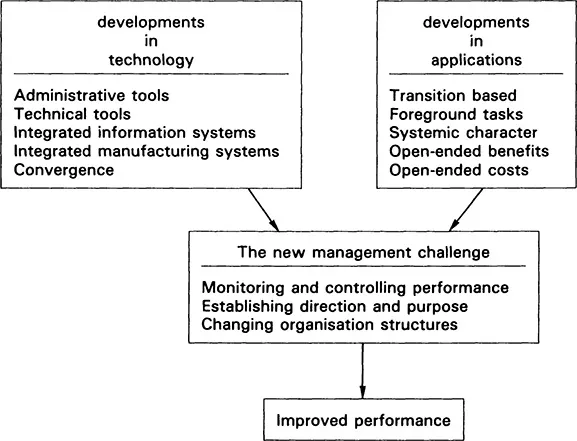
The chapters in this volume illustrate how this challenge is being met. The contributions are based on direct studies of information technology being introduced into organisations. Taken together, they are a source of fact and experience about three aspects of the new management challenge, namely:
- Monitoring and controlling performance.
- Establishing direction and purpose.
- Changing organisation structures.
We expect that this text will be most useful to readers who work with managers in planning and implementing technical and organisational change. Some may have responsibility for information technology projects, but may not be computing specialists. Others may be management services or systems specialists responsible for project management, or for providing advice to functional management. We hope that this book will be a useful source of ideas and stimulus for both these groups of ‘promoters’ and ‘internal consultants’ concerned with the effective application of information technology.
Another group of readers will be those conducting research into the management and human aspects of computers and information technology. For them it provides a sample of recent experience, and a review of some current issues, which they can take into account in formulating and interpreting their own research. Similarly, and finally, the book will be useful to those teaching the growing number of courses in further and higher education which include consideration of the management and social aspects of technology. It will highlight some of the issues which merit consideration in such courses, and provide teachers with a source of real examples, cases, and illustrations.
The chapters which follow are based on experience with a range of applications of computing and information technologies. Some of the applications represented in the chapters by Kinnie and Arthurs, Smeds, and Rose can best be described as technical or administrative ‘tools’. That is, they represent the use of computers on specific, independent tasks, in a way that raises few if any management issues. For example, they include the use of simple computerised time recorders, ‘free standing’ computer-aided design, or the use of a mainframe computer to process client records at an insurance company. A much bigger group of cases concerns various forms of integrated management information systems. The cases presented by Buchanan and McCalman, Dawson and McLoughlin, Rawlings and Martin all fall into this category.
The sectors covered are as diverse as the technologies. The cases are drawn from service industry as diverse as hotels, health, railway operations and insurance, as well as from organisations turning out a wide range of manufactured products.
Developments in Technology
Rapid and apparently turbulent developments of information technology have led to five types of application. Each is relatively easy to distinguish from the others, and each raises new issues for management and their organisations. Typically, later types of application have tended to augment, rather than replace, the others.
Administrative tools
This refers to the use of computers to perform relatively routine data-processing activities in a prescribed manner. This originally depended on large, ‘stand-alone’, mainframe computers, processing large volumes of data in batches. More recently mini and micro computers have dramatically widened the range of administrative information which can be processed by computer, and widened the types of staff directly involved. For example, financial or personnel data can now be processed by staff using micros in their own departments, rather than having to depend on a central computer department.
Technical tools
Computers have also been applied to the automation of specific, relatively independent, technical and physical processes of organisations. Early applications were principally in process control operations in industries such as chemicals and power supply. Now they are being applied to a much wider range of tasks such as component design, machine operation, typing and energy management.
Integrated information systems
By linking separate sets of administrative data, and processing them in particular ways, the information can be used by managers as they make decisions on current operations. A computer used only as an administrative tool may concentrate on recording and processing, say, cost information for various ‘historical’ accounting functions, and can thus be of limited value to current decisions. Technical developments now allow much more data to be captured, processed and transmitted to managers, at a speed and at a degree of detail that makes it of considerable value in dealing with current decisions.
Integrated manufacturing systems
Technical developments increasingly make it possible to link together previously independent ‘technical tools’ (or ‘islands of automation’) into integrated manufacturing systems. For example design, planning, manufacture and inspection functions can be linked and controlled from a single computer system, rather than being carried out as separate operations.
Convergence
The convergence of computing and telecommunications systems make it possible to link together previously separate information or manufacturing systems into networks. These may be in the same building or in widely separate places. Information from a computer in a distant office can be sent directly to one at, say, head office, giving corporate management an ‘up to date’ picture of the business. Similarly the ability to send drawings generated on a computer-aided draughting system in one plant to a similar system in another plant makes possible radical changes in manufacturing arrangements.
Features of Current Applications
Technical developments affect managers only as they are embodied in real applications. The challenges managers then face are also influenced by some or all of the following features of information technology projects. They can be labelled:
- Transaction-based
- Foreground tasks
- Systemic character
- Open-ended benefits
- Open-ended costs
A distinctive feature of many current applications is that they can capture data at the source of the original transaction or operation. In banks, hotels, restaurants and garages, for example, the initial transaction with the customer is often keyed directly into a terminal as it takes place. In factories analyses of machine utilisation and performance can be captured directly from software built into the machine’s operating programs.
Such information is immediately available for analysis in a way that was not practicable when the primary record of a transaction (say, a customer order, or a service or report) was on paper and needed to be separately keyed into the computer. Faster processing speeds make it possible for that primary data to be analysed immediately and in much greater detail than was possible.
Another current feature is the addition of ‘foreground’ tasks to the traditional ‘background’ ones. As long as computers were being used as administrative or technical tools, on essentially ‘background’ tasks, few managers needed to take much interest. The payroll or accounting systems were important, but customers were probably unaware that computers were being used, and the business could continue even if the system was down.
That is no longer the case. The range of applications has now become so wide that the quality of product and service received by the customer often depends directly on the quality of the computer system used by staff. Though often not apparent to the customer, the provision of many financial, travel and hotel services have depended heavily on computers for years. This dependence is now reaching other sectors of the economy. It is graphically illustrated by this comment from the computer manager at a large hospital, where integrated computer systems were being applied to a very wide range of live administrative processes:
Something I am very keen on now is to get over to senior managers the message of what happens when you introduce office automation. In applying a function like payroll, if it collapses the data processing expert will put it together somehow. If an office automation system goes down, and you have applied it to the whole administrative fabric, the whole administrative fabric goes down. That is very critical. Imagine something like what happened here last week (a terrorist bomb explosion which caused many casualties); there are hundreds of procedures that immediately have to happen at three o’clock in the morning and the whole administrative end has to be dealt with with total efficiency. If that is the moment your office automation system goes down . . . (from Boddy and Buchanan, 1986, p. 73).
Similarly in manufacturing, many design and production operations are now computer-aided or controlled. As dependency increases, so does management interest in the quality of the computer resource: they are becoming a key resource to all managers, not just those in particular functional areas.
Information technology applications frequently have a systemic character, in the sense that their influence is felt beyond the department or function in which they are installed. The introduction of computer numerically-controlled machine tools, for example, puts new demands on managers in the machining area directly affected — and also on managers responsible for planning, tooling and maintenance. Beyond that they raise issues such as the appropriate way to allocate and measure costs, or the most suitable kinds of payment systems, which involve even wider departmental interests (Ingersoll Engineers, 1982; Department of Trade and Industry, 1985). As office systems are introduced, managers become increasingly conscious of issues of compatibility and integration. They realise that whatever gains they can achieve in their own departments, even more may be gained if their systems can be linked to, say, a database in another department.
A feature of computer projects is often the open-ended nature of the potential benefits. The novelty of many applications, and uncertainty about how they will perform in practice, means that people are often unclear about the benefits expected and obtained.
While it is quite common to hear managers express disappointment that the new system has not lived up to expectations, it is equally common to hear them speak of unexpected benefits. Skilled and committed staff are often able to find new ways of using equipment, to do tasks or produce benefits which had not been expected at the time of the original investment.
Costs too have a habit of being open-ended. While the basic cost of the initial equipment can be established accurately, it is common for managers to observe that the system in its ‘final’ state ended up costing a great deal more than originally envisaged. Examples of the sources of these extra costs include unforeseen initial costs for things such as building alterations, cables and better peripheral equipment, the cost of maintenance and system support and upgrading facilities, or capacity to cope with new or unexpected demands. In addition, there are the less easily identified, but still incurred, costs of project management, training, and general disruption while major new systems are brought in.
The argument of this chapter is then that the new challenges facing managers arise not only from technical developments but also from how the new systems are applied. The more an application is characterised by the five features outlined in this section, the greater the management challenge is likely to be. Three aspects of that challenge will be considered.
Figure 1.1: The new management challenge
- Monitoring and controlling performance.
- Establishing direction and purpose.
- Changing organisation structures.
Each will be introduced bri...
Table of contents
- Cover
- Half Title
- Title Page
- Copyright Page
- Contents
- List of Figures and Tables
- Notes on Contributors
- Preface
- 1. The New Management Challenge: Information Systems for Improved Performance
- 2. Confidence, Visibility and Performance: the Effects of Shared Information in Computer-aided Hotel Management
- 3. Senior Managerial Roles in the Context of Direct Computer Use
- 4. Manufacturing Information Systems at the Crossroads
- 5. Information Management in an Industrial Environment — an Educational Perspective
- 6. New Technology — New Problems: the Knowledge Gap Between Management and Computing
- 7. The Role of Computerised Information Systems in Developing Organisational Structure
- 8. Constructing Organisational Forms for Flexible Computing
- 9. Organisational Choice in the Redesign of Supervisory Systems
- 10. New Techniques for Recording Time at Work: Their Implications for Supervisory Training and Development
- 11. Towards a New Framework for Helping Managers to Deal with Technical Change
- 12. Developing Managers to Meet the New Challenges
- Index
Trusted by 375,005 students
Access to over 1.5 million titles for a fair monthly price.
Study more efficiently using our study tools.
Frequently asked questions
Yes, you can cancel anytime from the Subscription tab in your account settings on the Perlego website. Your subscription will stay active until the end of your current billing period. Learn how to cancel your subscription
No, books cannot be downloaded as external files, such as PDFs, for use outside of Perlego. However, you can download books within the Perlego app for offline reading on mobile or tablet. Learn how to download books offline
Perlego offers two plans: Essential and Complete
- Essential is ideal for learners and professionals who enjoy exploring a wide range of subjects. Access the Essential Library with 800,000+ trusted titles and best-sellers across business, personal growth, and the humanities. Includes unlimited reading time and Standard Read Aloud voice.
- Complete: Perfect for advanced learners and researchers needing full, unrestricted access. Unlock 1.5M+ books across hundreds of subjects, including academic and specialized titles. The Complete Plan also includes advanced features like Premium Read Aloud and Research Assistant.
We are an online textbook subscription service, where you can get access to an entire online library for less than the price of a single book per month. With over 1.5 million books across 990+ topics, we’ve got you covered! Learn about our mission
Look out for the read-aloud symbol on your next book to see if you can listen to it. The read-aloud tool reads text aloud for you, highlighting the text as it is being read. You can pause it, speed it up and slow it down. Learn more about Read Aloud
Yes! You can use the Perlego app on both iOS and Android devices to read anytime, anywhere — even offline. Perfect for commutes or when you’re on the go.
Please note we cannot support devices running on iOS 13 and Android 7 or earlier. Learn more about using the app
Please note we cannot support devices running on iOS 13 and Android 7 or earlier. Learn more about using the app
Yes, you can access The New Management Challenge by David Boddy, James McCalman, David A. Buchanan, David Boddy,James McCalman,David A. Buchanan,David Buchanan in PDF and/or ePUB format, as well as other popular books in Business & Business General. We have over 1.5 million books available in our catalogue for you to explore.