The purpose of this book, originally published in 1991, is to provide managers with a practical approach to planning and managing significant changes. It will help them to determine the objectives, scope and direction of change and to formulate a structured implementation plan. Managers will learn how to identify and measure the skills needed to handle changes and to define activities that will develop those skills. The workbook incorporates self-assessment exercises, company assessment exercises, and a case-study. This title will be of interest to students of economics, management, and business studies.
- 110 pages
- English
- ePUB (mobile friendly)
- Available on iOS & Android
eBook - ePub
Managing Change
1 Introduction
We live in a period of accelerating change. Great political events change our perception of the world. Fundamental changes in society restructure our lives. New technology means that the impossible becomes commonplace. Change is all around us and the capacity to manage change effectively is the crucial attribute of a successful manager in today’s organizations.
This book is about the techniques and skills which are needed to manage change with confidence, sensitivity and expertise. It is a workbook that asks you to participate and use ideas in relation to your own situation. Throughout the book you will find reference to a case study, ‘Money Matters plc’, which demonstrates how the techniques and ideas have been used in practice. You may find it useful to read the background to the case study (see Part II, p. 65) alongside the main text so that you can see how these techniques have been applied.
The book is aimed at three audiences. First, managers whose whole working life is concerned with managing change. Second, teachers and trainers who are committed to developing practical skills for all those who jobs require them to be change agents, and third, students of management whose future working life will be spent in facilitating useful change.
The workbook has been designed to help managers identify what needs to be changed to secure improved performance and effectiveness for their own organization. In addition it provides the opportunity to review personal management skills and the skills of the management team across a range of ‘change management skills’. It is set out in two parts.
Part I of the workbook has been designed around a simple framework of managing change as set out below. A number of techniques are included, each with guidance on how results can be analysed and interpreted.
Activity |
Technique |
1 Corporate functional analysis |
|
Organizational diagnosis |
2 Organizational diagnosis questionnaire |
3 Improvement analysis |
|
Implementing change |
1 Implementation checklist 1 |
2 Implementation checklist 2 |
|
Change managenent skills |
1 Change management skills exercise
2 Analysis of change management skills
|
Part II comprises an analysis of a financial services company, Money Matters plc, using the techniques set out in Part I. The case study sets out a diagnosis of the company, a discussion of the issues to be faced in managing changes in that business and concludes with an implementation plan. In Part I each technique is summarized by using information taken from the case study in Part II.
Using the Workbook
The workbook is designed to be used in a number of ways:
- Any manager concerned to assess an organization carefully and systematically could complete the techniques creating ‘personal action plans’ for corporate and personal change and development.
- The various questionnaires and checklists can be completed by groups of managers at management workshops/seminars. This can provide a more systematic basis for reviewing the organization, learning about how to manage change and identifying improvement and implementation plans for the future.
- The questionnaires and checklists can be completed by either all or a sample of employees as input either to a management seminar/workshop dealing with the management of change or to individual/groups of managers responsible for planning and carrying out changes.
- Managers may usefully select one or more of the techniques to help with either planning, implementing or monitoring the impact of change.
It is important to ensure that people are asked questions they can answer. Often, for example, the corporate functional analysis (see p. 16) is completed only by senior management. At the same time we should not ignore the individual’s contribution, even if relevant to only a part of the analysis. Expectations are also important. Using techniques like these will create expectations. Therefore it makes sense to have worked out a strategy for dealing with the results before starting.
Whilst many readers will conclude that professional help would greatly assist the completion of data collection (e.g. use of questionnaires and interviews) and the interpretation of results, the workbook has been designed to assist people in organizations to do it themselves. Ultimately the successful use of these techniques should lead managers to think about problems and changes in new, more systematic and more effective ways. That is the objective of the author in producing this book.
Part I
The Workbook
2 Assessing organizational effectiveness
This exercise focuses on an internal analysis of the organization to identify its strengths and weaknesses. This will allow us to identify the organization’s capabilities and resources, how well it is exploiting them, and how effectively it is adapting to changing environmental pressures. The exercise is in three parts:
- Functional analysis
- Organizational diagnosis
- Organizational improvement analysis
Functional Analysis
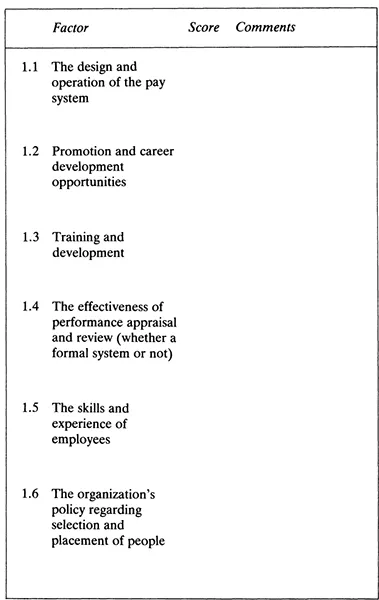
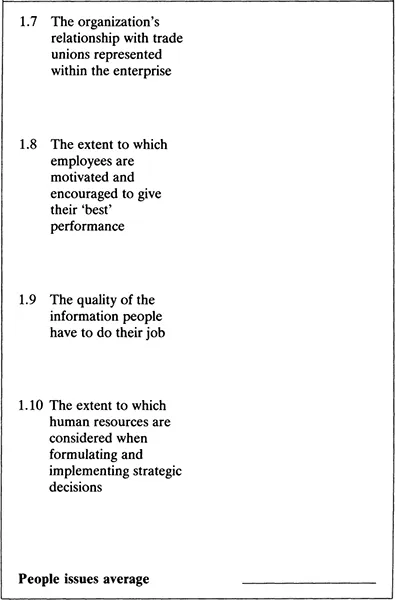
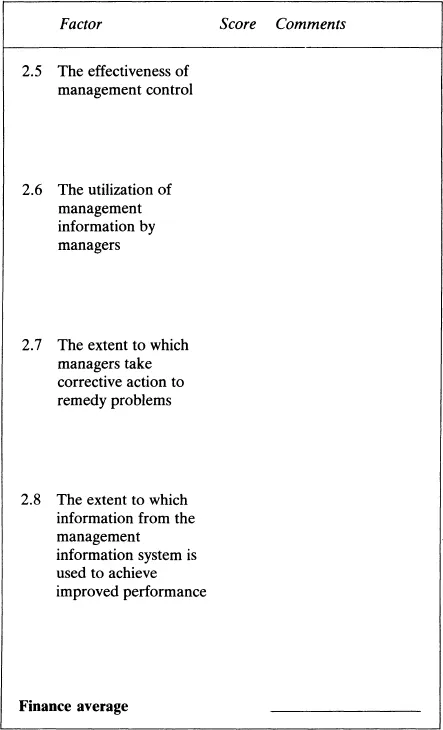
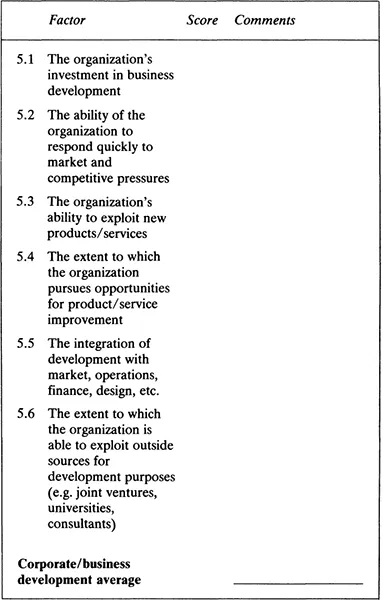
In this part of the workbook you should focus on the key functional elements of your organization, namely people, marketing, finance, operations/service and business/corporate development. Each section deals with one functional element and comprises a checklist of factors relating to that element. You are asked to assess the contribution to corporate objectives of each factor as a percentage. Record this figure in the Score column, and add your reasons for giving this score in the Comments column.
Factor 1.1, for example concerns the relationship between employees and the enterprise regarding pay. If groups of employees feel that the pay they receive is inadequate or if there is no clear link between improved performance and pay then we might conclude that corporate objectives are inadequately supported by the pay system. We would then enter a score of, say, 50% and record the main reasons for that score in comment form.
1 People issues
2 Finance

3 Marketing
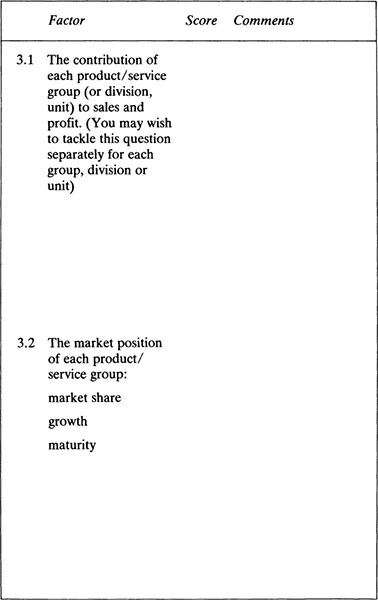
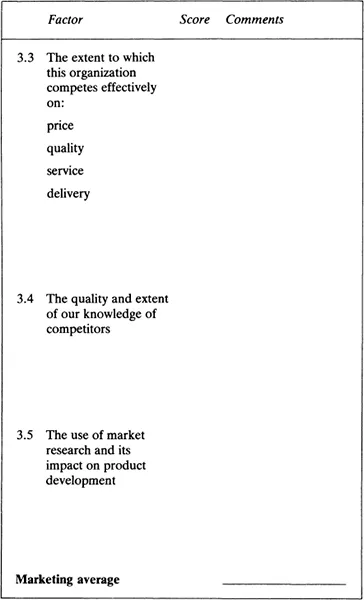
4 Operations/service
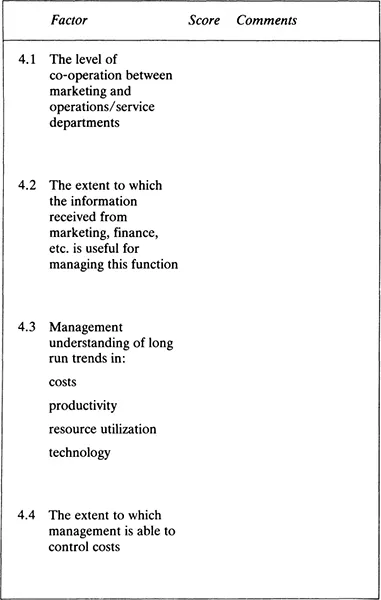
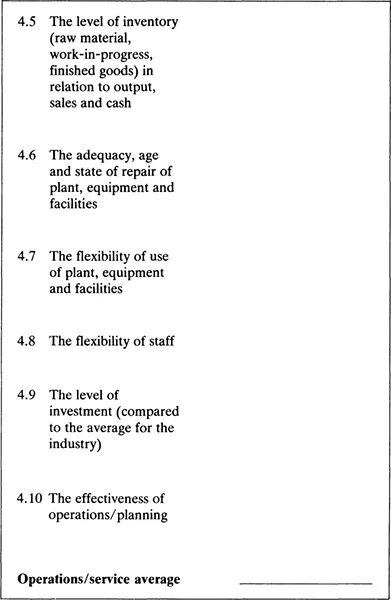
5 Corporate/business development
Analysis
For each of the five areas calculate the average score. Then subtract this average from each individual score to give a plus or minus percentage. Negative scores reveal weaknesses and positive scores strengths. Thus for each of the five areas, a list of strengths and weaknesses can be drawn up.
The next priority is to focus on the five functional areas as a whole. Any area where the average score is above 65 per cent may be considered as a strength. Areas with an average score of less than 65 per cent should then be ex...
Table of contents
- Cover
- Half Title
- Title Page
- Copyright Page
- Contents
- List of figures and tables
- Preface
- 1 Introduction
- Part I The Workbook
- Part II The Case Study
Trusted by 375,005 students
Access to over 1.5 million titles for a fair monthly price.
Study more efficiently using our study tools.
Frequently asked questions
Yes, you can cancel anytime from the Subscription tab in your account settings on the Perlego website. Your subscription will stay active until the end of your current billing period. Learn how to cancel your subscription
No, books cannot be downloaded as external files, such as PDFs, for use outside of Perlego. However, you can download books within the Perlego app for offline reading on mobile or tablet. Learn how to download books offline
Perlego offers two plans: Essential and Complete
- Essential is ideal for learners and professionals who enjoy exploring a wide range of subjects. Access the Essential Library with 800,000+ trusted titles and best-sellers across business, personal growth, and the humanities. Includes unlimited reading time and Standard Read Aloud voice.
- Complete: Perfect for advanced learners and researchers needing full, unrestricted access. Unlock 1.5M+ books across hundreds of subjects, including academic and specialized titles. The Complete Plan also includes advanced features like Premium Read Aloud and Research Assistant.
We are an online textbook subscription service, where you can get access to an entire online library for less than the price of a single book per month. With over 1.5 million books across 990+ topics, we’ve got you covered! Learn about our mission
Look out for the read-aloud symbol on your next book to see if you can listen to it. The read-aloud tool reads text aloud for you, highlighting the text as it is being read. You can pause it, speed it up and slow it down. Learn more about Read Aloud
Yes! You can use the Perlego app on both iOS and Android devices to read anytime, anywhere — even offline. Perfect for commutes or when you’re on the go.
Please note we cannot support devices running on iOS 13 and Android 7 or earlier. Learn more about using the app
Please note we cannot support devices running on iOS 13 and Android 7 or earlier. Learn more about using the app
Yes, you can access Managing Change by Colin Carnall in PDF and/or ePUB format, as well as other popular books in Business & Business General. We have over 1.5 million books available in our catalogue for you to explore.