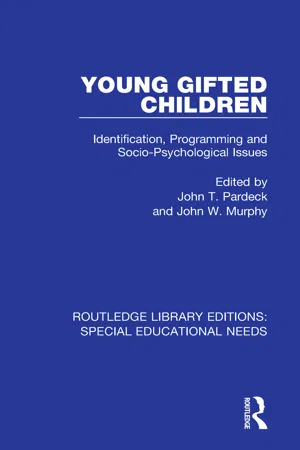
First published in 1990. This study on special educational needs explores the identification of the gifted, research on gifted children and programmes, programming for young gifted children, and the socio-psychological implications of giftedness. This title will be of great interest to student teachers, teachers of special educational needs, and parents.
eBook - ePub
Young Gifted Children
Identification, Programming and Socio-Psychological Issues
- 162 pages
- English
- ePUB (mobile friendly)
- Available on iOS & Android
eBook - ePub
Young Gifted Children
Identification, Programming and Socio-Psychological Issues
About this book
Information
Integrated learning: A viable alternative to gifted programs
BARBARA GARNER, SUSAN HAUGLAND, MELISSA SPEZIA AND ROBERT BOISSONEAU
Southeast Missouri State University
This article provides an innovative model for educating gifted young children, the Integrated Developmental Model. The model is based upon Rogoff’s theoretical framework, “Apprenticeship in Thinking.” By utilizing the Integrated Developmental Model, children’s learning is optimized in a social context. Growth is stimulated in an environment where children are actively engaged in exploration, facilitated by teachers who challenge, propose problems and guide children’s discovery. Multi-age classrooms facilitate learning at the “zone of promixal development.” The Integrated Development is responsive to their curiosity, their high energy levels, their exceptional planning skills and their abilities to initiate, execute and evaluate activities. In addition, the Integrated Developmental Model avoids the difficulties associated with identification of the gifted, negative effects of labeling and the numerous concerns regarding social adjustment of gifted children. Examples of activities reflective of the Integrated Developmental Model are provided.
Key words: Gifted, children, preschool, elementary, integrated-learning
In light of continuing controversy surrounding the education of gifted young children, the current article explores a new alternative, the integrated developmental model. Set in a theoretical framework that encompasses learning in a social context along with the individuals active participation in development, the model addresses education concerns of current programs for the gifted.
From very early in life, some individuals exhibit abilities and skills which set them apart from the expected course of development. Parents and practitioners alike recognize infants and toddlers who as individuals exhibit behaviors which suggest a generally advanced developmental pattern. They tend to reach milestones at an earlier age than expected, gain language skills early (often exhibited in the form of understanding language at an early age), are keen observers and have unusually long attention spans. These children seem extremely curious and often have exceptional memories (Karnes, 1987). As these children enter preschool and public school, they continue to develop at an accelerated rate. This population of children have come to be recognized as gifted.
PROGRAMS FOR GIFTED CHILDREN
Current programs available for gifted young children tend to be either acceleration or enrichment. Acceleration typically involves grade acceleration (skipping a grade), telescoping (covering two grades in one year), or content acceleration, covering content at children’s own rate. The latter seems to be the most beneficial for all children but there is danger that many children are missed and only the “go-getters” are identified. The real danger is that children may become pressured and these programs tend to stress acquisition of knowledge as an end in itself. The social, emotional, and physical aspects are ignored as are advanced thinking and reasoning skills (Levin, 1986; Van Tassel-Baska, 1986).
The other alternative currently available is enrichment. Typically this means children are pulled out of the classroom for enrichment activities. When carefully integrated and implemented, it offers a program which is easy to carry out within the educational setting. However, most of the child’s day is spent engaged in activities that are not developmentally appropriate. In addition, too frequently there is no integration and in-depth investigation into areas that are relevant to the classroom. Additional criticisms of enrichment are that not enough is offered and the program may still not meet the child’s developmental level, so new learning does not result (Ellis & Ellis Schwabe, 1986).
SELECTING THE GIFTED CHILDREN
In addition to the limitations inherent in gifted programs selection of children eligible to receive these services is an even bigger concern. Numerous difficulties arise when attempting to identify gifted children. There is not a uniform set of criteria to distinguish children who are gifted. Thus, standards used for placement of children in gifted programs differ from school district to school district and state to state. Many programs ultimately base their decision primarily or solely on an I.Q. test score. This policy is inappropriate for four reasons. First, young children are difficult to assess. Not only is it difficult to find a valid instrument, but once a test is selected, it is equally difficult to obtain a reliable score. Young children are easily influenced by their mood, the attitude of the administrator and even the testing situation. The difficulty of testing young children prompted the National Association for the Education of Young Children to state in their Guidelines for Developmentally Appropriate Practice (Bredekamp, 1986), “decisions that have major impact on children (such as enrollment, retention, assignment to remedial classes) are based primarily on information obtained from observations by teachers and parents” (p. 57).
Secondly, determining giftedness in young children is especially difficult due to the sensitive interplay of maturation and experience. Children may perform at unusually high levels on an assessment, yet not have exceptional aptitude. This arises when children are taught and sometimes even pressured to learn information. Of course, learning information early does not make children gifted. Yet basing giftedness on one I.Q. score may have this effect (Clark, 1988).
Thirdly, high test scores may also arise due to the uneven rate of development in young children. A young child may accelerate in some areas of development for a period of time and then development slows causing the child ultimately to perform at about the same level as peers. While this is perfectly normal and expected (Salkind & Ambron, 1987), assessments are not always a true picture of a child’s future achievement.
Identification of gifted children is further complicated because children may be truly exceptional in some areas and not in others. For example, the child may have exceptional abilities in art or music, but not in language. When using an I.Q. score as the standard for giftedness, these children are never identified.
LABELING GIFTED CHILDREN
Once a standard is established for giftedness and children are tested (sometimes this even occurs in the reverse order), children are labeled as gifted and enrolled in the special program or programs of that particular district. Even if the child has been properly identified, labeling these children presents additional concerns. First, parents with the best of intentions, may begin pressuring their child long before testing ocurs. The parent wants their child to excel, to win, to benefit from those special services given only to gifted children.
After identification, parents may overreact. Once their child is identified as gifted, they become concerned about their child actualizing this exceptional potential. Thus, effective parents who have done an excellent job of facilitating their child’s total development, begin to focus only on cognitive development, pressuring the child to perform in ways that are not realistic or developmentally appropriate.
When labeled, some children begin feeling different and isolated (Whitmore, 1980). Rather than perceiving the label positively, they become worried others will see them as different or reject them out of jealousy.
AN ALTERNATIVE TO SPECIAL PROGRAMS FOR GIFTED CHILDREN
Is it possible to avoid the difficulties associated with selecting gifted children, the negative effects of labeling, and the limitations of gifted programs currently available? Can these children be challenged to utilize their emerging skills and abilities without being identified, segregated and provided special services.
Children of all ability levels including those who are gifted must be stimulated. The critical importance of challenging gifted children is illustrated by current brain research. Brain research clearly indicates the brain must be stimulated or it will lose its capacity to function (Clark, 1988).
Quality developmental education of young children using an integrated approach will challenge and stimulate all children. Children are more alike than they are different. By using a developmental approach, gifted children are not only challenged to actualize their potentials, but taught how to relate effectively with individuals of diverse backgrounds and abilities, important skills for life-long learning.
THE DEVELOPMENTAL APPROACH
For decades scholars and researchers have questioned the processes underlying the phenomeon we know as development. Although much is known, many questions remain. One important question to be addressed is the identification of a developmental theory which has the capability of allowing researchers, scholars and practitions to understand the processes involved in the development of gifted children and to plan environments supportive of that development.
Current theories of development tend to focus on one aspect of development over others. Cognitive theorist such as Piaget (1926) offer views of how thinking develops and changes as children grow. Various others proposed theories address to the development and integration of ego, development of social competencies and how moral development proceeds (Erikson 1950; Kohlberg 1964; Mahler 1975; Damon, 1977; Maccoby 1980).
Any theory used as the basis for program planning and implementation must encompass all areas of children’s development: cognitive, social, emotional and physical. Theories often need to be combined to provide a theoretical framework which encompasses the total development of the child.
Piaget (1926) suggests that development is one of adaptation. Adaptation in Piaget’s framework has two simultaneous and complementary aspects which are referred to as assimilation and accommodation. Assimilation refers to the process of adapting external events to the child’s own internal mental structures and accommodation refers to the complementary process of adapting his/her mental structures to the events in the environment. Thus assimilation and accommodation are two sides of the same coin (Flavell, 1977). When combined with Vygotsky’s theory as in “Apprenticeship in Thinking” cognition becomes a process of active participation rather than the property of the individual (Rogoff, 1990).
Rogoff’s theory combines the elements of Piaget’s internal structuring of the world, with Vygotsky’s (1978) belief that development occurs in the context of the sociohistorical aspects of the culture. Rogoff suggests that cognition occurs on the social plane first which is then internalized and transformed into the individual plane. As Vygotsky suggests, mind develops from interpersonal activity in which societal history is the context.
RogofFs (1990) theory provides a framework to develop programs for all children, normal as well as special populations such as the gifted. Children are viewed in the context of their culture, and the social world is the mediator in which cognition can occur. Parents, caregivers, teachers and peers are instrumental in development because they possess the tools of the sociohistorical culture necessary for children’s development.
INTEGRATED LEARNING
The integrated learning approach has been known by numerous terms or titles including the responsive environment (Clark, 1988), open education (Noddings & Enright, 1982), the child-centered model (McCarthy, 1983), informal learning (Clark, 1988), experiential learning (Barr, 1981), and interdisciplinary education (See Figure 1-1). The roots of integrated learning are “buried deeply in the work of Plato, Socrates, Frobel, Pestalozzi, Dewey, Montessori, Piaget and numerous others” (Clark, 1988 p. 314).
When children are totally involved, their mind, body and feelings are integrated in the learning process. Every human being consists of three basic facets: a body whose sensations establish the nature of the world; a mind which enables us to perceive the meaning of sensations; and feelings which tell us the value of sensations (Jung, 1968). In integrated learning these three parts merge as children actively discover their world.
The theoretical framework proposes the basis for integrated learning programs is dialectical in nature. Also, there is a strong interactional-constructivist orientation Green (1989) stated, “children are viewed as curious scientists-philosophers seeking to make sense out of the world and their experiences” (p. 229). Children are actively engaged, attentive, direct and anticipatory in their strategies. Engaging in manipulation with the environment requires feedback from others. These educational programs help children become problem solvers and are directed to the development of the whole child.
Bonney (1969) emphasized the importance of integrated learning. He stressed, “a child should be seen as developing not trait by trait, but as an integrated individual who is being influenced constantly on a total person basis by a multitude of interacting influences from within his organism and from external stimulations” (p. 117).
English educators have long recognized the importance of integrated learning and have termed their approach the integrated day. There is no distinction between one subject in the curriculum or another. British schools do not separate or compartmentalize learning, but instead facilitate growth of the whole child throughout the day. They do not sep...
Table of contents
- Cover
- Half Title
- Title Page
- Copyright Page
- Table of Contents
- About the Editors
- Young Gifted Children: Identification, Programming, and Socio-Psychological Issues
- A Practical System for Identifying Gifted and Talented Students
- A Developmental Model for Identifying and Serving Young Gifted Children
- Treasures of Children: Collections then and now or Treasures of Children Revisited
- Supporting Gifted Students’ Acquisition of Relevant Knowledge for Solving Math Problems
- The Concurrent and Predictive Validity of a New Screening Test for Young Gifted Children
- Waiting for Entry: What Determines Admission to Gifted Programs
- An Exploration of Gifted Programs
- Kindergarten and First Grade: A Time for Developing and Nurturing Gifted Behaviors in Young Children
- Gifted Preschoolers within the Classroom
- Challenging the Early Reader
- Some Practical Perspectives for Educating Gifted Children
- Integrated Learning: A Viable Alternative to Gifted Programs
- A Structure for Affective Education for Young Gifted Children
- A Plea: Serving Young Gifted Children
- Behind the Walls of Poverty: Economically Disadvantaged Gifted and Talented Children
- The Effects of Labeling Children Gifted: A Review of the Literature
- Giftedness as a Limited Episteme: A Postmodern Exposition
Trusted by 375,005 students
Access to over 1.5 million titles for a fair monthly price.
Study more efficiently using our study tools.
Frequently asked questions
Yes, you can cancel anytime from the Subscription tab in your account settings on the Perlego website. Your subscription will stay active until the end of your current billing period. Learn how to cancel your subscription
No, books cannot be downloaded as external files, such as PDFs, for use outside of Perlego. However, you can download books within the Perlego app for offline reading on mobile or tablet. Learn how to download books offline
Perlego offers two plans: Essential and Complete
- Essential is ideal for learners and professionals who enjoy exploring a wide range of subjects. Access the Essential Library with 800,000+ trusted titles and best-sellers across business, personal growth, and the humanities. Includes unlimited reading time and Standard Read Aloud voice.
- Complete: Perfect for advanced learners and researchers needing full, unrestricted access. Unlock 1.5M+ books across hundreds of subjects, including academic and specialized titles. The Complete Plan also includes advanced features like Premium Read Aloud and Research Assistant.
We are an online textbook subscription service, where you can get access to an entire online library for less than the price of a single book per month. With over 1.5 million books across 990+ topics, we’ve got you covered! Learn about our mission
Look out for the read-aloud symbol on your next book to see if you can listen to it. The read-aloud tool reads text aloud for you, highlighting the text as it is being read. You can pause it, speed it up and slow it down. Learn more about Read Aloud
Yes! You can use the Perlego app on both iOS and Android devices to read anytime, anywhere — even offline. Perfect for commutes or when you’re on the go.
Please note we cannot support devices running on iOS 13 and Android 7 or earlier. Learn more about using the app
Please note we cannot support devices running on iOS 13 and Android 7 or earlier. Learn more about using the app
Yes, you can access Young Gifted Children by John T. Pardeck, John W. Murphy, John T. Pardeck,John W. Murphy in PDF and/or ePUB format, as well as other popular books in Education & Education General. We have over 1.5 million books available in our catalogue for you to explore.