First published in 1985. This book examines in-depth the administrative, curricular, attitudinal and pastoral care changes that are needed if teachers in ordinary schools are to meet their pupils' special needs successfully. Drawing on extensive research the author shows that the needs of a minority of 'special' pupils cannot sensibly be seen in insolation from those of the other pupils in the school. Schools that cater successfully for the majority of their pupils with special needs. Conversely, the curriculum and organisational problems in some schools create tensions which are reflected in the pupils' poor behaviour and performance. These are taken as evidence that the pupils have special needs.
- 192 pages
- English
- ePUB (mobile friendly)
- Available on iOS & Android
eBook - ePub
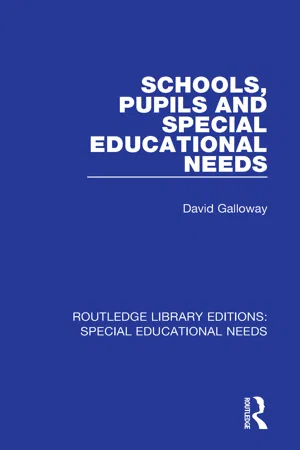
Schools, Pupils and Special Educational Needs
About this book
Information
1 Whose Special Needs?
Introduction
If teachers taken from a random sample in ordinary primary and secondary schools, were to be asked what they knew about the Warnock Report (DES, 1978a) almost all would know that it dealt with special education. If asked about the Report’s conclusions and recommendations, there would probably be less confidence. Some might say that the report recommended the integration of handicapped children into the mainstream. They would, incidentally, be considerably over-stating the committee’s position with respect to integration. The recommendation remembered by the largest number, however, might be that: ‘one in six children at any one time and up to one in five children at some time in their school career will require some form of special educational provision’.
Before looking more critically at the evidence for this conclusion, and at its implications for teachers, it is worth considering the three broad areas of need which Mary Warnock and her colleagues had in mind. The first was the need for provision of special means of access to the curriculum. This applies mainly to children with physical, visual and hearing disabilities. A blind child, for example, will need to be taught braille. The second and third areas were the need for ‘provision of a special or modified curriculum’ and ‘particular attention to the social structure and emotional climate in which education takes place’.
There is no doubt that up to 20 per cent of children have difficulty coping with the ordinary curriculum at some stage in their school lives. Nor is there much doubt that the social structure and emotional climate in the school or classroom is a source of substantial stress to a similar proportion. The question is whether a curriculum and an emotional climate which fails to cater for up to 20 per cent of pupils can be entirely suitable for the remaining 80 per cent. In more practical terms, the relationship between the proposed special or modified curriculum and the mainstream curriculum requires elucidation. This is also true of the relationship between the social structure and emotional climate needed for children with special needs and that required for ‘ordinary’ pupils. A recurring theme throughout this book is that special or modified curricula, and classes with special ‘social structures and emotional climates’ may as frequently create special needs as meet them.
Warnock’s 20 per cent: Educational Reality or Statistical Fiction?
The availability of places in special schools is unevenly distributed through the country. Marked variations can even occur between neighbouring boroughs. Thus, one London borough in 1977 placed ten times more children in schools for the maladjusted than another (DES, 1978a). Consequently, special school places have never provided evidence about the numbers of children with special educational needs. To see how the Warnock Committee formed its conclusions we have to look at evidence from studies of larger groups of children.
Disturbing Behaviour
The most widely quoted investigations are the National Child Development Study, and those carried out by Professor Michael Rutter and his colleagues on the Isle of Wight and in an Inner London borough. The National Child Development Study included all children born between 3rd and 9th March, 1958. On the basis of the teacher version of Stott’s Bristol Social Adjustment Guide (1963), 64 per cent of children were rated as stable, 22 per cent as unsettled and 14 per cent as maladjusted (Davie et al., 1972). The same study showed that 13 per cent of children were thought by teachers to need special educational help, but only 5 per cent were in fact receiving it.
Rutter and his colleagues asked teachers to complete a behaviour questionnaire (Rutter, 1967) on the pupils they studied. In addition they interviewed the children’s mothers, and on the Isle of Wight, but not in London, the children themselves. 19 per cent of children were rated as deviant in the Inner London borough on the basis of the teacher’s questionnaire results, compared with 11 per cent in the Isle of Wight. Using all the available questionnaire and interview data, 25 per cent of London’s 10-year-olds were said to be showing ‘clinically significant’ signs of psychiatric disorder, compared with 12 per cent on the Isle of Wight. The term psychiatric disorder was used to include ‘abnormalities of emotions, behaviour or relationships which are developmentally inappropriate, and of sufficient duration and severity to cause persistent suffering or handicap to the child and/or distress or disturbance to the family or community’ (Rutter and Graham, 1968).
An interesting incidental observation from the Isle of Wight study was the small overlap between children whose parents were concerned about their behaviour and children whose teachers expressed concern (Rutter et al., 1970). This was partly attributable to teachers reporting more behaviour problems of a broadly antisocial type, while parents tended to report a larger number of withdrawn children. Children whose parents complain about their behaviour at home may have special needs. Whether they have special educational needs is another question altogether.
Two explanation may be put forward for the low overlap between behaviour problems at home and at school, as reported by parents and teachers. One is that parents and teachers interpret similar behaviour in different ways. ‘Quietness’, for example, may be considered a virtue by some teachers who may be more concerned about openly disruptive pupils. Parents, on the other hand, may see quietness as an indication of lack of confidence or of anxiety in social situations. Another explanation is that children behave in different ways in different contexts.
Both explanations are valid. Both draw attention to the teacher’s role in attributing special educational needs to a child. Teachers vary between themselves in how they interpret behaviour. A healthy extrovert to one teacher can be a thoroughly noisy, disruptive nuisance to another. Similarly the child that one teacher in an open plan class sees as quiet, but sensitive and creative, may be seen as an immature, withdrawn little baby by another. Disturbing classroom behaviour, in other words, is not a problem because of any objective criteria in the behaviour itself, but rather because of the effect it has on teachers.
All experienced teachers, moreover, will recall children whose behaviour has changed dramatically with a change of teacher. In the same way a change of school can be accompanied by a change of attitudes and of behaviour. At home, parents recognise that their children’s language changes according to the company they are in; expressions and pronunciation considered unacceptable within the family may be necessary for social acceptance in the street or the playground. Thus, a teacher’s statement that a child’s behaviour indicates a need for special educational help has to be seen in terms not only of the teacher’s own values and attitudes, but also in terms of the child’s behaviour in a particular context.
An observation from a follow-up to the Isle of Wight study revealed a slight increase in the prevalence of psychiatric disorder at age 14 compared with four years earlier (Rutter et al., 1976). This was not, however, attributable to any important increase in the rate of overtly disruptive behaviour of most immediate concern to teachers. More important, perhaps, just over half the pupils assessed as showing signs of psychiatric disorder had first presented problems as adolescents. Fewer than half had been disturbing their parents or teachers four years earlier. This observation has two implications. Firstly, as the Warnock report recognised, the problems presented by many pupils are transient. Secondly, concentrating provision for pupils with special needs on the younger age-groups would be of limited value, even if all the pupils concerned could be ‘treated’ successfully. This is not the case, nor is there any way of identifying reliably pupils who will disturb their teachers towards the end of their school careers. Even if these pupils could be identified, there would be no way of telling what their educational needs would be, let alone how they should be met. We shall return later in the chapter to the confusion surrounding the concept of special educational need on account of disturbing behaviour. Firstly, though, we need to look at the prevalence of learning difficulties.
Learning Difficulties
Nationally, special schools for pupils with moderate learning difficulties, formerly known as ESN(M), account for roughly 1 per cent of school age pupils. This tells us nothing, however, about the number of children who might be experiencing learning difficulties. To see why, we need to consider the range of problems subsumed under the blanket term learning difficulties.
The 1944 Education Act and subsequent regulations (Ministry of Education, 1945) did not define criteria for ascertainment as ESN. Subsequent publications, though, made clear that special schools for ESN pupils should cater predominantly for those with a low IQ, generally assessed as below 70 or 75 (Ministry of Education, 1958, 1961). We shall return to the uses of IQ tests shortly. The point here is that the controversy was associated with two questions:
- The way in which most IQ tests are constructed ensures that roughly 2.5 per cent of the population will obtain a score below 70.
- Virtually all special schools for children with moderate learning difficulties have always admitted a disproportionate number of boys and a substantial minority of pupils with relatively high measured intelligence (Ministry of Education, 1958). Further, they have in many areas aroused understandable anger and suspicion by admitting a disproportionate number of children of Caribbean origin (e.g. Coard, 1971). The implication is that they have been used as convenient places for problem pupils, and not simply as the most appropriate place in which to meet the needs of pupils with moderate learning difficulties.
Even without the confusion surrounding criteria for admission to a special school for children with moderate learning difficulties we would still be no nearer an idea of the prevalence of learning difficulties. The predicted figure of about 2.5 per cent scoring below 70 on an IQ test is a purely statistical artifact of the way most of these tests are constructed, a point to which we return shortly. We therefore need to look at the number of children believed to have learning difficulties in ordinary schools.
Yule et al. (1974) noted that 8 per cent of 10-year-olds in the Isle of Wight and 19 per cent in an Inner London borough had a reading age at least 28 months below their chronological age. In most cases the poor reading ability was associated with low measured intelligence. In other words, their reading level could be predicted from knowledge of their IQ. These pupils were regarded as backward readers. Nearly 3 per cent of the Isle of Wight pupils and 10 per cent of the London pupils were reading significantly below the level predicted by their age and IQ. These pupils with specific reading retardation overlapped with the backward group. Their special educational needs, though, were more specifically confined to reading, since they did not, on the whole, have similar problems in mathematics.
Multiple ‘Handicap’
The four criteria noted so far in defining learning difficulties which indicate special educational need are an IQ below 70, reading backwardness, specific reading retardation and psychiatric disorder. At least one of these conditions applied to 16 per cent of 10-year-olds on the Isle of Wight (Rutter et al., 1970). More than one condition applied to a quarter of this 16 per cent, or 4 per cent of the total.
Warnock refers to these criteria as ‘handicaps’. Certainly, they have been taken as evidence both in the report and in subsequent discussion, as evidence of special educational need. It is therefore worth asking whether there was anything in the least surprising in the evidence that up to 20 per cent of children may have special educational needs, as defined in the report, at some stage in their school career. It is also worth asking whether the criteria themselves can meaningfully be seen as valid.
Prevalence of Special Educational Needs: a Critique
Neither New, Nor Surprising
The first thing to be said about Warnock’s conclusion on the prevalence of special educational need is that it could equally well have been reached on adequate research evidence at any time in the previous 50 years. This is true both of pupils whose behaviour disturbs their teachers and of children with learning difficulties.
As early as 1925 Haggerty had found teachers in North America reporting undesirable behaviour in more than 50 per cent of pupils. In London elementary schools teachers reported one or more of four ‘behaviour deviations’ in 46 per cent of pupils (McFie, 1934). The ‘deviations’ listed were timidity or lack of sociability, behaviour disorders such as truancy or stealing, habit disorders such as nail-biting or incontinence, and educational problems not attributable to mental deficiency. In the private sector, teachers at five schools run by the Girls Public Day Schools Trust had put forward 17 per cent of pupils for interview on account of difficult behaviour (Milner, 1938). Other studies, in North America, had been reviewed by Uger (1938) with broadly similar results.
The position on children with learning difficulties was equally clear. Cyril Burt’s (1937) book The Backward Child, written in his early years when his probity as a researcher remains relatively unquestioned is regarded as a classic. In it he concluded that one child in ten above the ‘educable defective’ level was backward, and only one in six of the so-called educable defectives, later labelled ESN(M), was actually in a special school. These pupils, moreover were ‘lacking not so much in social capacity as in scholastic capacity, they are incompetent pupils rather than incapable citizens’. Yet even earlier than this the first Medical Inspection to the Education Department had described as ‘very numerous’ children requiring special education because they are ‘physically and morally healthy — but backward’.
Burt himself exerted a strong influence on the deliberations between 1924-29 of a committee chaired by A.H. Wood into the educational needs of the ‘feeble-minded’. Excluding children with severe learning difficulties, who were then outside the education system altogether, the committee considered that existing special schools catered for only one-sixth of the estimated number of feeble minded children in the country. These children, formerly known as ESN(M), would today be said to have moderate learning difficulties. In addition, the Committee noted the special needs of children who did not formally qualify as feeble minded, estimating that they included roughly a further 10 per cent of the population (Board of Education and Board of Control, 1929).
A Statistical Fiction?
Tests of intelligence and of educational attainments are designed to assess children with a wide range of ability. Most intelligence tests are designed with a mean of 100 and a standard deviation of 15. The sample on which the norms are based is assumed to be representative of the population as a whole. Hence the design of the test ensures that roughly 34 per cent of children will obtain scores between 85-100 (within one standard deviation below the mean), and more than 47 per cent between 70-100 (within two standard deviations below the mean).
Results ...
Table of contents
- Cover
- Half Title
- Title Page
- Copyright Page
- Original Title Page
- Original Copyright Page
- Table of Contents
- Dedication Page
- Acknowledgements
- Introduction
- 1. Whose Special Needs?
- 2. Administrative and Legal Issues
- 3. Assessment
- 4. Policy and Provision for Children with Learning Problems
- 5. Responses to Disturbing Behaviour
- 6. The Hidden Curriculum, the Guidance Network and Provision for Special Needs
- 7. The Special Educational Needs of Teachers
- 8. Conclusions: Creating Special Educational Needs? or Meeting Them?
- References
- Index
Trusted by 375,005 students
Access to over 1.5 million titles for a fair monthly price.
Study more efficiently using our study tools.
Frequently asked questions
Yes, you can cancel anytime from the Subscription tab in your account settings on the Perlego website. Your subscription will stay active until the end of your current billing period. Learn how to cancel your subscription
No, books cannot be downloaded as external files, such as PDFs, for use outside of Perlego. However, you can download books within the Perlego app for offline reading on mobile or tablet. Learn how to download books offline
Perlego offers two plans: Essential and Complete
- Essential is ideal for learners and professionals who enjoy exploring a wide range of subjects. Access the Essential Library with 800,000+ trusted titles and best-sellers across business, personal growth, and the humanities. Includes unlimited reading time and Standard Read Aloud voice.
- Complete: Perfect for advanced learners and researchers needing full, unrestricted access. Unlock 1.5M+ books across hundreds of subjects, including academic and specialized titles. The Complete Plan also includes advanced features like Premium Read Aloud and Research Assistant.
We are an online textbook subscription service, where you can get access to an entire online library for less than the price of a single book per month. With over 1.5 million books across 990+ topics, we’ve got you covered! Learn about our mission
Look out for the read-aloud symbol on your next book to see if you can listen to it. The read-aloud tool reads text aloud for you, highlighting the text as it is being read. You can pause it, speed it up and slow it down. Learn more about Read Aloud
Yes! You can use the Perlego app on both iOS and Android devices to read anytime, anywhere — even offline. Perfect for commutes or when you’re on the go.
Please note we cannot support devices running on iOS 13 and Android 7 or earlier. Learn more about using the app
Please note we cannot support devices running on iOS 13 and Android 7 or earlier. Learn more about using the app
Yes, you can access Schools, Pupils and Special Educational Needs by David Galloway in PDF and/or ePUB format, as well as other popular books in Education & Education General. We have over 1.5 million books available in our catalogue for you to explore.