In this title, originally published in 1920, Leonard Woolf traces the history of economic imperialism and explores the relations of Europe and Africa since 1876. This analysis of economic imperialism helped to shape attitudes to colonialism for more than one generation of radicals and socialists, and still has the power to influence and inform today.
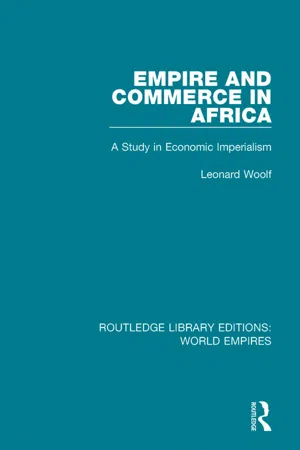
- 394 pages
- English
- ePUB (mobile friendly)
- Available on iOS & Android
eBook - ePub
PART I
INTERNATIONAL ECONOMIC POLICY
CHAPTER I
INTRODUCTORY
MOST people, if, for a moment, they shut their eyes and allow their memory to steal away out of their habitual control of it and rummage in the past, will find that suddenly a very vivid picture of their first “lessons” rises before them. No historian, no publicist, and certainly no writer or reader in any subject of what is aptly called controversial politics, should ever begin his task without five minutes’ ceremonial of this kind. Practically every page of this book will be concerned with political subjects so controversial that no gentleman can discuss them with any one who does not believe exactly the things which he believes, and remain a gentleman. Every writer naturally wants his reader to behave like a gentleman towards him, that is to listen to what he says at least with an air of respect. That is why I would beg my reader to go through this brief ceremony, and to recall his or her first lessons, whether at the proverbial mother’s knee or, more probably, at a kindergarten table under the worried eye of a most ill-informed lady. After pot-hooks and hangers he was taught to write, and in the process he made acquaintance for the first time with generalizations about man. His mother or his teacher impressed these generalizations upon, him as true, and, if he be candid with himself, he will admit that to this day his belief in them is more unquestioning and more deep than in almost any other facts. No one ever learns to question the statement that evil communications corrupt good manners, and nobody ever acts upon his belief. Another generalization—and it is one which I should like to get into my reader’s head at once as a perpetually recurring air or theme or rhythm running through every page and chapter of this book—was that man differs essentially from the animals because he acts according to reason. Man is infinitely above the beasts because he is self-conscious, because he reasons and acts on reason, because through his reason he is able to control his destiny. We believe these generalizations as passionately and as unquestioningly as that evil communications corrupt good manners, and perhaps with very much the same effect. People who go to Wagner’s operas often hold in their hands little explanatory nooks, in which the airs or tunes or themes are picked out and printed, as, for instance, Siegfried’s theme or Wotan’s or Brynhilde’s, and the listener who has not got these running in his head, so that he can pick them out and recognize them, is not supposed to be able fully to appreciate the meaning of the music as a whole. In every book there are, or ought to be, similar themes of thought, and the writer ought to pick them out and print them in his introductory chapter. No reader of this book will be able to appreciate its meaning who has not running in his head the generalizations given above, in which he almost certainly believes deeply and firmly.
The subject of this book is Policy and Commerce, or, as I propose to call it, international economic policy. If we can imagine the race of bees suddenly endowed with man’s peculiar gift of reason, the first step which it would take would undoubtedly be to appoint a Royal Commission of Bees to report upon the manner in which Man, the only other reasoning animal, organizes the human hive. There can be no doubt that, if the Commission of Bees began its enquiries in the year 1917, it would immediately see the immense and almost overwhelming importance in the economy of the human hive which is played to-day by the State. If man controls his destiny by the use of his reason, it has led him to decide that it can only be controlled effectively and happily through the organization of mankind in States. And if the Royal Commission of Bees treated its enquiry historically, it would report with amazement upon the enormous change in the form and importance of the State which has taken place in recent years. The State is one of the most ancient of man’s institutions, with an unbroken history of evolution stretching far back to times which are the twilight between mythology and history. Its chief attributes have, from the earliest times, been power and mystery, and of all human contrivances and abstractions it has always attracted to itself the most violent love, superstition, and hatred. Its age and its power may be recognized from the fact that time has swept away whole civilizations with all their marks and memorials except those of the State, out in hieroglyphics upon stone obelisks. But the State like all human institutions, to the almost universal dismay of man himself, changes. The change is usually so slow as to be almost imperceptible to each generation, so that the vast majority in each generation, to whom progress is extremely distasteful and discomforting because it implies change, can console themselves with the belief that, whatever else has been improved, the State at least has remained unalterably the same. Unfortunately, however, the pace at which men themselves and their lives change sometimes quickens, and then they can no longer delude themselves that even their God and their State have remained unchanged. Such a quickening in the pace of the evolution of European man occurred somewhere about the year 1790, and it has had the most profound effect upon the State.
This book is not a treatise upon either the nature or the theory of the State. But it will deal throughout with policy, and policy is at least the instrument of a State’s action. While I do not therefore wish to be led aside down any alluring and winding path of theory, it is necessary, in order to explain the scope and object of the book, to say something about the nature of the State and its growth during the last 125 years. The State, as we know it to-day, is a growth of very recent years: in its present form and with its present attributes it did not exist even in 1820. No doubt all the elements of its present form existed in the eighteenth-century State, but an embryo is not the same as an adult, nor a tadpole the same as a frog. All historians agree that the three strongest currents in European evolution during the last century were those of democracy, of nationalism, and of industrialism. It is these three currents which have been mainly responsible for the immense modifications in the structure and sphere of the State. Before the nineteenth century the State was a kind of vested interest, the personal preserve or estate of a particular family or families. The national power, organized or fashioned into an instrument for gain, or sharpened into a weapon for defence or offence by legislation and administration, was first vested in the hands of the king, and later in those of a few noble families. Occasionally a few city merchants were admitted to some share in the monopoly, and helped to shape national policy by imposing upon the unsound system of internal economy, devised by and for the landowners, a still more unsound system of foreign trade. The conception of the State as the whole nation organized for certain ends did not exist in practice, though it can be traced in the writings of publicists who, because they foresaw and foretold the trend of human development, seemed to their contemporaries to be either criminal or lunatic.
The old view of the State as a vested interest has not become extinct, but it has almost succumbed to the combined poisons of democracy, nationalism, and industrialism. Society was violently inoculated with these poisons, first in the democratic movement which centred in the French Revolution, secondly in the Napoleonic Wars, and thirdly through the industrial revolution. The old State and the ancient depositaries of power and policy have been forced to modify their methods, and even their views, in order to avoid complete destruction. In order to adjust itself to, and so far as possible nullify, the currents of democracy and nationalism, the State has abandoned the claim to be a personal preserve and prerogative, and has emerged as the Nation organized for national interests. The function of the eighteenth-century State was mainly power and government; that of the nineteenth century professes to be the attainment of “the greatest good of the greatest number,” or “the realization of the best life”, or the materialization of a mysterious and sacred “general will.” Interacting upon these conceptions, the industrial revolution has come with irresistible force and swung the State into an orbit where its range and velocity have been immeasurably increased. Before 1790 life was for the most part slow, local, inefficient, uneconomic: in the last century it has been enormously speeded up, it has become national, it has been industrialized and commercialized. The State has not escaped this tendency to apply the standards of industry and commerce to all the departments of human life. Nobody in the eighteenth century thought of asking whether the State was efficient, for the main functions of the State were not economic: to-day, despite the enormous increase of nationalistic patriotism, we instinctively regard the State as a kind of super-joint-stock-company.1 As an economic instrument the value of the organized national power could not escape the attention of the industrial age.
This book will be largely concerned with the examination of facts which prove the statement in the last sentence and paragraph. It will show how, in one sphere at any rate, our generation, permeated with the ideas and standards of industrialism and commercialism, has come to regard the main function of the State as the pursuit of national economic interests by means of organized national power. I do not propose, therefore, in this place to labour the point, but I will leave the reader to ponder over one little proof. If we wish to get a clear view of what any generation considers to be the work and ideals of State action, we should go to the writings and speeches of those men to whom have been entrusted the control of such action and the direction of State policy. They will show us what, in the opinion of the chief actors or rather engineers, were the objects and motives which at any particular moment set in motion the great engine of national power. Now in 1895 the British nation, through its electors, entrusted the direction of the State to a Conservative Government in which one of the most important and powerful Ministers was Mr. Joseph Chamberlain, Secretary of State for the Colonies. In 1896 the Birmingham Chamber of Commerce gave a banquet to Mr. Chamberlain, who made a speech in reply to the toast of “Her Majesty’s Ministers.” In that speech Mr. Chamberlain gives a very clear exposition of what he considered to be the main function of the State and the chief duty of the Ministry.
“From the moment that we accepted and entered upon the duties of office,” he said, “our most important duty, our most absorbing care, has been not the party legislation which occupies probably the largest part of our public discussions, but the development and the maintenance of that vast agricultural, manufacturing, and commercial enterprise upon which the welfare and even the existence of our great population depends. Now, I think, gentlemen, that you may safely give the widest interpretation to the statement that I have just made. All the great offices of State are occupied with commercial affairs. The Foreign Office and the Colonial Office are chiefly engaged in finding new markets and in defending old ones. The War Office and Admiralty are mostly occupied in preparations for the defence of these markets and for the protection of our commerce. The Boards of Agriculture and of Trade are entirely concerned with those two great branches of industry. Even the Education Department bases its claims to the public money upon the necessity of keeping our people well to the front in the commercial competition which they have to sustain ; and the Home Office finds the largest scope for its activity in the protection of the life and health, and in the promotion of the comfort of, the vast army of manual labourers who are engaged in those industries. Therefore it is not too much to say that commerce is the greatest of all political interests, and that that Government deserves most the popular approval which does most to increase our trade and to settle it on a firm foundation.”
It is clear that in the opinion of this Minister, who for many years took the first part in the direction of policy, the national economic interests are the primary concern of the State, and the whole machinery of government and Government Offices should be mainly directed to the promotion of the commercial interests of the nation. Is it altogether an exaggeration to say that Mr. Chamberlain’s conception of the State in this speech approximates more nearly to a super-joint-stock-company than to a City of God”? The applause of his audience showed that they shared his political vision, and with him had travelled far from the Greek, who, in thinking of the policy of his own State, fixed his eyes upon the vision of that city which is laid up in Heaven as a pattern “for him who desires to see it.”1 Some allowance must, of course, be made for the fact that the Greek was a philosopher, while the Minister was a politician addressing a company of commercial gentlemen who were his hosts. But the same view of the functions of the State can be found in all Mr. Chamberlain’s speeches during the ’90’s; and that they were endorsed by the electorate is shown by the fact that he and the Government to which he belonged were returned to power in 1902.
It will be observed that in form Mr. Chamberlain’s words were a statement of facts. In reality they were a statement of policy. The State, he said, is an organisation for the pursuit of the economic ends of nations; Government Offices and Ministers are the instruments of that pursuit; “commerce is the greatest of all political interests.” The minister was, however, in reality stating the formula of his own and his hearers’ policy; and policy is a question not so much of facts as of beliefs and ideals. The neglect of this truth or truism causes so much political folly and misery, and is the begetter of so much false history, that it is necessary to deal with it here at some length. History is presented to us as a record of events or facts, and the practical statesman, whenever any political problem has to be solved by us, exhorts us to fix our eyes not upon theories or ideals, but upon facts. Commercial rivalry between nations, the struggle for markets, tariffs, armaments, and war, are the kind of facts which humanity is continually being exhorted to contemplate, if not with satisfaction, at least with resignation. Call a political evil a fact and it is immediately invested with a kind of holiness which belongs to things which must remain eternally the same. Nearly every political evil, from slavery and torture to the subjection of women and war, has at some time or other been consecrated as a fact by contemporaries. Since most men are by nature pessimistic conservatives, it is the evils and not the goods which are particularly singled out for this consecration; and politicians, statesmen, and historians represent the horrible story of man’s political development which they call history, as almost entirely determined by the “logic of events” or the “logic of facts.” But in history there is no logic of events and no logic of facts, there is only a logic of men’s beliefs and ideals.
Let us test the truth of this by applying it to the particular problem of history and politics with which I am concerned in this book—Power, Policy, and Commerce. The general problem may be stated as follows: We find ourselves living here in a world of States. The sphere of the State’s internal and external action has in the last century increased enormously, until to-day there is hardly any department of individual life and activity which is not subjected to State control or interference. External policy, with whnch I am concerned, is from one point of view the instrument of the State’s action in its relations with other States. All these are no doubt facts, but is there any logic of these facts in the sense that their existence is inevitable, or that, because they exist, certain other facts must inevitably exist? The answer to the question will depend upon whether, after all, man is a reasoning animal and is capable by his reason of determining his destiny.
Policy, I have said, is the instrument of a State’s action. But policy is determined by our beliefs and our ideals: it represents our view of what we want the State to be, and what we want the State to do in the world of States. Thus the State is what we want it to be and believe it to be, and there is here no logic of facts, but a logic of beliefs and desires. Mr. Chamberlain’s State and his Government Offices and his Secretaries of State and his Policy will all be of a particular kind, because he believes that the promotion of commercial interests is the greatest of political interests, the chief function of the State. Here there is a logic of Mr. Chamberlain’s belief and desire, no logic of facts. The builders and controllers of the Ottoman Empire believed that the greatest of political interests was an unlimited supply of slaves and concubines.1 That belief and desire determined the nature of the Ottoman State, determined the policy of the Ottoman people, and determined the fate of millions of individuals living between the Persian Gulf and the Danube. The Ottoman Empire and its history differed from the British Empire and its history, because the Turk believed and wanted the State to be or to do one thing, and Mr. Chamberlain and other Britons believed and wanted the State to be or to do something else. The Turkish State sacked city after city to supply its citizens with concubines: the British State in a few years added 2,600,000 square miles to its territory in order to supply its citizens with free markets.2 That is the logic, not of events, but of beliefs and desires.
Man’s past was caused by what men desired and believed: the future will be caused by what we desire and believe. Hence the enormous and increasing importance of our desires and beliefs with regard to the State and policy. For policy is a kind of immaterial tissue of communal desires and beliefs, woven out of what we desire and believe the State to be, and what we desire and believe that the State can attain for us in its rel...
Table of contents
- Cover
- Half Title
- Title Page
- Copyright Page
- Table of Contents
- PART I.—INTERNATIONAL ECONOMIC POLICY
- PART II.—ECONOMIC IMPERIALISM IN AFRICA
- PART III.—REFLECTIONS AND CONCLUSIONS
- INDEX
Trusted by 375,005 students
Access to over 1.5 million titles for a fair monthly price.
Study more efficiently using our study tools.
Frequently asked questions
Yes, you can cancel anytime from the Subscription tab in your account settings on the Perlego website. Your subscription will stay active until the end of your current billing period. Learn how to cancel your subscription
No, books cannot be downloaded as external files, such as PDFs, for use outside of Perlego. However, you can download books within the Perlego app for offline reading on mobile or tablet. Learn how to download books offline
Perlego offers two plans: Essential and Complete
- Essential is ideal for learners and professionals who enjoy exploring a wide range of subjects. Access the Essential Library with 800,000+ trusted titles and best-sellers across business, personal growth, and the humanities. Includes unlimited reading time and Standard Read Aloud voice.
- Complete: Perfect for advanced learners and researchers needing full, unrestricted access. Unlock 1.5M+ books across hundreds of subjects, including academic and specialized titles. The Complete Plan also includes advanced features like Premium Read Aloud and Research Assistant.
We are an online textbook subscription service, where you can get access to an entire online library for less than the price of a single book per month. With over 1.5 million books across 990+ topics, we’ve got you covered! Learn about our mission
Look out for the read-aloud symbol on your next book to see if you can listen to it. The read-aloud tool reads text aloud for you, highlighting the text as it is being read. You can pause it, speed it up and slow it down. Learn more about Read Aloud
Yes! You can use the Perlego app on both iOS and Android devices to read anytime, anywhere — even offline. Perfect for commutes or when you’re on the go.
Please note we cannot support devices running on iOS 13 and Android 7 or earlier. Learn more about using the app
Please note we cannot support devices running on iOS 13 and Android 7 or earlier. Learn more about using the app
Yes, you can access Empire and Commerce in Africa by Leonard Woolf in PDF and/or ePUB format, as well as other popular books in Economics & Economic History. We have over 1.5 million books available in our catalogue for you to explore.