Chapter 1
Introduction — A Very Special School for Children with Very Special Needs
At one level, this book is about the care and education of children with very special needs. The needs result from emotional damage which impinges on their lives both at school and at home. At another level it is about the development of a holistic approach to education — applicable to children generally.
The first part of the book describes the Raddery experience. Raddery was established in the North of Scotland in 1979 as a voluntary-run school with charitable status. It is one of a number of special schools based on a holistic and therapeutic community approach. It comprises forty children and about the same number of staff adults. There are five to six children in each class and for children needing very individualized and personal attention in an informal setting there is a ‘foundation unit’. Education throughout the day and evening, seven days a week, encompasses an enormous range of activities, appealing to every aspect of each child’s potential. A therapeutic approach underpins education and is, in turn, promoted through education. Five living units called ‘venues’, where children spend much of their domestic time together, are separately located in three different parts of the main building, in a nearby cottage and (for some older children who have made substantial progress) in a separate house in a village a few miles away. Yet the emphasis is on ‘one community’ which finds specific expression in intensive staff support, a complex network of community meetings, and a daily morning meeting. There is a major emphasis on children learning together and supporting one another with the care, help and understanding of staff. In summary, education, care and therapy take place within the context of a community of adults and children.
Raddery receives its referrals from local authority education and/or Social Work Departments (as Social Services Departments are called in Scotland). The school charges fees, agreed with the Convention of Scottish Local Authorities (COSLA), and these are paid by the referring authorities. The largest single number come from the authority in which the school is situated, namely Highland Region, and the second largest number come from the neighbouring Grampian Region. A minority come from further afield.
The second part of the book looks at the implications for educational and child-care policy and practice. For example, it examines the justification for this kind of special provision at a time when the role of special schools is being questioned in the light of the growing emphasis on integrating children with special needs into mainstream schools. Are the needs of the children who attend Raddery very different from others who have been successfully retained within normal classes? If Raddery, and schools like it, have a particular contribution, what is the secret? Can it be shared with ordinary schools?
Raddery is not just a school. It offers residential care. The two aspects of care and education are combined in the concept of a residential community. This, too, raises questions in the light of current policy favouring care in the normal community.
In Britain, admitting a child to a children’s home is nowadays usually regarded as temporary leading to return to family at home with social work support or as preparation for fostering or adoption. But this policy has not affected the continued demand for some residential communities for children with special needs. Perhaps the two approaches are not inconsistent provided, as at Raddery, links are maintained with the child’s parents or other carers.
The notion of community care in the health field as well as in the social services has meant that children (as well as adults) are no longer expected to live in long-stay institutions. For example, children who traditionally stayed in hospitals for longterm care or for other social reasons are now expected to be cared for elsewhere. Old policies and practices are now questioned. But where, in these circumstances, does the responsibility for care lie? The answer is that sometimes it falls to residential special schools to care for children who, in the past, might have been either in children’s homes or other special care establishments or in hospital wards.
Successful community care policies require adequate resources, especially adequate staffing. This is true for the integration of children with special needs into mainstream schools. But what kind of resources are we talking about in the case of the children we have described as having ‘very special needs’? Different considerations apply here than for children with physical disabilities. Raddery children could be said to have had social disabilities. The emotional damage and the suffering they have experienced are visible in their behaviour. Many, especially the girls, have been sexually abused — a fact which might not have been disclosed a decade ago. Many have suffered from inconsistency from parents or other carers. Many have also suffered from inappropriate responses from the social services and in earlier schooling. In other words, their problems are the responsibility of society as a whole. If they are not tackled, wounds will be carried unattended into adulthood with often disastrous consequences which will affect society as a whole.
While Raddery has no shortage of referrals, some other special schools for children with emotional difficulties have recently closed in Scotland. Was this because some referring local authorities rushed into a policy of ‘integration’ without counting the social cost? This is one of the questions I will try to examine.
This is not to claim that a school like Raddery can take on ‘any child’, whatever the problems or whatever the situation, and expect to be able to cope. For some children, Raddery will not be the best placement — at least not at any given time. It is hard to define these limitations because they depend on the situation at the school and the needs of other children. Raddery, as we have said, is a community and any newcomer will affect the life of the community. An aggressive frightened child might at one stage cause too much disruption without finding any opportunity to learn — and it that case no-one will benefit. In some circumstances it is felt that if the child had come sooner, more could have been offered.
The writing of this book was commissioned by Raddery Council and was occasioned by the school’s tenth anniversary celebrations. It is intended for various groups of readers. First, and most obviously, it is intended for those associated with special education for similar groups of children. This includes teachers, carers, managers and parents. Secondly, it is intended for teachers in ordinary schools. Thirdly, it is intended for residential social workers and other care staff as well as health care staff and specialists concerned with emotionally damaged children. Finally, the book is intended for managers and policymakers in the agencies which impinge on the children and their families, including education, child guidance, social work, mental health services and juvenile justice.
I have written this book from several perspectives. For the past twenty years I have been engaged in social research. I have been especially concerned with evaluating facilities and services. This includes finding out what service-users think. In looking at Raddery, it was natural for me to ask what the children experienced and also to ask parents, as well as those who referred the children to Raddery for their views.
As a piece of research, what I have attempted represents a ‘case study’. There is a discipline in this approach. It involves describing and analyzing my experiences in ways which place them in a wider context so that they help to illuminate the experience of other schools and other residential establishments.
I believe that to do justice to this approach, one has to be sympathetic to the ‘case’. Since Raddery started a little over ten years ago, I have been closely involved as a member of the school’s governing body, called a Council. I am currently its Chairman. I have, therefore, a sympathetic interest to declare in the school I have researched.
I have a deeper personal interest to declare. As a young man, out of university, I had the privilege to work for a short time with a pioneer in special education in Britain, namely David Wills. He had a great influence not only on the lives of the children and their families but on the future lives of his staff. He wrote many books describing early pioneering experiments which are eminently readable. Amongst other things, I owe to him an example of writing about subjects which could be seen as technical and professional in a very human way. One of the first schools he described for ‘maladjusted children’ (as they were then called) was founded by him, also in Scotland, called The Barns Experiment, which started in Peebles in 1940. (It later closed to be replaced by other more advanced educational experiment.
Like David Wills, I believe it is possible to write informatively and with integrity from a position of personal involvement. The sort of language I believe he would have approved of would be to say that a school like Raddery is based on understanding and on love. The staff need to understand the children they are working with and to love them. Education is the product. Of course, I am not as involved as David Wills was when he wrote about Barns. He founded and ran Barns. But David Wills also wrote about a famous ‘approved’ school, Cotswold, when it was in the process of change which eventually led to its becoming a well known therapeutic community, the Cotswold Community.
I, too, am writing about a school that has changed and is changing. But in this case, both the founding of the school and its development are associated with another ‘David’, David Dean, OBE. The changes are less dramatic than those which affected the Cotswold School which became the Cotswold Community. The changes that have taken place at Raddery could be called a subtle evolution of ideas and practice together with a natural growth in numbers, from some twenty children to the present forty (and a decision not to increase numbers any further.)
If I had written about Raddery during its first few years, it would very much have appeared as a portrait of its founders, David and Valery Dean. It is a tribute to David that this is now less the case. His is still the central and abiding influence. But the descriptions ‘facilitator’, ‘focalizer’ (to use a Raddery expression) as well as Principal, would more aptly describe his current roles than ‘charismatic leader’ (an expression which was often on people’s lips a few years ago). This is not to suggest that David Dean has lost any of his charisma. Instead, the charisma has become the charisma of the school in which staff, and ultimately the children, can share.
I write as someone caught up in this charisma. Yet, more than any of the children, staff or parents, I am an outsider looking in. I have looked ‘in’ very closely. I have interviewed each one of the staff, some of them more than once. I have focused on a random selection of the children over a period of about two years. Several of these have left and I have followed them through to see what the outcome has been since they left. I have also seen the parents. In addition, I have attended, watched and contributed to, innumerable meetings, activities and happenings in the school, and at a house a few miles from the main school known as Strathallan. Situated in the small town of Fortrose, Strathallan offers a more intimate environment for older children preparing to live ‘inter-dependently’ (a term which I prefer to ‘independently’) in the community. Some of these children are now attending the local secondary school from their intensively supported base.
In one respect, my involvement with Raddery is related to some earlier research. In the late 1970s, with Margaret Thomson, I conducted a survey of the needs and services of ALL children in the Highlands and Western Isles of Scotland who were living away from parents.* A disturbing finding was that children who were emotionally damaged were then being sent hundreds of miles away to special schools in Dumfries and Galloway because there was no provision nearer home. David Dean arrived in the Highlands to look for an area where a new school was needed just at this time. The Highland Regional Council were happy to support him and offered premises which appeared very suitable, at least as a starting-point. The buildings have grown and developed — that is one aspect of the story of Raddery which has to be placed alongside the development of staff, of ideas and, perhaps no less important, of public relations.
From both of my perspectives on the school — as researcher and as Chairman of Council — I have no hesitation in saying that Raddery is a ‘very special school’ centred on the needs of its children with ‘very special needs’. The central question I have set myself to address is what can be learnt from the Raddery experience?
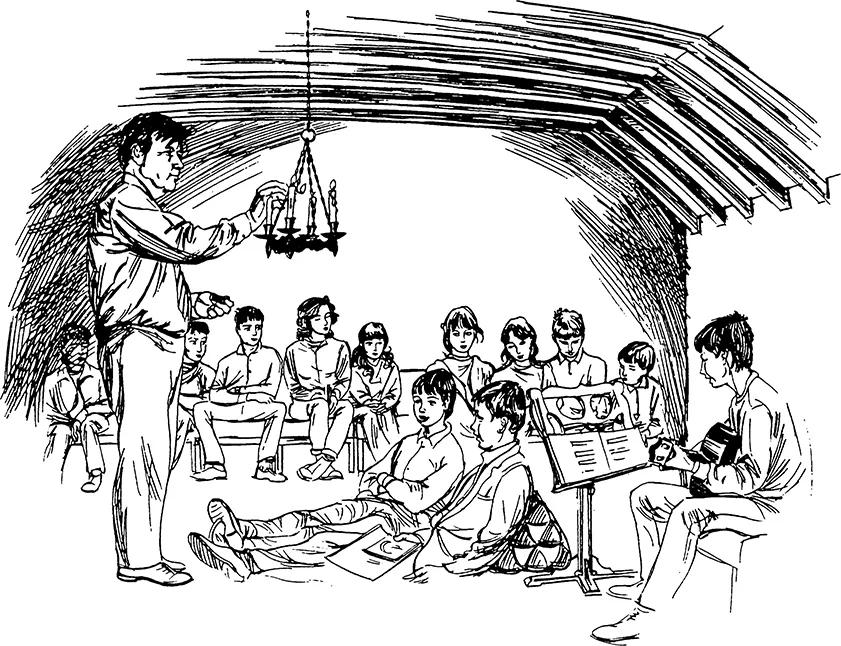
I have been helped in all sorts of ways — far too numerous to attempt to list — by David and Valery Dean and all of the staff and others associated with the school. As an example, this is manifest in the illustrations undertaken by Christopher Fry, at the time a member of staff (since pursuing further education for teaching art).
Everything that is written and illustrated is authentic but, at the discretion of the children, Christian names only have been used in their case. The faces drawn in the illustrations do not identify any of the Raddery children.