First published in 1985. The responses to special educational needs in the 1980s prompted radical changes in the initial and in-service education of teachers. This title is the result of a major conference which was called to anticipate the combined effects on training and special educational needs work and to project a spectrum of positive responses. The authors are drawn from all branches of education in order to provide a critical review of developments since 1983 in teacher-education and to discuss the current recommendations on training to meet special educational needs both in Great Britain and the rest of Europe.
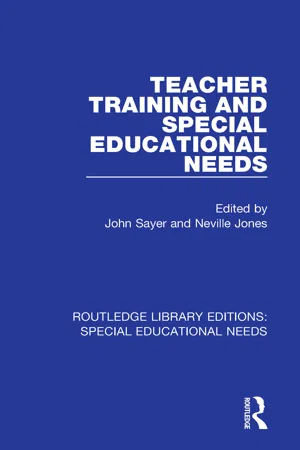
- 212 pages
- English
- ePUB (mobile friendly)
- Available on iOS & Android
eBook - ePub
Teacher Training and Special Educational Needs
About this book
Information
Chapter One
IN-SERVICE TRAINING AND PROGRESS IN SPECIAL EDUCATION
Tony Booth
In this chapter I will argue that before in-service training can make a contribution to progress in special education we have to be clear about what constitutes progress. Since progress can only be defined in terms of moral and political goals any particular initiatives have to be examined for their underlying philosophy and practical consequences so that a choice can be made between them. What kinds of schools do they support or tend to produce? I will look at the way the moral and political choices in education are obscured by the needs of educators to claim neutrality. I will then examine the ‘new’ approach to special education which has followed the Warnock report and 1981 Education Act and is characterised by such slogans as ‘Every teacher a teacher of special needs’, ‘ A whole school approach’, ‘An expanded notion of special needs’. I will suggest that it contains contradictory elements, with their own history which require analysis before they should be adopted. The approach may owe more to a selective philosophy than one compatible with the long-term development of the comprehensive school. Finally I will indicate a conception of special education which is compatible with the enhancement of a ‘comprehensive’ non-selective education in primary and secondary schools.
Progress and Politics in Education
Even if we make the assumption that progressive change within schools can be facilitated through in-service training, the simple provision of more training cannot of itself lead to progress. For progress is change in accordance with our moral and political values. In a society in which people differ markedly about the way of life, including the style and content of schooling they desire, there can be no consensus about the nature of progress nor about the means to foster it. Special educators cannot be pictured as a single community of benevolent gardeners tending a common plot of special education, each contributing to compatible corners of scented beauty. One should consider the possibility instead, that some might like to cultivate sunflowers while others specialise in bind weed though the identities of each of these group would depend on one’s perspective. In gardening, weeds are plants which you don't want to see on your patch.
The notion that change can and should be achieved through consensus remains attractive. It implies that disagreement within education can be resolved despite major political differences and may appear to offer a way out of an interminable need to push one’s own case against opposing forces. However I would suggest that such a notion only obscures the nature of educational change and can be counterproductive. While some of us wait for consensus to be reached others will be fashioning education for their own ends. Further, the emergence of an apparent consensus within a professional group, which suppresses differences in basic philosophy, may work against the interests of the population it is meant to serve. For consensus may be achieved on the basis of a shared professional interest. It can be argued that the advancement of professional power is at the expense of the power of the client group.
If we wish to make progress in education, we need to have a vision of the way we would like education to be developed as well as an understanding of the implications for changes in current practice that this entails. The value on any intervention in education can be assessed, in part, by the extent to which it contributes to desired moral and political ends. Now I am putting this forward as purely an option for the ‘ideologues’. I am suggesting that it is a necessary condition for intelligent action in education. In her philosophical role Mary Warnock has argued:
...understanding things imaginatively is itself a deep source of pleasure and satisfaction. But it is also the only possible way to intelligent action. In order to see how things can or should be changed, it is necessary first to know what they are, even how they came to be as they are...
Imagination, then, is what enables one both to understand how things are, and to raise the question Need they remain like this? and How could they be different?
(Warnock, 1978, pp.8-9)
But this imaginative mental overview of practice and possibility cannot make our actions intelligent by itself. We have to make the ‘right’ choices and to do that we have to assess possibilities against the standard of principles.
But surely even if a view of education as politics can be sustained for mainstream education, it is strangely out of place within special education? In special education there is a widespread belief that the provision of appropriate education can depend on the neutral identification of educational needs discovered by assessment of individual pupils. A debate about the functions of special schools within a selective and stratifying system of education can be avoided for example, by arguing pupils should be placed in accordance with their individual needs; that it is quality rather that place of education which is the important issue (Brennan, 1982). By focusing on the needs of the child it is thought that we may discover that he or she needs a particular placement. Such an argument relies on a mistaken analogy with basic bodily requirements and presumes that the connection between educational need and its satisfaction is as unproblematic as the connection between hunger and food. Yet it should be clear that the content and organisation of schooling for all pupils raise similar questions. What should they learn? How should they learn?
The idea that debates such as those about selection and comprehensive education and about racist and sexist curricula do not apply within special education is itself a form of segregation which has overtones of ineducability. Yet a consideration of the educational consequences of the sex, class or colour of pupils is of particular relevance to special education. All categories of special school have a majority of boys and the preponderance in maladjusted schools is overwhelming (DES Statistics, 1982). The disproportionate number of black pupils in disruptive units or recommended for ESM(M) provision remains a cause of argument and conflict (Tomlinson, S. 1981). Virtually all pupils sent to schools for pupils with moderate learning difficulties or day maladjusted provisions are working class (Tomlinson, 1982). Recently a further issue has resurfaced to my consciousness with relative numbers of men and women taking courses about ‘special needs’- In the first three years of the Open University course ‘Special Needs in Education’, 78 per cent of students were women. Some people might go further than proposing that these issues should be on the agenda of special education by suggesting that they are the agenda; that the significance of special education lies in the way pupils (and possibly teachers) are categorised, stratified and differentially valued.
The fact that advocacy of a particular change in education is also the advancement of moral and political ends can appear to be terribly inconvenient in our education system. Education is meant to be steered by politically neutral experts, DES officials, HMI and teachers. Of course such an assumption involves an interesting view of processes within the structure of the Department of Education and Science. At exactly what point in such a structure is political influence filtered out of the system? After all, the political party in power would see its role of education as the introduction of political bias into the system and this might be most clearly detected by overt efforts to remove contrary views. The involvement of the DES hierarchy at the level of HMI in the political control of what should be taught in schools is suggested for example in a statement by Pauline Perry, Chief HMI, about an in-service training course in peace studies: ‘we never intervene in actual topics - although I think we might have done in this case’ (Guardian, 28th July 1984). The independence that HMI do have has been challenged by recent attempts to question their right to examine the effects of government spending cuts in education (TES, October 5th 1984). The moves to greater central political control of the curriculum has been widely discussed elsewhere (see for example Lawton, 1980, 1984). Actions do not have to carry a party label to be political. All actions which sustain a particular way of life are political and they do not cease to be simply because the life they support has majority approval or is really questioned.
But because political neutrality is often assumed in the job description of educators they have become adept at concealing their reasons for advocating or disparaging certain changes. At times this sets them off on false though self-perpetuating trails to find non-political answers to political questions. For example, the question ‘what is a good school?’, although beloved by researchers, actually lies outside the province of research. Thousands of working days have been devoted to the attempt to find the school ethos which produces successful law-abiding citizens with different researchers arguing for ‘tight ships’ or ‘happy families’ (Rutter, et.al, 1979; Reynolds, et.al, 1981). Yet our preferred ethos for schools is not ‘caused’ by a relationship with so-called outcome measures. On the contrary the outcomes we expect as well as the means we employ to achieve them depend on the way we wish to run our schools.
Research is introduced, then, as the neutral middle- person in supporting change. We await the results of research before we say that ‘research has shown that....’ so it must be desirable. We also like to lean on laws; ‘We should do it because it’s in the 1981 Act’. Yet we know that educational law rarely contains precise prescriptions and that there are good laws and bad laws. Our belief in the general value that laws should be obeyed may lead to a game over interpretation of laws between advocates of opposing view. Since the enactment of the 1981 Act the argument over whether or not the Act implies greater integration of pupils from special schools has appeared at times like a touring Punch and Judy show. ‘The 1981 Act is an integrationist Act’ - ‘oh no it isn't...,etc. The real issue, of course, is whether or not integration should be supported rather than whether or not the Act can supply an escape from that moral di lemma.
But perhaps the most prevalent way for avoiding or concealing moral responsibility involves an appeal to historical inevitability; that’s the way things are going; schools are going to have to be more accountable; the technological revolution is coming. Such a view has two poles: positive and negative; inevitable progress or unavoidable disaster. Pritchard’s history of special education emphasises the former view. He outlines the succession of stages in the education of handicapped children - from earliest provision through the periods of experiment, transition, state intervention, growth and consolidation. Reading his account it seems as if progress has been guaranteed by the benevolence of history:
Progress there has been; progress from that day in 1760 when Thomas Braidwood first used his spatulalike instrument to a day two hundred years later, when the Department of Education of the Deaf at Manchester advertised for a research fellow with qualifications in physics or electrical engineering. Progress there must yet be; progress in overcoming the problems that still exist in every aspect of the field of special education.
(Pritchard, 1963, p. 221)
The vision of society as a diabolical machine careering towards disaster beyond human control is conveyed in Zola’s ‘La Bete Humaine’ with the metaphor of the driverless train carrying soldiers into battle:
Now out of control, the engine tore on and on...What did the victims matter that the machine destroyed on its way? Wasn't it bound for the future, heedless of spilt blood? With no human hand to guide it through the night, it roared on and on, a blind and deaf beast let loose amid death and destruction, laden with cannon-fodder...
(Zola, 1890, pp. 365-6)
Both images of education, as a hurtling and unstoppable train heading for disaster or as constituted in the march of progress depict teachers as a compliant force, maintenance engineers or ‘cannon fodder’, with little interest in or contribution to make to the direction in which they travel. Yet it is the assumption of this book that teachers and other educators influence schooling. It is the main argument of this chapter that if we are to know what we are doing we have to link our day to day actions with an overall philosophy of education.
What is New in Special Education?
In examining the contribution of in-service training to progress we need to look carefully, then, at the content of courses, at the view of education which underlies them and the practices within schools which they encourage and sustain. The approach we adopt should be one that is compatible with our desired ends. Now, current literature on special education assumes that there is a new approach to special education associated with the 1978 Warnock Report (DES, 1978) and the 1981 Education Act (DES, 1981) which has been described in some sections of official circles as radical or even revolutionary. Without any precise specifications of this ‘new’ approach we are all meant to regard it as progressive and implement it in our practice. In fact some books and in-service initiatives have responded to the inevitable mental confusion which arises from taking such an attitude to official documents by passing on the messages of Report and Act as if they were coherent and clear (see Brennan, 1982a). The effect that such a tactic is likely to have on the mental states of any but the most independent minded of the recipients of such messages is likely to be anything but educational.
An End to Categorisation
We are now meant to see difficulties and disabilities in education as part of a seamless continuum, as argued in a recent in-service training package:
As categorisation of handicapped pupils promotes confusion between a child’s disability and the form of special education he needs, the report firmly recommends its abolition. This removes any statutory distinction between handicapped and nonhandicapped and allows the focus to be centred on the child himself rather than on his disability. It emphasises the fact that children with learning difficulties display limitless patterns of individual strengths and weaknesses along a wide continuum of need.
(Leeson and Foster, 1984, p. 10)
Yet we are also meant to have the precise numbers of ‘special’ and ‘special-needs ‘ children fixed firmly in our heads:
The report actually makes the conclusion that about one in six children at any time, and up to one in five children at some time during their career will require some form of special educational provision.
This means that out of every 100 children in the ordinary school, 20 will have special educational needs and of these only 1 or 2 require special schooling.
(Leeson and Foster, 1984, p. 9)
The Warnock Report contained a section headed Ά new system to replace categorisation’ but also argued for the collection of statistics about children with disabilities according to traditional categories distinguished by five levels of severity. In fact the new form 7 introduced by the DES transformed the five levels of severity into three levels of ability (DES, 1984a). In California, there was a similar attempt to replace old categories by the phrase ‘individuals with exceptional needs’. Teachers began referring to ‘IWEN’s’, making them sound like little beings from outer space (Booth, 1982).
Along with the new injunction to end categorisation we must identify which pupils have special needs as early as possible. Although there were attempts within the recent ACSET sub-committee to discuss the needs of education rather than the needs of children, there are passages in the ACSET report which encourage the early identification of children with special needs as a separate group.
All teachers of the 2-19 age group need to know how to identify the special educational needs of children and young people, what they can do to meet these needs and when and how to enlist specialist help ...Many teachers in ordinary schools who have pupils with special educational needs in their classes are ill-equipped to ensure that these needs are met.
(ACSET), 1984, pp. 2-3)
New Definitions
We must learn and inwardly digest (and chant in unison?) the 1981 Act definitions until their familiarity causes us to forget problems about their sense, let alone their sexist language:
For the purposes of this Act a child has "special educational needs" if he has a learning difficulty which calls for special educational provision to be made for him.
A child has a "learning difficulty" if he has a significantly greater difficulty in learning than the majority of children of his age; or he has a disability which either prevents or hinders him from making use of educational facilities of a kind generally provided in schools.
When learning difficulties reach the point at which additional or alternative provision is required they give rise to special educational needs.
(Leeson and Foster, 1984, p. 11)
Within a single sentence learning difficulties are defined as a deviation from a population norm and, for pupils with disabilities, as relative to the provision in an LEA. In both cases learning difficulties are the property of pupils which stretches ordinary language considerably when applied to a gifted child in a wheelchair who has not been provided with ramps to enter a school building.
All Teachers of Special Needs
We embrace the slogan ‘every teacher a teacher of special needs’ and turn it into an objective of in-service training (Muncey and Ainscow, 1982). We adopt a whole school approach to learning difficulties echoing the Bullock report’s view of language teaching across the curriculum (DES, 1975), but we may not specify the approaches we are all to take unless, of course, it is behavioural objectives. These were imported from mainstream education in the USA into special education in the UK and are now to be spread from there across the curriculum. They are often taken to be part of the essence of the official new approach to special education embracing in one fell swoop a modern approach to both ordinary and special education:
The technique of modern curriculum development and design have not been widely applied to the curriculum for slow learners...the technique is outlined as the reduction of general curriculum aims to the statements of behavioural objectives at intermediate and terminal points in the curricular process...
(Brennan, W., 1974, p. 96)
Without going into a detailed account of the advantages and disadvantages of behaviourist theory, practice and terminology in education (Swann, 1983) it should be clear that the spread of behaviourist approaches depends on a particular view of teachers, pupils and their relationship in education which many reject (see, for example, Holt, 1981). Their use has something to say, too, in the UK context at least, of about where models of good practice are to be derived for all teachers now that ‘every teacher is a teacher of special needs’. Should ‘the approach’ be about th...
Table of contents
- Cover
- Half Title
- Title Page
- Copyright Page
- Original Title Page
- Original Copyright Page
- Table of Contents
- Foreword
- Introduction Training for Diversity: the Context for Change
- Part One : Responding to Needs in New Contexts
- Part Two : A New Look at Training Needs
- Part Three : Strategies for Training Provision
- References
- Appendices
- Index
Trusted by 375,005 students
Access to over 1.5 million titles for a fair monthly price.
Study more efficiently using our study tools.
Frequently asked questions
Yes, you can cancel anytime from the Subscription tab in your account settings on the Perlego website. Your subscription will stay active until the end of your current billing period. Learn how to cancel your subscription
No, books cannot be downloaded as external files, such as PDFs, for use outside of Perlego. However, you can download books within the Perlego app for offline reading on mobile or tablet. Learn how to download books offline
Perlego offers two plans: Essential and Complete
- Essential is ideal for learners and professionals who enjoy exploring a wide range of subjects. Access the Essential Library with 800,000+ trusted titles and best-sellers across business, personal growth, and the humanities. Includes unlimited reading time and Standard Read Aloud voice.
- Complete: Perfect for advanced learners and researchers needing full, unrestricted access. Unlock 1.5M+ books across hundreds of subjects, including academic and specialized titles. The Complete Plan also includes advanced features like Premium Read Aloud and Research Assistant.
We are an online textbook subscription service, where you can get access to an entire online library for less than the price of a single book per month. With over 1.5 million books across 990+ topics, we’ve got you covered! Learn about our mission
Look out for the read-aloud symbol on your next book to see if you can listen to it. The read-aloud tool reads text aloud for you, highlighting the text as it is being read. You can pause it, speed it up and slow it down. Learn more about Read Aloud
Yes! You can use the Perlego app on both iOS and Android devices to read anytime, anywhere — even offline. Perfect for commutes or when you’re on the go.
Please note we cannot support devices running on iOS 13 and Android 7 or earlier. Learn more about using the app
Please note we cannot support devices running on iOS 13 and Android 7 or earlier. Learn more about using the app
Yes, you can access Teacher Training and Special Educational Needs by John Sayer,Neville Jones in PDF and/or ePUB format, as well as other popular books in Education & Education General. We have over 1.5 million books available in our catalogue for you to explore.