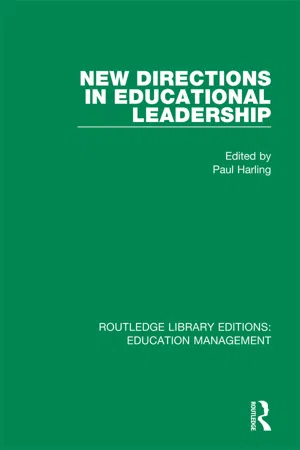
Originally published in 1984. The argument of this book is that the preceding 12 to 15 years saw significant changes in educationalists' understanding and application of the concepts of leadership, and because of these changes two things happened. One, the relationship between participants changed; and two, policy and practice also changed. The papers in this collection have been specially commissioned or collected together with this thesis in mind. Each of them examines leadership with special reference to one or more aspects, sectors, roles or interests within the educational system of England and Wales.
- 434 pages
- English
- ePUB (mobile friendly)
- Available on iOS & Android
eBook - ePub
New Directions in Educational Leadership
About this book
Information
1
Introduction: The Organizational Framework for Educational Leadership
The Organizational Framework for Educational Leadership
Paul Harting
All Saints’ CE School, Chorley
All Saints’ CE School, Chorley
The Educational Organization
The educational system in England and Wales can be regarded as a ‘complex social organization’ (Katz, 1964).1 It is ‘complex’ because it includes many different persons who interact in their performance of many different functions. It is ‘social’ because ‘the participants are interdependent and their actions are socially promulgated and enforced’ (Katz, 1964).2 This emphasis on people and their influence on other people is echoed by Kelly who writes that ‘the most important thing to know about organizations is that they do not exist — except in people’s minds’ (Kelly, 1974),3 and by Etzioni who refers to organizations as ‘social units that pursue specific goals which they are structured to serve’ (Etzioni, 1964).4 At risk of being pedantic it is therefore clear that the educational system as a whole is ‘an organization’ and that it possesses constituent ‘organizations’ at various levels. All the participants are thus part of the same organization — although at times the behaviour of some sectors would seem to suggest otherwise.
The distinctive characteristic of an organization is therefore that it has been formally established for the explicit purpose of achieving certain goals. Every organization has a formally instituted pattern of authority and an official body of rules and procedures which are intended to aid the achievement of those goals. However, alongside this formal aspect of the organization are networks of informal relationships and unofficial norms which arise from the interaction of individuals and groups working within the formal structure. Every ‘leader’ has to be aware of both these aspects since it is their interaction which determines the level and nature of his autonomy and therefore his ability to lead other participants and influence the system as a whole. The importance of considering such theoretical viewpoints is emphasized by Sergiovanni and Starratt when they refer to the various theories of administration, management and leadership as ‘alternative windows through which the educational practitioner can view [educational] problems and issues’.5 They point out that the practitioner is the one qualified to ‘build prescription from theory … in view of the uniqueness and complexity of the circumstances he faces.’6 This advice has been followed to the letter in the choice of authors and contributions to this book.
The Bureaucratic Model
The most widely recognized framework for understanding formal administrative and supervisory structures is the bureaucratic model first articulated methodically by Max Weber. Contrary to the popular view of a bureaucracy being characterized by layers of inefficient functionaries Weber sees bureaucracy as a form of organization which strives continuously for maximum efficiency through rationally defined structures and processes. Indeed, he believes that ‘the decisive reason for the advance of bureaucratic organization has always been its purely technical superiority over other forms of organization.’7
Abbott (1965),8 among others, has outlined Weber’s model of ideal bureaucracy, noting how its features are present to some degree in most organizations, including schools and educational systems and sub-systems. It is worth considering these briefly in turn to ascertain the extent of their presence and effect on educational leadership, decision-making and organization.
Firstly, organizational tasks are distributed among the various positions as official duties. This implies a division of labour and a degree of specialization enabling the organization to employ personnel on the basis of specific skills and experience. The DES is divided into branches, LEAs are divided into administrative districts and by type of educational institution. Similarly schools are divided into types, departments are established within schools and there is a clear distinction, except in the case of headteachers, between the administration function and the teaching function.
Secondly, in the classical Weberian model, the positions and offices are organized into a hierarchical authority structure, usually a pyramid. Thus the DES and Parliament have powers of control over LEAs who in turn ‘lead’ school governors who ‘lead’ headteachers who ‘lead’ classroom teachers.
Thirdly, there is a formally established system of rules and regulations governing official decisions and actions. The regulations ensure a degree of uniformity of operation and together with the authority structure make possible the coordination of the various activities. Such regulations provide a degree of continuity regardless of changes in personnel, thus promoting stability. In fact there is considerable standardization of textbooks, syllabi, examinations and the like to provide for orderly behaviour, and each LEA has a system of issuing bulletins and memoranda on matters of safety, health and the legal rights and obligations of teachers.
Fourthly, officials are expected to assume an impersonal orientation in their contact with ‘clients’ and other officials. Such detachment is designed to prevent the personal feelings of officials from distorting their rational judgement in carrying out their duties. In schools and LEAs authority has been generally established on the basis of rational considerations rather than charismatic qualities, participants are expected to apply rules with strict impartiality and thus, by operating in a spirit of ‘formalistic impersonality’ the typical school system and school has succeeded, to a large extent, in separating organizational rights and obligations from the private lives of individuals.
Fifthly, employment by the organization constitutes a career for participants based on expertise and qualifications. Officers and teachers are appointed by ‘normal’ competitive procedures and ‘career advancements are according to seniority or to achievement or both’ (Blau and Scott, 1962).9 Such features are easily recognized as fundamental to the conditions of employment in the educational organization and encourage the development of ‘fair’ styles of leadership.
The Weberian model therefore projects an image of certain ‘leaders’ deliberately controlling the educational system or sub-system by adjusting the ‘levers of authority’ (Hanson, 1976–77).10 A recurring theme of the papers in this book is whether in fact the bureaucratic model accurately reflects the structure, the mode of decision-making, and therefore the style of leadership in the schools and local authorities. To some degree the educational system is a unique type of organization and, as Parsons11 and Gouldner,12 among others, have stressed, Weber’s approach fails to recognize the effects of the presence of personnel with ‘professional’ tendencies and orientations on the process of leadership and decision-making in education. The distinction appears to be one of differentiating between the existence of the educational system as an entity in its own right and the ‘life’ and ‘action’ which are brought in by the human participants. This distinction is highlighted in the model of administrative and supervisory behaviour which discusses schools in terms of social systems analysis and which was developed by Getzels and Guba.13
The Social Systems Model
The constituent organizations of our educational system individually and collectively respond to stimuli from their social environment, and also affect the environment with their ‘output’. Getzels and Guba suggest that the context and process of management, of which leadership is a part, can be examined from structural, functional and operational perspectives. Structurally, management and leadership consist of a series of superordinatesubordinate relationships within the system. Functionally, this hierarchy of relationships is the basis for allocating and integrating roles, personnel and facilities on behalf of the goals of the system. Operationally, the management process occurs totally through interpersonal relationships. The emphasis is therefore on people and on t...
Table of contents
- Cover
- Half Title
- Title Page
- Copyright Page
- Table of Contents
- General Editor’s Preface
- Foreword
- 1 Introduction: The Organizational Framework for Educational Leadership
- 2 The Nature of Educational Leadership
- Trends in Educational Leadership Thought
- Leadership and the Effective School
- 3 The System
- Education and Local Government in the Light of Central Government Policy
- National Policies For Education
- The Influence of Her Majesty’s Inspectors
- Leadership by the Chief Education Officer: Past, Present and Future
- The Deputy Director of Education: The Phoenix of LEA Administration
- Planning and Sustaining the School Curriculum: Questions of Coordination and Control
- Local Education Authority Advisers: Their Role and Future
- The LEA Adviser: Developing Roles
- 4 The Schools
- Educational Leadership and the School Governing Body
- Selected Leadership Functions of the School Principal
- Educational Management and School Leadership: An Evolutionary Perspective
- School Decision-Making and the Primary Headteacher
- The Secondary School Head As Leader
- The Role of the Deputy Head in Secondary Schools
- New Directions in Departmental Leadership
- The Role of the Head of Department: Some Questions and Answers
- Leadership and the Teacher
- Subordinates’ Strategies of Interaction in the Management of Schools
- 5 Higher Education
- Leadership in Post-Compulsory Education
- Beyond the Subject Monolith: Subject Traditions and Sub-Cultures
- 6 Quangos and Other Influences
- The Schools Council, the ‘Professional Centre’ Concept and the ‘Teachers’ Centre’ Movement
- Pushing For Equality: The Influence of the Teachers’ Unions and Other Pressure Groups
- Parental Choice in Education
- Leadership in the Primary School: The Role of the Media
- Author Index
- Subject Index
Trusted by 375,005 students
Access to over 1.5 million titles for a fair monthly price.
Study more efficiently using our study tools.
Frequently asked questions
Yes, you can cancel anytime from the Subscription tab in your account settings on the Perlego website. Your subscription will stay active until the end of your current billing period. Learn how to cancel your subscription
No, books cannot be downloaded as external files, such as PDFs, for use outside of Perlego. However, you can download books within the Perlego app for offline reading on mobile or tablet. Learn how to download books offline
Perlego offers two plans: Essential and Complete
- Essential is ideal for learners and professionals who enjoy exploring a wide range of subjects. Access the Essential Library with 800,000+ trusted titles and best-sellers across business, personal growth, and the humanities. Includes unlimited reading time and Standard Read Aloud voice.
- Complete: Perfect for advanced learners and researchers needing full, unrestricted access. Unlock 1.5M+ books across hundreds of subjects, including academic and specialized titles. The Complete Plan also includes advanced features like Premium Read Aloud and Research Assistant.
We are an online textbook subscription service, where you can get access to an entire online library for less than the price of a single book per month. With over 1.5 million books across 990+ topics, we’ve got you covered! Learn about our mission
Look out for the read-aloud symbol on your next book to see if you can listen to it. The read-aloud tool reads text aloud for you, highlighting the text as it is being read. You can pause it, speed it up and slow it down. Learn more about Read Aloud
Yes! You can use the Perlego app on both iOS and Android devices to read anytime, anywhere — even offline. Perfect for commutes or when you’re on the go.
Please note we cannot support devices running on iOS 13 and Android 7 or earlier. Learn more about using the app
Please note we cannot support devices running on iOS 13 and Android 7 or earlier. Learn more about using the app
Yes, you can access New Directions in Educational Leadership by Paul Harling in PDF and/or ePUB format, as well as other popular books in Education & Education General. We have over 1.5 million books available in our catalogue for you to explore.