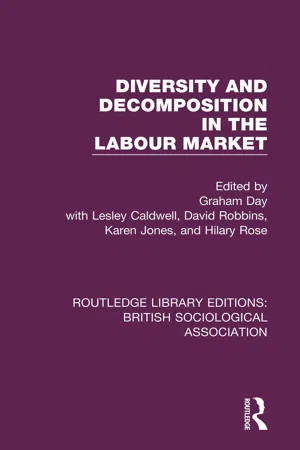
Originally published in 1982 Diversity and Decomposition in the Labour Market, is an edited collection addressing the contemporary sociology of the labour market. The collection focuses on the categorisation of the diverse dualities that might be thought to characterise certain labour markets. The collection addresses many economic sectors, and there is a distinct focus on labour market analyses developed within neo-classical and radical economics in the USA. The analyses maintain that the labour market is in some sense dualistic.
eBook - ePub
Diversity and Decomposition in the Labour Market
- 218 pages
- English
- ePUB (mobile friendly)
- Available on iOS & Android
eBook - ePub
Diversity and Decomposition in the Labour Market
About this book
Information
1 Introduction: Diversity and Decomposition in the Labour Market
Few would dispute the centrality of the labour market as a feature of capitalist society. The selling of labour power, the variation in the terms on which it can be sold, and the social regulations surrounding the contract of employment define a large part of the field of industrial sociology (Brown, 1980). These issues have assumed a growing importance within what has been termed the ‘new’ industrial sociology (Hill, 1981) as sociologists have belatedly begun to give sustained attention to the operation of the labour market, and to the linkages between career and employment patterns and class formation. This reflects an awareness that more general theories and concepts of stratification in contemporary capitalism need to be tested and refined through the examination of detailed and often local variations. This volume brings together a number of contributions to the 1981 British Sociological Association annual conference, on the theme of inequality, which continue this emphasis. The papers provide a range of insights into the empirical reality of particular labour market sectors and the complexity of different employment situations. At the same time, their authors share a concern with theoretical relevance that leads them to enter into several of the important debates which have been taking place, often without sufficient reference to one another, around the central question of how sociology can best capture the differentiation of the various classes, and the composition of the working class in particular.
A great variety of positions now exist which stress the existence of a fragmented working class; they assign differing weights to the impact of a number of sociological fault lines which are said to split the class, inhibiting the development of a unified class consciousness and preventing mobilisation for action around supposedly shared interests. Opinions differ as to the depth and permanence of these fractures, as well as to the extent to which differentiation and diversity in the labour market is to be seen as the major element producing such divisions. The tendency has been to seek to handle diversity through a set of simplifying assumptions or categories which can be accepted as having universal validity, within at least the capitalist mode of production; characteristically, one recent text, drawing its empirical material from Britain, maintains that ‘although our argument takes its specificity from this instance, its general theme is universally applicable to trends in advanced capitalist societies, notwithstanding local variations’ (Clegg and Dunkerley, 1980, p.402). This belief, which is widely prevalent, had encouraged a readiness to transfer models developed in one society to others with relatively little alteration. There are however considerable dangers in this: as Parkin has commented, analyses formulated too specifically for one society can resemble theories of ‘capitalism in one country’; so, he contends,
in the sociology of the working class, the terminology of affluent and traditional, old and new, rough and respectable, secular and deferential, and so forth, sets up distinctions that appear to derive more from the peculiarities of British society than from the universal, systemic features of capitalism (Parkin, 1979, p.29).
In practice, lately, the temptation has been to import American models into Britain, without always scrutinising them carefully enough to assess their applicability. This is something called into question by several of the papers which follow.
Where systemic properties of capitalism have been indicated, they have often been oversimplified to provide excessively generalised explanations both for the internal divisions in the working class, and for processes which might be expected ultimately to transcend them; examples of such one dimensional, single process accounts would include the notion of ‘embourgeoisement’, widely discussed in the 1960s and (as the other side of the coin) some accounts of proletarianisation, and the more recent deskilling thesis, as formulated by Braverman, in which a more or less constant, uniform thrust towards the homogenisation of work by the elimination of skills is asserted (Braverman, 1974). The closer the attention paid to specifying actual, historical class fractions, or the more detailed the investigation of market processes and work organisation, the more critically either abstract a priori categorisations or simplified empirical descriptions tend to be viewed: the market is more complex and less orderly, and the differentiation within the class less easily constituted, than the models tend to suggest.
In some respects, British sociology has a healthy pedigree with regard to the empirical study of labour market situations (see, for example, Lockwood, 1958; Lupton, 1963; Cunnison, 1966; Mann, 1973). But criticisms levelled at market centred approaches by Marxists and feminists highlight two major areas of difficulty which they encounter. The first concerns their ability to specify the distinct positions or places to be filled by the labour force; the second has to do with the processes through which workers are recruited into these positions.
The basic problem for students of the labour market is how to reduce a potentially infinite variety of market situations to a manageable and theoretically grounded set of categories (Crompton and Gubbay, 1977, p.34): in other words, that of moving from a conception of market ‘inequalities’ to an account of how the market is structured. This entails locating salient discontinuities or boundaries: hence the significance given to concepts of ‘structuration’ and ‘closure’ in recent Weberian sociology, in which the method employed is to seek to define distributive groupings which share the same broad market situation by virtue of similar market capacities, such as skills, qualifications, or organisational strength. Market situation then essentially defines ‘class’ in terms of a stable pattern of inequalities generated by the market mechanisms: the classic example is the boundary said to exist between manual and nonmanual employees.
The alternative approach has been to treat the market as ‘merely’ distributive, and therefore secondary: to see market institutions and practices as concerned only with access, with assigning workers to positions which are defined elsewhere, in ‘production’, through the division of labour in the workplace and the relations of control and domination surrounding the process of value creation. Some analyses in this Marxist tradition are quite dismissive of the relevance of variations in market conditions and rewards which are allowed at best a derivative significance: differentiation in the labour market is held to be relatively marginal in relation to the truly fundamental class divisions between capital and labour.
In reality it is difficult to sustain a sharp distinction between ‘production’ and ‘distribution’ as determinants of class, since both the opportunities typically encountered in the market, and the functions performed in work enter into the formation of class identity and affect the potentialities for action. Therefore some attempt to bridge the two is usual. David Lockwood in his pioneering effort brought both ‘market’ and ‘work’ situations into his attempt to define the class position of clerical labour; subsequent writers have tried to relate market differentiation more closely to the exigencies of production, either in terms of patterns of control, or of the imperatives of valorisation and accumulation. Some kind of correspondence is looked for between productive functions and market situations. According to Blackburn and Mann, in the most thorough study so far of a segment of the British labour market, this presents no particular problem, given that ‘workers with a common position in production relate similarly to the market, and vice versa’ (1979, p.3). However, this would by no means be generally accepted, and it is those instances where the two appear not to coincide which give rise to some fairly intractable boundary disputes, and produce inconsistencies and ambiguities in attempts to resolve them.
Further difficulties arise when it comes to locating the origins of market capacity or the conditions for success and failure in the market. This requires clarification of the processes which in fact allocate workers to positions in one or other section of the job market. The possibilities are indicated by a comment of Barron and Norris (1976, p.53) that the attributes which link social groups to labour market positions are simultaneously ‘a product of the social relationship between employer and worker ... (and) qualities which are to some extent shaped elsewhere in the social structure and brought to the employment market’ . Most accounts would accept that the formation of market segments depends upon an interaction between factors ‘within’ production and those outside it, but there is considerable dispute as to their relative priority. At one pole, the key to labour market differentiation is said to lie in practices and structures beyond the strictly economic sphere, which are ‘found’ but not created by the social relations of production. Thus capitalism is held to appropriate, and possibly modify or reinforce, a variety of pre-existing structures.
This case has been argued most forcefully and thoroughly with regard to sexual differentiation in the labour market. Not only does a particularly sharp split exist between jobs available to men and to women but in certain respects it even appears to be increasing (Hakim, 1978) . Indeed it is partly because there has been so little interchangeability of work between men and women that it has been possible for industrial sociologists to pay hardly any attention to the specific market situation and experiences of women. The feminist critique of the inadequate understanding of women’s role in production and in the occupational structure which results has so far made only limited inroads into mainstream sociology of industry: research continues to be done which either leaves women out entirely, or perpetuates the discredited practice (see West, 1978; Garnsey, 1978) of simply assigning women to the class position of their husbands or fathers. This effectively means that a crucial dimension of labour market structure is taken for granted, as given outside analysis: treating women as peripheral to the class structure allows the question how and why men occupy the positions they do to go unanswered.
In some interpretations the basis of this labour market segregation has to be traced to conditions external to production itself. It arises as a consequence of prejudice and discrimination which is possible only because other economic activities co-exist with the particular organisation of domestic production. Capitalist relations interact with the structures of patriarchy (Beechey, 1978). A number of other divisions of labour, racial, ethnic and cultural, can be regarded as broadly analogous, although less deeply rooted (Hartmann, 1979). For this reason, one will find a close fit between the sectioning of the labour market, and other poocesses of group formation; such divisions, which are used within production but established elsewhere, can only be fully analysed in terms of the ‘separate dialectics’ (Edwards, 1979, p.195) of sexism and racism, or the operation of ‘sexual and racial divisions of labour’ (Friend and Metcalf, 1981).
Others would attach primacy to developments within production and the labour process, viewing it as ‘accidental’, but convenient for dominant interests, that visible criteria of ascription - age, sex, race - become markers for selection into places that have their origin in economic necessities such as the need to cope with variability, or the different requirements of capital and labour intensive technologies. Such factors can be held for example to bring about market separations between those whose labour is used in positions where the premium is on stability, reliability, and responsibility, and those whose commitment is not needed, since they form part of disposable or marginal labour. From these basic contrasts is generated a whole range of features attributed to ‘dualism’ in the labour market.
There has been a proliferation of models which claim to detect dualism either in the segmentation of the market, or within the structure of production itself and the associated organisation of labour. The basic outlines of the approach are now reasonably familiar (Barron and Norris, 1976; McNabb, 1980) but there are considerable unresolved problems, some of which are tackled in the paper by Morgan and Hooper.
The notion of the dual labour market sets up a distinction between those workers who occupy places in a ‘primary’ market, where work is secure, relatively well paid, affording some prospects for mobility, chiefly through administrative arrangements within the employing firm, and protected by strong unionisation and/or by managerial policy, and a ‘secondary’ market for low paid, insecure, dead end jobs where labour organisation is weak or nonexistent. These are seen as more or less self contained labour force segments, engendering a division within the modern working class similar to, and perhaps as fundamental as that which others have detected historically between the mass of ordinary workers and a relatively privileged ‘labour aristocracy’. Indeed, Edwards accommodates the latter in his version of contemporary labour market segmentation in the USA when he constructs a three tier framework comprising an ‘independent’ primary sector which includes mobile skilled craft workers, a ‘subordinate’ primary sector of the routine, semiskilled working class, and the secondary sector. These he regards as roughly equal in size, and held apart by deep structural barriers into ‘separate groups, each with its distinct job experiences, distinct community cultures, and distinct consciousness’ (1979, p.184).
The same tendency for an initial duality to be broken down into further subdivisions occurs elsewhere in the literature (Berger and Piore, 1980, p.18). The scope for disagreement as to how many layers within the working class should be accorded significance reflects the problem already mentioned, of making break lines within a continuum of market situations. While some regard the divisions as marking qualitative discontinuities, others are prepared to see them as matters of degree. Moreover, some regard dualism as existing in certain labour markets, but not all, whereas others (such as Berger and Piore) view dual arrangements as universal. Barron and Norris adopt an agnostic position, saying that
dualism is a matter of degree. Some labour markets are more dualistic than others, but probably most labour markets are neither wholly dualistic nor entirely unsegmented (1976, p.49).
Further complications arise as soon as we ask where precisely the boundaries of the segments are to be drawn. Among possibilities suggested we find the following:
- dual institutions that correspond to sectoral divisions within the economy, such as those between the ‘monopoly’ and ‘competitive’ sectors, or between the ‘core’ economy and its ‘periphery’. The basis of this separation is seen to depend on possession or lack of possession of the ability to regulate demand and guard against economic fluctuations, since it is this which affords scope to create primary jobs.
- Differences between firms - between large corporations and small business, or between ‘traditional’ and ‘modern’ enterprises (Berger and Piore, 1980). Here dual arrangements may cut through industries, as in the interdependent relationship of mass manufacturers and small component suppliers.
- Boundaries within firms, for example between central and peripheral labour (Friedman, 1977) where the occupants of different jobs are treated in radically dissimilar ways according to whether their labour is believed to be essential or dispensable.
- Contrasts between spatial units and regions, where it is possible to draw upon theories of development to link developed and underdeveloped areas; the secondary labour market, for example, being typical of the inner city or geographical periphery.
- Distinctions between whole sections of the population, as when one finds suggestions of ‘a marked tendency towards the maintenance of a dual labour market in which women are routinely underprivileged by being consigned to a secondary sector’ (Clegg and Dunkerley, 1980, p.405; Barron and Norris, 1976). Alternatively blacks or ethnic minorities may be considered to provide the secondary labour force or a reserve population: the idea of labour market dualism was originally developed to characterise the work and market situations of blacks m the USA.
It is clear that the relative balance of class fractions will differ very considerably depending on how these various distinctions are used to slice up the workforce. Secondary labour may be seen as a marginal minority, or as a sub-stantial element in the working class. Giddens, for instance, believes the emergence of a ‘massive’ and ‘quite highly structurated’ underclass (the secondary workforce) to be ‘a fundamentally important phenomenon now conditioning the American experience’ (1973, p.216). Similar assertions can be made about the British situation, particularly where specific local class structures are concerned (Friend and Metcalf, 1980; Gilroy, 1980). However the overlapping nature of the divisions referred to, and the scope this affords for shifting between levels of analysis, makes the ‘theory’ of dualism elusive and difficult to test.
Morgan and Hooper subject dual labour market approaches to critical review in their paper; while applauding them for allowing a way into sociological analyses of the labour market which have been lacking in the past, they are sceptical as to the mileage to be got from them. Their criticisms bear on both the theoretical and empirical content of models of dualism. Thus, it would seem that theoretical ambiguities and disagreements indicate that the dual framework is really at best a descriptive formulation, since whatever explanatory content it has rests either with conceptualisations of the production process or with claims about the market capacities of different groups and collectivities. In any case, the authors show, British uses of the framework have tended to become detached from the theoretical context, explicit or implicit, within which the original American formulations were produced.
Furthermore, Morgan and Hooper point out that as descriptions, dual models are quite poor; either the relevant evidence is lacking altogether, or the data which are available fail to match up to the theoretical categories employed, as is the case with the heavy reliance placed upon average aggregate data. As they suggest, this encourages the central ambiguity as to whether dualism is indeed a discontinuit...
Table of contents
- Cover
- Half Title
- Title Page
- Copyright Page
- Contents
- Acknowledgements
- 1. Introduction: Diversity and Decomposition in the Labour Market
- 2. Labour in the Woollen and Worsted Industry: a critical analysis of dual labour market theory
- 3. Patterns of Disadvantage in a City Labour Market
- 4. Women in the Local Labour Market: a case study with particular reference to the retail trades in Britain 1900-1930
- 5. The Contest Terrain’: a critique of R. C. Edwards’ theory of working class fractions and politics
- 6. ‘Fraternalism’ and ‘Paternalism’as Employer Strategies in Small Firms
- 7. Clerical ‘Proletarianisation’: Myth or Reality?
- 8. Class Relations and Uneven Development in Wales
- 9. Technocratic Ideology and the Reproduction of Inequality: the case of the electronics industry in the Republic of Ireland
- Contributors
Trusted by 375,005 students
Access to over 1.5 million titles for a fair monthly price.
Study more efficiently using our study tools.
Frequently asked questions
Yes, you can cancel anytime from the Subscription tab in your account settings on the Perlego website. Your subscription will stay active until the end of your current billing period. Learn how to cancel your subscription
No, books cannot be downloaded as external files, such as PDFs, for use outside of Perlego. However, you can download books within the Perlego app for offline reading on mobile or tablet. Learn how to download books offline
Perlego offers two plans: Essential and Complete
- Essential is ideal for learners and professionals who enjoy exploring a wide range of subjects. Access the Essential Library with 800,000+ trusted titles and best-sellers across business, personal growth, and the humanities. Includes unlimited reading time and Standard Read Aloud voice.
- Complete: Perfect for advanced learners and researchers needing full, unrestricted access. Unlock 1.5M+ books across hundreds of subjects, including academic and specialized titles. The Complete Plan also includes advanced features like Premium Read Aloud and Research Assistant.
We are an online textbook subscription service, where you can get access to an entire online library for less than the price of a single book per month. With over 1.5 million books across 990+ topics, we’ve got you covered! Learn about our mission
Look out for the read-aloud symbol on your next book to see if you can listen to it. The read-aloud tool reads text aloud for you, highlighting the text as it is being read. You can pause it, speed it up and slow it down. Learn more about Read Aloud
Yes! You can use the Perlego app on both iOS and Android devices to read anytime, anywhere — even offline. Perfect for commutes or when you’re on the go.
Please note we cannot support devices running on iOS 13 and Android 7 or earlier. Learn more about using the app
Please note we cannot support devices running on iOS 13 and Android 7 or earlier. Learn more about using the app
Yes, you can access Diversity and Decomposition in the Labour Market by David Robbins, Lesley Caldwell, Graham Day, Karen Jones, Hilary Rose, David Robbins,Lesley Caldwell,Graham Day,Karen Jones,Hilary Rose in PDF and/or ePUB format, as well as other popular books in Social Sciences & Sociology. We have over 1.5 million books available in our catalogue for you to explore.