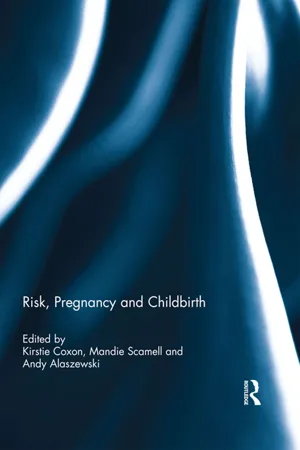
Over the last hundred years, pregnancy and childbirth has become increasingly safe – yet it is still a site of risk, and a contested ground on which health professionals and pregnant women both face high costs of error. In this context, all those involved in managing pregnancy and birth are expected to identify and mitigate risk: pregnant women are subject to increasing surveillance to ensure the safety of the unborn foetus, and every aspect of childbearing is increasingly medicalised. This publication brings together fascinating social science research to explore the ways in which risk is both created and managed in pregnancy and childbirth. The introductory chapters reflect on the changing social context of childbirth, in particular the medicalisation of both pregnancy and childbirth with development of specialist practitioners, such as obstetricians and midwives who claim to have the knowledge, technology and skills to identify and manage the risks involved. The next three chapters that examine the ways in which women's behaviour during pregnancy is constructed as potentially risky -- for example smoking, drinking alcohol and taking drugs, and how these risks are monitored and mitigated. The final two parts of the book address the construction of and responses to both medicalisation and risk in childbirth. Altogether, it represents a valuable insight into the complex world of pregnancy, childbirth and risk. This book brings together editorials and articles originally published in special and open issues of Health, Risk and Society.
- 190 pages
- English
- ePUB (mobile friendly)
- Available on iOS & Android
eBook - ePub
Risk, Pregnancy and Childbirth
About this book
Information
Risk in pregnancy and birth: are we talking to ourselves?
Kirstie Coxon
Division of Women’s Health, Women’s Health Academic Centre (King’s Health Partners), King’s College, London, UK
In this editorial, I explore the contribution of the recent special issue of Health, Risk & Society (Volume 16, Issue 1), and three related papers published in the current volume (Volume 16, Issue 6), and identify themes and concepts which are consistent across these papers. The aims of the special issue were twofold; the call for papers invited articles on the topic of risk in relation to pregnancy and childbirth, and which sought to explore risk theorisation in this field. Looking at these papers as a body of work, I explore the breadth of this collective endeavour, and identify areas which have been researched at some depth, whilst drawing attention to other areas which manage to evade our theoretical gaze. I also reflect on the ways in which these papers have, independently and together, added to the field of risk theorisation, and propose some future directions which might usefully help move beyond the current limits of our enquiry. The combined body of work in these issues represents a considerable resource, and one which makes a clear contribution to contemporary understandings of risk, pregnancy and birth, however I argue that of late, the focus of enquiry has become narrowed, with much of our research providing new evidence from the perspective of relatively privileged women from high-income countries, who have good access to safe, high quality maternity care. The sum of this work is now such that it is possible to synthesise themes across studies and settings, which is valuable to our understanding, but the lack of research amongst women from developing nations, or amongst those with less privilege in high-income countries, means that our resource is incomplete, and fails to do justice to women’s broader experience of pregnancy and birth. Developments of risk theorisation are evident in the collected papers; authors have interrogated the positioning of individuals as subjects, and drawn new conclusions about historicised risk, and practices of resistance to risk discourse. I review these developments in this editorial, and also propose that the collection generates many new dimensions to our initial understanding of the ‘virtual object’ of risk in the context of pregnancy and birth. I conclude by outlining potential new directions and approaches to meet some of the identified gaps in our exploration and theorisation of risk in pregnancy and birth.
Introduction
A recent special issue of Health, Risk & Society (16 (1–2)) focussed on risk in pregnancy and birth. This brought together a set of papers with a common theme; each answered a call for articles that explored ways in which risk is understood or constructed by different agents, and sought to extend theoretical thinking about risk in pregnancy and birth. We took as a starting point that ‘pregnancy and child birth have become important sites of risk in late modern societies’ (Coxon, Scamell, & Alaszewski, 2012, p. 505) and acknowledged the ubiquity of what Lee and colleagues describe as ‘the imperative at the individual level to become a risk manager’ (Lee, Macvarish, & Bristow, 2010, p. 299).
In this editorial, I review the contribution of the special issue on pregnancy and childbirth, and consider the extent to which the collected body of work adds new understanding to the topical field overall, and to social science understandings of risk in particular. First, I briefly outline recent changes that affect pregnancy and birth from an international perspective to establish a context for this renewed enquiry, and argue that these changes have gradually reframed the ways that risk in pregnancy and birth is constructed from multiple perspectives. I then examine the papers included in the special issue and the three new papers that appear in this edition (Jette, Vertinsky, & Ng, 2014; Leppo, Hecksher, & Tryggvesson, 2014; Wiggington & Lafrance, 2014) as a core body of work. I interrogate the theoretical content and debates within these papers to highlight new insights, with particular reference to a proliferation of ‘virtual objects’ (Van Loon, 2002) in accounts of pregnancy and birth risk. I identify gaps in the established body of work and argue that this theoretical enquiry has overlooked some important areas in relation to historical discourse, and to understanding intersections of inequality in relation to risk, and it is important to examine why this might be the case.
International focus: current debates in pregnancy and birth
Whilst it is not possible to rehearse here the full extent of international change in relation to pregnancy and birth, some key trends and concerns are important. The division of the globe into low-income regions where birth remains dangerous for women and babies, and regions where women can expect safe, high quality care, is stark; this basic inequity is the focus of the United Nations’ Millennium Development Goal Five (Maternal Health), which aims to reduce the maternal mortality ratio by three quarters and provide universal access to reproductive health by 2015 (http://www.un.org/millenniumgoals/maternal.shtml , Renfrew et al., 2014). In high- and middle-income countries, perspectives on birth are also changing; concerns about rising costs, medicalisation, morbidity and variations in care mean that the ‘techno-scientific’ approach to birth, so long considered dominant, is under concerted attack, and a gradual transformation towards ‘scientific-bureaucratic’ medicine (Harrison & Wood, 2000) is apparent. Although the practice of obstetrics has been historically resilient to such attacks (see, for example, Arney, 1982; Donnison, 1988), some change is evident; witness, for example, the American College of Obstetricians and Gynaecologists’ position paper on home birth (American College of Obstetricians and Gynecologists, 2011); for the first time, this highly conservative professional group is edging towards some level of support from US obstetricians for this practice.
In this respect, the USA lags behind the UK, where there is already established cross-professional support for birth at home and in midwifery units as well as in hospital, and active endorsement of normal birth (NCT/RCM/RCOG, 2007) and vaginal birth following a previous birth by Caesarean Section by both obstetricians and midwives. These initiatives have taken place within a policy environment which is, in rhetorical terms at least, supportive of birth choice for women, and of ‘low tech’ birthing when women are healthy and well. In 1993, the publication of Changing Childbirth (Department of Health, 1993), a policy statement which arguably changed the landscape of birth in the UK by proposing that women should be involved in decisions about their care as a matter of course, and offered women choice (including home birth), control and continuity of care. At a ‘witness’ seminar held to commemorate the twenty-year anniversary of this policy statement, which has been maintained and even expanded by successive governments, individuals involved in the original drafting joined a panel to discuss its legacy, and to consider the extent to which childbirth has indeed changed. The panel noted that the home birth rate remains static twenty years on, and that the main change has been an increase in birth intervention and surgical birth; this change is certainly not in keeping with the aspirations underpinning the policy, but as one obstetrician commented, what has changed childbirth in England is not the policy framework, but rather the realities of litigation, and the introduction of the Clinical Negligence Scheme for Trusts in 2003 (McIntosh, 2014, p. 28). Clinical Negligence Scheme for Trusts is a ‘risk pooling’ scheme into which English National Health Service (NHS) trusts pay on a voluntary basis, and can then draw upon in the event of a maternity litigation claim. The amount a Trust pays depends on the level of compliance with Clinical Negligence Scheme for Trusts maternity standards, each of which must be evidenced within Trust guidelines or protocols; discount between 10–30% can be gained by demonstrating adherence to these, including auditing of compliance with guidelines by staff.
The way that these changes are implemented through policy and legislation can be understood within the framework Scamell and Stewart describe as a shift from professional autonomy towards encoded models of governance for pregnancy and birth risks (Scamell & Stewart, 2014, p. 85). These authors argue that clinical governance has become ‘a form of collective self-regulation…based on [Harrison and Wood’s (2000) concept of] scientific-bureaucratic medicine’. This change is directly related to the perceived costs of litigation, as governments and healthcare funders seek to homogenise maternity care by reducing scope for variations brought about by individual clinical autonomy. The historical focus on obstetric practice as the sole source of intervention risk during birth is therefore now outdated; as Annandale (1989) observed in her rather prescient paper, to understand medical care, we need to learn what the lawyers are doing, and how professional practices change because of this.
Scamell and Stewart (2014) explored clinicians’ loss of autonomy and the effects this had on their clinical and professional identities, and presented data that showed how, as UK midwives found themselves straitened by both National Institute for Health and Care Excellence (NICE) clinical guidance and fear of litigation (either their own fear, or the sense of a litigation-fearing culture within their employing NHS organisation, or both), women in their care also lost autonomy as choices were downplayed or no longer even offered. Whilst clinical autonomy and the ‘techno-scientific’ approach to birth may then be weakened, risk governance ‘solutions’ still close down choice, control and autonomy for women, and the benefits anticipated by detractors of the biomedical model continue to elude us. Rather, it appears that surveillance medicine has merely shifted into a higher gear, capable of instigating what Brown and Crawford (2003, p. 67) describe as ‘deep’ self-regulation amongst individuals and organisations. In less affluent, middle-income countries however, as Chadwick and Foster (2014, p. 71) remind us, the techno-scientific model is expanding apace; a sentinel indication being that countries such as China, Mexico and Chile report caesarean section rates in excess of 50%, compared to 25% in UK and 32% in US.
What did we know, and what do we need to know?
Health, Risk & Society is a journal with international scope, and risk issues in pregnancy and birth a prime example of a topic with global relevance, yet most of the papers in the special issue refer to research undertaken in high-income countries. Only one paper (Chadwick & Foster, 2014) came from a country with a developing economy (South Africa), but even so, as the authors acknowledged, the focus was on affluent, educated and mainly white women’s’ perspectives of pregnancy risk. Almost all of the empirical work in the special issue collection arose from samples of privileged women; the main exception is Stengel’s paper, which considered licit and illicit drug use during pregnancy (Stengel, 2014). Stengel opted not to collect demographic data; understandably, her participants expressed a strong need for anonymity, and may not have participated if such information were collected and held by the research team, but Stengel comments that contextual details within women’s accounts pointed to marked levels of socio-economic deprivation operating alongside the effects of stigma. In this issue, Wiggington and Lafrance (2014) recount interviews with women who smoked during pregnancy, and again, precise demographic data were not included, but sample description suggests most participants were employed with post-high-school qualifications. Our paper on place of birth in England included a diverse sample in terms of ethnicity and levels of education and affluence (Coxon, Sandall, & Fulop, 2014), although we did not highlight the impact of socio-economic status on birth risk constructions in this article. This does not mean that accounts from women with privileges of affluence and education are not valuable; on the contrary, as these papers illustrate, socio-economic privileges offer little insurance against the complex identity work that women must undertake in becoming mothers. Nevertheless, this collection represents a partial and imbalanced sociology of pregnancy and birth risk with important omissions that obscure the experiences of many women, and this imbalance is certainly replicated in the discipline more widely.
Theorising risk in pregnancy and birth
Each of the papers in our special issue details a particular aspect of how societies and individuals construct and enact pregnancy and birth risk, and the resulting resource, rich in detailed data on lived experiences, certainly builds deeper understanding and establishes links and corollaries across the field. To some extent, the homogeneity of the original samples, which might be considered a limitation of the special issue as a whole, increases the potential for theoretical synthesis across the papers. For example, two papers (Chadwick & Foster, 2014; Coxon et al., 2014) explored place of birth; both used a sociocultural approach, drawing respectively on Lupton (1999a, 1999b) and Beck (1992) and each positioned women as self-regulating risk managers within a risk society. Both papers confirmed the prominence of faith in techno-scientific birthing amongst women who chose hospital labour wards (Coxon et al., 2014) and caesarean birth (Chadwick & Foster, 2014), each echoing Bryant, Porter, Tracy, and Sullivan (2007) and Davis-Floyd’s earlier work on this subject (Davis-Floyd, 1994). Each paper also added something new, which is that women described how childbirth involved ‘risks of birthing embodiment’ (Chadwick & Foster, 2014, p. 80), such as loss of dignity, or public shame. The issues of public and private ‘pollution’ in birth have been reported before (see, for example, Callaghan, 2007), but the observation that women might seek to control these risks either by birthing at home (where home is considered to be private and intimate), or in hospital (where hospital is thought to be safe and clean), is new, and points to a deeper set of beliefs about risk and place; the conceptualisation of different venues as ‘safe havens’, depending on associations with private and public pollution, represents a potential theoretical development. Both papers also speak to the nature of consumer relations within maternity care, and the influence this has on personal control over clinical decisions, and these discussions, again building on earlier work by Davis-Floyd (1990, 1994) and Lupton (1997), point to a new consumer-oriented risk perspective in contemporary health economies.
Across the special issue, authors consistently drew on prominent theorists associated with sociocultural understandings of risk; Beck (1992, 1999), Lupton (1999a, 1999b), Douglas (1966, 1992), Douglas and Wildavsky (1982) and Giddens (1991b) provide the theoretical bedrock for this accumulated work. Within these analyses, sociocultural theories of risk were largely endorsed without a great deal of critical interrogation, which raises the issue of the extent to which such analyses are self-replicating; if we anticipate ...
Table of contents
- Cover
- Half Title
- Title
- Copyright
- Contents
- Citation Information
- Notes on Contributors
- 1. Risk in pregnancy and birth: are we talking to ourselves?
- 2. Pregnancy, birth and risk: an introduction
- 3. ‘Knowledge is power’: risk and the moral responsibilities of the expectant mother at the turn of the twentieth century
- 4. ‘I don’t think it’s risky, but…’: pregnant women’s risk perceptions of maternal drinking and smoking
- 5. The risk of being ‘too honest’: drug use, stigma and pregnancy
- 6. ‘Why take chances?’ Advice on alcohol intake to pregnant and non-pregnant women in four Nordic countries
- 7. To what extent are women free to choose where to give birth? How discourses of risk, blame and responsibility influence birth place decisions
- 8. Negotiating risky bodies: childbirth and constructions of risk
- 9. Pluralist risk cultures: the sociology of childbirth in Vanuatu
- 10. Time, risk and midwife practice: the vaginal examination
- 11. Pregnancy, risk perception and use of complementary and alternative medicine
- 12. Fateful moments and the categorisation of risk: Midwifery practice and the ever-narrowing window of normality during childbirth
- Index
Trusted by 375,005 students
Access to over 1.5 million titles for a fair monthly price.
Study more efficiently using our study tools.
Frequently asked questions
Yes, you can cancel anytime from the Subscription tab in your account settings on the Perlego website. Your subscription will stay active until the end of your current billing period. Learn how to cancel your subscription
No, books cannot be downloaded as external files, such as PDFs, for use outside of Perlego. However, you can download books within the Perlego app for offline reading on mobile or tablet. Learn how to download books offline
Perlego offers two plans: Essential and Complete
- Essential is ideal for learners and professionals who enjoy exploring a wide range of subjects. Access the Essential Library with 800,000+ trusted titles and best-sellers across business, personal growth, and the humanities. Includes unlimited reading time and Standard Read Aloud voice.
- Complete: Perfect for advanced learners and researchers needing full, unrestricted access. Unlock 1.5M+ books across hundreds of subjects, including academic and specialized titles. The Complete Plan also includes advanced features like Premium Read Aloud and Research Assistant.
We are an online textbook subscription service, where you can get access to an entire online library for less than the price of a single book per month. With over 1.5 million books across 990+ topics, we’ve got you covered! Learn about our mission
Look out for the read-aloud symbol on your next book to see if you can listen to it. The read-aloud tool reads text aloud for you, highlighting the text as it is being read. You can pause it, speed it up and slow it down. Learn more about Read Aloud
Yes! You can use the Perlego app on both iOS and Android devices to read anytime, anywhere — even offline. Perfect for commutes or when you’re on the go.
Please note we cannot support devices running on iOS 13 and Android 7 or earlier. Learn more about using the app
Please note we cannot support devices running on iOS 13 and Android 7 or earlier. Learn more about using the app
Yes, you can access Risk, Pregnancy and Childbirth by Kirstie Coxon,Mandie Scamell,Andy Alaszewski in PDF and/or ePUB format, as well as other popular books in Medicine & Gynecology, Obstetrics & Midwifery. We have over 1.5 million books available in our catalogue for you to explore.