First published in 1975. Remedial education aims to help the pupil who is failing. It is richly rewarding to the committed teacher but makes great demands on him. Olive Sampson, whose conviction of the importance of this form of schooling is based on extensive personal experience and research, gives an objective account of its history, present status and best practices.
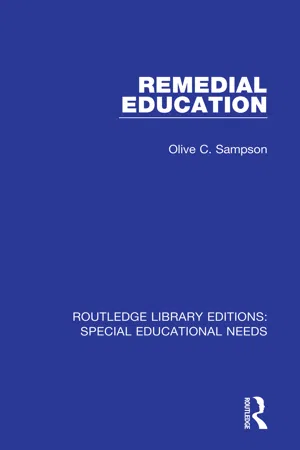
- 108 pages
- English
- ePUB (mobile friendly)
- Available on iOS & Android
eBook - ePub
Remedial Education
About this book
Information
1 How it all began
Early approaches to backwardness
No doubt there have always been individual teachers who have devoted their skills to the failing and the handicapped. In the case of such obvious disabilities as blindness and deafness their efforts have a long history (Pritchard, 1963). Recognition of less dramatic but commoner forms of educational difficulty is of far more recent date and connects with the beginning of universal schooling. Many of the children drafted into the huge classes of those days must have found the position baffling. If they failed, the teacher’s initial reaction was to ascribe this to incapacity or idleness or both. A movement towards a real understanding of the complexities of the learning situation, however, began in this country with Galton and his anthropomorphic laboratory in 1884, and was much strengthened and popularized by Sully. His British Child Study Association (founded in 1893) and its branches disseminated the psychological approach. Meetings discussed such topics as ‘children who are unfit’. Members wrote essays competing for prizes. One, ‘Steps to be taken in discriminating which children are to be considered suitable for special instruction’ (1901), suggested that teachers should extend their observation of cases ‘to the playground and going to and from school’.
Progress towards a more exact diagnosis of children’s difficulties became possible with the development of better techniques of intelligence and scholastic testing. Beginnings had certainly been made by Galton, but the work of Stern and Binet on the continent and of Burt and Schonell in England put mental measurement and scholastic testing on an altogether firmer footing during the early years of this century.
With Burt’s appointment as psychologist to the LCC in 1913, a new profession ‘with a new type of specialist’ came into existence; and later, educational psychologists in similar posts elsewhere were able to offer the teacher scientifically-based insights and thus increasingly influenced teaching, particularly teaching of the less successful pupil, in a variety of ways. New methods involving case studies and educational surveys helped to identify the children’s problems; and seminal publications, destined to have lasting influence, gave further guidance. Chief among these are two classic works, Burt’s The Backward Child (1937) and Schonell’s Backwardness in the Basic Subjects (1942). Both demand fuller description on account of their impact on remedial education.
Burt: The Backward Child
Burt’s book is based on some twenty years of quite exceptional experience. He was able to draw on individual contacts and extensive studies covering many aspects of educational backwardness. His comments throughout are penetrating and pioneering but here, only those closely connected with the purpose of this volume will be given.
After seven engrossing chapters devoted to the physical concomitants of school failure, Burt discusses the intellectual factors involved. In particular he highlights the information gained from mental test results. Summarizing these he finds that ‘not all children in the backward group’ fall ‘below the average in general intelligence’. In fact his figures showed that while 60-1 per cent were ‘dull’ (IQ 70-85) and 355 per cent were ‘inferior’ (IQ 85-100), no less than 44 per cent were ‘average or above’. This last percentage represented a distinct type.
It is necessary to distinguish between those pupils whose backwardness is accidental or acquired and those whose backwardness is innate or permanent. In the former, transference to a backward class is to be regarded as nothing but a temporary expedient. Individual attention as regards teaching ... should result in progress being so speeded up that all who are not dull as well as backward should, after one or two terms, be fit for re-transference to the ordinary class. In most schools these cases are the rarer of the two main types (pp. 605-6).
Schonell: Backwardness in the Basic Subjects
Schonell’s studies of educationally backward pupils (Backwardness in the Basic Subjects, 1942) were geared to his methods of teaching the three Rs. He was also keenly interested in the relationship of maladjustment to school progress. Like Burt, Schonell found that ‘although dullness necessarily produces scholastic backwardness, not all backwardness is the outcome of dullness’. Again like Burt, Schonell estimates the non-dull backward as a relatively small group (about 4 per cent). They represent cases of ‘improvable scholastic deficiency’. Their present scholastic status he considers ‘is characterized by an unrealized margin of intellectual power, a condition to which the term retardation seems most applicable’. While duller children can show retardation in this sense, ‘it is seen at its most pronounced forms in bright children’. Such retardation, Schonell recognized, is often quite specific, being typically confined to a single school subject. As to treatment, he thinks that both retardation and backwardness demand ‘individual and at times specially organized’ methods of treatment. Elaborating on this, he emphasizes a need, especially in cases of specific retardation, for a ‘proportion of private, individual assistance’ as well as ‘flexible coaching groups’ meeting for a short time each day, rather than full-time backward classes. Like Burt, he notes that such ‘concentrated individual consideration of their problems quickly brings many pupils to a level so that they can be re-drafted to their normal class’.
While the theories of Burt and Schonell were being digested, related developments were afoot in the field. Broadly these were of two kinds. (1) Where child guidance facilities existed, remedial teaching (usually by the psychologist, sometimes by a specially appointed teacher), was commonly among the forms of therapy offered. Maladjusted and retarded children of good intelligence were the main recipients. (2) In some cases, small full-time classes for ‘dull and backward’ pupils were being formed. Local policy sometimes lay behind such developments, but often they were the result of the personal initiative of head teachers. The author well remembers visiting one such class in Wiltshire in the mid-1930s. The numbers were relatively small, comprising some fourteen pupils, mostly boys. The intelligence range included a severely subnormal girl who spent most of her time in the passage. The teacher was willing to try anything. Poetry and painting as well as the basic subjects featured on the timetable. The atmosphere was optimistic and supportive.
Such arrangements as the above were hopeful signs but the situation from area to area was very uneven. Some places had a fair variety of well-established facilities to help failing and handicapped children, others had practically nothing.
A small-scale but excellent example of the former, well known at the time in question, was Leicester, where from 1932 onwards a school psychological service along with facilities to help the backward, retarded, and maladjusted had been built up.
Remedial work in the post-war period
When the war came in 1939, the disruptions and staffing difficulties that followed called a halt even in the most progressive areas. However, new impetus returned with the Education Act of 1944 and under the influence of post-war idealism fresh efforts were made. Important landmarks at this stage are provided by the practical work of L. B. Birch in Burton-on-Trent and of W. D. Wall (under Schonell) in Birmingham. Their example set standards and spurred on the remedial movement. Indeed, much that is characteristic of remedial education methods today can be traced to these beginnings. The accounts they gave (Birch, 1948, 1950; Schonell and Wall, 1949) contain uniquely detailed descriptions of the teaching approaches employed. For all these reasons they deserve close attention.
Burton-on-Trent Birch, in an article entitled ‘The remedial treatment of reading disability’ (Educational Review, 1948) describes the efforts made in Burton to deal with backwardness and retardation in reading. A survey of three age groups’ attainments and intelligence was first carried out. This suggested that standards had deteriorated during the war years. A drive to improve matters, with discussions and lectures for teachers was initiated. Particular attention was concentrated on the intelligent but ‘retarded’, defined as those whose attainments were two or more years behind the level appropriate to their mental age. A centre was set up which received pupils on a part-time basis in groups of twelve. Selection and diagnosis was based on detailed psychological testing and parents were fully consulted and informed. ‘They were told of the aims of the centre and the status of the children to be admitted ... and they were encouraged to throw any light they could on their child’s disability.’
The methods used at the centre were systematic and purposeful. Some quotations from Birch’s account will show how he and his assistant worked.
The beginning of the course was spent on removing the aversion to reading which existed in most cases and to welding children from different schools into co-operative units (p. 111).
On the first day the children were told why they had been selected.
In none of the cases so far dealt with have the children been unaware of their disability; usually it was found that they had been worried about it. Most seemed relieved that someone was offering to give them special help. They were encouraged to talk openly about their reading difficulty and almost all of them it seemed had formulated plausible reasons for their failure, blaming some third person or outside circumstances. About half thought that their disability was due to an illness in early childhood. The first two or three periods were short and were spent discussing any topic which presented itself (p. 112).
After this informal start, the children were introduced to a series of specially designed games and puzzles involving words and pictures. ‘Gradually the children began to solve the puzzles by using the words,’ says Birch. ‘After a fortnight or so of this sort of word play the real process of learning to read was begun over again from the beginning.’ A specially prepared serial story was used. It had resemblances to the Happy Venture introductory volume but was built up, section by section, by the children themselves.
Throughout and especially during the early days when building up the first little book, the children were never allowed to experience failure. They were prepared in advance for the reception of each new word and when they met it for the first time it was usually so imbedded in meaningful context and, when possible, illustrated, that it was almost always recognised at once.... The children worked alone or in small groups as they discussed and displayed their own work while the teacher moved among them quietly, helping, advising and encouraging. The pupils soon settled down to the free atmosphere and showed by their keenness that they were enjoying themselves ... when the serial booklet was finished, its cover added and the pages stapled together, there was a noticeable air of something having been achieved. Confidence had been restored and the children were ready to tackle a ‘real’ book. This took the form of the introductory books of the Happy Venture Readers.... A work sheet for each few pages of the book was prepared on which were printed in words well within the reading vocabulary of the pupil, simple instructions as to reading to be done, pictures to be drawn or puzzles to be solved (p. 113).
Later, Happy Venture Books 1 and 2 were studied in the same way. ‘By the time Book 3 was started, however, some of the children in the groups had begun to outstrip their classmates. From this stage, class methods were gradually eliminated and the children were allowed to proceed at their own pace.’
The results, Birch tells us, were ‘higher than had been expected’. This aspect will be fully discussed in a later chapter.
Birmingham While Birch was developing remedial education as a service in Burton-on-Trent, Schonell, who had become Professor of Education at the University of Birmingham in 1946, was launching operational research, with a team of workers under Dr W. D. Wall. Practical experimentation began at the newly inaugurated Remedial Education Centre. The work is described in an article by Schonell and Wall which appeared in 1949. In this they tell how the centre was set up with various objectives in mind. Among these was ‘the investigation of various aspects of backwardness in school including methods of remedial teaching’. After careful surveys and screening, a group of children who all had IQs of at least 90, with attainments ‘one educational year or more behind the mental age’ and who were not too maladjusted to fit in, were selected for the experimental programme. Three distinct methods were to be tried: (1) the small (five to eight) group (2) the weekly interview with child and parent (3) various forms of individual treatment. Of these the principal method, which was also ‘on the whole the most successful’, was the small group. Schonell and Wall (1949) describe their various procedures in some detail.
The purpose of the groups has been frankly that of remedial education. In the children’s eyes, help with school work which they have found difficult is the main objective. This has meant that the backbone of the work done has been direct teaching and a systematic and planned attack upon each child’s difficulties as revealed both in the original diagnosis and as knowledge of his problems has developed.
In reading, for example, a combination of sentence method with short periods of practice aimed at specific weaknesses in phonic analysis or synthesis or at increasing the pupil’s ability to discriminate word or letter patterns may be used. In other cases, where there is a marked weakness in reading for comprehension the stress may be upon work sheets which direct the child’s attention to the content of what he reads. In all, case material ... carefully graded to suit the child’s reading level and based on a controlled vocabulary, is the basis. From these and other sources, work sheets, card games and so on are constructed often by the pupil himself; and supplementary reading to give extended practice at the level attained is provided (pp. 13-14).
After describing parallel methods for dealing with arithmetic difficulties, the authors generalize.
The foundation of the remedial work is thus a systematic attack ... based on brief periods of teaching and practice. The purpose of this is made clear to the pupil; he is set immediate and attainable objectives; and he records his own progress on a personal chart. This is the framework without which achievement might be sporadic or slight. It should not be however interpreted to suggest that the work is formal. The atmosphere of the groups is informal, friendly and highly motivated. Every form of activity is encouraged and so far as possible all the work done by the child is based upon some project of his own or of the group (p. 14).
As well as considering teaching methods, other factors in success are emphasized.
The constitution of the groups is given careful thought. The aim is to develop a group which will cohere and from which the individual children can get some of the support and social experience which they lack. No direct psychotherapy is attempted. The stress is laid on an atmosphere of encouragement and steady success. Freedom to experiment and the availability of all kinds of projective play materials—puppetry, modelling, sand and water, Lowenfeld world, finger painting, dramatics —allow the child to chose for himself or as a member of a group situations and outlets which have therapeutic value for him (p. 15).
As in Birch’s work, but to an even greater extent, parents were involved.
In the treatment of the groups ... the role of the psychiatric social worker is of the utmost importance. ... From the time of the first interview ... until well after the case is closed as far as remedial teaching is concerned, contact is maintained with the home. In many cases a good deal of adjustment of parental attitudes and inter-parental difficulties has to be attempted. Every effort is made to suggest practicable lines along which the parents can cooperate with the school and the centre to help the child (p. 16).
As well as using groups for remedial work, experiments using interviewing (counselling) and individual sessions were also embarked on, as already stated. The counselling approach was found to have certain advantages when circumstances made it practicable.
The important aspects of this method are that the child and the responsible parent meet the psychologist for twenty minutes each week, together. This continues until a thorough understanding is built up in the mind of the parent of the way in which the child’s difficulties are to be approached. The weekly interview is not a coaching period in the strict sense at all. It is occupied in discussing with the child and the parent the work which has been done in the previous week, a quick check on progress, some help with any difficulties which may have arisen, and in setting a new assignment (p. 17).
Parents were given a list of ‘suggestions for parents helping children with their reading’ to guide them.
The method of individual tuition and p...
Table of contents
- Cover
- Half Title
- Title Page
- Copyright Page
- Original Title Page
- Original Copyright Page
- Table of Contents
- Series Editor’s Preface
- Preface
- Acknowledgments
- Introduction: What’s in a Name?
- 1 How it all Began
- 2 The Situation Today
- 3 The Effects of Remedial Education
- 4 The Skills of the Remedial Teacher: (1) Testing and Recording
- 5 The Skills of the Remedial Teacher: (2) the Selection of Methods and Materials
- 6 The Psychological Background of Remedial Education
- 7 Definitions and Appraisals
- Appendix: Tests, Apparatus and Resources
- Bibliography
Trusted by 375,005 students
Access to over 1.5 million titles for a fair monthly price.
Study more efficiently using our study tools.
Frequently asked questions
Yes, you can cancel anytime from the Subscription tab in your account settings on the Perlego website. Your subscription will stay active until the end of your current billing period. Learn how to cancel your subscription
No, books cannot be downloaded as external files, such as PDFs, for use outside of Perlego. However, you can download books within the Perlego app for offline reading on mobile or tablet. Learn how to download books offline
Perlego offers two plans: Essential and Complete
- Essential is ideal for learners and professionals who enjoy exploring a wide range of subjects. Access the Essential Library with 800,000+ trusted titles and best-sellers across business, personal growth, and the humanities. Includes unlimited reading time and Standard Read Aloud voice.
- Complete: Perfect for advanced learners and researchers needing full, unrestricted access. Unlock 1.5M+ books across hundreds of subjects, including academic and specialized titles. The Complete Plan also includes advanced features like Premium Read Aloud and Research Assistant.
We are an online textbook subscription service, where you can get access to an entire online library for less than the price of a single book per month. With over 1.5 million books across 990+ topics, we’ve got you covered! Learn about our mission
Look out for the read-aloud symbol on your next book to see if you can listen to it. The read-aloud tool reads text aloud for you, highlighting the text as it is being read. You can pause it, speed it up and slow it down. Learn more about Read Aloud
Yes! You can use the Perlego app on both iOS and Android devices to read anytime, anywhere — even offline. Perfect for commutes or when you’re on the go.
Please note we cannot support devices running on iOS 13 and Android 7 or earlier. Learn more about using the app
Please note we cannot support devices running on iOS 13 and Android 7 or earlier. Learn more about using the app
Yes, you can access Remedial Education by Olive C. Sampson in PDF and/or ePUB format, as well as other popular books in Education & Education General. We have over 1.5 million books available in our catalogue for you to explore.