Chapter 1
The Origin of Puppets and Homunculi
The puppet, be it a hand puppet or a marionette, is an extension of our heart, an extension of our soul.
Breathing life into a puppet, you wish it really would open its eyes and live: the Pinocchio effect. In a way, the puppet has you over a barrel. In stop motion, you are communicating with a puppet like a shaman and the puppet seems to communicate with you, at least in your imagination. A shaman acts as a bridge between different worlds, the material and the spiritual world. There are tales of ventriloquist’s puppets, demonic dummies, who have minds of their own and absorb the puppeteer. Michael Redgrave’s dummy from Dead of Night became the prototype for more devil dolls to come. There is slight resentment concerning puppets on behalf of many adults, as they confuse puppets with dolls.
“Aren’t you too old to play with dolls?” Ray Harryhausen was once asked, and since that time he never talked about puppet but model animation.
Puppets can be cult objects in the material world, including the Voodoo puppets of black magic. Superstitious people believe them to be cursed. Early shadow and puppet theaters have a religious background. Puppets are materialist manifestations from the spiritual world. Three-dimensional computer animation is only spiritual: it doesn’t create material manifestations, only ghost images. The animator cannot touch them.
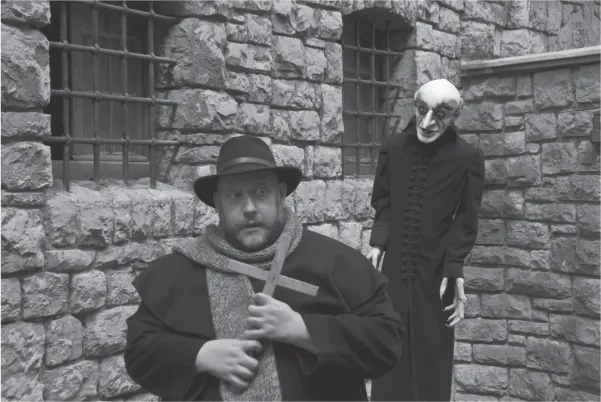
Puppeteer Gerd Josef Pohl and his Nosferatu marionette. (Photographed by Martin van Elten. Courtesy of Gerd J. Pohl.)
An Act of Magic
Creating puppets is an act of magic: like creating homunculi.
The so-called homunculus was the alchemic goal of Doctor Faustus, the legendary necromancer and astrologer who—before he became a durable character in literature—was the star of puppet plays in which he sold his soul to the devil, a predecessor of Frankenstein.
One of these alchemists was Theophrastus Bombast von Hohenheim, otherwise known as Paracelsus, a sixteenth-century master of holistic medicine and natural healing, who is said to have been interested in artificially made human beings, a concern that in those days came close to blasphemous black magic.
In the second century, Hero of Alexandria even wrote manuals on how to fabricate images of god that would move. He would rotate statues and design a miniature puppet theater—not for entertainment’s sake, but for religious purposes. To create a god was to perform theurgy: giving life to inanimate objects. The tradition of animated gods carried on in the fascination with puppets.
There is a classic German short story titled “The Sandman” written by E. T. A. Hoffmann in 1816: A man falls in love with a girl—until he realizes that she is not human. The man’s name is Nathanael. He abandons Klara, his down-to-earth fiancée, for a beautiful girl he has seen from his room in a neighboring building. This girl, Olimpia, does nothing but sit motionless in her bedroom. She plays piano, however, as Nathanael learns, and dances with perfunctory precision. When Nathanael talks to her, she only responds with a gentle “Ah, ah!” To his horror, Nathanael realizes that Olimpia is a life-size mechanical doll fabricated by Spallanzani, his physics professor. Olimpia’s eyes are made of glass. Inside her body is a clockwork mechanism that controls her movements and dancing.
Olimpia is a relative of Disneyland’s Animatronics, and Spallanzani is the ancestor of Walt Disney. Disney was the proverbial puppet master. (There are even some historians who claim that puppetry predates live actors on stage.)
I didn’t know that there was such a thing as the World Puppetry Day. And I didn’t know that besides the Muppets, there was such a thing as Christian puppetry, a form of Christian ministry through puppetry.
Chapter 2
The Art of Silhouette Plays and Films
One special art form in puppetry is flat. Shadow puppetry may be as old as the discovery of shadows themselves. Folk tales, fables, and legends are favorite topics on the shadow screen in any culture and time period.
Shadow puppets were first made of paper sculpture and later from the hides of donkeys or oxen. That’s why their Chinese name is pi ying, which means shadows of hides. Shadow puppetry was quite successful during the Tang and Song dynasties. Under the rule of Kangxi, the fourth emperor of the Qing dynasty, this folk art became so popular that there were eight generously paid puppeteers in one prince’s mansion. When the Manchu emperors spread their rule to various parts of China, they brought the puppet show with them to make up for the fact that they could not appreciate local entertainment due to language barriers. However, for a few years, the art of puppetry hit hard times in the Middle Kingdom. From 1796 to 1800, the government forbade the public presentation of puppet shows to prevent the spreading of peasant uprising at the time. It was not until 1821 that shadow puppet shows gained vigor again.
In Germany, at the end of the Silk Road, the art of the shadow play moved from stage straight to the moving picture screen.
Lotte Reiniger (1899–1981) created the most wonderful silhouette films like the feature-length The Adventures of Prince Achmed (Die Abenteuer des Prinzen Achmed), which premiered in Berlin and Paris in 1926. Lotte adored actors and dancers, particularly ballet dancers, and she spent many hours watching them in their performances. At a young age, Lotte had entered the Theater School of Max Reinhardt. Here she developed her paper-cutting skills, producing tiny portrait figures with great accuracy, particularly of the stars, in order to attract their attention.
During Germany’s financial crisis, Louis Hagen, a banker, had invested in a large quantity of raw film stock as a shelter from inflation, but the gamble hadn’t paid off—and so Lotte was allowed to use it to make the Thousand and One Nights fantasy of Prince Achmed in the magnificent tradition of the shadow theater, which in fact is one of the founding stones of intercultural synergy between East and West.
The technique of this type of film is fairly simple. As with cartoon drawings, silhouette films are photographed frame by frame, but instead of using drawings, silhouette marionettes are used. These marionettes are cut out of black cardboard and thin lead, every limb being cut separately and joined with wire hinges. A study of natural movement is very important so that the little figures appear to move just as men and women and animals do. The backgrounds for the characters are cut out with scissors as well, and designed to give a unified style to the whole picture.
Describing the process of animation, Lotte Reiniger explained that, before any acting, there is a lot of technique involved to move the flat silhouette puppets around: