Originally published in 1977. Management is a dynamic process reflected in three essential functions: management of time, change and people. The book provides a bridging gap between quantitative theories imbedded in the systems approach and managerial decision-making over time and under risk. The conventional wisdom that management is a dynamic process is rendered operational. This title will be of interest to students of business studies and management.
eBook - ePub
Managerial Planning
An Optimum and Stochastic Control Approach (Volume 1)
- 260 pages
- English
- ePUB (mobile friendly)
- Available on iOS & Android
eBook - ePub
CHAPTER I: On Time
I.1 Introduction
The accelerating rates at which our social and economic environments change compel us not only to cope with change but also to manage it. The management of time and change is, however, a very complex task, requiring that we understand how and why change occurs over time. To do this, it is necessary that we first understand what time is and how social and economic states are interrelated in time: that is, how they are “temporally dependent” on each other. When this is achieved, the functions of management consist in selecting a succession of steps, actions, events, and conditions which will manage time and change to increase the chances that “desirable” outcomes will occur over time.
In the context of time, management is a complex activity which requires that we define a time preference for various outcomes; that we define in detail the available means over time; and that these outcomes and means, together with a representation of the process of change over time—i.e., a model explaining how social and economic states change—be used to decide on an effective action. This temporal framework of management is implicit in most managerial decisions; management simultaneously evaluates various desired outcomes and the implicit and explicit costs incurred in reaching these outcomes at a particular time. Because social and economic states are temporally dependent on each other, there must be serious efforts to construct models which can represent accurately the process of change and the implications of managing decisions over time. When we take time into consideration, the questions traditionally of concern to management— such as how, where, and what—must be augmented by when. The explicit inclusion of time in management processes provides an opportunity for better modeling of those processes; and although it entails certain pitfalls, these can be avoided if:
- (1) A better understanding of time and processes is achieved.
- (2) Appropriate numerical methods are devised for the control of processes and the solution of problems connected with processes.
- (3) Static management—that is, management assuming temporal independence of social and economic states—is transformed smoothly into dynamic management—management assuming explicitly that social and economic states are temporally dependent.
Traditionally, management problems were analyzed “statically."1 Although problems of a “dynamic” nature attracted much interest, more often than not these were analyzed intuitively rather than systematically and rationally. As a result, the study of processes has been meagre, and comparatively little attention has been given to the formulation of managerial problems as having to do with phenomena existing over time.
Management over time and of time introduces certain considerations which, although accounted for by managerial behavior, need to be made explicit by the analyst. If this is to be done, the analyst must reach an understanding of time and determine the models and methods for the manipulation of processes. In this chapter, psychological and philosophical notions of time will be correlated to operational notions of time. Such notions will allow better comprehension of why and how events occur over time. This is a prerequisite if we are to observe, model and manage activities as they occur over time.
I.2 Time and Operations Management
It is appropriate to begin with the questions.2 What is time? and How is time related to operations management?
We cannot attempt to define time here except by extension, for time itself is an elusive concept. In management over time, time will be associated with specific concepts and will be used as an operational term. In this regard, we will use time much as we use spatial coordinates: but time — the fourth dimension of human experience — has characteristics and properties unlike those of the three spatial dimensions, which make it a unique variable.
Approaches to the notion of time may be subdivided into two essential groups: (1) those which define “objective time” and (2) those which define “subjective” or “psychological” time. The notion of objective time assumes that time is measurable in terms of temporal milestones, so that there may be quantitative definition for the passage of time. The time-and-motion studies of Frederick Taylor, and his school of management thought in general, are based on such a concept.3 The notion of subjective or psychological time, on the other hand, can be summarized as being a function of three essential concepts: (1) memory; (2) change; (3) value. These concepts are of particular importance to modeling over time and therefore will be discussed next in greater detail.
(1) Memory
Piaget,4 whose conclusions are based on experimental studies of children and adults, proposed that the concept of time is tied to memory and is connected to our perception and awareness of elapsed time. Thus without memory, there is no perception of time. In management memory is a particularly useful concept,5 as it is a mechanism for modeling intricate operational processes that exist through time.
Suppose that a system contains an evolution or behavior which is not recorded temporally. Then time as a dimension of analysis is simply not defined. Conversely, unless time-related activities are patterned, or in sequence, memory does not exist.6 In other words, time and memory are intrinsically related, and both are essential to the modeling of processes. Time is a variable recording the evolution of a process: memory is an incremental description of the evolution of a process over time.
Time and memory, in both the psychological and the operational senses, can also form the basis for distinguishing among past, present, and future. Objectively, the present is simply now; subjectively, the present consists of both the past and the future. This idea has been best stated by Saint Augustine, in his Confessions:
...yet perchance it might be properly
said, 'there be three times; a present
of things past, a present of things present,
and a present of things future.' For
these three do exist in some sort, in
the soul, but otherwhere do I not see
them; present of things past, memory;
present of things present, sight:
present of things future, expectation.7
As Figure 1.1 indicates, we always are in the present. But the present has three dimensions:
- (1) The present of the past
- (2) The present of the present
- (3) The present of the future
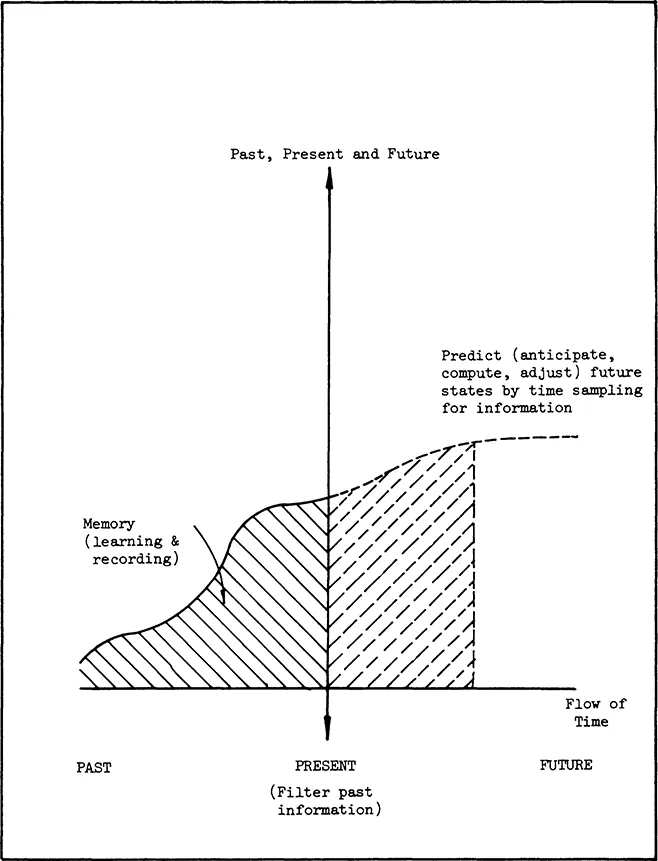
Figure 1.1: Past, Present and Future
At any instant of time, our actions depend not only on our current state but on our memory of the past and our anticipation of the future.8 Some of our actions account for this explicitly; all our actions account for it implicitly. In other words, we may say that each of our acts can be seen in a temporal perspective. Operationally, we construct the past with experiences and empirical observations of temporal processes; our construction of the future, on the other hand, must be in terms of indeterminate and uncertain events which are not always the reflection of the past. We have different mechanisms for establishing opinions of things past and things that may happen in the future. We cannot influence events once they have occurred, but we can influence both their present and their future consequences.9 We exercise influence by the actions and strategies we adopt as well as by our interpretation of past events as relevant to present and future conditions.
Our ability to relate the past and the future to each other — i.e., to make sense of temporal change — by means of an incremental sequentiality is the prime reason for studying the past and inserting it into the mechanisms describing the future. In management this is called planning. The notion of planning is, therefore, a temporal activity which is conceived for the sole purpose of selecting a desired sequence of states. Thus, our ability to plan is strictly a function of our ability to reconstruct the process of temporal change as a function of discretionary actions.
(2) Change
Change is a transformation process relating the past and the future. That is, if we could model the functional transformation of past into future states, we would have determined the process of change. Change is in the present, and it is here that management can influence future states. To do so, a memory of past changes (i.e. memory of the past) is used to estimate current states and forecasts of future changes, and to bring about better decisions. To manage change, we must therefore, “manage the view of the past", “manage the expectations of the future” and comprehend how events are related to each other in time.
Psychologists have related time and change by noting that perceptions of time estimates are inversely proportional to the number of changes occurring in a given time interval. For example, given a task requiring a large number of operations, subjects will estimate the elapsed time to be shorter than if fewer operations were required. Since this estimation is...
Table of contents
- Cover
- Half Title
- Title Page
- Copyright Page
- Dedication
- Table of Contents
- Foreword
- Acknowledgement
- Preface
- Chapter I: On Time
- Chapter II: Planning and Planning Models - Over Time
- Chapter III: Planning Decision—Over Time
Trusted by 375,005 students
Access to over 1.5 million titles for a fair monthly price.
Study more efficiently using our study tools.
Frequently asked questions
Yes, you can cancel anytime from the Subscription tab in your account settings on the Perlego website. Your subscription will stay active until the end of your current billing period. Learn how to cancel your subscription
No, books cannot be downloaded as external files, such as PDFs, for use outside of Perlego. However, you can download books within the Perlego app for offline reading on mobile or tablet. Learn how to download books offline
Perlego offers two plans: Essential and Complete
- Essential is ideal for learners and professionals who enjoy exploring a wide range of subjects. Access the Essential Library with 800,000+ trusted titles and best-sellers across business, personal growth, and the humanities. Includes unlimited reading time and Standard Read Aloud voice.
- Complete: Perfect for advanced learners and researchers needing full, unrestricted access. Unlock 1.5M+ books across hundreds of subjects, including academic and specialized titles. The Complete Plan also includes advanced features like Premium Read Aloud and Research Assistant.
We are an online textbook subscription service, where you can get access to an entire online library for less than the price of a single book per month. With over 1.5 million books across 990+ topics, we’ve got you covered! Learn about our mission
Look out for the read-aloud symbol on your next book to see if you can listen to it. The read-aloud tool reads text aloud for you, highlighting the text as it is being read. You can pause it, speed it up and slow it down. Learn more about Read Aloud
Yes! You can use the Perlego app on both iOS and Android devices to read anytime, anywhere — even offline. Perfect for commutes or when you’re on the go.
Please note we cannot support devices running on iOS 13 and Android 7 or earlier. Learn more about using the app
Please note we cannot support devices running on iOS 13 and Android 7 or earlier. Learn more about using the app
Yes, you can access Managerial Planning by Charles S. Tapiero in PDF and/or ePUB format, as well as other popular books in Business & Business General. We have over 1.5 million books available in our catalogue for you to explore.