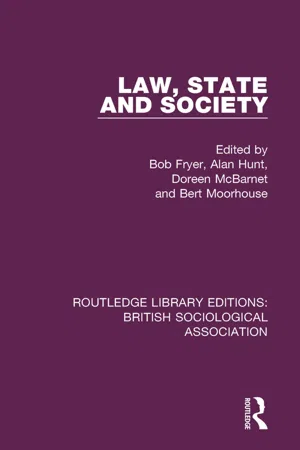
Originally published in 1981 Law, State and Society confronts many of the most important issues within the developing field of law and society. The essays cover the key political debates and the subject of the sociology of law through two key debates, the first tackling the wider theoretical and political system, while the other essays are concerned with more concrete aspects of both the political and social face of law. Together, the essays show how crucial the potential is that exists for a considerable extension and integration of work that focuses explicitly on empirical problems, yet is at the same time more conscious of the theoretical issues that underpin the effectivity of law.
- 232 pages
- English
- ePUB (mobile friendly)
- Available on iOS & Android
eBook - ePub
Law, State and Society
About this book
Information
1
LAW, STATE AND SOCIETY
Bob Fryer, Alan Hunt, Doreen Mcbarnet and Bert Moorhouse
The 1979 British Sociological Association Conference on Law and Society set out to achieve three aims, reflected in the choice of papers for this volume: first, to develop theoretical explorations in a field which had for so long been theoretically underdeveloped; second, and closely related, to encourage theoretically informed empirical investigation, as a conscious move away from what Campbell and Wiles have called the ‘socio-legal’ approach,1 focusing on pragmatically identified ‘problems’ and purporting to adopt a theoretically neutral empirical methodology; third, to redirect the focus of research from criminal law towards civil law and deeper underlying questions of the form of law. Criminal law may have been the logical focus for a sociology of law revived through radical criminology.2 But the roots of the sociology of law go back much further to the grand theorists, Marx, Weber, Durkheim, and to the core of sociological theory.
Indeed the concerns of the sociology of law converge with the most important questions confronting contemporary sociology for reasons other than its historical roots. The sociology of law in Britain has barely reached the level of a recognised sub-discipline of sociology. It occupies a marginal place in the organisation of academic sociology and just as precarious position on the fringe of legal education. Yet the very fact of its late achievement of sub-disciplinary status has meant that it has not become entrapped in the self-protective specialisation which both protects and immunises many sociological sub-disciplines from the wider concerns of the social sciences as a whole. One major consequence of sub-disciplinary specialism manifests itself in the tendency for the sociology of law to become narrowly linked to the requirements of facilitating reforms in the administration of the legal process to such an extent that concern with the social and political context within which the legal system is located has received much less attention. It is thus significant that some of the work that has had the greatest impact on the field has come from people who are not ‘sociology of law’ specialists. Important examples of such interventions have been the very provocative discussion of ‘the rule of law’ by E.P. Thompson in the conclusion of Whigs and Hunters, in which he has insisted on ‘the unqualified human good’ embodied in the rule of law in opposition to the prevailing tenor of Marxist discussion which has relegated the rule of law as bourgeois ideology.3 Similarly the work of Stuart Hall and his colleagues in Policing the Crisis articulates an explicitly Gramscian perspective to the theorisation of law.4 The issues there raised are taken up and discussed by Philip Corrigan and Derek Sayer in their paper which opens this volume.
However, the convergence with mainstream sociology is perhaps most clearly the product of one important feature of the recent development of the sociology of law: the extent to which it bears the theoretical imprint of Marxism. This does not imply that all work in the field is Marxist oriented. There are other methodologically radical departures from the ‘socio-legal’ approach,5 such as the ethnomethodological and phenomenological critique. However, much of the work which could legitimately claim to be influencing the direction of research within the field as a whole is written under the influence of the theoretical presence of Marxism. Now this approach to identifying the impact of a particular intellectual current should not be taken as implying that Marxism is of importance solely because it is (or is presented as) a ‘general theory’. Indeed part of the later argument will seek to stress the developing convergence between empirical and theoretical concerns within the field.
The ‘convergence’ is manifest in four central themes present in contemporary sociology of law:
- the coercion-consent dichotomy;
- the ideological dimension of law;
- legality and the form of law;
- law and the state.
The ‘rediscovery’ of structural conflict by sociology since the 1960s, epitomised by the work of Alvin Gouldner, manifested itself at the most general level in ‘conflict sociology’ and in a temptation to effect the simple negation or reversal of the dominant paradigm. However necessary it may have been to install structural conflict into the concerns of an increasingly complacent sociological enterprise, the inadequacy of the simple substitution of the supposition of ‘conflict’, counterposed to normative consensus, soon became apparent. The recognition of the inadequacies of conflict sociology were for some time masked by the focusing of attention on elements of social structures and institutions in which the presence of conflict was most readily apparent; this was particularly pronounced in the development of sociological consideration of deviance, crime and law over the last decade. The liberation from the complacent assumptions of the normative integrationist assumptions of the prevailing orthodoxy revealed itself in enthusiastic insistence on the conflictual face of deviance, crime and law.6 One of its immediate consequences was to direct the attention of radicals towards a sociology of law that focused almost exclusively on criminal law and ignored the whole body of civil law exhibiting a more apparently consensual face.
The search for a theoretical grounding for conflict sociology reinforced a tendency already present which released a fresh interest in Marxist sociology.7 However, it must be stressed that the process of adoption of Marxism was a contradictory development since the theoretical and conceptual structure of Marxism is one which is to a greater or lesser extent divergent from the theoretical base of conflict sociology. One important consequence was that the form of Marxism adopted, at least in the early stages of the process of transition from conflict theory to Marxism, was a rather naive and instrumental version of Marxism, which treated law exclusively as a coercive apparatus wielded at will by a malevolent ruling class.8
The developments that were taking place within general Marxist theory brought to light the problems inherent in the dichotomy between ‘coercion’ and ‘consent’. This is most sharply apparent in the debates engendered by the explosion of interest in the theoretical potential of the Marxism of Antonio Gramsci.9 Gramsci insisted on the central part played by the ‘mobilisation of consent’ (hegemony) in the reproduction of capitalist social order and of the integral role of law in these processes. Such an insistence accorded well with a recognition of the political inadequacy of trying to understand the persistence of capitalist relations as a result of coercion or conspiracy. An immediate consequence was to provide a theoretical base for the rejection of the instrumentalist theory of law that had almost universally been regarded as synonymous with a Marxist theory of law. Undoubtedly the appropriation of Gramsci in discussions of Marxist theory of law resulted in a one-sided emphasis on the consensual dimensions of the function of law. Yet little advance is achieved through Perry Anderson’s insistence on reinstating the role of coercion, state and domination in Gramsci’s Marxism. The central problem remains: how to conceptualise social processes that involve both ‘coercion’ and ‘consent’ without lapsing into ‘either-orism’; that is either consent is the dominant element or coercion is paramount. In other words the process of the reproduction of social order is conceptualised as taking specific historical forms along a continuum from ‘coercion’ to ‘consent’. Essentially the same dualism is involved in Althusser’s distinction between ideological state apparatuses (ISA) and repressive state apparatuses.10 It hardly needs to be underlined that the dichotomy between coercion and consent had a central importance for all theoretical discussion of law not only within the Marxist tradition but also in non-Marxist sociology of law and in jurisprudence. Similarly this dualism goes to the very root of the wider sociological concern with the processes of social order. Thus the current concerns of the sociology of law exhibit a basic congruence with wider sociological problems and at the same time provides a fertile arena of exploration for attempts to overcome the limitations of the dualistic presentation of the problem.
The second arena of convergence revolves around the relationship between law and ideology, again manifested most visibly in work within the Marxist tradition, but equally present, if not always couched in the same terminology, in non-Marxist sociology.11
A key role in the development of contemporary Marxism has been played by debates concerning ideology. The importance of ideology in Marxist sociology stems from its theoretical function of providing the linkage between the conceptualisation of the ‘objective’ structures and processes, and the subjective experience of individuals. The recent developments in the theorisation of ideology have gone a long way towards breaking away from the determinist equation of ideology = appearance = falsity = false consciousness. The importance of Althusser, whatever other controversies surround his essay on Ideology and Ideological State Apparatuses,12 lies precisely in the fact that he insisted upon ideology as a real relationship. Taken alongside the theoretical trends which have been concerned to break with economic reductionist versions of Marxism, the result has been that the concept ‘ideology’ has become one of central importance not only in Marxist sociology but in sociological theory in general.
Law and legal relations demonstrate both the reality and effectivity of ideology. Legal relations are constituted in and through ideology. There is no better field of analysis than this to undertake the examination of fundamental ideological categories, the subject, equality, rights, justice, etc., etc., whilst at the same time to be forcefully made aware that such ideological elements are not mere glosses or mystification but have quite specific and determinant effects in the social, political and economic contests and struggles that find their way before the courts. Thus, for example, ‘justice’ is no more the self-evident reality of every Western democracy than it is a deceitful manipulation of the ruling class; rather its reality is the result of complex social struggles which manifest themselves in important shifts in the legal and political construction of justice. Two essays in this collection focus upon the ideological dimension of law. Pat Allatt’s essay on stereotyping and the family explores the role of ideology in first marking the whole substantive content of social security legislation in the post-Beveridge era and then the role that such ideologically forged legislation plays in reinforcing and legitimising the ideological constructs. Mike Brogden on the other hand explores the contradictory and volatile popular conceptions of police and policing.
The ideological dimension of law is closely related to issues surrounding the form of law. This constitutes a third area of convergence and focus of current attention. In this field the convergence is surprisingly wide since it links the concerns of mainstream sociology of law with what have been some of the most influential developments in jurisprudence. The important focus of theoretical liberalism within the sociology of law is with the quest for the elusive role of ‘legality’ or with what Selznick identifies as the quest for the ‘distinctively legal’.13 The same preoccupation lies at the heart of Roberto Unger’s concept of ‘legal order’.14 This concern with the uniqueness of law, explicitly focused on the concern with ‘a special ideal — the rule of law’,15 also provides the frame of reference for post-war jurisprudence epitomised by the confluence of the concerns of Hart and Fuller and the liberal theory of justice of Rawls. Iain Stewart draws upon this jurisprudential tradition in his paper ‘Sociology in Jurisprudence’ to problematise the way in which sociology has conceptualised law.
This proximity between liberal sociology of law and modern jurisprudence is perhaps not surprising, but what is less obvious, and probably more controversial, is the proximity of these concerns to those of contemporary Marxist theories of law. At the point in its development when Marxist theories of law arrived at a common recognition of the inadequacies of an instrumentalist conception of law as the unproblematic tool of the ruling class to be deployed in the protection of its class interests, then attention necessarily becomes directed towards a concern with the attempt to come to grips with the ‘distinctively legal’. If law is no longer conceived as an instrument then ‘legality’ emerges from the shadows as a constitutive element of law. This changing focus of concern has clear political roots in the dual process which is characterising the contemporary left in Western Europe. On the one hand the displacement of the traditional division between revolution and reform manifests itself in the coming together, albeit hesitantly, of political traditions that can be identified for our present purposes as Euro-Communism and left social democracy, both positions sharing a common critique of the ‘actual socialism’ of Eastern Europe. One important element of this critique is the insistence on the necessary place of some conception of ‘the rule of law’...
Table of contents
- Cover
- Half Title
- Title Page
- Copyright Page
- Contents
- Nicos Poulantzas
- 1. Law, State and Society
- 2. How the Law Rules: Variations on Some Themes in Karl Marx
- 3. The Development of Capitalism and the Formalisation of Contract Law
- 4. Theory and Practice in Law and History: A Prologue to the Study of the Relationship Between Law and Economy from a Socio-Historical Perspective
- 5. Sociology in Jurisprudence: The Problem of ‘Law’ as Object of Knowledge
- 6. State, Redundancy and the Law
- 7. The Law and the Use of Troops in Industrial Disputes
- 8. Stereotyping: Familism in the Law Patricia Allatt
- 9. ‘All Police is Conning Bastards’ – Policing and the Problem of Consent
- Notes on Contributors
- Name Index
Trusted by 375,005 students
Access to over 1.5 million titles for a fair monthly price.
Study more efficiently using our study tools.
Frequently asked questions
Yes, you can cancel anytime from the Subscription tab in your account settings on the Perlego website. Your subscription will stay active until the end of your current billing period. Learn how to cancel your subscription
No, books cannot be downloaded as external files, such as PDFs, for use outside of Perlego. However, you can download books within the Perlego app for offline reading on mobile or tablet. Learn how to download books offline
Perlego offers two plans: Essential and Complete
- Essential is ideal for learners and professionals who enjoy exploring a wide range of subjects. Access the Essential Library with 800,000+ trusted titles and best-sellers across business, personal growth, and the humanities. Includes unlimited reading time and Standard Read Aloud voice.
- Complete: Perfect for advanced learners and researchers needing full, unrestricted access. Unlock 1.5M+ books across hundreds of subjects, including academic and specialized titles. The Complete Plan also includes advanced features like Premium Read Aloud and Research Assistant.
We are an online textbook subscription service, where you can get access to an entire online library for less than the price of a single book per month. With over 1.5 million books across 990+ topics, we’ve got you covered! Learn about our mission
Look out for the read-aloud symbol on your next book to see if you can listen to it. The read-aloud tool reads text aloud for you, highlighting the text as it is being read. You can pause it, speed it up and slow it down. Learn more about Read Aloud
Yes! You can use the Perlego app on both iOS and Android devices to read anytime, anywhere — even offline. Perfect for commutes or when you’re on the go.
Please note we cannot support devices running on iOS 13 and Android 7 or earlier. Learn more about using the app
Please note we cannot support devices running on iOS 13 and Android 7 or earlier. Learn more about using the app
Yes, you can access Law, State and Society by Bob Fryer,Alan J. Hunt,Doreen McBarnet,Bert Moorhouse in PDF and/or ePUB format, as well as other popular books in Social Sciences & Sociology. We have over 1.5 million books available in our catalogue for you to explore.