First published in 1982. After the economic crises of the late seventies and early eighties, remedial education was affected particularly badly. Due to lack of funding, a child had to be labelled and diagnosed before they could receive any remedial education. For some children this labelling produced unintended and destructive consequences. The author examines this context of failure, and analyses various approaches to remedial education.
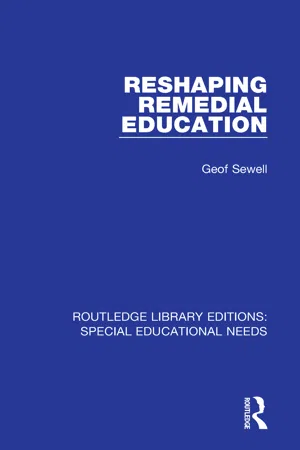
- 138 pages
- English
- ePUB (mobile friendly)
- Available on iOS & Android
eBook - ePub
Reshaping Remedial Education
About this book
Information
Chapter One
THE CONTEXT OF FAILURE
In constructing a theoretical framework for remedial education, it is usual to conceive of the child and his needs as the focus and the school and its social context as peripheral. Yet even so far as the individual child is concerned, it is quite likely that his handicaps only appear when he enters the educational system. Very few of the children who are later thought of as having learning difficulties have handicapping medical conditions. They seem quite ordinary to themselves and their parents. It is only when they start school that they appear to have problems.
From the beginning, children seem to be capable of reflecting on their learning abilities. What they learn about their successes and failures has implications for their motivation, self-esteem and sense of identity. As soon as they begin to think they are backward at reading they start to learn what that may mean to the wider social audience.
Learning to read is a highly visible social event with far reaching implications. Children also learn who can read as well as they can, who better and who worse. They learn which books their friends are reading and what significance these have in their teachers’ minds. The British psychologist Roy Nash (1975) asked six year old children which of their peers were better at reading than themselves and which worse. He then collated these judgements and compared them with the teachers’ subjective rankings and their scores on a formal reading test. The children’s views correlated more accurately with the teachers’ than did the formal test scores. Whilst such a statistical correlation could be accounted for by the unreliability of formal tests at this stage of reading, it emphasizes the degree of pupil awareness of relative reading progress and teacher expectations.
Some teachers make this form of social learning extraordinarily obvious. In a three year ethnographic study of an all black school in the American south, Rist (1970) found that after only eight days of kindergarten, the teacher sorted out three groups according to what she assumed were intellectual variations. The groupings were made on the basis of her informal observations and they corresponded largely to socio-economic distinctions. Each group was given graded assignments with differentiated amounts of teaching time, praise and disciplinary interventions. They were nicknamed ‘Tigers’, ‘Cardinals’ and ‘Clowns’. By the end of the second grade, this labelling had been accepted and reinforced by another teacher and the groups remained remarkably stable over the three years.
So compelling are the forces of social differentiation that even teachers who profess child-centred techniques inwardly grade children. The American sociologist Aaron Cicourel (1974) found that formulations such as ‘maturity’ influenced the way teachers promoted kindergarten children. Even where these children were given formal intelligence tests, these symbolic referents influenced the way teachers interpreted specific pupil answers. The British sociologists Rachel Sharp and Antony Green (1975) found the pressures on teachers to keep children busy and make them conform, vitiated child centred practices to a much greater extent than they were aware of:
What is being suggested is that the child centred educator, with his individualistic, voluntaristic and psychologistic solutions to the problems of freedom, fails to appreciate the ways even in his own practice the effects of a complex stratified society penetrate the school.
Pupils may become labelled whether the teacher accepts the inevitability of this or when she thinks she can avoid it. Another of the mechanisms at work is that peer groups learn appropriate behaviour towards those more or less successful than themselves in school tasks. The American anthropologist Jules Henry (1971) describes how middle class children are taught to put up their hands if they think they know the answer to a teacher’s question. If the child does not know, the rest of the class are rarely expected to help him out or wait respectfully while the teacher does so. Competition for the teacher’s attention is more likely even when this makes it more difficult for the child who does not know. In one example, he describes how a child called Boris is having difficulty reducing the fraction 12/16 to its lowest terms. The child is urged to ‘think’ by his teacher and meanwhile all the other children put up their hands, ‘frantic to correct him’. The teacher unsuccessfully prompts the child in two or three ways, but Boris is by now mentally paralysed. She then turns to the rest of the class for an answer. Henry concludes that:
Boris’ failure has made it possible for Peggy to succeed. To a Zuni, Hopi or Dakota Indian, Peggy’s performance would seem cruel beyond belief. Yet Peggy’s action seems natural to us; and so it is‥
Such observations are borne out by other North American cross cultural studies, like that of Dumont and Wax (1969) of Cherokee Indians. The ways in which young British pupils learn about and interact with their less successful pupils have been less thoroughly researched, although Henry’s account could be duplicated in many traditional primary classrooms.
The realization of the implications of a late start in reading, or other manifestations of failure, affect the learning strategies of children. It would seem that systematic questioning of one’s judgement contaminates perception of detail (Westwood: 1975). In his observation of children failing in Mathematics, John Holt (1964) found that they became less adventurous in problem solving and liable to regress to intuitive or pre-operational thinking. The risk of appearing not to know the right answer prompted them to screen off much of the lesson. Holt postulated that they kept up the pretence of attention by learning to predict when the teacher was about to ask them a question. At this they would jolt awake. If made to answer a question they did not understand, they would fall back on a repertoire of tricks to escape investigation. Nash (1975) found similar phenomena in British schools. There would often be an unvoiced agreement among teachers and low expectation pupils whereby each side would limit their interference with the others’ activities.
In a series of studies of the effects of teacher-pupil expectations, Brophy and Good (1974) found that while there are teachers who succeed in overcoming this vicious cycle, they are a small minority. They concluded that most teachers wait less time for low expectation pupils than for high. If a low expectation pupil seems not to know an answer he receives proportionately less time, encouragement and prompting. Even when the ratio of correct answers is taken into account, low expectation pupils receive proportionately less praise and more criticism than high. They are called on to answer less in class discussion and receive less private attention. The mode of teacher approach also varies. High expectation pupils receive their reinforcement in public, lows are seen relatively more in private. Although this form of discrimination is rarely gross, it is constant:
It appears that relatively few teachers overreact to the extent that they treat lows in grossly inappropriate ways. Also some teachers reach out forcefully and successfully to involve low achievers. However teachers of the latter type are also relatively rare. Most teachers simply respond to (without enhancing) lows’ present motivational and ability levels. These teachers communicate minimum expectations to lows, accept their mediocre performance and indirectly (and without awareness) allow lows to remain passive and disinterested learners.
(Brophy and Good: 1974: p.330)
Even when low expectation pupils produced a surprisingly good response, Brophy and Good found that most teachers failed to perceive it as such or reinforce it. Nell Keddie saw this as one of the primary mechanisms of labelling in the British use of streaming (Keddie: 1971). She asked the same teacher to deliver the same lesson to ‘A’ and ‘C stream classes. It was about a boy who had been kept in a chicken coop by his parents and suffered such sensory and linguistic deprivation that he had failed to learn to speak. The discussion with the top class took place at a relatively abstract level and when the children adopted the word ‘regression’, the teacher assumed they knew what it meant. She did not probe or get them to elaborate their understanding with concrete examples. The ‘C stream discussion was more anecdotal and illustrative. One child volunteered a question which implied a critical attitude towards the concept of regression. He did not use the word itself, but he showed he understood what it implied. ‘The woman who put him in the chicken coop made him go backwards.’ He then asked the teacher: ‘How do you unlearn?’ The teacher apparently failed to scan this as an appropriate question. She kept the exchange at a nominal rather than a conceptual level, redefining the concept and offering illustrative material which begged the boy’s question: ‘Well you simply forget – in schools – the tests show that.’ In Keddie’s example not only is the child’s attempt at original thinking discounted, but the school’s ideological commitment to measures of success and failure is re-emphasized.
Whether or not the teachers are aware of the effect of such slights, this constant pattern of rejection communicates itself to the children’s affective development and attitudes to school. Those perceived as low attainers are more likely to become bored, withdrawn or disruptive. It would seem safer not to take risks if these merely reinforce a sense of failure. As they grow older, some learn to distrust even those who encourage them. In his study of lower class American delinquents, Werthman (1971) found that most young adolescents were aware of grades as a source of power for the teacher. High grades could imply that the teacher was attempting a bribe and this had to be checked out. Where groups of children realize how deeply their sense of values conflict with the school’s, as in Hargreaves’ (1968) study of peer group formation in a British secondary modern school, a pupil subculture can grow up in opposition to the official ethos of the school.
This widening gap also affects the staff. In trying to account for it, they build up a series of expectations for their own roles. It may be taken for granted that certain children will present problems and that there is a limit to what can be asked of the ordinary teacher. Such beliefs come to seem quite natural and it may only be a minority who will question them, such as this teacher who had recently left an ordinary school to become a deputy headteacher of a special school:
The majority of teachers in ordinary schools are worried by two or three children in their class whom they see as problem children. They are anxious to get rid of them. The teachers in ordinary schools are not concerned where the child goes. They just want them out. They don’t want to cope and they don’t see it as their job. They see their job as coping with the middle of the road child. They feel they can’t cope. They are not trained. This child is disruptive and takes up too much of their time. They shouldn’t be spending too much of their time in this way. The majority of teachers don’t prepare individual programmes according to children’s needs. They try to fit the majority of the class into a pattern and if they don’t fit they haven’t really got the time.
(Sewell: 1981)
As this teacher suggests, part of the way such a belief system is substantiated is by reference to training courses or guidance given at the start of a career. In their review of the professional orientation of mathematics teachers, Shuard and Quadling (1980) suggest that experienced colleagues expect probationary staff to be apprehensive about bottom sets. According to their research, many mathematics graduates give teaching too many low ability groups as a major reason for leaving teaching. Part of the rationale was that they had had insufficient training for this.
Subsequent to the recommendations of the Warnock Committee that all postgraduate students should receive a special educational element, the author surveyed the University Departments of Education to see what arrangements were being made. Apart from the four departments where there was a strong tradition of support for special education, the other fifteen or so who responded seemed to lack enthusiasm and expertise. In a few cases, of which the following reply was the most outspoken, it seemed that the expectation of teacher education staff was that students on teaching practice and even probationary teachers should be spared remedial classes:
Given the very limited time available in a P.G.C.E. course to introduce students to the ‘problems’ and ‘needs’ of ‘normal’ children (i.e. the statistical majority without gross physical or mental handicaps or physiological problems), we do not consider it wise to include special courses in what used to be termed (pre-Warnock) Special Education, nor do we encourage our students to undertake remedial work, which requires the expertise or experience of teaching ‘normal’ pupils which students and probationers do not have.
Teachers argue that they cannot take responsibility for the least able and most disruptive because they were not trained to do so; the teacher educators argue that they cannot include such programmes because the students are inexperienced. No doubt the well known educationist quoted above was aware of the American evidence that student teachers may be led to lower their expectations of quite ordinary children shown them on film where these children were labelled backward or maladjusted (e.g. Foster, Ysseldyke and Reese: 1975; Salvia, Clark and Ysseldyke: 1973). Yet other researchers have found that the greater the experience, the more likely teachers are to lower expectations to conform to labels (Gilling and Rucker: 1977).
Perhaps the most sinister aspects of the self-fulfilling prophecy are its social class and ethnic dimensions. Early investigations of the relationship between poor school attainments and social class assumed that it was reliable and static (Binet: 1904; Burt: 1937). More recent research (e.g. Douglas: 1965; Halsey, Heath and Ridge: 1980) would indicate that from infant school onwards, teachers’ perception of children play a role in the relative deterioration of working class performance. Rosenberg (1965) found that among Negroes from the southern United States, this can lead to absolute losses on formal intelligence scores. Coard (1971) found that West Indians in Britain formed chronic learning blocks. In general, teachers who are sarcastic and humiliating appear to generate higher proportions of learning difficulties (e.g. Nash: 1975) and it should come as no surprise that racial intolerance produces similar effects (e.g. Carrington and Wood: 1981). Where the majority of teachers are concerned, the Rampton Report concludes the problem is rather one of an inability to provide sufficient positive discrimination (H.M.S.O.: 1981).
It may well seem that once a child has been seen as a backward reader, poor, or as coming from an ethnic minority, there is nothing he or anyone else can do to break the vicious circle of low expectations and poor attainments. Yet there are instances of children who seemed to refuse to conform to type. Many labelling theorists have explored the problem of freedom in terms of others’ expectations. They have pointed out that there is a degree of choice about acceptance of others’ assessments. Erving Goffman (1963) demonstrated how consciousness of social stigma, including physical handicap, vagrancy and illiteracy, may allow the individual to develop a series of strategies for hiding or compensating for the handicap. This may then lead to ‘passing’ or prima facie acceptance by the community:
Therefore, when goal orientation is pronounced or imperative and there...
Table of contents
- Cover
- Half Title
- Title Page
- Copyright Page
- Original Title Page
- Original Copyright Page
- Table of Contents
- Introduction
- 1. The Context of Failure
- 2. The Effectiveness of Remedial Education
- 3. The Special Class
- 4. The Co-Ordination of Special Education
- 5. Issues of Support and Control
- 6. Special Education and the Outside Agencies
- 7. Parents
- 8. Needs, Rights and Obligations
- Bibliography
- Index
Trusted by 375,005 students
Access to over 1.5 million titles for a fair monthly price.
Study more efficiently using our study tools.
Frequently asked questions
Yes, you can cancel anytime from the Subscription tab in your account settings on the Perlego website. Your subscription will stay active until the end of your current billing period. Learn how to cancel your subscription
No, books cannot be downloaded as external files, such as PDFs, for use outside of Perlego. However, you can download books within the Perlego app for offline reading on mobile or tablet. Learn how to download books offline
Perlego offers two plans: Essential and Complete
- Essential is ideal for learners and professionals who enjoy exploring a wide range of subjects. Access the Essential Library with 800,000+ trusted titles and best-sellers across business, personal growth, and the humanities. Includes unlimited reading time and Standard Read Aloud voice.
- Complete: Perfect for advanced learners and researchers needing full, unrestricted access. Unlock 1.5M+ books across hundreds of subjects, including academic and specialized titles. The Complete Plan also includes advanced features like Premium Read Aloud and Research Assistant.
We are an online textbook subscription service, where you can get access to an entire online library for less than the price of a single book per month. With over 1.5 million books across 990+ topics, we’ve got you covered! Learn about our mission
Look out for the read-aloud symbol on your next book to see if you can listen to it. The read-aloud tool reads text aloud for you, highlighting the text as it is being read. You can pause it, speed it up and slow it down. Learn more about Read Aloud
Yes! You can use the Perlego app on both iOS and Android devices to read anytime, anywhere — even offline. Perfect for commutes or when you’re on the go.
Please note we cannot support devices running on iOS 13 and Android 7 or earlier. Learn more about using the app
Please note we cannot support devices running on iOS 13 and Android 7 or earlier. Learn more about using the app
Yes, you can access Reshaping Remedial Education by Geof Sewell in PDF and/or ePUB format, as well as other popular books in Education & Education General. We have over 1.5 million books available in our catalogue for you to explore.