Settler colonialism in Canada has traditionally been portrayed as a gentler, if not benevolent, colonialism—especially in contrast to the Indian Wars in the United States. This national mythology has penetrated into comparative genocide studies, where Canadian case studies are rarely discussed in edited volumes, genocide journals, or multi-national studies. Indeed, much of the extant literature on genocide in Canada rests at the level of self-justification, whereby authors draw on the U.N Genocide Convention or some other rubric to demonstrate that Canadian genocides are a legitimate topic of scholarly concern.
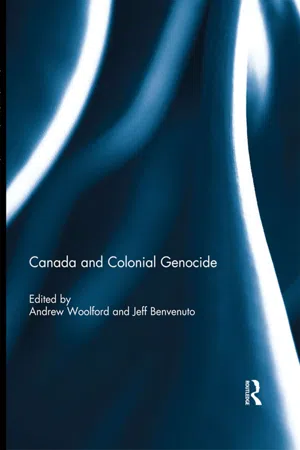
In recent years, however, discussion of genocide in Canada has become more pronounced, particularly in the wake of the findings of the Truth and Reconciliation Commission of Canada. This volume contributes to this ongoing discourse, providing scholarly analyses of the multiple dimensions or processes of colonial destruction and their aftermaths in Canada. Various acts of genocidal violence are covered, including residential schools, repressive legal or governmental controls, ecological destruction, and disease spread. Additionally, contributors draw comparisons to patterns of colonial destruction in other contexts, examine the ways in which Canada has sought to redress and commemorate colonial harms, and present novel theoretical and conceptual insights on colonial/settler genocides in Canada. This book was previously published as a special issue of the Journal of Genocide Research.
eBook - ePub
Canada and Colonial Genocide
- 126 pages
- English
- ePUB (mobile friendly)
- Available on iOS & Android
eBook - ePub
Canada and Colonial Genocide
About this book
Information
Canada and colonial genocide
ANDREW WOOLFORD AND JEFF BENVENUTO
This introductory article offers an overview of debates about genocide and settler colonialism in Canada. The argument is presented that Canada, although a marginal case to genocide studies, provides important insights and challenging questions, particularly with respect to the need to decolonize the field of genocide studies.
Introduction
In June 2015, the Truth and Reconciliation Commission (TRC) of Canada released its summary report and recommendations.1 With the report came the announcement that an estimated 6,000 children perished while held within Canadian Indian Residential Schools (IRS). From the mid nineteenth century until 1996, when the last school finally closed, about 150,000 First Nations, Inuit and Métis children were forcibly removed from their families and placed into institutions fundamentally designed to destroy their indigenous identities.2 There are presently an estimated 80,000 former students of the IRS system, who since the 1990s have been commonly identified as ‘survivors’ (often with an upper-case ‘S’), a term that inversely acknowledges the thousands of children who died in these schools.3 Many of these survivors have made public claims of ‘genocide’ in order to articulate their traumatic experiences. And because survivor testimonies are the bedrock of the TRC, an institution with national scope and stature, such claims have elicited an increasingly prominent debate in Canada in recent years.
Although many survivors speak simply of residential schools as ‘genocide’, the TRC opted to use the term ‘cultural genocide’ when describing the destructive nature of the Canadian IRS system. In his contribution to this special issue, David MacDonald examines potential reasons for the TRC’s choice of terminology, including a desire to avoid legal debate over the applicability of the United Nations Convention on the Prevention and Punishment of the Crime of Genocide (UNGC), a debate that may distract from the experiences of survivors. This pronouncement nonetheless generated abundant media attention.4 Likewise, when delivering the fourth annual Pluralism Lecture of the Global Centre for Pluralism only a few days prior to the release of the summary report, Supreme Court Chief Justice Beverley McLachlin said that Canada attempted to commit ‘cultural genocide’, making her the highest-ranking Canadian official to use the term in this context.5 Her words gave further legitimacy to the TRC’s claim of cultural genocide, though it was already firmly based upon more than 6,750 statements from survivors and their families, along with the most thorough investigation yet of residential school archival documents.
These are thus heady times for discussion of genocide in Canada. It is also true, however, that use of the term genocide in the Canadian context has a much longer pedigree, going back at least to the responses to the federal government’s 1969 White Paper and its policy proposals aimed to repeal the Indian Act and dissolve the federal government’s legal relationship with Aboriginal peoples.6 At that time, such language contributed to broader political discourses concerned with what is referred to in Canadian politics as Aboriginal rights, as well as with the field of indigenous rights that was emerging in international law and relations.7 Indeed, discussion of genocide in such contexts is often entangled with more politicized issues related to claims for self-determination, which begins to explain the activist underpinnings of genocide studies in Canada, a point exemplified by Seth Adema’s analysis of Aboriginal prison writings in this special issue. Since the onset of colonial settlement in North America, indigenous peoples have struggled to assert their territorial rights and political autonomy in the face of multiple and coordinated efforts to destroy their unique forms of group life. Noted destructive actions, in addition to residential schooling, include sporadic and small-scale massacres,8 forced removals,9 negligent disease spread,10 prohibition of cultural practices such as the potlatch,11 welfare-state child removals,12 the sterilization of Aboriginal women13 and the ecological devastation of indigenous territories.14
It was not until the 1990s that usage of the genocide keyword began centring on the legacy of the IRS system.15 The issue attracted greater public attention as survivors raised class action lawsuits against the Canadian government and churches, eventually leading to the 2007 Indian Residential School Settlement Agreement between the government, churches, legal counsels of former students, the Assembly of First Nations and other Aboriginal organizations.16 The recent focus of the ‘genocide’ concept in the Canadian context is not exclusively on the IRS system, as connections between residential schools and the broader project of settler colonial dispossession and erasure are being drawn.17 For example, in the aftermath of Ian Mosby’s 2013 article on the nutritional experiments carried out by the Canadian government in residential schools and reserve communities,18 James Daschuk used ‘genocide’ to describe findings from his well-received book, Clearing the plains, pointing in particular to the starvation policies purposefully implemented under Prime Minister John A. Macdonald and their toll on prairie- region indigenous peoples.19 These ongoing discussions took place alongside the debate about the new Canadian Museum for Human Rights, which has decided not to employ the term ‘settler colonial genocide’ when discussing residential schools and other destructive Canadian policies used against indigenous peoples but rather to raise questions about whether or not genocide occurred.20 In such instances, the discussion has moved beyond whether or not the IRS system met the criteria of the UNGC, and in particular Section II(e) on the forcible transfer of children.21 Instead, scholarly discourse is considering how policies of land appropriation, starvation and disease, combined with residential schooling, stoke indigenous fears of social and political death, an idea discussed in Matthew Wildcat’s review essay in this issue.
Despite these developments, there has been a paucity of attention towards Canada in genocide studies for a number of reasons. Although the field has undergone a ‘colonial turn’ since the 2000s, scholars of other geographical contexts have taken the lead. In particular, Australian scholars have been ahead in advancing colonial genocide studies, and Canadian scholars have been slow off the mark for a number of reasons.22 First of all, it is possible that patterns of denial and disavowal deeply embedded in the Canadian mythology of the ‘peaceful frontier’ have been difficult to overcome, a point noted by Tricia Logan both here and elsewhere.23 Moreover, perceptions of history frame conceptions of genocide, and the mythology of the ‘peaceful frontier’ dovetails with the idea of genocide prototyped on the Holocaust.24 As such, the culturally oriented forms of indigenous group destruction that characterize Canadian colonialism challenge entrenched colloquial and scholarly understandings of genocide as nothing more than mass murder.
A second possible reason for the relative lack of attention to colonial genocide and Canada is that the spatial and temporal boundaries of the Canadian case are not obvious, as demonstrated in Wildcat’s review of recent literature on the late nineteenth-century Northern Plains. If Canadian settler colonialism was genocidal, where exactly did it occur and when did it begin? And considering the intergenerational effects at stake, as well as the perpetuation of settler colonial practices, can we say for sure whether genocide has even ended? In addition, why did colonial expansion and group destruction take multiple forms and achieve varying levels of intensity in different regions over time? The very word ‘case’ threatens to flatten the uneven and diverse character of settler colonialism on Turtle Island (a geographical conception of the North American continent rooted in certain indigenous worldviews). Much nuance is lost by force fitting it into a traditional comparative genocide studies paradigm that defines cases on national rather than regional or international levels of analysis.25
The unsteady temporal and spatial boundaries of settler colonialism in Canada also have problematic implications for the third issue posed by this so-called case. Settler colonialism persists as a particular social formation in Canada, and this means that mechanisms of redress risk perpetuating settler colonialism simply by operating under (and potentially legitimating) the authority of the colonial sovereign. In this issue, Robyn Green illustrates how ostensibly well-meaning discourses and practices of reconciliation can effectively become exercises in settler nation-building.26
Finally, Canada raises familiar but still troubling questions with respect to scholarly engagement and the politics of identity. In particular, it challenges scholars situated within the Canadian settler colonial complex to consider how they might ‘unsettle’ or ‘decolonize’ their genocide research. Before addressing these issues in turn, a brief historiography is needed to situate the present collection of articles.
Canada and the genocide studies canon
No single genocide reader or book can be expected to cover every genocidal moment in world history. However, a quick survey of the literature demonstrates how Canada is situated outside the genocide studies canon.27 Canada receives brief mention in Leo Kuper’s Genocide: its political use in the twentieth century, where he reviews the relationship between colonialism and genocide, noting the distinct charact...
Table of contents
- Cover
- Half Title
- Title
- Copyright
- Contents
- Citation Information
- Notes on Contributors
- 1. Canada and colonial genocide
- 2. Fearing social and cultural death: genocide and elimination in settler colonial Canada—an Indigenous perspective
- 3. Canada’s history wars: indigenous genocide and public memory in the United States, Australia and Canada
- 4. Settler colonialism in Canada and the Métis
- 5. Not told by victims: genocide-as-story in Aboriginal prison writings in Canada, 1980–96
- 6. The economics of reconciliation: tracing investment in Indigenous–settler relations 99
- Index
Trusted by 375,005 students
Access to over 1.5 million titles for a fair monthly price.
Study more efficiently using our study tools.
Frequently asked questions
Yes, you can cancel anytime from the Subscription tab in your account settings on the Perlego website. Your subscription will stay active until the end of your current billing period. Learn how to cancel your subscription
No, books cannot be downloaded as external files, such as PDFs, for use outside of Perlego. However, you can download books within the Perlego app for offline reading on mobile or tablet. Learn how to download books offline
Perlego offers two plans: Essential and Complete
- Essential is ideal for learners and professionals who enjoy exploring a wide range of subjects. Access the Essential Library with 800,000+ trusted titles and best-sellers across business, personal growth, and the humanities. Includes unlimited reading time and Standard Read Aloud voice.
- Complete: Perfect for advanced learners and researchers needing full, unrestricted access. Unlock 1.5M+ books across hundreds of subjects, including academic and specialized titles. The Complete Plan also includes advanced features like Premium Read Aloud and Research Assistant.
We are an online textbook subscription service, where you can get access to an entire online library for less than the price of a single book per month. With over 1.5 million books across 990+ topics, we’ve got you covered! Learn about our mission
Look out for the read-aloud symbol on your next book to see if you can listen to it. The read-aloud tool reads text aloud for you, highlighting the text as it is being read. You can pause it, speed it up and slow it down. Learn more about Read Aloud
Yes! You can use the Perlego app on both iOS and Android devices to read anytime, anywhere — even offline. Perfect for commutes or when you’re on the go.
Please note we cannot support devices running on iOS 13 and Android 7 or earlier. Learn more about using the app
Please note we cannot support devices running on iOS 13 and Android 7 or earlier. Learn more about using the app
Yes, you can access Canada and Colonial Genocide by Andrew Woolford, Jeff Benvenuto, Andrew Woolford,Jeff Benvenuto in PDF and/or ePUB format, as well as other popular books in Politics & International Relations & American Government. We have over 1.5 million books available in our catalogue for you to explore.