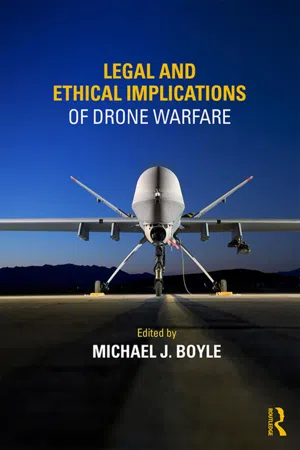
Over the last decade, the U.S., UK Israel and other states have begun to use Unmanned Aerial Vehicles (UAVs) for military operations and for targeted killings in places like Pakistan, Yemen and Somalia. Worldwide, over 80 governments are developing their own drone programs, and even non-state actors such as the Islamic State have begun to experiment with drones. The speed of technological change and adaptation with drones is so rapid that it is outpacing the legal and ethical frameworks which govern the use of force. This volume brings together experts in law, ethics and political science to address how drone technology is slowly changing the rules and norms surrounding the use of force and enabling new, sometimes unprecedented, actions by states. It addresses some of the most crucial questions in the debate over drones today. Are drones a revolutionary form of technology that will transform warfare or is their effect merely hype? Can drone use on the battlefield be made wholly consistent with international law? How does drone technology begin to shift the norms governing the use of force? What new legal and ethical problems are presented by targeted killings outside of declared war zones? Should drones be considered a humane form of warfare? Finally, is it possible that drones could be a force for good in humanitarian disasters and peacekeeping missions in the near future? This book was previously published as a special issue of The International Journal of Human Rights.
- 130 pages
- English
- ePUB (mobile friendly)
- Available on iOS & Android
eBook - ePub
Legal and Ethical Implications of Drone Warfare
The legal and ethical implications of drone warfare
Michael J. Boyle
Department of Political Science, La Salle University, Philadelphia, PA, USA
This article examines whether American drone-based targeted killing program represents a fundamentally new challenge to the traditional legal and ethical standards of armed conflict. It argues that the novelty of drones flows less from the technology itself than from the Obama administration’s articulation of a presumptive right of anticipatory self-defense, which allows it to strike anywhere in the world where al Qaeda and its allies are present. It highlights five new legal and ethical dimensions to the Obama administration’s drones policy, all of which may lower the traditional barriers to the use of force if other actors begin to follow contemporary American practice.
In a speech at the National Defense University in May 2013, President Barack Obama described the US drone campaign in Pakistan, Yemen and elsewhere as part of ‘a just war – a war waged proportionally, in last resort, and in self-defense’.1 Emphasising the dilemmas associated with confronting the threat of modern terrorism, President Obama cast the American drones programme as a legally and morally superior alternative to using Special Forces or ground troops to capture or kill terrorist suspects in places where the United States (US) was not formally at war. This address, along with an earlier speech by Obama’s chief counterterrorism advisor John Brennan in April 2012, showed the Obama administration on the defensive against a rising tide of criticism about the civilian casualties associated with American drone strikes.2 In describing its response to what it called a new, de-territorialised form of armed conflict against terrorist groups, the Obama administration fell back upon long-established concepts of the law of armed conflict and just war theory to argue that its drone strike campaign was legally appropriate and ethically sound. Yet beyond the rhetoric, its actual position on drones has long been marked by ambiguities and internal contradictions. At some points, the administration has been insistent that it is fully complying with all applicable law, including the laws of war, in its drone strike policies.3 At others, it has denied that some bodies of law – for example, international human rights law – should be applied to these conflicts.4 At still others, it has implied that the law of armed conflict, and traditional notions of self-defence, need to be updated to reflect the realities of twenty-first century warfare.5 Throughout its term in office, the Obama administration has tried to use the traditional legal and moral standards of armed conflict as a shield to protect itself from criticism, while simultaneously suggesting that the shield itself is fundamentally inadequate for the threats that the US and its allies face in the twenty-first century.
The fact that the Obama administration has continued to rely on the same legal and ethical frameworks used to restrain the behaviour of states during wars in the nineteenth and twentieth centuries to defend its drone campaign against a range of critics is not surprising.6 These standards have proven invaluable in checking the cruelty and moral callousness of armies and government states for over a hundred years; indeed, they have proven resilient in light of the vast technological changes in warfare that have occurred since the first Geneva Convention in 1864. Although they do pose some new legal and ethical dilemmas, drones do not fundamentally undermine the applicability of traditional legal and ethical standards of armed conflict.7 Drones are merely the latest iteration of a process of rapid technological change in warfare that has continued for much of the last one hundred years, and they are not the biggest technological change during this period. The challenges posed by drones are not larger than those posed by nuclear weapons or other twentieth-century innovations such as inter-continental ballistic missile systems (ICBM). As Stephanie Carvin argues in her contribution here, there is no reason to assume that the legal and ethical problems posed by drones are wholly unprecedented or unique to this form of technology.8 Some of the literature on drones makes this mistake by assuming that the new aspects of drone technology mean that unprecedented legal and ethical questions are now being raised. In fact, the opposite is true. Even more than nuclear weapons and or ICBMs, drones can be discussed within the traditional legal and ethical frameworks governing armed conflict because they are so analogous to conventional or manned aircraft. For many of the relevant ethical questions, such as how many were killed and why, drone strikes can be measured in a straightforward way against bombing done by conventional manned aircraft. In most respects, there is not much of a difference between a bomb dropped by a piloted aircraft and one dropped by a drone provided that both are done by declared combatants in a recognised armed conflict.9
Further, some of the charges that are levelled against drones on the basis of the technology itself – for example, that drones automate killing, or that they produce a moral distance between the operator and the target that facilitates gratuitous killing – are either overstated or unproven. For example, while it is true that fully autonomous weapons would produce a new set of legal and ethical challenges for warfare, this is not the situation that prevails today.10 In all major or well-established drones programmes, the technology remains under the firm control of an individual from the military or intelligence services of an established government.11 No modern drones programme is fully automated, and in all cases it remains the decision of a single individual – often located in a military chain of command – to strike a target and be held accountable for the consequences. The allegation that there is a ‘Playstation mentality’ to targeted killings by drones remains to be proven.12 There is some evidence that the moral distance between the drone operator and target desensitises the operator from the act of killing and may make targeted killings easier.13 Some drone operators’ use of derogatory terms for their targets – ‘bug splats’ and ‘squirters’ – points to this dynamic at play.14 But equally there is evidence that drone operators feel a surprising degree of intimacy with their targets because they monitor them for such long periods of time. Drone operators report relatively high rates of post-traumatic stress disorder (PTSD) in part because they are so acquainted with their target.15 Further, many of these charges of moral distance are not, strictly speaking, new as they were levelled against automated weapons systems such as cruise missiles and nuclear weapons during the Cold War. The possibility of an individual callously ending a life by pressing a button is as real with cruise missiles as it is with a drone, and even more real with the prospect of a nuclear strike.16 None of these forms of lethal violence preserve the direct confrontation between perpetrator and target that characterises most depictions of honour in warfare, yet all have been a reality of modern warfare for over half a century.17
Still, there may be something new about drone warfare that requires rethinking some of the rules of armed conflict in the twentieth century. While the technology itself may not present wholly new moral and legal dilemmas, it may exaggerate some of them and accelerate other trends – towards speed, precision, and targeting those who blur the distinction between combatants and civilians – present in other forms of armed conflict. If so, while it is certainly not necessary to rewrite the rulebook on armed conflict, it may be necessary to adapt it in ways that reflect the reality of the legal and ethical dilemmas that drones pose, either due to the technology itself or the way that the technology is used. This is the challenge that has yet to be fully met despite a decade of drone-based targeted killing. Although the Obama administration has implied that the rules of armed conflict need to change to meet the new threat of terrorism, and has stated on multiple occasions that the domestic legal authority for drone strikes (the Authorization to Use Military Force, passed in 2001) needs to be revised, it has shied away from explicitly stating what is new about the drone technology and why it requires changes in the rules of war for the twenty-first century. It has left this debate open for scholars and outside experts to identify what is new about drones and to spell out the legal and ethical implications of this technology.
The articles in this special edition identify and analyse the new legal and ethical implications of drones and illustrate how they relate to the existing legal and ethical frameworks that govern armed conflict. This introduction and the article by Stephanie Carvin wrestle with the key conceptual question about what is new with drones: the technology, or the policies surrounding the use of them? The second set of articles, by Craig Martin and by Daniel Brunstetter and Arturo Jimenez Bacardi explain why the legal and ethical debate over drone-based targeted killing remain so contested after nearly a decade of operation. The third set of articles, by David Whetham and by Caroline Kennedy and James Rodgers, look at some of the legal and ethical issues surrounding the next generation uses of drones for humanitarian relief and United Nations (UN) peacekeeping. Taken together, these articles show how American policies surrounding drone usage have themselves produced the dilemmas that the Obama administration now confronts while charting a way in which drone usage might be reconciled with the traditional legal and ethical frameworks in international politics.
This introductory article will address the central conceptual question about what is new with drone warfare, with a f...
Table of contents
- Cover
- Half Title
- Title Page
- Copyright
- Contents
- Citation Information
- Notes on Contributors
- 1. The legal and ethical implications of drone warfare
- 2. Getting drones wrong
- 3. A means-methods paradox and the legality of drone strikes in armed conflict
- 4. Clashing over drones: the legal and normative gap between the United States and the human rights community
- 5. Drones to protect
- 6. Virtuous drones?
- Index
Trusted by 375,005 students
Access to over 1.5 million titles for a fair monthly price.
Study more efficiently using our study tools.
Frequently asked questions
Yes, you can cancel anytime from the Subscription tab in your account settings on the Perlego website. Your subscription will stay active until the end of your current billing period. Learn how to cancel your subscription
No, books cannot be downloaded as external files, such as PDFs, for use outside of Perlego. However, you can download books within the Perlego app for offline reading on mobile or tablet. Learn how to download books offline
We are an online textbook subscription service, where you can get access to an entire online library for less than the price of a single book per month. With over 1.5 million books across 990+ topics, we’ve got you covered! Learn about our mission
Look out for the read-aloud symbol on your next book to see if you can listen to it. The read-aloud tool reads text aloud for you, highlighting the text as it is being read. You can pause it, speed it up and slow it down. Learn more about Read Aloud
Yes! You can use the Perlego app on both iOS and Android devices to read anytime, anywhere — even offline. Perfect for commutes or when you’re on the go.
Please note we cannot support devices running on iOS 13 and Android 7 or earlier. Learn more about using the app
Please note we cannot support devices running on iOS 13 and Android 7 or earlier. Learn more about using the app
Yes, you can access Legal and Ethical Implications of Drone Warfare by Michael Boyle in PDF and/or ePUB format, as well as other popular books in Law & Conflict of Laws. We have over 1.5 million books available in our catalogue for you to explore.