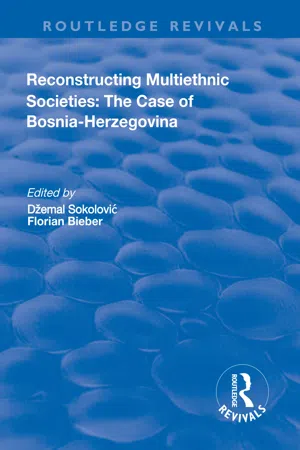
This title was first published in 2001. A range of views on the challenges of the social, political, legal and psychological reconstruction of bosnian society are presented in this volume. It draws on the knowledge and experiences of scholars and practitioners from Bosnia-Herzegovina and internationally, and presents an analysis of the Bosnian case as an example for the study of other mulit-ethnic societies emerging from war. By combining a theoretical analysis of multi-ethnic societies with practical examples, the book hopes to highlight the complexities and sensitivities of a political system in a multi-ethnic state, especially in a post-war setting.
eBook - ePub
Reconstructing Multiethnic Societies
The Case of Bosni-Herzegovina
- 234 pages
- English
- ePUB (mobile friendly)
- Available on iOS & Android
eBook - ePub
About this book
Trusted by 375,005 students
Access to over 1.5 million titles for a fair monthly price.
Study more efficiently using our study tools.
Information
1 The Injustice of Procedural Democracy*
Thomas William Simon
In his Gettysburg Address of 1863, Lincoln characterized democracy as “government of the people, by the people, and for the people.”1 The old adage reveals a great deal. Democracy certainly has something to do with the people ruling in some form or another. People favor democracy, but after a general and vague form of agreement comes a perplexing series of questions that generate little consensus in their answers. What constitutes government? Who is to rule whom and for what purpose? Who are the people? What is the relationship between rule of, rule by, and rule for the people?
Of the three components in Lincoln’s formulation, “government by” (Rule By) has received the most attention. Democratic theorists focus primarily on procedures. Further, the theorists offer little in the way of prescription or even indictment of the economic or social and political disparity among groups. The following serve as typical examples of the proceduralist position:2
I follow…those who insist that “democracy” is to be understood in procedural terms. That is to say, I reject the notion that one should build into “democracy” any constraints on the content of the outcomes produced, such as substantive equality, respect for human rights, concern for the general welfare, personal liberty or the rule of law.3
I regard democracy as a system for making governmental decisions. “Democracy” is to be defined in terms of procedures, not in terms of substantive policy….While there are many legitimate questions to be answered in political philosophy, one good question, certainly, is how the various institutions affecting governmental decision making should be structured.4
Giovanni Sartori, a contemporary democratic theorist, speculated that Lincoln thought that “for the people” (Rule For) was a consequence of democracy and not a defining characteristic.5 In contrast, I take “for the people” as the most important aspect of democracy, as a central concern underlying any definition of democracy, more important than its close counterpart, “rule by the people” (Rule By). “Rule By” refers to a set of procedures that governs political decision making. “Rule For” serves as a shorthand for the substantive value judgments made about justice and injustice. The first represents Procedural Democracy; the second, Substantive Democracy. A global campaign has succeeded in presenting Procedural Democracy as the only version of democracy. It is an injustice that the dominant Procedural Democracy has managed to sever questions of democracy from questions of justice. Democracy must make a commitment to social and economic justice. Democracy only makes sense as a mythology if, in places like Bosnia, it is allowed to operate uncontested in the midst of widespread inequality or massive economic malaise.
It would border on insanity, for example, to insist that the Tutsi minority government in Rwanda institute majority rule after a genocide led by factions of the Hutu majority. The insanity of a majoritarian rule requirement for Rwanda does not make news because few political analysts pay any attention to Rwanda. The absurdities of Procedural Democracy do not fully rise to the surface in the Balkans because it serves as a useful tool for Western policy makers. Procedural democracy provides the international players in the Balkans with an ideal cover. They use it to justify their external inaction and to indict indigenous internal action (or inaction). Foreign economic aid is made contingent on progress on democratic reforms. The outcomes of democratic reforms, in turn, hinge on the implausibility of imposed procedures and the unlikelihood of effective implementation of democratic outcomes. Procedural democracy, then, does not offer one more way to measure success or failure of a nation to develop. Rather, an undue reliance on procedural democracy accomplishes a great deal. It almost guarantees failure; it produces a continuing range of options for Western powers to operate; and it assures a weakened state.
Looking at the social, economic, and political conditions in a society may seem like an obvious consideration in evaluating the democratic character of a country, but the effects of economic well being on democracy, while acknowledged, seldom play a central role in democratic theory or in policy making. Many democratic theorists do not pay sufficient attention to the problems of social and economic injustices. Western policy makers follow suit by treating such matters as economic conditions as secondary to democratic procedures.6 The U.S. not only separated the democratic from the socio-economic aspects of reconstruction in Bosnia following the Dayton Accords, it also considered elections as primary. Substantive economic considerations continue to take a back seat to procedural concerns.
The critique of procedural democracy undertaken here does not imply the abandonment of the proceduralists’ cause and promoting only economic improvement. Many examples, ranging from movements like Jim Jones’s People’s Temple to states like China, illustrate the harmful consequences that follow when visions of social and economic justice swamp concerns for internal democratic procedures. I include Jonestown along side China to underscore another point. Democratic theory and policy should not only address state-level organizational structures. The democratic character of meta state-level structures is a critical issue. How democratic were the Dayton Accords, which have framed and continue to frame every major change undertaken in Bosnia? In addition, the organizational parts within a state are also important. While the nationstate encompasses and conditions the other forms of organization within it, the democratic nature of the parts also can positively infect the democratic character of the whole. The democratic character of civic groups, social associations, and political organizations influence the democratic character of larger structures. Minimally, questions regarding democracy should not be automatically excluded from discussions about any level, meta or local, of organization.
Procedural Democracy: The Indeterminacy Problem
If procedural democracy contains serious conceptual problems, then a foundational critique should become a key item on the contestation-of- democracy agenda. The phrase “procedural democracy” generally is shorthand for certain kinds of procedures and institutional structures, which typically include voting, majority rule, representation, a constitution, separation of powers, and checks and balances. Appealing to one or more of these items characterizes a proceduralist approach to democracy. Procedural democracy confronts three major conceptual problems: consent to the procedures, indeterminacy among the acceptable democratic procedures, and justifications for specific procedures. Let us address the last two difficulties. Analysts regard democracy in the United States as consisting of a set of procedures that includes the following: voting in elections, majority rule limited by minority rights, representative government, constitutional guarantees of individual and civil liberties, and separation of powers with judicial review.7 Disagreements over what qualifies as a member of this set of procedures are widespread. Should judicial review make up one of the elements of a democratic regime or does judicial review hinder the development of a democracy? Should the separation of powers be deleted from the list or does it constitute an essential ingredient of democracy? Should other devices, such as proportional representation, take their place on the list?
Let us call the difficulties associated with the changeability of the elements on the procedure list “the indeterminacy problem.” Proceduralists need a standard for choosing one set of procedures over another. Otherwise, the democratic devices employed by proceduralists function without any fixed moorings. In other words, the choice of mechanisms remains in flux. No one set of procedures qualifies as necessary or sufficient (or some combination of these) for democracy. The democratic user or consumer can expand or contract the list of procedures almost at will. No theoretical argument about the procedures themselves will provide compelling reasons for choosing one procedure or one set of procedures over any others. To choose from the array of candidate procedures, proceduralists must make substantive value judgments about justice. However, proceduralists want to keep out substantive judgments.8 In the proceduralist’s world, procedures trump considerations of substantive results. Procedures operate on the neutral ground of fairness. Above all, proceduralists would refuse to evaluate procedures according to how well they measured up to substantive goals, such as promoting the welfare of the least advantaged. Supposedly, promoting substantive values under the guise of democracy subverts democracy by imposing a value system not chosen by democratic means.
One way to undermine the proceduralist argument is to conjure up a picture of democracy, that meets proceduralist’s intuitions but ultimately violates moral intuitions. Even the proceduralist would admit that procedures do not serve as guarantees and that some procedures can yield very troubling results. Even if the proceduralist admits that abhorrent consequences can flow from democratic procedures, he or she would maintain that some set of procedures could patch up the disastrous consequences from another set of procedures.
The transition from the Weimar Republic to the Third Reich in Germany serves as a good test for the proceduralist’s position. The Nazi party had considerable electoral success. Hitler attained absolute power through democratic means. The 1933 Enabling Act passed the legislature, the Reichstag, by an overwhelming majority (444 to 84). The “Law for Removing the Distress of People and Reich,” the Enabling Act’s formal name, granted Hitler’s cabinet legislative power for four years. William Shirer drew the following conclusion from the passage of the Enabling Act: “Thus was parliamentary democracy finally interred in Germany. Except for the arrests of the Communists and some of the Social Democratic deputies, it was all done quite legally, though accompanied by terror. Parliament had [democratically?] turned over its constitutional authority to Hitler and thereby committed suicide.”9 Democratic procedures can yield one of the worst results imaginable: democratic suicide. A democracy can democratically abdicate its democratic responsibilities. Proceduralists would not admit defeat so readily. The Nazis violated many democratic procedures on their way to power. The procedural violations seemed endless: the Nazi party never achieved a majority; a decree, “For the Protection of the People and the State,” suspended seven sections of the constitution that guaranteed individual and civil liberties; the storm troopers terrorized the electorate; the Enabling Act permitted Hitler to violate the separation of powers. However, even granting that Hitler’s rise to power could scarcely serve as a model of how to follow democratic procedures, would the successful implementation of one or more democratic procedures have prevented Hitler’s ascension?
Although answering the question would initiate some fascinating speculative historical reconstruction, some more general points emerge from the inquiry so far. Proceduralists have a considerable number of elements in the democratic grab bag. These elements prove useful in plugging any leaks in the democratic ship. The challenge, however, lies not in an ad hoc repair job but in first building the ship. What proceduralist planks would keep the democratic ship afloat at the outset of the ship’s construction? To answer that question the proceduralists face the following claims about any given set of democratic procedures or elements:
1. There is no complete set of democratic procedures. No one proposed set has all the necessary and sufficient elements for a democracy.
2. There is no set of necessary elements for democracy. The absence of one element or of any combination of elements will not destroy the set, in the sense that the set no longer qualifies as democratic. If we remove one or more of the elements from the set, the remainder could still qualify as democratic. So, a system without one or more of the proposed necessary elements could still qualify as a democracy.
3. There is no set of sufficient elements for a democracy. A system can have all the proposed sufficient elements o...
Table of contents
- Cover
- Half Title
- Preface
- Title Page
- Copyright Page
- Contents
- Contributor
- Acknowledgments
- Introduction
- I Challenges for Multiethnic States
- 1 The Injustice of Procedural Democracy
- 2 Self-determination in a Multiethnic State: Bosnians, Bosniaks, Croats and Serbs
- 3 The Fractured Soul o f the Dayton Peace Agreement: A Legal Analysis
- 4 Social Reconstruction and Moral Restoration
- 5 The Challenge o f Democracy in Divided Societies:
- 6 Lessons from the Belgian Constitution for Multiethnic Societies
- 7 The Building of Civil Society by “Core” Europe?
- II Reconstructing Multiethnic Bosnia
- 8 How a Quota Borda System of Elections may Facilitate Reconciliation
- 9 Journalism in Post-Dayton Bosnia: How to Make the Media More Responsible
- 10 Reclaiming Kozarac: Accompanying Returning Refugees
- 11 Women in Between: “Where do I belong?”
- 12 Restructuring Regions: The Case of Croatia
- Bibliography
Frequently asked questions
Yes, you can cancel anytime from the Subscription tab in your account settings on the Perlego website. Your subscription will stay active until the end of your current billing period. Learn how to cancel your subscription
No, books cannot be downloaded as external files, such as PDFs, for use outside of Perlego. However, you can download books within the Perlego app for offline reading on mobile or tablet. Learn how to download books offline
Perlego offers two plans: Essential and Complete
- Essential is ideal for learners and professionals who enjoy exploring a wide range of subjects. Access the Essential Library with 800,000+ trusted titles and best-sellers across business, personal growth, and the humanities. Includes unlimited reading time and Standard Read Aloud voice.
- Complete: Perfect for advanced learners and researchers needing full, unrestricted access. Unlock 1.5M+ books across hundreds of subjects, including academic and specialized titles. The Complete Plan also includes advanced features like Premium Read Aloud and Research Assistant.
We are an online textbook subscription service, where you can get access to an entire online library for less than the price of a single book per month. With over 1.5 million books across 990+ topics, we’ve got you covered! Learn about our mission
Look out for the read-aloud symbol on your next book to see if you can listen to it. The read-aloud tool reads text aloud for you, highlighting the text as it is being read. You can pause it, speed it up and slow it down. Learn more about Read Aloud
Yes! You can use the Perlego app on both iOS and Android devices to read anytime, anywhere — even offline. Perfect for commutes or when you’re on the go.
Please note we cannot support devices running on iOS 13 and Android 7 or earlier. Learn more about using the app
Please note we cannot support devices running on iOS 13 and Android 7 or earlier. Learn more about using the app
Yes, you can access Reconstructing Multiethnic Societies by Florian Beiber,Džemal Sokolović in PDF and/or ePUB format, as well as other popular books in Social Sciences & Sociology. We have over 1.5 million books available in our catalogue for you to explore.