- 528 pages
- English
- ePUB (mobile friendly)
- Available on iOS & Android
eBook - ePub
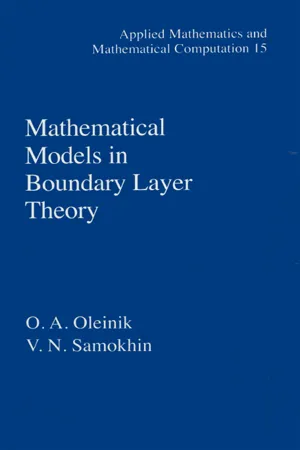
Mathematical Models in Boundary Layer Theory
About this book
Since Prandtl first suggested it in 1904, boundary layer theory has become a fundamental aspect of fluid dynamics. Although a vast literature exists for theoretical and experimental aspects of the theory, for the most part, mathematical studies can be found only in separate, scattered articles. Mathematical Models in Boundary Layer Theory offers the first systematic exposition of the mathematical methods and main results of the theory.
Beginning with the basics, the authors detail the techniques and results that reveal the nature of the equations that govern the flow within boundary layers and ultimately describe the laws underlying the motion of fluids with small viscosity. They investigate the questions of existence and uniqueness of solutions, the stability of solutions with respect to perturbations, and the qualitative behavior of solutions and their asymptotics. Of particular importance for applications, they present methods for an approximate solution of the Prandtl system and a subsequent evaluation of the rate of convergence of the approximations to the exact solution.
Written by the world's foremost experts on the subject, Mathematical Models in Boundary Layer Theory provides the opportunity to explore its mathematical studies and their importance to the nonlinear theory of viscous and electrically conducting flows, the theory of heat and mass transfer, and the dynamics of reactive and muliphase media. With the theory's importance to a wide variety of applications, applied mathematicians-especially those in fluid dynamics-along with engineers of aeronautical and ship design will undoubtedly welcome this authoritative, state-of-the-art treatise.
Information
Table of contents
- Cover
- Title Page
- Copyright Page
- Table of Contents
- Preface
- 1 The Navier-Stokes Equations and the Prandtl System
- 2 Stationary Boundary Layer: von Mises Variables
- 3 Stationary Boundary Layer: Crocco Variables
- 4 Nonstationary Boundary Layer
- 5 Formation of the Boundary Layer
- 6 Finite Difference Method
- 7 Diffraction Problems for the Prandtl System
- 8 Boundary Layer in Non-Newtonian Flows
- 9 Boundary Layer in Magnetohydrodynamics
- 10 Homogenization of Boundary Layer Equations
- Some Open Problems
- References
- Index
Trusted by 375,005 students
Access to over 1.5 million titles for a fair monthly price.
Study more efficiently using our study tools.
Frequently asked questions
Yes, you can cancel anytime from the Subscription tab in your account settings on the Perlego website. Your subscription will stay active until the end of your current billing period. Learn how to cancel your subscription
No, books cannot be downloaded as external files, such as PDFs, for use outside of Perlego. However, you can download books within the Perlego app for offline reading on mobile or tablet. Learn how to download books offline
Perlego offers two plans: Essential and Complete
- Essential is ideal for learners and professionals who enjoy exploring a wide range of subjects. Access the Essential Library with 800,000+ trusted titles and best-sellers across business, personal growth, and the humanities. Includes unlimited reading time and Standard Read Aloud voice.
- Complete: Perfect for advanced learners and researchers needing full, unrestricted access. Unlock 1.5M+ books across hundreds of subjects, including academic and specialized titles. The Complete Plan also includes advanced features like Premium Read Aloud and Research Assistant.
We are an online textbook subscription service, where you can get access to an entire online library for less than the price of a single book per month. With over 1.5 million books across 990+ topics, we’ve got you covered! Learn about our mission
Look out for the read-aloud symbol on your next book to see if you can listen to it. The read-aloud tool reads text aloud for you, highlighting the text as it is being read. You can pause it, speed it up and slow it down. Learn more about Read Aloud
Yes! You can use the Perlego app on both iOS and Android devices to read anytime, anywhere — even offline. Perfect for commutes or when you’re on the go.
Please note we cannot support devices running on iOS 13 and Android 7 or earlier. Learn more about using the app
Please note we cannot support devices running on iOS 13 and Android 7 or earlier. Learn more about using the app
Yes, you can access Mathematical Models in Boundary Layer Theory by V.N. Samokhin,O.A. Oleinik in PDF and/or ePUB format, as well as other popular books in Mathematics & Differential Equations. We have over 1.5 million books available in our catalogue for you to explore.