Circuit Simulation Methods and Algorithms
eBook - ePub

Circuit Simulation Methods and Algorithms

  1. 496 pages
  2. English
  3. ePUB (mobile friendly)
  4. Available on iOS & Android
eBook - ePub

Circuit Simulation Methods and Algorithms

About this book

Circuit Simulation Methods and Algorithms provides a step-by-step theoretical consideration of methods, techniques, and algorithms in an easy-to-understand format. Many illustrations explain more difficult problems and present instructive circuits.
The book works on three levels:

  • The simulator-user level for practitioners and students who want to better understand circuit simulators.
  • The basic theoretical level, with examples, dedicated to students and beginning researchers.
  • The thorough level for deep insight into circuit simulation based on computer experiments using PSPICE and OPTIMA.
    Only basic mathematical knowledge, such as matrix algebra, derivatives, and integrals, is presumed.
  • Frequently asked questions

    Yes, you can cancel anytime from the Subscription tab in your account settings on the Perlego website. Your subscription will stay active until the end of your current billing period. Learn how to cancel your subscription.
    No, books cannot be downloaded as external files, such as PDFs, for use outside of Perlego. However, you can download books within the Perlego app for offline reading on mobile or tablet. Learn more here.
    Perlego offers two plans: Essential and Complete
    • Essential is ideal for learners and professionals who enjoy exploring a wide range of subjects. Access the Essential Library with 800,000+ trusted titles and best-sellers across business, personal growth, and the humanities. Includes unlimited reading time and Standard Read Aloud voice.
    • Complete: Perfect for advanced learners and researchers needing full, unrestricted access. Unlock 1.4M+ books across hundreds of subjects, including academic and specialized titles. The Complete Plan also includes advanced features like Premium Read Aloud and Research Assistant.
    Both plans are available with monthly, semester, or annual billing cycles.
    We are an online textbook subscription service, where you can get access to an entire online library for less than the price of a single book per month. With over 1 million books across 1000+ topics, we’ve got you covered! Learn more here.
    Look out for the read-aloud symbol on your next book to see if you can listen to it. The read-aloud tool reads text aloud for you, highlighting the text as it is being read. You can pause it, speed it up and slow it down. Learn more here.
    Yes! You can use the Perlego app on both iOS or Android devices to read anytime, anywhere — even offline. Perfect for commutes or when you’re on the go.
    Please note we cannot support devices running on iOS 13 and Android 7 or earlier. Learn more about using the app.
    Yes, you can access Circuit Simulation Methods and Algorithms by Jan Ogrodzki in PDF and/or ePUB format, as well as other popular books in Technology & Engineering & Computer Engineering. We have over one million books available in our catalogue for you to explore.
    Chapter 1
    Introductory Topics in Circuit Simulation
    1.1 Main concepts
    1.1.1 Systems, models, circuits, equations and responses
    Real electrical systems consist of electrical devices (e.g. resistors, transistors, integrated circuits) fixed to certain boards (or even made on them) and electrically assembled. If a mathematical characterization of these devices is provided, it is possible to set up a formal description of the whole system and so predict its behavior. The formal characterization of a device by means of a set of ideal elements and mathematical expressions is called a device model. Once we have models of all devices involved, we can combine them and then use a computer to solve the whole system for signals that are of interest. This procedure is called circuit analysis or circuit simulation. Proper modeling is a crucial element in simulation, on which the ability to satisfactorily predict physical reality depends, yet practical simulation must involve a compromise between computational complexity and inherent inaccuracy.
    In this section the path from a physical system to prediction of its electrical response is outlined via an extremely simple example shown in Figure 1.1(a). The modeling stage relies on the assignment of certain models to the various devices involved. At this point we have to choose which physical phenomena should be incorporated in the model, and which are to be neglected. In the system shown in Figure 1.1(a) we assume the following models: resistance R1 for the resistor, voltage source VG(t) = 1(t)A sin(ωt) switched on at the instant t = 0 for the a.c. generator GEN, constant current source I for the current supplier CS and, finally, an assembly of nonlinear conductance iD(vD) = is[exp(vD/VT) –1] and nonlinear capacitance CD(vD) = CD0 exp(vD/VT) for the diode D. Thus we have carried out the modeling procedure that results in the circuit in Figure 1.1(b).
    The circuit is a mathematical object subject to computer analysis. Before passing to analysis itself, we have to answer three important questions. The first two are whether the accuracy of the models is sufficient for our specific engineering problem, and the whether parameters of the models might be easily identified by an appropriate measuring and fitting procedure. The third question is whether, due to the complexity of the model, the whole circuit is not too large to be solved by the computer available. To our surprise, these problems are neither marginal, nor obvious. In practice, engineers make use of proprietary models as, for example, those implemented in the ubiquitous circuit simulator SPICE [1.1, 1.2, 1.3, 1.4], and often employ measured sets of parameters provided by companies as libraries. They should know, however, that even common device models are sometimes not suitable in certain ranges of signals, and the extraction of parameters by taking measurements in those ranges may involve considerable inaccuracy. Discussion of these important topics is beyond the scope of our book.
    Image
    Figure 1.1 (a) A simple system and (b) its circuit model
    Coming back to our circuit in Figure 1.1(b) we are able to set up its mathematical characterization. Though practical circuits are quite complicated, even such a small example exhibits what is essential in circuit...
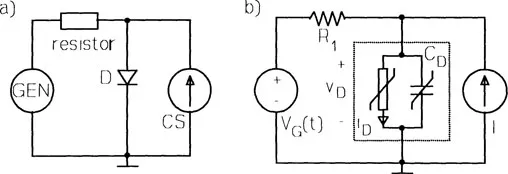
    Table of contents

    1. Cover
    2. Title Page
    3. Copyright Page
    4. Dedication
    5. Table of Contents
    6. Chapter 1 Introductory Topics in Circuit Simulation
    7. Chapter 2 Numerical Analysis of Linear Circuits
    8. Chapter 3 Numerical Solution of Linear Algebraic Equations
    9. Chapter 4 D.c. Analysis of Nonlinear Circuits
    10. Chapter 5 Time-domain Analysis of Nonlinear Circuits
    11. Chapter 6 Periodic Steady-state Time-domain Analysis
    12. Chapter 7 Sensitivity Analysis
    13. Chapter 8 Decomposition-based Methods for Large-scale Circuits
    14. Chapter 9 Relaxation-based Simulation Methods
    15. Index